# 5 Signs Your Cleaning Business Needs AI for Scheduling & Dispatch
**Quick Answer:** Tired of missed appointments and angry clients? AI-powered scheduling and dispatch automates shift planning, confirmations, and follow-ups so jobs stop falling through the cracks. If two or more signs below hit home, take the two-minute Fit Check.
## Key Facts
- Field service businesses commonly lose several jobs every month to missed calls and follow-up gaps
- Manual scheduling errors trigger a cascade from double-booking to lost recurring contracts
- Many cleaning business owners report spending 10+ hours weekly juggling spreadsheets, calls, and last-minute changes
- Automated reminders and confirmations are the single biggest lever for cutting no-shows
- A missed cleaning isn't one lost invoice, it's the lifetime value of a recurring client walking out the door
## Table of Contents
- [The Hidden Cost of Manual Scheduling: Why Small Errors Become Big Losses](#the-hidden-cost-of-manual-scheduling-why-small-errors-become-big-losses)
- [The 5 Warning Signs Your Dispatch Process Is Breaking Down](#the-5-warning-signs-your-dispatch-process-is-breaking-down)
- [How AI Scheduling & Dispatch Actually Fixes Each Problem](#how-ai-scheduling-dispatch-actually-fixes-each-problem)
- [From Spreadsheets to Smart Dispatch: Your Implementation Roadmap](#from-spreadsheets-to-smart-dispatch-your-implementation-roadmap)
- [Choosing Your Path: What to Look For in an AI Automation Partner](#choosing-your-path-what-to-look-for-in-an-ai-automation-partner)
## The Hidden Cost of Manual Scheduling: Why Small Errors Become Big Losses
Your phone rings at 7:00 PM. It's a client, furious because your crew never showed up for their scheduled deep clean. This isn't just a missed appointment; it's a crack in your business's foundation that quickly widens into lost revenue and a damaged reputation.
These small scheduling errors are rarely isolated incidents. A double-booking here, a late arrival there, each one chips away at client trust. When cleaners miss jobs or show up late, these seemingly minor issues escalate into client complaints, bad reviews, and ultimately, lost contracts.
The financial bleed is often bigger than owners realize. The problem isn't just the revenue from one missed job; it's the lifetime value of that recurring client walking out the door. For field service businesses, gaps in call handling and follow-up alone can cost several jobs every month. Each missed cleaning isn't a single lost invoice, it's the start of a churn cycle that quietly drains your most stable revenue streams.
This cascade of failure typically follows a predictable pattern:
- A cleaner is double-booked or sent to the wrong address.
- The client calls to complain, frustrated and inconvenienced.
- A negative review appears online, deterring new customers.
- The client cancels their recurring service, citing unreliability.
- Your team spends hours on damage control instead of revenue-generating work.
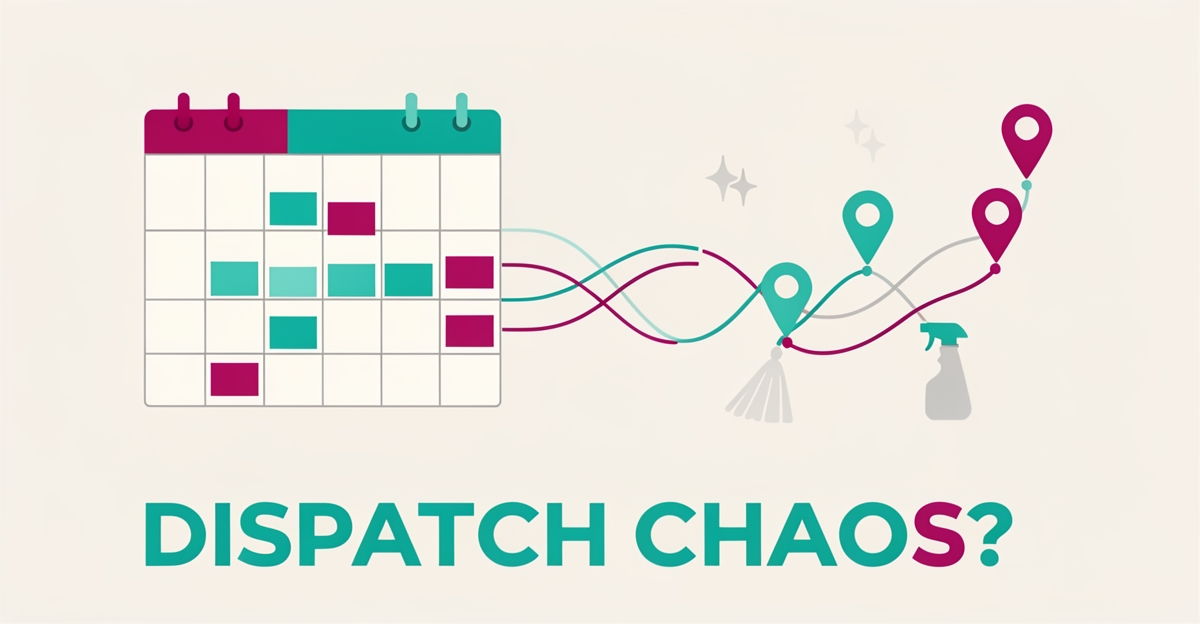
This is why **scheduling is the number one operational failure point** for cleaning businesses. Manual methods like spreadsheets, paper calendars, and even basic group chats are prone to human error. They can't account for last-minute changes, traffic delays, or cleaner availability in real time, creating a system where mistakes are not just possible, but inevitable.
The true cost of a single scheduling error is therefore a multiplier. It's the lost job, plus the cost of acquiring a new customer to replace them, plus the intangible damage to your brand's reputation. When your operations depend on precision, **manual scheduling becomes a liability** that quietly caps your growth.
Fixing this requires more than just a better calendar; it demands a system that thinks ahead. This is where AI-driven workflow automation transforms a business's core operations. At AIQ Labs, we rebuild broken workflows, turning a chaotic dispatch process into a streamlined, automated system that ensures the right cleaner is at the right job, every time. Learn more at [AI Workflow Builds](/workflow-builds).
## The 5 Warning Signs Your Dispatch Process Is Breaking Down
When a cleaning business's dispatch process starts failing, the damage rarely announces itself. It shows up quietly, a missed appointment here, a frustrated client there, until small scheduling issues turn into client complaints, bad reviews, and lost contracts. Here are the five warning signs that your dispatch process is breaking down, each with a quick self-check.
**Sign 1: Missed or late appointments and client complaints.** When cleaners miss jobs or show up late, reliability, the thing clients pay for, erodes fast. This is the most visible symptom of a scheduling system that can't keep jobs assigned clearly and without overlap. Self-check: Have you received more than one complaint about arrival times this month?
**Sign 2: Hours lost to manual shift planning and phone-tag.** If you're building schedules by hand and chasing cleaners by text to confirm shifts, you're paying an invisible labor tax every week. Drag-and-drop scheduling tools that push real-time notifications to cleaners' phones exist precisely because manual coordination doesn't scale. Self-check: How many hours did you spend last week just building and adjusting the schedule?
**Sign 3: No real-time visibility into crews or job status.** Without GPS tracking or location-verified clock-ins, you can't confirm cleaners actually arrived at the right job site, a capability now standard in modern cleaning business software. Self-check: If a client calls asking "is your team still coming?"
AI Employees
Hire a team member that works 24/7 — for less than a part-time wage.
AI receptionists, SDRs, dispatchers and 99+ roles. Trained on your business, fully managed.
See If You’re a Fit — AI Employees from $700/mo
Not sure where to start? Ask our AI planner
, can you answer with certainty?
**Sign 4: Recurring scheduling conflicts from paper-based availability.** When time-off requests and availability live on paper or scattered texts, double-bookings become routine. Modern workforce apps let employees submit availability directly in-app and auto-fill shifts based on roles and availability, reducing conflicts and manual work. Self-check: How many times last month did two cleaners show up for the same job, or nobody did?
**Sign 5: No-shows and unconfirmed jobs.** If reminders and follow-ups depend on someone remembering to send them, some will fall through the cracks. Automated client reminders and follow-ups are what keep recurring cleanings confirmed and clients in the loop. Self-check: Can you name every job tomorrow that hasn't been confirmed with the client?
Scoring two or more of these against yourself is a strong signal. The underlying pattern is the same in every case: dispatch depends on human memory and manual effort, and both fail under load. This is where AI-driven scheduling changes the math, automating shift planning, assigning jobs based on cleaner availability, and cutting no-shows through systematic reminders and follow-ups. AIQ Labs builds custom AI workflows tailored to cleaning operations, including [AI dispatcher employees](/ai-employees) that handle scheduling, confirmations, and coordination end-to-end at a fraction of the cost of a human hire. If several of these signs hit home, a quick conversation about what automation could absorb is a low-cost way to find out where your biggest bottleneck actually sits.
## How AI Scheduling & Dispatch Actually Fixes Each Problem
When cleaning businesses struggle with scheduling inefficiencies, the symptoms often point to deeper operational gaps that AI can systematically resolve. Each warning sign maps directly to a specific AI capability that transforms reactive firefighting into proactive workflow automation.
Automated shift planning solves the chronic issue of understaffed or overbooked jobs by intelligently filling openings based on cleaner availability, role certifications, and client preferences, eliminating the manual guesswork that leads to coverage gaps. This ensures the right person is always assigned to the right job, reducing last-minute scrambles and improving service consistency.
Intelligent job assignment goes beyond simple availability checks by factoring in real-time location data, skill matching, and travel time optimization, cutting down on inefficient routing and ensuring cleaners arrive prepared for specialized tasks like deep cleaning or move-out services. When combined with automated reminders and confirmations sent directly to cleaners' and clients' phones, no-show rates drop significantly as both parties stay synchronized throughout the service cycle.
For businesses missing after-hours booking opportunities, 24/7 AI receptionist and dispatcher coverage captures every call, books appointments directly into the scheduling system, and sends immediate follow-ups, turning voicemail into revenue. Real-time notifications keep everyone informed of changes instantly, so delays or cancellations are communicated before they impact the next job, maintaining trust and accountability across the team.
AIQ Labs builds these capabilities into custom AI workflows that you own outright and that scale with your operations, no subscription chaos, just streamlined dispatching that works while you focus on growth.
## From Spreadsheets to Smart Dispatch: Your Implementation Roadmap
Start by auditing your current scheduling workflow to quantify the time spent on manual coordination, many cleaning business owners report spending 10+ hours weekly juggling spreadsheets, phone calls, and last-minute changes. Track how often cleaners arrive late or miss appointments due to miscommunication, as these gaps directly impact client satisfaction and revenue. This baseline measurement reveals where AI-driven automation can deliver the fastest return by eliminating repetitive administrative tasks.
Identify the single most broken workflow to fix first, whether it's recurring job assignments, emergency rescheduling, or cleaner availability conflicts. Focusing on one high-impact pain point allows you to measure improvement clearly before scaling. For example, if missed cleanings due to poor dispatch are your top issue, target that specific process for initial AI intervention rather than attempting a full-system overhaul. This is exactly the model behind [AI Workflow Builds](/workflow-builds): rebuild the one workflow that costs you the most, at a fixed price, in phases.
Decide between off-the-shelf tools and a custom AI dispatch system based on your operational complexity. Generic scheduling apps often fail to handle nuanced rules like assigning specific cleaners to specialty jobs or balancing workloads across multiple locations. A custom solution built around your exact cleaning operation ensures the system adapts to your unique scheduling logic, integrates with existing tools like Google Calendar or Jobber, and gives you full ownership instead of vendor lock-in.
Pilot with minimal risk by starting with one AI dispatcher role on a monthly plan, typically far less than the cost of a human hire, before scaling to a fully owned system. This approach lets you validate performance in real-world conditions, refine the AI's decision-making based on actual job data, and build confidence across your team. Once the pilot proves reliability in reducing no-shows and optimizing routes, expand incrementally toward a fully connected [AI Operating System]
AI Development
Still paying for 10+ subscriptions that don’t talk to each other?
We build custom AI systems you own outright. No vendor lock-in. Full control.
See If You’re a Fit — AI Employees from $700/mo
Not sure where to start? Ask our AI planner
(/ai-operating-systems) while maintaining control over your AI assets.
## Choosing Your Path: What to Look For in an AI Automation Partner
When evaluating AI partners for scheduling and dispatch automation, prioritize builders who architect custom systems rather than resellers repackaging generic tools. True ownership is non-negotiable, you should receive full rights to the system with zero vendor lock-in, ensuring long-term control over customization and scaling. Seamless integration with existing workflows is equally critical; the solution must connect natively to calendars (Google, Calendly), CRMs (Jobber, HubSpot), and payment processors (Stripe, Square) without fragile middleware or manual data transfers. Flexible engagement models allow businesses to start small, fixing a single broken workflow like technician dispatch, and scale only when results are proven, avoiding costly overhauls upfront.
AIQ Labs works this way, with three entry points that match where you are: [AI Employees](/ai-employees) for managed dispatcher and receptionist roles on a monthly plan, [AI Workflow Builds](/workflow-builds) to rebuild your most expensive workflow at a fixed price, and [AI Operating Systems](/ai-operating-systems) for a single connected layer across your whole operation, built in phases and owned outright. Payment models follow the same logic: Start Monthly, Build in Milestones, or Own It Outright, with no invented prices and no surprises. The proof is in the track record: 200+ multi-agent systems deployed and four live SaaS products the company runs daily.
To determine if this path aligns with your needs, begin with the two-minute [Fit Check](/apply), followed by a free 30-minute strategy call. During that session, we'll map your biggest scheduling bottleneck, quantify potential gains, and clarify whether AI automation delivers a clear win for your cleaning business. If there isn't a measurable opportunity, we'll say so, no pitch, just clarity on your AI readiness.
## Frequently Asked Questions
**What are the most common signs that my cleaning business needs AI for scheduling and dispatch?**
The top warning signs include frequent missed or late appointments, spending excessive hours on manual scheduling, lack of real-time crew visibility, recurring double-bookings, and unconfirmed jobs due to forgotten reminders. These issues indicate your dispatch process relies too heavily on human memory and manual effort, which AI can automate to prevent revenue loss and reputational damage.
**How much time do cleaning businesses typically waste on manual scheduling each week?**
Many cleaning business owners report spending 10+ hours weekly juggling spreadsheets, phone calls, and last-minute schedule changes, time that could be redirected to revenue-generating work with AI-driven automation.
**Can AI scheduling really reduce missed jobs?**
Yes. The biggest levers are automated reminders and confirmations sent to both cleaners and clients, real-time notifications when schedules change, and 24/7 call capture so after-hours booking requests never go to voicemail. Businesses that systematize these steps consistently see fewer no-shows and faster response times.
**What specific problems does AI solve in the cleaning business dispatch process?**
AI automates shift planning based on cleaner availability and role certifications, optimizes job assignments using real-time location and skill matching, and reduces no-shows through automated reminders and confirmations sent to both cleaners and clients, ensuring the right person is at the right job every time.
**Is it better to use off-the-shelf scheduling tools or build a custom AI system for my cleaning business?**
Off-the-shelf tools often fail to handle nuanced rules like assigning specific cleaners to specialty jobs or balancing workloads across multiple locations. A custom AI system built around your exact cleaning operation ensures the solution adapts to your unique scheduling logic, integrates with existing tools like Google Calendar or Jobber, and eliminates vendor lock-in through full ownership.
**How can I start implementing AI scheduling without a large upfront investment?**
You can begin with a pilot of one AI dispatcher role on a monthly plan, typically far less than the cost of a human hire, to validate performance in real-world conditions before scaling. This low-risk approach lets you refine the AI's decision-making based on actual job data and build team confidence.
## Turn Dispatch From a Liability Into Your Growth Engine
Manual scheduling quietly caps cleaning businesses by turning small errors into lost revenue, bad reviews, and churn. Missed or late appointments, hours lost to shift planning, lack of real-time crew visibility, paper-based availability conflicts, and unconfirmed jobs are all symptoms of the same root problem: dispatch that relies on human memory under load. Each missed cleaning isn't just one invoice lost, it's the lifetime value of a recurring client walking out the door. AI-driven scheduling fixes this by automating shift planning, intelligently assigning jobs with location and skills in mind, and confirming appointments before no-shows happen. If two or more warning signs hit home, audit one broken workflow first and measure the time and errors it costs you. That baseline makes the return clear. AIQ Labs builds custom AI workflows tailored to cleaning operations that you own outright and that scale with you. Start the two-minute [Fit Check](/apply), then book a free 30-minute strategy call to map your biggest bottleneck and see where automation can absorb it first.
AI Transformation Partner
Make AI your competitive advantage — not just another tool.
Strategy, implementation and ongoing optimization. One partner, end to end.
See If You’re a Fit — AI Employees from $700/mo
Not sure where to start? Ask our AI planner