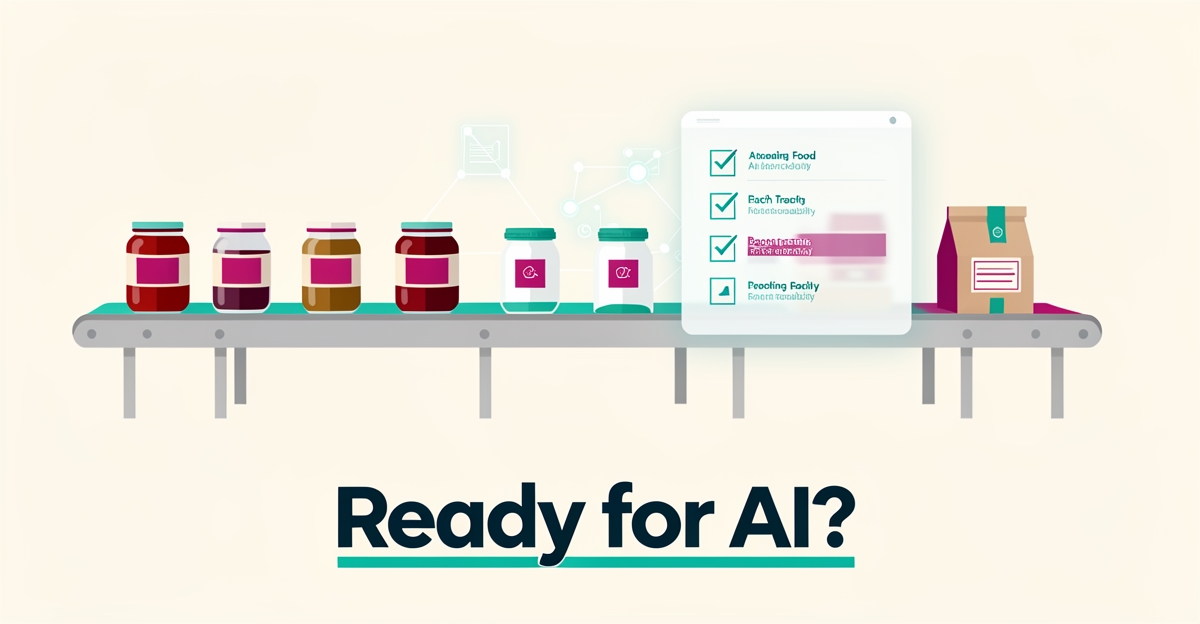
5 Signs Your Craft Food Co-Packer Business Is Ready for AI Automation
Key Facts
- AI-driven automation can reduce material waste by up to 30% compared to manual processes in food manufacturing according to comprehensive research
- Automated systems typically process thousands of units per hour, while manual operations handle only dozens or hundreds based on industry analysis
- The global AI in food safety market has been projected to reach roughly $12.7 billion per market forecasts
- Integrating AI with sensor data and blockchain enables end-to-end traceability from origin to consumer as demonstrated in food industry studies
- AI-powered computer vision allows real-time defect detection at every production stage per research on AI in food quality control
- AI-driven workflow automation reduces dependency on hard-to-fill repetitive roles in co-packing operations based on automation impact studies
- Scalable AI workflows maintain consistent quality and accuracy even during high-volume demand spikes per food industry automation research
Hire a team member that works 24/7 — for less than a part-time wage.
AI receptionists, SDRs, dispatchers and 99+ roles. Trained on your business, fully managed.
Not sure where to start? Ask our AI planner
Inconsistent Batch Tracking and Traceability Issues
When a single mislabeled lot code can trigger a full product recall, inconsistent batch tracking stops being an operational nuisance and becomes an existential risk. For craft food co-packers juggling multiple client brands, manual logs and spreadsheets quietly erode the traceability that regulators and customers demand.
The core problem is speed and accuracy. According to industry analysis of food processing operations, manual systems typically handle dozens or hundreds of units per hour, while automated systems process thousands. That gap means batch records often lag behind production, creating blind spots where errors compound.
These blind spots carry real consequences. A comprehensive review of AI in the food industry highlights how fragmented traceability directly undermines recall management and supply chain visibility. When you cannot instantly connect a finished case back to its ingredient lots, every quality issue becomes a crisis.
- Handwritten logs that vary by shift or operator
- Spreadsheets that drift out of sync with physical inventory
- Delayed lot reconciliation during client audits
- Recall scopes that widen unnecessarily because precise tracking is impossible
AI-driven traceability closes these gaps by capturing data at the source and maintaining a continuous chain of custody. Research shows that integrating AI with sensor data and blockchain creates end-to-end visibility from origin to consumer, enabling rapid, targeted recalls instead of blanket withdrawals. The global market for AI in food safety alone has been projected to reach roughly $12.7 billion, reflecting how urgently the industry is moving toward automated compliance.
For co-packers, the shift does not require ripping out existing equipment. AIQ Labs' AI Workflow Builds rebuild the one workflow that costs you the most, often batch tracking and record-keeping, layering real-time monitoring and predictive analytics onto current production lines at a fixed price, in phases. The result is consistent batch integrity that satisfies both regulators and brand partners.
If your team spends more time reconstructing batch histories than preventing deviations, that is a clear signal your operation has outgrown manual tracking. The sooner you replace reactive record-keeping with proactive intelligence, the sooner traceability becomes a competitive asset rather than a liability.
Long Lead Times and Throughput Bottlenecks
When production slows, growth stalls. For craft food co-packers, long lead times and throughput bottlenecks aren't just operational headaches, they directly limit revenue potential and customer satisfaction. Manual processes simply can't keep pace with scaling demand, especially when every minute of delay compounds across batches.
AI-powered automation transforms this dynamic by dramatically increasing processing speed and consistency. Research shows automated systems can process thousands of units per hour, significantly faster than manual operations which may process dozens or hundreds of units per hour. This leap in throughput isn't just about working harder, it's about working smarter with systems designed for continuous, high-volume output.
Beyond raw speed, AI optimizes how work flows through your facility. Intelligent scheduling and resource allocation reduce idle time, balance workloads across equipment and shifts, and predict maintenance needs before they cause downtime. These capabilities ensure your line runs at peak efficiency, turning variability into predictable, reliable output.
When lead times stretch and throughput plateaus despite added labor, it's a clear signal your operation has outgrown manual limits. AIQ Labs helps co-packers pinpoint the single most expensive workflow in the operation and rebuild it with a fixed-price, phased AI Workflow Build, processing more units, with fewer errors, and far greater consistency than manual methods ever could. To map your biggest automation opportunity, start with the two-minute Fit Check at aiqlabs.ai/apply.
High Labor Costs and Staff Turnover in Repetitive Tasks
For craft food co-packers, repetitive manual tasks like labeling, sorting, or packaging aren't just tedious, they're expensive and unsustainable. Labor costs for these roles often consume a significant portion of operational budgets, especially when factoring in turnover, training, and inconsistency. When staff repeatedly perform the same high-volume tasks, errors increase, waste accumulates, and morale declines, creating a cycle that's hard to break without intervention.
Research shows that AI-driven automation in food manufacturing can reduce material waste by up to 30% compared to manual processes, directly addressing one of the hidden costs of labor-intensive workflows. Beyond waste, automated systems process thousands of units per hour, far outpacing manual operations that may only handle dozens or hundreds, delivering both speed and precision that human labor struggles to maintain consistently over shifts. This efficiency gain isn't just about output; it translates to lower operational costs per unit and fewer resources spent on rework or scrap.
- Reduces dependency on hard-to-fill repetitive roles
- Minimizes variability in product handling and packaging
- Lowers long-term labor expenses through scalable automation
- Improves throughput without proportional increases in headcount
There's also an administrative layer most co-packers overlook: order intake, scheduling, invoicing, and client follow-ups eat hours every week. AIQ Labs' AI Employees, managed AI staff covering 99+ roles from receptionists to dispatchers, handle that back-office workload at roughly 80% less cost than a human hire, while AI Workflow Builds target the physical and data bottlenecks on the line itself. By attacking both layers, businesses cut costs and create more stable, predictable operations that support sustainable growth.
Inability to Scale During Demand Spikes
When demand spikes unexpectedly, whether from seasonal trends, viral marketing, or new retail partnerships, manual co-packing operations often hit a hard ceiling. Without scalable systems, increased volume leads to bottlenecks, inconsistent output, and rushed quality checks that compromise product integrity. This inflexibility not only risks customer trust but also limits growth opportunities during critical peak periods.
AI-powered workflow automation, by contrast, is designed to adapt dynamically to fluctuating demand. Research shows that automated systems can process thousands of units per hour, far exceeding the dozens or hundreds manageable through manual labor, a difference that becomes decisive during surges. These systems maintain consistent performance regardless of volume, ensuring that every batch meets the same quality standards whether producing 500 units or 5,000.
AIQ Labs helps co-packers build adaptive workflows that scale with demand, using intelligent automation to balance workloads, prevent overload, and maintain traceability even at high throughput. For operations that want one connected layer across production, inventory, and client management, an AI Operating System is built in phases and owned outright, so the system grows with you rather than renting capability forever. By replacing rigid manual processes with responsive AI-driven operations, businesses gain the flexibility to handle spikes without sacrificing consistency or incurring costly delays.
- Automated systems process thousands of units per hour compared to dozens or hundreds manually
- AI-driven automation reduces material waste by up to 30% versus manual processes
- Scalable AI workflows maintain consistent quality and accuracy at high volumes
This scalability isn't just about speed, it's about resilience. When your co-packing operation can scale intelligently, demand spikes become opportunities for growth rather than threats to quality and delivery reliability. AIQ Labs has deployed 200+ multi-agent systems and runs four live SaaS products daily, so scaling infrastructure is proven, not theoretical. To explore how AI can future-proof your scaling capacity, book a free 30-minute strategy call at aiqlabs.ai/book.
Lack of Real-Time Quality Control and Waste Reduction
In the fast-paced world of craft food co-packing, a single missed quality check can turn a profitable run into a costly write-off. When defects slip through and are only discovered after packaging, the result is wasted ingredients, scrapped product, and frustrating rework that eats into already thin margins.
Manual quality control relies on human inspectors who, despite their expertise, can only process a limited number of units per hour. According to industry analysis, automated systems can handle thousands of units per hour, while manual operations often manage only dozens or hundreds. This gap means that by the time a human inspector spots a defect, hundreds of faulty units may have already passed through the line.
The financial impact is significant. Research shows that AI-driven automation can reduce material waste by up to 30% compared to manual methods, according to a comprehensive study on AI in the food industry. For a craft co-packer operating on tight margins, that reduction translates directly into reclaimed profit and stronger client trust.
AI-powered computer vision and predictive analytics change the game by enabling real-time defect detection at every stage of production. Instead of relying on periodic spot checks, these systems continuously monitor for inconsistencies in color, texture, fill levels, and packaging integrity. When a deviation is detected, the system flags it instantly, allowing for immediate correction before an entire batch is compromised.
Here are the key advantages of real-time AI quality control over manual methods:
- Continuous monitoring of every unit, not just samples
- Immediate alerts when parameters drift out of specification
- Predictive analytics that identify equipment issues before they cause defects
- Consistent accuracy that doesn't degrade with fatigue or shift changes
For growing co-packers, the question isn't whether to adopt AI, but when. If your operation still depends on manual inspections and you're seeing recurring waste or client complaints, it's a clear signal that your quality control process has outgrown its current capabilities. AIQ Labs helps food manufacturers assess readiness and deploy tailored automation that integrates with existing workflows, ensuring you catch defects in real time and protect both your product and your reputation.
Still paying for 10+ subscriptions that don’t talk to each other?
We build custom AI systems you own outright. No vendor lock-in. Full control.
Not sure where to start? Ask our AI planner
Frequently Asked Questions
What are the signs that my craft food co-packing business needs AI automation?
How much can AI automation reduce material waste in food manufacturing?
Will AI automation require replacing my existing production equipment?
How much faster are automated systems compared to manual food processing?
Can AI help with real-time quality control and defect detection in food co-packing?
How does AIQ Labs price its automation work?
Turn Signals Into Scalable Advantage
If these five signs feel familiar, fragmented batch records, lead times that stretch with every order, repetitive roles driving up labor costs and turnover, demand spikes that bottleneck production, and quality issues caught too late, your co-packer operation has outgrown manual limits. The pattern is clear: manual tracking creates risk, manual throughput caps revenue, and manual inspection wastes margin. AI workflow automation addresses those exact pressure points by capturing data at the source, balancing workloads in real time, reducing reliance on hard-to-fill repetitive tasks, scaling cleanly during surges, and enabling continuous quality monitoring. AIQ Labs helps co-packers assess readiness and deploy automation that layers onto existing lines, from AI Employees for back-office roles to AI Workflow Builds for the workflow that costs you most, up to a full AI Operating System you own outright. Start with clarity on where you stand: take the two-minute Fit Check at aiqlabs.ai/apply, then book a free 30-minute strategy call at aiqlabs.ai/book to map your biggest bottleneck. If there isn't a clear win, we'll tell you that too. Research shows AI-driven automation can reduce material waste by up to 30% compared to manual processes.
Make AI your competitive advantage — not just another tool.
Strategy, implementation and ongoing optimization. One partner, end to end.
Not sure where to start? Ask our AI planner