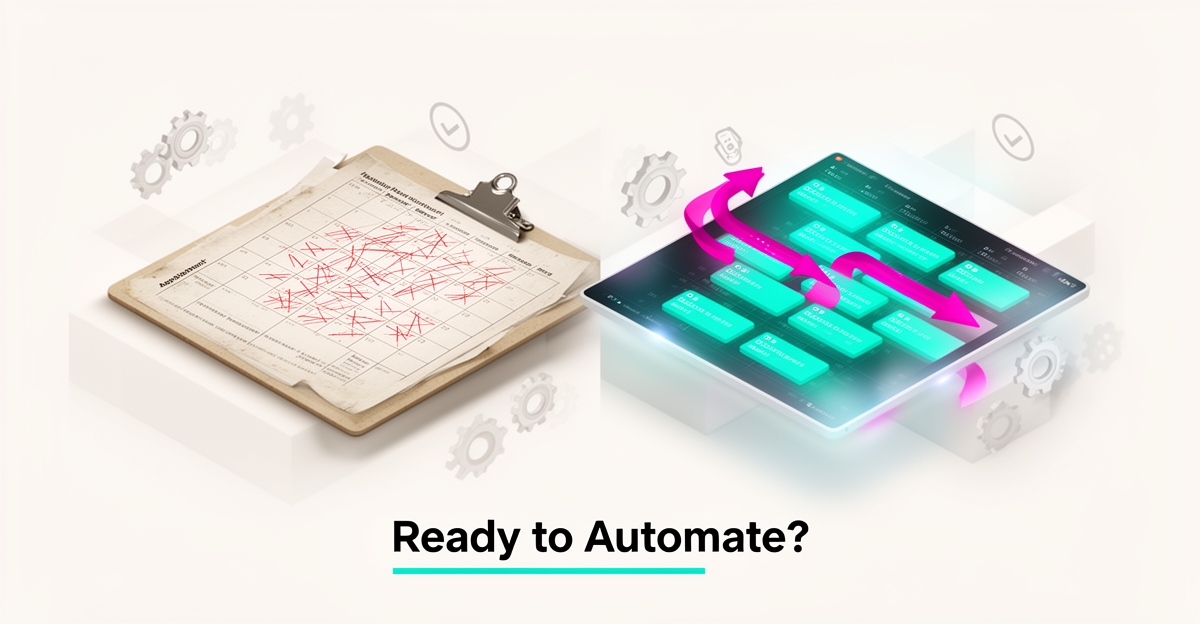
5 Signs Your Inspection Station Is Ready to Automate Its Scheduling System
Key Facts
- Overbooking is usually a workflow problem, not a staffing problem.
- Manual scheduling scales linearly: more bookings mean more staff hours and more errors.
- AI scheduling treats availability as live data rather than a fixed plan.
- AIQ Labs has deployed 200+ multi-agent systems across scheduling, intake, and dispatch workflows.
- AI Employees typically cost around 80% less than an equivalent human hire.
- You can start with a single workflow, at a fixed price, before committing to anything larger.
Hire a team member that works 24/7 — for less than a part-time wage.
AI receptionists, SDRs, dispatchers and 99+ roles. Trained on your business, fully managed.
Not sure where to start? Ask our AI planner
Overbooked Shifts and Scheduling Conflicts Are Costing You Time and Revenue
Chronic overbooking is rarely a staffing problem. It is a workflow problem that shows up as double-booked bays, idle technicians, and customers who leave without an inspection.
When scheduling relies on spreadsheets, phone notes, and manual confirmations, small errors compound fast. Missed inspections create revenue leakage while overbooked shifts burn technician time and erode trust. Inspection station managers often see the symptoms first, then spend hours untangling the cause.
AI-powered scheduling changes the pattern by removing the manual handoffs that create bottlenecks. Systems can automate appointment booking, rescheduling, and real-time availability tracking without constant human intervention—the approach AIQ Labs takes in its Workflow Builds, where we rebuild the one workflow that costs you the most, at a fixed price and in phases. The result is a continuous flow where capacity matches demand without constant oversight.
Signs the workflow is broken typically cluster around a few repeatable pain points:
- Technicians regularly start shifts with conflicting appointments
- Customers call back multiple times to confirm or change a time
- Last-minute cancellations leave bays empty with no backfill
- Manual rescheduling creates data entry errors across tools
Recognizing these patterns helps determine when to adopt AI scheduling. Custom AI systems can handle booking, rescheduling, and availability in real time without adding headcount. For inspection stations, that means fewer missed inspections, less overtime, and a smoother experience for both staff and customers.
When scheduling is automated, the business gains visibility and control. Teams stop firefighting the calendar and start managing capacity strategically.
Your Team Spends Too Much Time on Manual Rescheduling and Availability Tracking
Your team spends too much time on manual rescheduling and availability tracking—time that could be better spent on high-value tasks like customer engagement or process improvement. When staff are constantly juggling spreadsheets, phone calls, and last-minute changes, operational efficiency suffers. This constant firefighting prevents teams from focusing on strategic work that drives growth.
The math is simple: every hour spent confirming appointments, chasing updates, and correcting calendar errors is an hour not spent on inspections themselves. For many stations, that adds up to a meaningful share of a full-time role absorbed by coordination work that a system could do instead.
Consider the specific pain points your team faces daily: double-booked inspection slots, missed appointments due to outdated availability, and hours spent calling clients to reschedule. Each of these tasks adds friction and increases the risk of errors. Automated systems eliminate this cycle by continuously updating schedules in real time and handling changes without human intervention.
This is where AI Employees come in. An AI receptionist or dispatcher can take bookings, confirm appointments, handle rescheduling requests, and answer routine questions around the clock—typically at around 80% less cost than a human hire, and without sick days or peak-hour bottlenecks.
The result isn't just time saved—it's a shift in how your team operates. Staff can move from reactive scheduling to proactive service delivery, improving both customer satisfaction and internal morale. When routine tasks are handled intelligently, your team gains the bandwidth to focus on what truly matters: delivering consistent, high-quality inspections.
You Lack Real-Time Visibility into Inspector Availability and Job Readiness
When a customer calls to ask whether their inspection can happen today, the answer too often involves a pause, a glance at a whiteboard, and a guess. Traditional scheduling methods—paper calendars, spreadsheets, disconnected tools—create blind spots that make it impossible to know who is available, which jobs are ready, and where the day is falling apart. The result is a pattern familiar to many station managers: overbooked shifts, missed inspections, and rising operational costs that compound quietly week after week.
These blind spots show up in several predictable ways:
- Inspectors are double-booked while other shifts sit underutilized, wasting labor you are already paying for.
- Jobs slip through the cracks because no one sees that an inspection was never assigned in the first place.
- Rescheduling a single appointment triggers a chain of phone calls, crossed-out names, and manual corrections.
- Managers spend hours each week reconciling calendars instead of optimizing throughput.
The deeper problem is that static schedules reflect a plan, not reality. A schedule built Monday morning is obsolete by Tuesday afternoon the moment an inspector calls in sick or a vehicle arrives early. Without real-time tracking, every disruption becomes a manual firefight. This is precisely where AI-powered scheduling changes the equation—by treating availability as live data rather than a fixed plan.
Modern AI systems handle appointment booking, rescheduling, and availability tracking without constant human intervention. AIQ Labs builds systems of this kind, synchronizing integrated calendars and station tools so that every booking, cancellation, and assignment updates instantly across the operation. When an inspector becomes available, the system knows. When a job is ready, it gets assigned. No one has to ask, check, or chase.
Real-time visibility also prevents delays before they start. When the system detects an overbooked shift or a missed-inspection pattern, it flags and corrects it automatically, rather than letting the problem surface as an angry customer call. Managers gain instant insight into resource use, allowing them to balance inspector workloads and fit more inspections into the same operating hours.
If your team's day currently depends on memory, whiteboards, and back-and-forth calls to answer the simple question of who is available, that dependency itself is the signal. The absence of real-time visibility is not a minor inconvenience—it is the bottleneck capping your station's capacity, and it is exactly the kind of workflow AI scheduling was built to eliminate.
Customer Complaints About Missed or Delayed Inspections Are Increasing
Customer complaints about missed or delayed inspections tend to rise as traditional scheduling methods struggle to keep pace with demand, directly impacting customer satisfaction and operational trust. When inspection appointments are overbooked, rescheduled last-minute, or simply forgotten, customers experience frustration that erodes confidence in the service provider. This pattern of dissatisfaction is not just anecdotal—it reflects a systemic failure in scheduling reliability that AI-powered automation is well positioned to resolve.
AI scheduling systems reduce human error in appointment management by automating booking, rescheduling, and real-time availability tracking. By replacing manual calendars and reactive adjustments with consistent automation, these systems help ensure inspections occur when promised. Fewer scheduling failures means fewer inbound complaints, fewer apology calls, and less time spent rebuilding trust you've already earned once.
Beyond reducing inbound complaints, AI-driven scheduling improves responsiveness by ensuring accurate, up-to-date information is always available. When customers call with concerns, your staff—or an AI Employee—can instantly verify appointment status, reschedule if needed, or provide proactive updates without delay. This level of responsiveness transforms negative experiences into opportunities for trust-building, turning frustrated callers into satisfied customers. For inspection stations facing growing dissatisfaction, the link between scheduling unreliability and customer complaints is clear: automation doesn't just fix the schedule—it restores confidence in the service.
To assess whether your station's scheduling challenges are ready for AI-driven resolution, start with the two-minute Fit Check, then book a free 30-minute strategy call to map your options.
You're Ready to Scale but Your Current System Can't Handle Growth
Growth is a good problem—until your scheduling system becomes the bottleneck. When inspection bookings multiply, manual methods like whiteboards, shared calendars, and phone-tag bookings start breaking down in ways that cost you revenue every single week.
The warning signs usually appear before a full breakdown. Overbooked shifts force last-minute shuffles. Inspections get missed because no one updated the master schedule. Front-desk staff spend hours each day confirming, rescheduling, and apologizing instead of serving customers. Each of these patterns is a signal that your current system has hit its ceiling.
What makes this frustrating is that the problem isn't your team's effort—it's the architecture of manual scheduling. A human-run system scales linearly: more bookings require more staff hours, and more staff hours introduce more errors. An AI-driven system scales differently. Because appointment booking, rescheduling, and real-time availability tracking happen automatically, adding volume doesn't require adding headcount or complexity.
This is the principle behind how AIQ Labs builds scheduling systems for inspection stations and similar operations. You can start with a single workflow through a Workflow Build—fixed price, delivered in phases—or connect everything into one operating layer with an AI Operating System you own outright. Either way, the goal is a system that handles the entire scheduling lifecycle: customers book, reschedule, and receive confirmations automatically, while real-time availability tracking keeps every inspector's calendar accurate around the clock.
Consider what "ready to scale" actually looks like in practice:
- Your booking volume has grown, but your scheduling staff hours have grown faster—and errors are creeping in.
- Peak-season demand creates overbooked shifts that manual coordination can no longer untangle.
- Missed inspections are damaging customer relationships and creating compliance exposure.
- You're turning away bookings because no one can reliably manage real-time availability across multiple inspectors.
The good news is that modern AI scheduling infrastructure is more accessible than most operators assume. You don't need a data science team or a full system overhaul to get started—AIQ Labs has deployed 200+ multi-agent systems, and the work starts with one workflow, one milestone at a time. Coordinating bookings, calendars, reminders, and follow-ups is exactly the kind of structured, rule-based task AI agents handle well.
If your inspection station is growing but your scheduling system is straining under the weight, automation isn't a luxury anymore—it's the infrastructure your next stage of growth requires.
Still paying for 10+ subscriptions that don’t talk to each other?
We build custom AI systems you own outright. No vendor lock-in. Full control.
Not sure where to start? Ask our AI planner
Frequently Asked Questions
What are the signs that my inspection station needs to automate its scheduling system?
How much time can AI-powered scheduling save my team on manual rescheduling and availability tracking?
Do I need AI expertise to implement an AI scheduling system for my inspection station?
How does AI scheduling improve customer satisfaction and reduce complaints about missed inspections?
Can AI scheduling handle growth in booking volume without requiring more staff?
What is the first step to explore if AI scheduling is right for my inspection station?
Ready to Trade Calendar Chaos for Continuous Flow?
If your inspection station is wrestling with overbooked shifts, manual rescheduling marathons, blind spots in inspector availability, rising customer complaints, or a growth ceiling imposed by outdated tools, these aren't just growing pains—they're clear signals that your scheduling workflow needs an upgrade. The transition doesn't require specialized expertise or a massive overhaul: AIQ Labs has deployed 200+ multi-agent systems, and you can start with a single workflow at a fixed price, add an AI Employee to handle bookings and rescheduling, or build toward a full AI Operating System you own outright. Stop letting manual processes cap your capacity and erode customer trust. Take the two-minute Fit Check to map your biggest bottleneck, then book a free 30-minute strategy call to explore how automation can transform your operations.
Make AI your competitive advantage — not just another tool.
Strategy, implementation and ongoing optimization. One partner, end to end.
Not sure where to start? Ask our AI planner