5 Signs Your Mulching Service Needs AI to Handle Job Requests and Service Tracking
Key Facts
- AI field service platforms routinely handle millions of optimized deliveries and field tasks globally, with documented cost savings for operators
- Mulching jobs depend on site-specific details, soil type, terrain, and existing vegetation, that must be captured consistently at intake
- AI route optimization trained on historical fleet performance can meaningfully cut drive time and fuel spend across wide service territories
- AIQ Labs has deployed 200+ multi-agent systems and runs 4 live SaaS products daily
- Managed AI staff typically cost around 80% less than an equivalent human hire
Hire a team member that works 24/7 — for less than a part-time wage.
AI receptionists, SDRs, dispatchers and 99+ roles. Trained on your business, fully managed.
Not sure where to start? Ask our AI planner
Overwhelmed by Phone Calls and Manual Job Intake
High call volume and manual job intake create immediate bottlenecks for mulching services trying to scale. When office staff spend hours each day fielding phone calls, taking handwritten notes, and entering job details into spreadsheets, response times slow and errors increase. This manual approach becomes unsustainable as demand grows, turning a simple inquiry into a multi-step process that delays service delivery. AI-powered intake directly addresses this burden by digitizing the entire workflow: automated digital forms, intelligent quote generation, and real-time scheduling reduce the need for constant phone monitoring. For a mulching service, this means transforming chaotic phone queues into a streamlined system where job details are captured accurately the first time. By automating intake, staff gain back hours previously lost to data entry and follow-up calls. This shift allows teams to focus on higher-value activities like customer consultation and crew coordination rather than administrative toggling between tools. AI systems standardize how job information is collected, ensuring every request includes critical details like property access notes, mulch type preferences, and scheduling constraints, eliminating the inconsistencies that plague paper-based or memory-dependent logging. The result is faster response times, fewer missed details, and a foundation for scalable operations without proportional increases in headcount. One practical option is an [AI receptionist or dispatcher](/ai-employees), a managed AI employee that answers calls, captures job details, and books work around the clock, typically at around 80% less cost than a human hire. To explore how AI can resolve your specific intake bottlenecks, start with the [2-minute Fit Check](/apply) and a free 30-minute strategy call to map your workflow and identify high-ROI automation opportunities.Inconsistent Job Logging Leads to Costly Errors
A missed detail on a mulching job rarely stays small. It turns into a return trip, a damaged plant, or an angry customer call that eats the margin you planned for the day. Paper records, spreadsheets, and memory-based logging force crews to reconstruct jobs in the field. That reconstruction creates variation, and variation creates costly rework. The same principle that drives smart manufacturing, strong connectivity, standardized data capture, and optimal material flow, applies just as much to field services. Mulching services live on site-specific requirements. Most operators evaluate soil type, terrain, and existing vegetation before planning projects. When those details are captured inconsistently, crews arrive unprepared. Inconsistent job logging shows up as: - Missing access notes or gate codes that delay start times - Incomplete customer requests for mulch depth, area boundaries, or protected zones - Lost equipment or material requirements that force mid-job resupply - No standardized record for future maintenance or repeat visits Manual logging also fragments data. One crew writes notes on a clipboard, another updates a spreadsheet at day's end, and the office relies on memory for follow-ups. AI-standardized data collection closes that gap by enforcing the same fields for every job, validating entries at intake, and making records instantly accessible to dispatch and crews. The cost of inconsistency scales with volume. Field service platforms have demonstrated the impact of clean data at scale, and those gains start with reliable, complete job data captured at the source. An [AI Workflow Build](/workflow-builds) turns manual intake into a repeatable workflow at a fixed price. An AI employee can capture job requests from phone, web form, or text, prompt for missing details like terrain constraints, and log them in a single source of truth. That standardization reduces errors, supports skill-based assignment, and creates history that improves future estimates. AIQ Labs builds systems that replace fragmented logging with owned, connected workflows. The result is fewer missed details, less rework, and operations that scale without adding headcount.Missed Appointments and Poor Route Planning Waste Time and Fuel
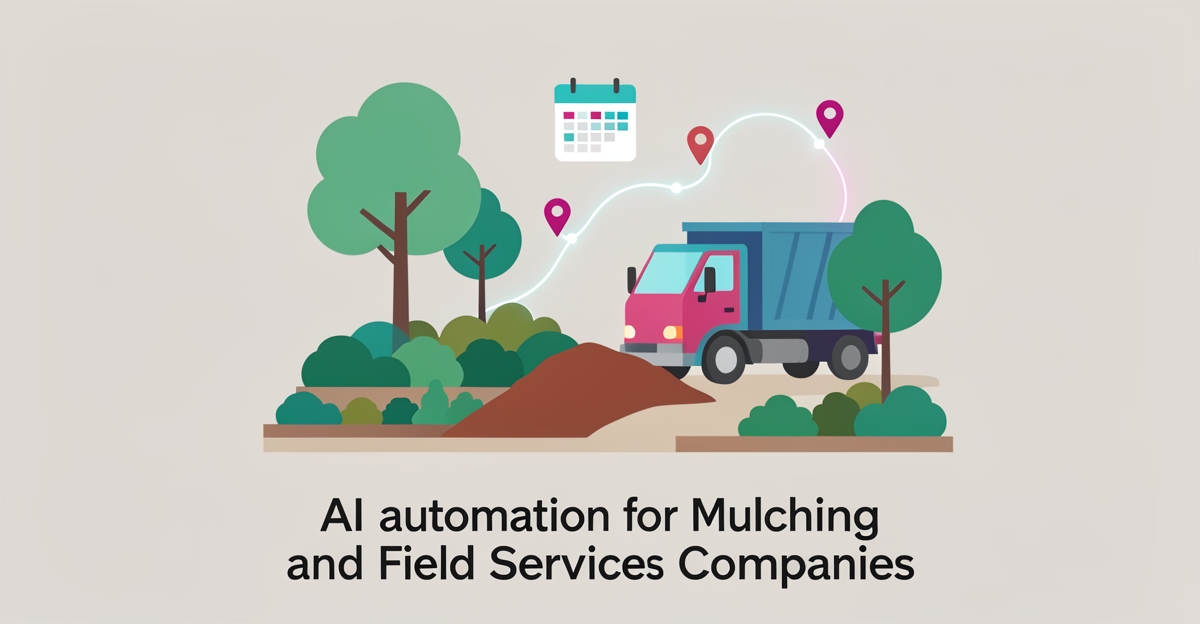
When your crews spend more time behind the wheel than behind the mulcher, your operation bleeds profitability. Scheduling conflicts and inefficient routing quietly drain resources through wasted fuel, lost labor hours, and frustrated customers waiting on late arrivals. The math is brutal. Mulching services often cover expansive territories, some operators deploy teams across nine or more counties. Without intelligent routing, technicians crisscross these regions inefficiently, burning fuel and daylight. AI-powered route optimization solves this through machine learning trained on historical fleet performance. The technology generates routes reflecting real completion times and preferred corridors, then dynamically re-optimizes when same-day cancellations or urgent jobs disrupt the schedule. This approach delivers measurable improvements: - Reduced drive time between appointments through intelligent sequencing - Improved on-time arrivals via realistic scheduling that accounts for actual travel conditions - Increased productive hours by minimizing windshield time - Dynamic re-optimization for same-day changes and cancellations Real-time tracking amplifies these gains. Live GPS monitoring and geofencing automation provide accurate ETAs and automatic status updates, eliminating the "where is your crew?" phone calls that interrupt office staff. When a job runs long or a technician finishes early, the system adjusts downstream appointments automatically rather than leaving customers waiting or crews idle. This level of operational intelligence compounds: systems grow smarter with each completed job. The AI learns your actual service times, traffic patterns, and crew capabilities, creating increasingly accurate schedules that manual planning cannot match. For mulching services ready to eliminate routing waste, AIQ Labs builds custom dispatch and scheduling systems that integrate with your existing workflows. Rather than forcing your operation into generic software, we architect solutions that reflect how your crews actually work, whether you need a single workflow fix or a complete operational overhaul. The technology exists to transform your scheduling from reactive chaos to predictive precision; the question is whether your business will capture those efficiencies before competitors do.Lack of Real-Time Tracking Hurts Customer Trust and Operational Control
When a customer calls asking, "Where's my crew?" and no one can give a straight answer, trust erodes fast. Mulching services operating across wide service areas know this gap well. Without live visibility, dispatchers rely on phone check-ins, customers flood the office with follow-up calls, and crews waste time coordinating instead of working. AI-powered field service systems close this loop with geofencing and real-time GPS tracking. These systems monitor crew locations continuously, automatically log arrivals and departures, and feed live data back into dispatch workflows. The result: accurate ETAs pushed to customers without a single manual call, route adherence verified in real time, and historical performance data captured for future schedule optimization. - Automated arrival and departure logging via geofencing - Live ETA updates sent to customers proactively - Route adherence monitoring with instant alerts - Historical tracking data feeding schedule improvements - Reduced inbound call volume from status inquiries For a mulching service, that translates to fewer missed windows, tighter routes, and a reputation for reliability that wins repeat business. AIQ Labs builds custom tracking and dispatch systems that integrate with your existing tools, calendars, CRMs, routing platforms, so the data flows where your team already works. The goal isn't more screens; it's operational control without the overhead.From Manual Chaos to AI-Powered Workflow: How to Start
For mulching services drowning in manual job requests and scheduling chaos, the path to AI-powered efficiency begins with a clear assessment of current pain points. Identifying where manual processes cause the most friction, whether it's overwhelmed phone lines, inconsistent job logs, or frequent missed appointments, is the critical first step. Pinpointing high-value automation opportunities creates the foundation for measurable operational gains. The implementation journey follows a structured sequence: deploy AI scheduling for intelligent job assignment and dynamic re-optimization, integrate route optimization that uses historical performance data to minimize drive time, and establish real-time tracking with geofencing for accurate ETAs and automated customer updates. These technologies transform reactive scheduling into proactive, data-driven workflows. How you engage depends on where you are: - Just need the phones and intake handled? Start with [AI Employees](/ai-employees), managed AI receptionists, SDRs, and dispatchers on a monthly plan, at roughly 80% less cost than a human hire. - One workflow costing you the most? A [Workflow Build](/workflow-builds) rebuilds it at a fixed price, in phases. - Want everything connected? An [AI Operating System](/ai-operating-systems) builds one connected operating layer across your business, in phases, owned outright. Whichever path fits, the payment model matches: start monthly, build in milestones, or own it outright. AIQ Labs has deployed 200+ multi-agent systems and runs 4 live SaaS products daily, this isn't theoretical for us. - Assess current operational pain points - Deploy AI scheduling and dispatch - Implement route optimization - Set up real-time tracking and geofencing - Automate customer communication - Integrate with existing systems - Monitor and optimize continuously The result is a resilient workflow where AI handles routine tasks like job intake and route planning, freeing skilled crews to focus on quality mulching work while providing customers with reliable, transparent service.Still paying for 10+ subscriptions that don’t talk to each other?
We build custom AI systems you own outright. No vendor lock-in. Full control.
Not sure where to start? Ask our AI planner
Frequently Asked Questions
How do I know if my mulching service actually needs AI for job scheduling?
What happens when job details get lost or logged inconsistently?
Can AI really reduce drive time and fuel costs for mulching crews?
How does real-time tracking improve customer satisfaction for mulching services?
What's the first step to implementing AI for job intake and dispatch?
Will AI replace my office staff or just help them work better?
From Manual Chaos to Mulching Mastery: Your AI-Powered Path Forward
The signs are clear: overwhelmed phone lines, inconsistent logging, missed appointments, wasted fuel, and frustrated customers all point to the same truth, your mulching service is ready for AI. By automating job intake, standardizing data collection, optimizing routes, and enabling real-time tracking, you can reclaim hours lost to manual work, eliminate costly errors, and build a reputation for reliability that drives repeat business. The path forward starts with a clear assessment of your biggest bottlenecks. Take the first step today with the 2-minute Fit Check and a free 30-minute strategy call, no obligation, just clarity on how AI can work for your specific operation.
Make AI your competitive advantage — not just another tool.
Strategy, implementation and ongoing optimization. One partner, end to end.
Not sure where to start? Ask our AI planner