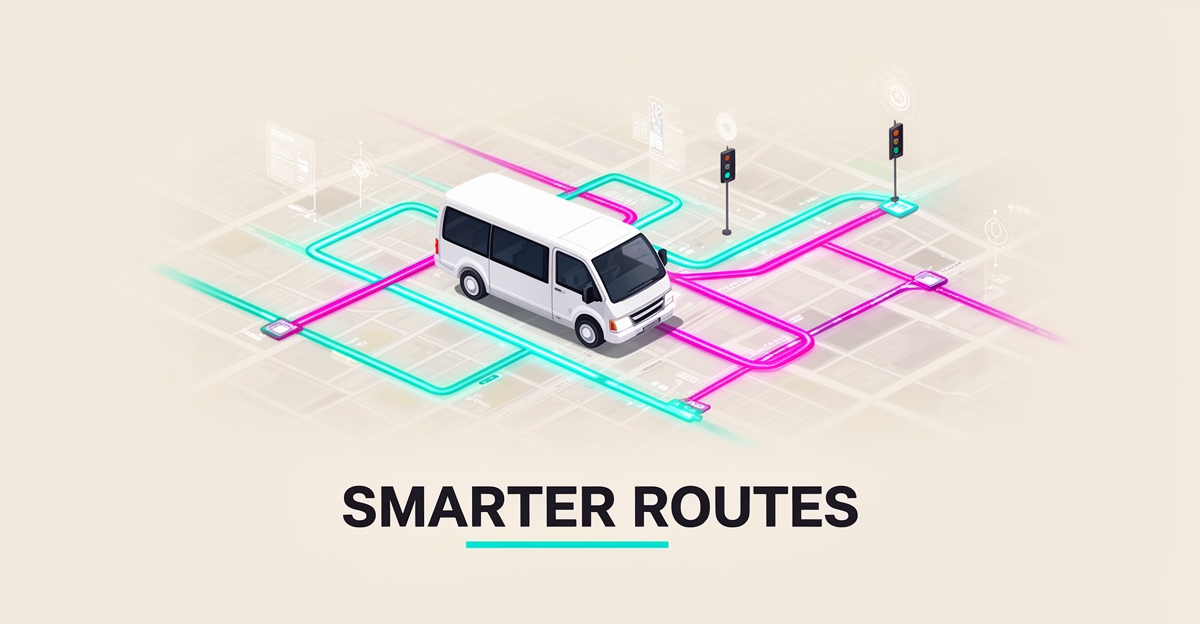
5 Signs Your Shuttle Business Needs AI for Real-Time Route Optimization
Key Facts
- Industry analyses report AI route optimization can reduce logistics costs by roughly 5-20% cited by RTS Labs
- DHL reported 90-95% accuracy in predicting shipment arrival times after integrating AI into its Resilience360 platform per RTS Labs research
- McKinsey research indicates AI implementation can cut inventory levels by 20-30% through better demand matching reported by RTS Labs
- AI-driven routing updates paths in real time by factoring traffic delays, weather disruptions, roadblocks, and vehicle availability according to RTS Labs
- Rule-based routing tools rely on static schedules and zip codes while AI uses real-time traffic and predictive data per RTS Labs comparison
- AI systems examine historical trip data to uncover patterns like recurring congestion near hubs or longer dwell times per RTS Labs on predictive modeling
- Businesses implementing AI route optimization report gains in SLA compliance, reduced delivery costs, better fleet use, and higher first-attempt success rates according to RTS Labs
Hire a team member that works 24/7 — for less than a part-time wage.
AI receptionists, SDRs, dispatchers and 99+ roles. Trained on your business, fully managed.
Not sure where to start? Ask our AI planner
Unpredictable Demand and Long Wait Times Signal Operational Breakdown
Passenger demand rarely follows a neat schedule, and when it spikes without warning, static routes collapse under the strain. Long wait times follow, vehicle utilization drops, and the operation starts reacting instead of serving.
Unpredictable demand exposes the limits of pre-planned shuttle routes because they cannot absorb sudden surges, event-driven crowds, or weather shifts. AI-driven route planning updates paths in real time by factoring in traffic delays, weather disruptions, roadblocks, and vehicle availability. That dynamic recalculation happens without manual intervention, keeping service consistent when conditions change.
Predictive modeling is what turns volatility into preparation. AI systems examine historical trip data to uncover patterns that often lead to delays, such as recurring traffic congestion near specific hubs or longer-than-average dwell times at certain locations. By factoring in variables like loading times, unloading durations, and stop-level dwell times, the system can anticipate potential delays and refine routing decisions before disruptions occur.
Live data integration closes the gap between forecast and reality. Modern optimization leverages inputs from GPS devices, traffic APIs, and IoT-enabled sensors to access real-time updates on congestion, road closures, and accidents. When delays arise, the software recalculates routes immediately to preserve speed and minimize detours.
The business impact is measurable. According to industry research, businesses implementing these solutions see gains in SLA compliance, reduced delivery costs, better fleet use, and higher first-attempt delivery success rates. McKinsey analysis points to a 5-20% potential reduction in logistics costs through AI implementation.
Signs the problem is operational, not just busy season, include:
- Wait times lengthen at peak hours even with the same fleet size
- Drivers idle between runs while passengers queue at hotspots
- Manual re-routing interrupts service and creates inconsistent ETAs
- Demand spikes from events or flight arrivals are missed or underserved
These symptoms point to a need for real-time route optimization that aligns capacity with live demand. AIQ Labs builds custom systems that adjust routes in real time using live traffic, flight data, and passenger patterns, moving shuttle operations from reactive dispatch to proactive service. The shift is from static schedules to adaptive workflows that anticipate demand and reduce idle time automatically.
Inefficient Vehicle Utilization Reveals Hidden Cost Drain
Every shuttle operator knows the sinking feeling of watching a half-empty van cruise through rush hour while dispatch scrambles to cover a surge across town. This imbalance—idle capacity in one moment, overcrowding the next—is one of the clearest signals that your routing is costing you money you never see on an invoice.
Poor vehicle utilization shows up in predictable patterns. Buses run underused during off-peak hours, then overflow when demand spikes. Drivers sit idle between assignments. Fuel burns on routes that carry more mileage than passengers. Each of these inefficiencies compounds into a quiet but persistent drain on both labor and operating budgets.
The financial stakes are significant. According to McKinsey research, AI implementation can reduce logistics costs by 5-20%, with the potential to cut inventory levels by 20-30%—gains that come directly from matching resources to actual demand rather than static assumptions. For a shuttle business, that same logic applies to vehicles, drivers, and fuel.
The core problem is that manual scheduling treats capacity as fixed. AI-driven systems treat it as a variable to be solved continuously. As RTS Labs explains, AI applies constraint optimization to align route plans with real-world limitations like fleet capacity, time-window commitments, and legal driving hours—ensuring each route respects operational rules while still reducing total mileage and maximizing productivity.
In practical terms, an AI-optimized fleet can:
- Rebalance vehicles across routes as passenger demand shifts throughout the day
- Consolidate trips to minimize empty mileage and improve fuel efficiency
- Enforce capacity and driver-hour constraints automatically during route generation
- Reduce the manual planning hours your team spends rebuilding schedules by hand
The productivity gains are well documented beyond logistics. Businesses implementing AI-driven route planning report better fleet use, higher first-attempt success rates, and significantly reduced time spent on manual planning, since optimized routes can be generated far faster than human planners can produce them, according to industry analysis.
This is precisely the gap that custom AI systems are built to close. Rather than relying on rigid, rule-based scheduling tools, operators can deploy systems that adjust routes in real time using live traffic, flight data, and passenger patterns—continuously matching vehicle supply to actual demand. AIQ Labs builds these kinds of custom automation systems for small and medium-sized businesses, replacing static workflows with intelligent ones that respond to conditions as they change.
If your utilization reports show vehicles running light on some runs while others turn passengers away, the issue is not your drivers or your demand—it is the routing logic underneath. That is a solvable problem, and the data shows solving it pays for itself.
Inability to Adapt to Real-Time Disruptions Creates Service Failures
When a major accident shuts down a highway or a sudden storm floods local roads, rule-based routing systems freeze — they follow static logic that cannot account for conditions that didn't exist when the schedule was printed. Shuttle operators relying on these tools watch service levels collapse in real time, with drivers stuck in gridlock and passengers left waiting without updates. The gap between planned routes and actual conditions widens with every minute of disruption.
Research shows that AI-driven route planning "updates delivery paths in real time by factoring in traffic delays, weather disruptions, roadblocks, and vehicle availability" without requiring manual adjustments. This capability proves critical during crisis scenarios where storms reduce on-time performance and force rerouting that delays emergency response and supply transport. In healthcare logistics, where time-sensitive medical supplies demand precision, AI systems can prioritize these deliveries and reroute them instantly in response to road closures or other disruptions, ensuring critical supplies arrive on time and at the correct temperature.
- Live traffic APIs and IoT sensors feed real-time congestion, accident, and road-closure data directly into the routing engine
- Predictive modeling identifies recurring delay patterns — such as rush-hour bottlenecks near transit hubs — before they impact today's schedule
- Constraint optimization enforces driver hours, vehicle capacity, and service-level agreements while recalculating optimal paths
- Incident response logic automatically redistributes stops across available vehicles when a shuttle breaks down mid-route
- Prioritization rules ensure high-urgency trips (airport transfers, medical appointments) receive preferential routing during disruptions
Retail logistics teams use this same architecture during peak seasons to adjust delivery routes in real time by analyzing current inventory, live traffic conditions, and customer demand, reducing delays and cutting fuel consumption even under extreme pressure. Field service companies apply it to optimize technician assignments by factoring in real-time location data, required skills, and service urgency. The difference is fundamental: rule-based tools rely on static schedules and fixed logic, while AI-driven routing offers dynamic optimization tailored to real-world conditions. AIQ Labs builds custom systems that bring this level of adaptive intelligence to shuttle operations, integrating live traffic, flight data, and passenger patterns so routes evolve as fast as conditions change.
Lack of Live Data Integration Keeps You Reacting, Not Predicting
When your dispatcher hears about a traffic jam from a driver's phone call instead of your routing system, you've already lost the race. Businesses without live data integration are stuck in a reactive loop—fixing problems after passengers are already waiting, rather than preventing them altogether.
The core issue is a technological gap. Traditional shuttle operations run on static schedules and zip-code-level planning, while AI-driven systems update routes in real time by factoring in traffic delays, weather disruptions, roadblocks, and vehicle availability, according to RTS Labs research on AI route optimization. Without that live feed, every disruption becomes a manual scramble.
The difference comes down to what the system can actually see. Rule-based tools rely on fixed logic and static inputs, while AI accounts for live data, constraints, and priorities to deliver smarter, more dynamic routing decisions. A system that only knows yesterday's schedule cannot anticipate today's congestion near your busiest pickup hub.
The missing pieces typically fall into three categories:
- Vehicle GPS and telematics data that shows where every shuttle actually is right now, not where the plan says it should be
- Traffic API connections (such as Google Maps) and IoT-enabled sensors that flag congestion, road closures, and accidents the moment they happen
- Historical trip logs that reveal recurring delay patterns, like longer-than-average dwell times at specific stops
Once those inputs exist, predictive modeling turns raw data into foresight. AI systems examine historical data to uncover patterns that often lead to delays, factoring in variables like loading times and stop-level dwell times to refine routing decisions before disruptions occur. The results are proven at scale: after integrating AI into its Resilience360 platform, DHL reported a 90-95% accuracy rate in predicting shipment arrival times.
This is the workflow AIQ Labs builds for shuttle operators: a data ingestion layer pulling from GPS, traffic APIs, and historical logs, followed by predictive models that continuously learn from every completed route. Because the system ingests new trip data daily, its routing recommendations get sharper over time instead of going stale. McKinsey estimates AI implementation can reduce logistics costs by 5-20%, gains that compound as the models improve.
The payoff is a shift from reacting to predicting. Instead of rerouting a shuttle after a passenger complaint, your system recalculates the moment congestion appears—preserving schedules, minimizing detours, and keeping vehicles utilized efficiently without anyone touching a spreadsheet.
If your current setup can't see live conditions, it can't prevent delays. A free 30-minute strategy call with an AIQ Labs engineer can map exactly which data integrations your operation is missing and whether there's a clear, high-ROI path to closing the gap—or we'll tell you honestly if there isn't. Book it at https://aiqlabs.ai/book.
From Diagnosis to Deployment: How AIQ Labs Builds Your Custom Optimization System
The journey from recognizing your shuttle business needs AI for route optimization to seeing it in action requires a partner who understands both the technology and your operational reality. AIQ Labs turns those signs into solutions through three entry points: AI Employees for managed AI staff like dispatchers, Workflow Builds to rebuild the one workflow that costs you the most, and AI Operating Systems for a fully connected operating layer you own outright.
Our process begins with deep discovery and architecture, where we analyze your existing systems, data flows, and pain points like unpredictable demand or inefficient vehicle utilization. During the build phase, we create a custom system that ingests live traffic data, flight schedules, and passenger patterns, then applies constraint solvers to respect time windows, fleet capacity, and driver regulations while continuously optimizing routes. This isn't a generic tool—it's engineered for your specific shuttle operations, integrating with your current dispatch software, CRM, and telematics systems through deep API connections.
Deployment includes user training and performance monitoring setup, ensuring your team can trust and effectively use the new system. From there, ongoing refinement adjusts algorithms based on real-world performance, incorporates new data sources, and scales as your fleet grows. You can start monthly, build in milestones, or own the system outright—see the payment models for details. With 200+ multi-agent systems deployed and four live SaaS products we run daily, the work is proven in practice, not theory.
Ready to see how this applies to your operation? Start the 2-minute Fit Check, then schedule your free 30-minute strategy call to map your specific bottlenecks and identify high-ROI opportunities. No obligation—just clarity on whether AI route optimization is your next strategic move.
Still paying for 10+ subscriptions that don’t talk to each other?
We build custom AI systems you own outright. No vendor lock-in. Full control.
Not sure where to start? Ask our AI planner
Frequently Asked Questions
What are the main signs that my shuttle business needs AI for route optimization?
How does AI route optimization improve vehicle utilization and reduce costs?
Can AI route optimization handle real-time disruptions like accidents or bad weather?
What data sources does AI route optimization need to work effectively?
Is AI route optimization only for large fleets, or can small shuttle businesses benefit too?
How does AIQ Labs help shuttle businesses implement AI route optimization?
Turn Your Shuttle Operations from Reactive to Resilient
The signs are clear: when unpredictable demand strains your fleet, vehicles sit idle while passengers wait, or disruptions leave you scrambling, it’s not a staffing issue—it’s a routing gap. AI-driven route optimization closes that gap by turning live traffic, flight data, and passenger patterns into proactive adjustments that cut wait times, boost vehicle utilization, and reduce manual planning. For shuttle operators ready to move from guesswork to precision, the path forward starts with clarity. AIQ Labs helps you map your specific bottlenecks and see where AI can deliver real ROI—no obligation, just insight. Take the first step with the free two-minute Fit Check, then book your free 30-minute strategy call to explore how custom AI can transform your shuttle service into a model of efficiency and reliability.
Make AI your competitive advantage — not just another tool.
Strategy, implementation and ongoing optimization. One partner, end to end.
Not sure where to start? Ask our AI planner