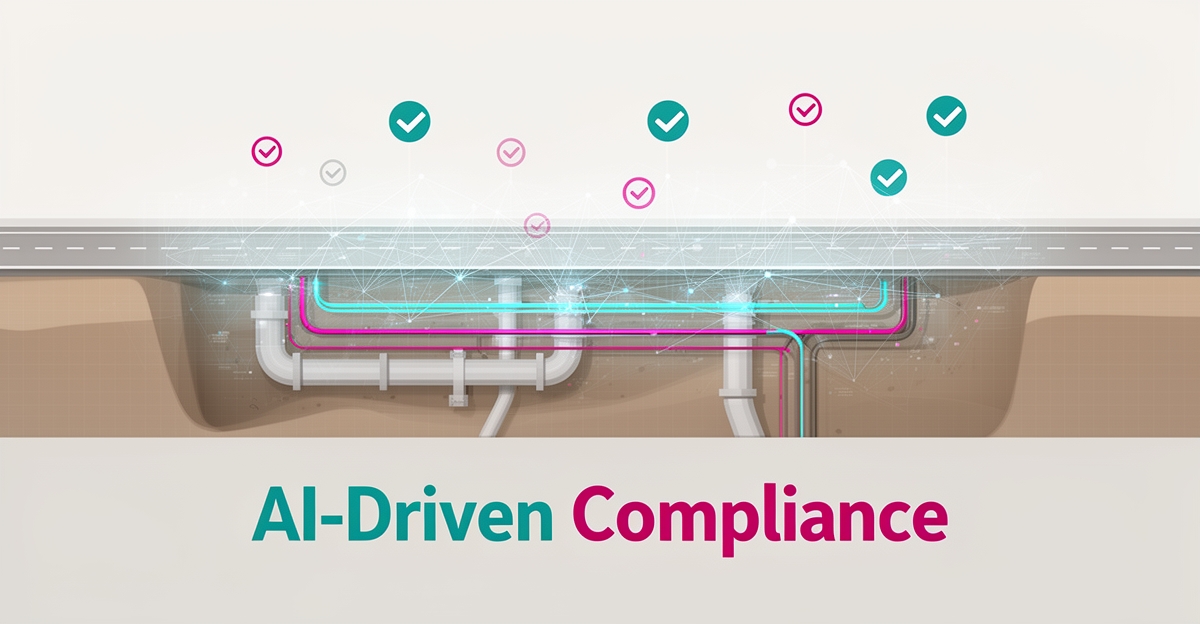
5 Ways AI Can Improve Compliance in Underground Utility Work
Key Facts
- A large and growing share of businesses now use analytical and generative AI to handle compliance challenges, as of late 2026
- AI-driven compliance is expected to enable significantly faster approvals and real-time adherence to standards over the coming years
- AI-powered documentation eliminates manual entry delays and keeps every action traceable for audits
- AI systems can generate safety logs and regulatory submissions in real time using data from field sensors and equipment usage
- Real-time monitoring with IoT sensors enables immediate intervention when anomalies like pressure drops indicate potential leaks
- AI reduces compliance gaps by predicting risks from historical incident data and excavation patterns before work begins
- Organizations using AI-powered tools typically report fewer compliance violations and greater confidence during regulatory reviews
Hire a team member that works 24/7 — for less than a part-time wage.
AI receptionists, SDRs, dispatchers and 99+ roles. Trained on your business, fully managed.
Not sure where to start? Ask our AI planner
The Compliance Burden in Underground Utility Work
Utility teams face mounting pressure to maintain safety logs, regulatory submissions, and adherence to local and national standards, tasks that are not only time-consuming but also prone to human error. Manual compliance processes drain valuable resources, with teams spending hours on documentation that could be better spent on fieldwork or preventive maintenance. This burden increases the risk of missed deadlines, incomplete records, and non-compliance, which can trigger audits, fines, and erosion of stakeholder trust. As underground utility work grows more complex due to aging infrastructure and stricter regulations, the gap between compliance demands and manual capacity widens. AIQ Labs helps bridge this gap by building compliant, auditable AI systems that automate tracking, verification, and report generation for municipalities and insurance providers. By reducing reliance on error-prone manual entry, AI ensures that every utility job meets required standards while freeing teams to focus on safety and service delivery. Industry research as of late 2026 shows that a large share of businesses are already using analytical and generative AI to tackle compliance challenges, underscoring its growing role in risk mitigation. Analysts also project that AI-driven compliance will enable significantly faster approvals and real-time adherence to standards over the coming years, benefits that are increasingly critical for utility operations. Without such innovation, organizations remain vulnerable to preventable compliance failures that compromise both safety and operational continuity.
- Inconsistent safety log entries due to manual data entry
- Delayed regulatory submissions causing project holdups
- Difficulty adapting to evolving local and national standards
- Increased audit risk from incomplete or inaccurate documentation
- Erosion of stakeholder trust following compliance violations
How AI Transforms Risk, Documentation, and Monitoring
Underground utility work demands precision, where even minor oversights can trigger safety hazards or regulatory penalties. AI transforms how teams manage risk, documentation, and monitoring by turning reactive processes into proactive, data-driven systems that align with compliance requirements from the ground up.
Traditional compliance relies on manual logs and periodic checks, which are slow and error-prone. In contrast, AI-powered risk management analyzes historical incident data, soil conditions, and excavation patterns to predict potential hazards before work begins. For example, AI can detect subtle trends in utility strike reports that humans might miss, enabling teams to adjust dig plans or reinforce safety protocols in advance. This shift from guesswork to foresight reduces the likelihood of non-compliance incidents by identifying root causes early. As of late 2026, a large share of businesses are already using analytical and generative AI to strengthen their compliance posture, reflecting growing confidence in AI’s ability to handle complex regulatory landscapes.
Documentation, often a bottleneck in utility projects, becomes streamlined through automation. AI systems can generate safety logs, incident reports, and regulatory submissions in real time by pulling data from field sensors, worker check-ins, and equipment usage. This eliminates delays caused by manual entry and ensures every action is traceable for audits. AIQ Labs builds compliant, auditable AI systems that track, verify, and generate required reports for municipalities and insurance providers, reducing the administrative burden on field teams while maintaining audit readiness. The result is not just faster paperwork but higher accuracy, critical when submissions must meet strict local and national standards.
Real-time monitoring takes compliance further by embedding AI with IoT sensors that continuously track pressure, temperature, and vibration near active work zones. When anomalies arise, such as unexpected pressure drops indicating a potential leak, the system alerts supervisors instantly, allowing immediate intervention. This capability supports the broader industry expectation of faster approvals and real-time compliance as AI adoption matures. By connecting sensor data to compliance rules, AI ensures that work stays within permitted parameters without constant manual oversight.
Together, these capabilities create a compliance ecosystem where risk is anticipated, documentation is self-sustaining, and monitoring is continuous. Organizations using AI-powered tools typically report fewer compliance gaps, faster incident resolution, and greater confidence during regulatory reviews. AI doesn’t replace human judgment, it augments it, giving teams the insights they need to make safer, more compliant decisions every day. For underground utility work, where the cost of error is high, this partnership between human expertise and AI precision isn’t just efficient, it’s essential.
From Gaps to Certification: A Practical AI Compliance Roadmap
Underground utility work faces constant pressure to meet safety and regulatory standards without slowing operations. AIQ Labs helps organizations turn compliance from a reactive burden into a proactive advantage by implementing AI systems that are built for auditability and real-world use. The path forward starts with a clear, step-by-step approach grounded in what the research shows works.
First, assess gaps and define scope by mapping current workflows against local and national requirements. As of late 2026, a large share of businesses are already using analytical and generative AI, showing widespread recognition of its value in compliance functions. This assessment identifies where manual processes create risk, such as incomplete safety logs or delayed regulatory submissions, and sets clear objectives for AI integration.
Next, strengthen controls with AI tools that automate documentation and monitoring. AI can generate safety logs, track excavation permits, and verify crew certifications in real time, reducing human error and ensuring records are always up to date. By linking sensor data from IoT devices with AI analysis, organizations gain continuous visibility into site conditions, enabling immediate corrective action when deviations occur.
Then, run targeted audits using AI-powered tools to close compliance gaps. These systems can cross-reference field data against regulatory standards, flagging inconsistencies before they become violations. Early detection translates directly into fewer delays and lower remediation costs.
Prepare for management review and certification by using AI to compile complete, traceable documentation packages. AI systems maintain audit trails that show who did what, when, and why, critical for demonstrating due diligence to insurers and municipal reviewers. This preparation step ensures that certification isn’t a scramble but a confirmation of ongoing compliance.
Finally, monitor and improve continuously. AI doesn’t just report past performance; it learns from patterns to predict where future risks may emerge. Organizations that treat compliance as a dynamic process, using AI to refine checklists, update training triggers, and adjust controls, build resilience into their operations. This ongoing cycle turns compliance into a driver of efficiency, not just a box to check.
Building Compliant, Auditable AI for Utility Operations
Building compliant AI systems for utility operations means solving three interconnected challenges: data quality, specialized expertise, and total cost of ownership. Industry research as of late 2026 shows widespread AI adoption for compliance, yet many organizations struggle to move from pilots to production-grade compliance systems. The gap isn't technology, it's architecture. Municipalities and insurance providers require audit trails, version control, and deterministic outputs that generic AI tools cannot deliver.
- Custom workflow builds that replace subscription chaos with owned, auditable systems
- Managed AI employees trained on your specific regulatory frameworks and workflows
- A connected AI operating system that embeds governance from day one
AI supports human judgment rather than replacing it, a principle that shapes every system AIQ Labs builds. Our AI Workflow Builds deliver custom code and deep API integrations that connect CRM, project management, and accounting systems into a single source of truth. Our AI Employees provide managed, role-specific agents, dispatchers, intake specialists, field coordinators, that work 24/7/365 with full compliance tracking, typically at a fraction of the cost of a human hire. And our AI Operating Systems establish the governance frameworks, audit trails, and human-in-the-loop controls that regulated industries demand, built in phases and owned outright.
Forward-looking analysis projects significantly faster approvals and real-time compliance for organizations that invest in proper infrastructure today. The choice isn't whether to adopt AI for compliance, it's whether to rent black-box tools or own transparent systems that generate the exact reports your municipality and insurance partners require.
Still paying for 10+ subscriptions that don’t talk to each other?
We build custom AI systems you own outright. No vendor lock-in. Full control.
Not sure where to start? Ask our AI planner
Frequently Asked Questions
How can AI actually improve compliance documentation in underground utility work?
Is AI going to replace utility workers or just add more complexity to their jobs?
What kind of real-time monitoring can AI provide for underground utility work, and how does it prevent compliance issues?
Our team is small and doesn’t have AI expertise, can we still implement compliant AI systems without hiring data scientists?
What’s the first step to actually start using AI for compliance in our utility operations?
How do we know AI-powered compliance systems will hold up during audits or regulatory reviews?
From Compliance Burden to Strategic Advantage
Underground utility teams no longer need to choose between safety and efficiency, AI-powered compliance transforms documentation from a reactive chore into a proactive safeguard. By automating safety logs, predicting risks through sensor data, and generating audit-ready reports in real time, organizations eliminate human error, reduce approval delays, and build durable trust with municipalities and insurers. The path forward starts with assessing your current gaps, then implementing AI tools that work within your existing workflows to ensure every dig, repair, and installation meets the highest standards. Ready to see how AI can turn compliance into your competitive edge? Start with AIQ Labs' 2-minute Fit Check and a free 30-minute strategy call to map your biggest bottleneck and uncover high-ROI automation opportunities, no obligation, just clarity on your AI opportunity.
Make AI your competitive advantage — not just another tool.
Strategy, implementation and ongoing optimization. One partner, end to end.
Not sure where to start? Ask our AI planner