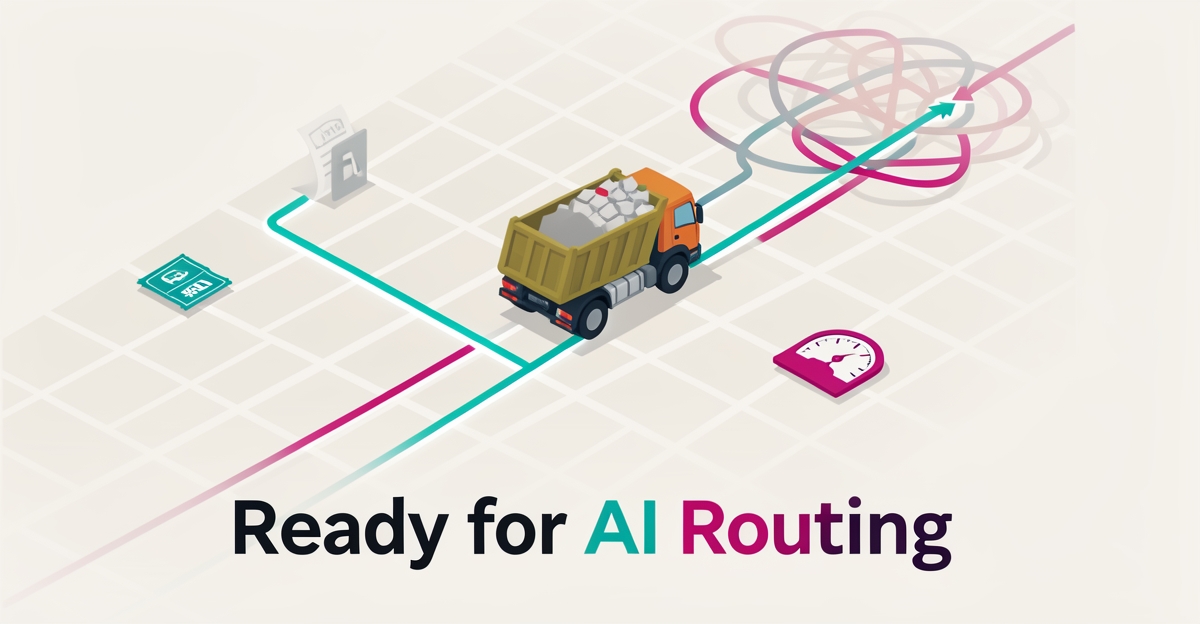
7 Signs Your Debris Hauling Business Is Ready for AI-Driven Route Optimization
Key Facts
- AI route optimization typically improves route accuracy well beyond what manual planning achieves, since it evaluates far more variables than a human dispatcher can hold in their head
- Manual route planning commonly wastes a meaningful share of fuel budgets, often cited in the range of 10-25%, while frustrating customers with late deliveries
- AI systems can process 100+ factors simultaneously, live traffic, weather, truck capacity, material type, disposal site rules, compared to the handful a human planner manages
- Route planning time often drops from hours per day to minutes or seconds once AI handles the sequencing
- On-time delivery rates typically climb into the mid-90s or higher with continuously optimized routing
- Combined ticketing and routing inefficiencies can cost a mid-size hauling operation tens of thousands of dollars a year
Hire a team member that works 24/7 — for less than a part-time wage.
AI receptionists, SDRs, dispatchers and 99+ roles. Trained on your business, fully managed.
Not sure where to start? Ask our AI planner
The Hidden Costs of Manual Route Planning in Debris Hauling
Every day your trucks roll out with routes planned on paper or memory, your debris hauling business is bleeding money. These aren't just operational hiccups, they're systematic drains on your profitability that compound daily.
The first major leak is paper ticket reconciliation. Drivers submit stacks of tickets at week's end, leading to missing information, unmatched billing, and delayed invoicing. This process often stretches billing cycles to two weeks, creating cash flow gaps that strain operations. Worse, disputes from lost or damaged tickets erode customer trust and consume administrative hours.
Disposal site errors represent another costly pitfall. When drivers take mixed loads to the wrong facilities, you face rejections, return trips, and doubled job costs. Different materials require specific disposal facilities under varying regulations, a complexity that manual systems struggle to manage. These mistakes don't just cost money; they damage your reputation with customers who expect professional, compliant service.
Then there's the inefficient truck utilization that plagues most debris hauling operations. Trucks drive 30 minutes back to the home yard for next assignments when profitable pickups exist nearby. This lack of coordination between dispatchers and project supervisors can cost mid-size fleets tens of thousands annually in lost margin. Without real-time visibility, you're essentially flying blind.
The picture of these hidden costs, consistent with what industry analysis of AI routing typically reports:
- Manual route planning can waste a significant share of fuel budgets, often cited between 10% and 25%, while frustrating customers with late deliveries
- Combined ticketing and routing inefficiencies can cost a mid-size operation tens of thousands of dollars a year
- Paper-based systems commonly delay billing by up to two weeks, straining cash flow
- Disposal site errors can double job costs through rejections and return trips
Manual planning considers only a handful of variables, traffic, distance, maybe a driver preference, while an AI system evaluates 100+ factors at once. That gap means human planners routinely miss optimization opportunities that translate into fuel savings typically in the 10-20% range. The result? You're paying more to deliver less.
AIQ Labs understands these challenges because we've built the systems that address them directly, 200+ multi-agent deployments across field service operations, including dispatch-heavy businesses. The question isn't whether you can afford to implement AI route optimization, it's whether you can afford not to.
How AI Route Optimization Solves Debris Hauling’s Biggest Inefficiencies
Debris hauling margins disappear in the space between the job site and the disposal facility. Manual dispatch and paper tickets create delays that compound into higher fuel burn, missed windows, and late billing.
AI route optimization replaces guesswork with continuous calculation. Systems process 100+ factors simultaneously, live traffic, weather, truck capacity, crew availability, material type, and disposal site rules, compared to the 5-10 factors a human planner can effectively juggle.
The result is measurable efficiency across the operation. Route accuracy climbs well above what manual planning achieves, planning time drops from 2-3 hours daily to minutes or seconds, fuel efficiency typically improves 10-20%, and on-time delivery rates commonly rise into the mid-90s or better.
Large logistics operators have validated the approach for years, UPS's ORION routing system is widely credited with saving hundreds of millions of dollars annually in fuel and operational costs. The same principles apply at hauling-fleet scale: eliminate backtracking, cut deadhead miles, and assign the closest available truck to the next job.
For debris hauling specifically, optimization solves three chronic pain points:
- Digital load ticketing captures material type, quantity, job site and disposal facility with timestamps for same-day billing
- Real-time dispatch assigns the next job from the closest available truck instead of waiting for yard check-in
- Automated disposal site assignment prevents wrong-facility incidents and return trips that double job costs
AIQ Labs builds these systems through [AI Workflow Builds](/workflow-builds), we rebuild the one workflow that costs you the most, at a fixed price, in phases. For dispatch-heavy operations that want a fuller connected layer, our [AI Operating Systems](/ai-operating-systems) approach ties routing, ticketing, billing, and reporting into one system you own outright. The technology learns with every delivery, steadily improving ETA accuracy over static, manual methods.
Beyond routing, the system enables operational visibility that supports billing and compliance. Daily and weekly load summaries by material type and disposal site are delivered to general contractors, while performance tracking monitors loads per shift, turnaround time per site, and fuel efficiency per driver and truck.
The shift is from reactive dispatch to proactive logistics. Businesses that adopt AI-driven route planning stop losing tens of thousands of dollars annually to uncoordinated trucks and start competing on speed, accuracy, and transparency.
Is Your Business Ready? 7 Signs It’s Time to Implement AI Routing
Many debris hauling businesses operate with hidden inefficiencies that silently erode profits. Recognizing these warning signs early can prevent costly delays, compliance issues, and lost revenue. Here are seven clear indicators that your operation is primed for AI-driven route optimization.
1. Inconsistent scheduling and frequent last-minute job changes. These signal a lack of real-time visibility into crew availability and job locations. When dispatchers rely on spreadsheets or paper tickets, they cannot dynamically adjust routes based on current truck locations or emerging priorities, leading to wasted drive time and missed opportunities. AI systems process hundreds of variables simultaneously, far exceeding human cognitive limits, to reassign jobs in seconds as conditions change.
2. Rising fuel costs despite stable routes. This often points to suboptimal truck sequencing and excessive idling between jobs. Manual planning typically considers only 5-10 factors, while AI evaluates traffic patterns, load constraints, disposal site proximity, and crew schedules to minimize unnecessary mileage, commonly delivering 10-20% fuel savings by eliminating inefficient backtracking and deadhead miles.
3. Delayed job completions and customer complaints about late arrivals. These reveal breakdowns in ETA accuracy. Human planners struggle to account for real-time variables like traffic accidents, weather shifts, or site access issues. AI route optimization keeps on-time delivery rates in the mid-90s or better by continuously adapting routes based on live conditions, and customers consistently value accurate ETAs over vague promises.
4. Manual dispatch that eats hours of planning time every day. When dispatchers spend 2-3 hours each morning building routes, they have less time for customer service, compliance monitoring, and proactive problem-solving. AI typically cuts route planning time by 75-85%, turning a multi-hour task into a matter of seconds while producing more accurate routes than manual methods.
5. Disposal site compliance errors. Taking mixed loads to incorrect facilities indicates a gap between job requirements and execution. These mistakes trigger rejections, return trips, doubled costs, and regulatory risk. AI systems integrate digital load ticketing with real-time dispatch to automatically assign jobs to crews equipped for specific material types and route them to approved facilities, eliminating wrong-facility incidents when built into the workflow.
6. Flat or declining revenue per truck despite steady job volume. This suggests underutilized assets. Optimized routing can meaningfully increase daily job completion rates, often by double-digit percentages, by reducing transit time between sites. Haulers combining digital ticketing with AI routing commonly add extra loads per truck per day, directly boosting revenue without adding vehicles or drivers.
7. Competitors responding faster, providing real-time tracking, or billing same-day. If that's happening around you, you're likely losing market share. AI-enabled operations position haulers as professional logistics partners rather than just truck operators, meeting modern customer expectations for transparency and reliability. AIQ Labs helps debris hauling businesses assess these readiness signs and implement routing solutions that integrate with existing workflows, [AI Employees](/ai-employees) like an AI dispatcher can run at roughly 80% less cost than a human hire, while [Workflow Builds](/workflow-builds) target the routing-and-billing process that costs you the most.
Next Steps: From Assessment to AI-Powered Dispatch with AIQ Labs
Begin by assessing your current operational inefficiencies, paper ticket reconciliation delays, disposal site compliance issues, and unoptimized routing that can waste a meaningful share of your fuel budget while leaving customers frustrated with late arrivals. Identify where manual processes create bottlenecks, such as drivers submitting stacks of tickets at week's end or trucks driving to the home yard for next assignments when nearby pickups exist. This foundational step reveals the specific pain points AI can resolve, from billing delays to rejections from wrong-facility incidents that double job costs.
Deploy digital load ticketing to capture material type, quantity, job site, and disposal facility information with timestamps, enabling same-day billing from actual ticket data and eliminating lost or damaged tickets. Integrate real-time dispatch optimization that tracks trucks live and automatically assigns jobs from the closest available location rather than waiting for driver check-in. Establish customer reporting systems that provide daily and weekly load summaries by material type and disposal site, positioning your hauler as a professional logistics partner. Implement performance tracking to monitor loads per shift, turnaround time, and fuel efficiency, enabling data-backed coaching conversations that improve driver and fleet performance.
How you engage depends on where you're starting from. If you need dispatch capacity first, an [AI dispatcher as an AI Employee](/ai-employees) runs on a flat monthly plan, roughly 80% less than a human hire, with training on your business, tool integrations, monitoring, and improvements included, and the ability to pause or adjust anytime. If the routing-and-billing workflow itself is the bottleneck, a fixed-price [Workflow Build](/workflow-builds) rebuilds it in phases. And if you want routing, ticketing, billing, and reporting connected into one layer you own outright, that's an [AI Operating System](/ai-operating-systems), built in phases. Every engagement starts the same way: take the [2-minute Fit Check](/apply), then book a free 30-minute strategy call to identify your highest-ROI automation opportunities. You can reach the team anytime at [email protected].
Still paying for 10+ subscriptions that don’t talk to each other?
We build custom AI systems you own outright. No vendor lock-in. Full control.
Not sure where to start? Ask our AI planner
Frequently Asked Questions
What specific problems does AI route optimization solve for debris hauling businesses?
How much can a debris hauling business save on fuel costs with AI route optimization?
Is AI route optimization only for large fleets, or can small debris hauling companies benefit too?
How does AI improve on-time delivery rates compared to manual planning?
What does implementing AI route optimization actually involve for a debris hauling business?
Can AI route optimization help with disposal site compliance and regulatory requirements?
Turn Operational Leaks into Competitive Wins
You've seen how paper tickets, disposal errors, and inefficient routing silently drain your debris hauling business, wasting fuel budget, delaying billing, and eroding customer trust. AI route optimization isn't just a tech upgrade; it's a direct path to reclaiming that lost revenue through digital load ticketing, real-time dispatch, and automated compliance, typically saving 10-20% on fuel and meaningfully increasing daily job completion. If you're ready to stop losing money to manual processes and start operating with the precision of a modern logistics partner, the next step is simple: take the [2-minute Fit Check](/apply), then book a free 30-minute strategy call to see exactly where AI can deliver measurable impact in your operation.
Make AI your competitive advantage — not just another tool.
Strategy, implementation and ongoing optimization. One partner, end to end.
Not sure where to start? Ask our AI planner