7 Signs Your Electrical Supply Distributor Business Needs AI for Order Processing
Key Facts
- AI-driven warehouse logistics improve order fulfillment rates by 25% according to industry research
- Smart production planning cuts material waste by 18% according to industry research
- Predictive maintenance reduces unplanned downtime by 30% according to industry research
- AI-powered data extraction can reduce entry errors by up to 95% according to industry research
- Intelligent forecasting can reduce stockouts by up to 70% according to industry research
- Automating repetitive data entry can eliminate 20+ hours weekly according to industry research
Hire a team member that works 24/7 — for less than a part-time wage.
AI receptionists, SDRs, dispatchers and 99+ roles. Trained on your business, fully managed.
Not sure where to start? Ask our AI planner
The Hidden Costs of Manual Order Processing in Electrical Distribution
The daily reality for many electrical supply distributors involves wrestling with manual data entry errors, mounting order backlogs, and slow fulfillment cycles that frustrate customers and strain teams. These aren't just operational hiccups—they represent tangible costs that erode profitability and competitive positioning. Manual order processing is inherently time-consuming and prone to human error, leading to incorrect shipments, delayed deliveries, and increased labor costs as staff spend excessive time correcting mistakes instead of focusing on value-added activities. As competitors adopt automation, distributors relying on manual processes risk falling behind in speed, accuracy, and customer satisfaction.
The financial impact of sticking with manual systems becomes clear when examining operational inefficiencies. Industry research shows that manual workflows contribute significantly to waste and downtime, with smart production planning reducing material waste by 18% and predictive maintenance cutting unplanned downtime by 30%. For electrical distributors, these inefficiencies translate directly into higher operating costs, missed revenue opportunities, and strained supplier relationships. Order fulfillment rates also suffer—AI-driven warehouse logistics have demonstrated a 25% improvement in fulfillment rates, highlighting the performance gap manual processes create. When orders pile up due to slow processing, customer trust erodes, and the likelihood of losing business to more agile competitors increases.
Continuing with manual order processing exposes distributors to several hidden costs beyond immediate labor expenses. These include increased error-related returns and replacements, overtime pay to clear backlogs, lost early payment discounts from delayed invoicing, and inefficient inventory management that leads to overstocking or stockouts. Additionally, manual systems lack the scalability to handle demand spikes, forcing businesses to either miss sales opportunities or incur rush-order premiums. In contrast, AI-powered order processing streamlines data capture, validates entries in real time, and accelerates fulfillment cycles—directly addressing the pain points of errors, backlogs, and slow throughput. Distributors that recognize these signs are better positioned to evaluate automation not as a cost, but as a necessary investment in operational resilience and market competitiveness. To explore how AI can transform your order processing workflow, start with a free strategy call to assess your specific bottlenecks and identify high-ROI opportunities.
7 Warning Signs Your Order Workflow Is Ready for AI
Many electrical supply distributors overlook subtle but costly signals that their order workflow is straining under manual processes. These warning signs often start small—like recurring data entry mistakes—but compound into significant operational drag, delaying quotes, frustrating customers, and eroding margins. Recognizing these indicators early is critical to preventing scalability limits and identifying where AI-driven automation can deliver immediate relief.
Recurring entry errors in customer or product details frequently point to overburdened staff manually transcribing orders from email, phone, or fax into ERP systems. Each mistake risks incorrect shipments, returns, or billing disputes, directly impacting fulfillment accuracy. Industry research shows that AI-powered data extraction can reduce such errors by up to 95%, transforming a painful choke point into a reliable, automated input stream according to industry research. When your team spends more time fixing mistakes than processing new orders, it’s a clear sign the workflow needs intelligent augmentation.
Order backlogs and slow quote-to-delivery cycles often stem from bottlenecks in validation, pricing, or inventory checks that require human intervention at every step. These delays not only frustrate customers but also increase the likelihood of lost sales to faster competitors. AI can streamline these stages by instantly validating configurations, applying contract pricing, and checking real-time stock levels—cutting cycle times significantly. Businesses using AI-driven warehouse logistics have seen a 25% improvement in order fulfillment rates, demonstrating how automation accelerates the entire order-to-cash process according to industry research.
Inventory mismatches and frequent stockouts reveal a disconnect between sales orders and actual warehouse availability, usually caused by lagging updates or siloed systems. When sales teams promise items that aren’t truly available, it leads to backorders, expedited shipping costs, and damaged trust. AI excels at synchronizing demand signals with inventory levels, enabling predictive reordering and reducing stockouts by up to 70% through intelligent forecasting according to industry research. If your team is constantly firefighting availability issues, the root cause likely lies in a manual order-to-inventory feedback loop.
Staff spending excessive time on repetitive data entry—such as rekeying customer info, part numbers, or pricing—is perhaps the most visible sign of workflow inefficiency. This not only inflates labor costs but also diverts skilled employees from higher-value activities like customer engagement or exception handling. Automating these tasks with AI can eliminate 20+ hours weekly of manual data entry, freeing teams to focus on strategic priorities according to industry research. When your best people are stuck in data entry purgatory, the system—not the staff—is failing.
Missed fulfillment targets and scaling pain during growth periods indicate that your current process lacks the elasticity to handle volume spikes without breaking. Whether it’s seasonal promotions, new product launches, or regional expansion, manual workflows simply can’t scale proportionally. AI-powered systems, however, maintain consistent performance regardless of order volume, enabling predictable throughput without proportional headcount growth. If every increase in sales brings a corresponding surge in overtime and errors, your order process is signaling readiness for automation—not more bandaids.
What AI-Powered Order Processing Actually Delivers
For electrical supply distributors, order processing is where margin leaks first appear. Manual entry, spreadsheet handoffs, and disconnected ERP modules create backlogs that slow fulfillment and erode customer trust.
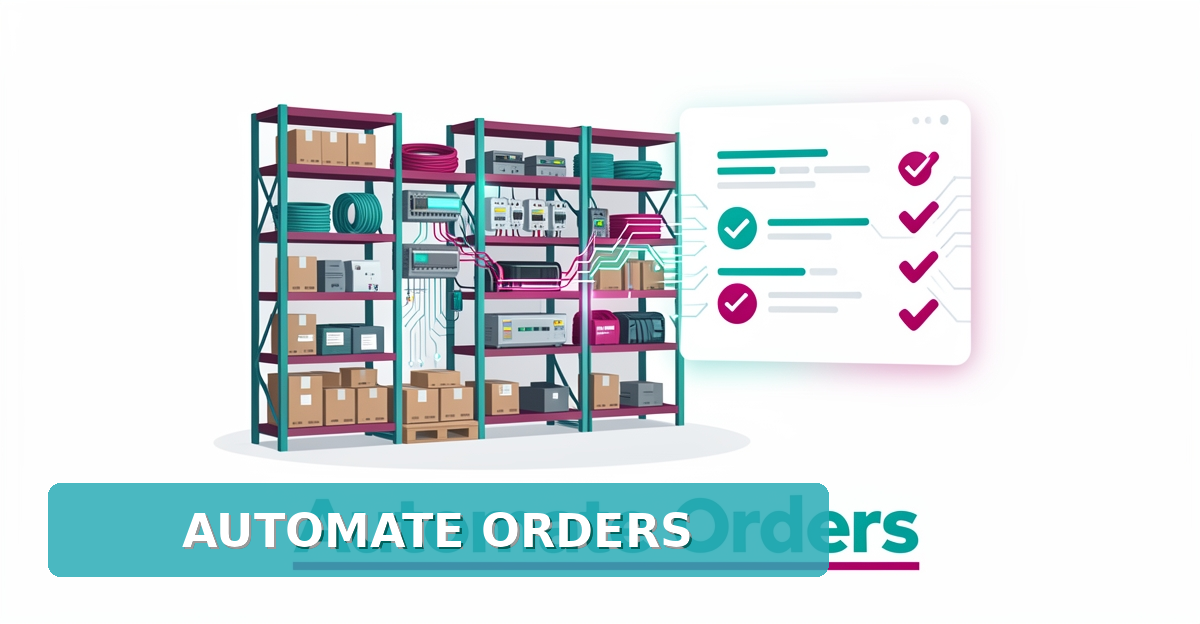
AI-powered order processing replaces those friction points with automated, end-to-end workflows that move from quote to delivery without repeated re-keying. The system ingests customer requests, validates stock and pricing in real time, and routes orders directly into ERP for picking and invoicing.
Operational impact is measurable. Industry research shows a 25% improvement in order fulfillment rates through AI-driven warehouse logistics. The same research documents an 18% reduction in material waste through smart production planning, which translates into fewer expedites and less excess inventory tied up in distribution.
Error reduction is equally critical. Automated data extraction removes manual re-entry from purchase orders, catalog updates, and shipment confirmations, cutting the transcription mistakes that cause wrong items, pricing errors, and returns. Fewer errors mean faster cycles and cleaner data across sales, inventory, and finance.
Integration is the key to adoption. AI does not replace existing ERP tools; it connects to them. Quote capture, customer validation, inventory checks, order creation, picking instructions, and delivery confirmations all flow through the distributor’s current systems with seamless operational workflows. That preserves existing investments while eliminating manual handoffs.
In practice, AI order processing delivers:
- Automated extraction and validation of order data from emails, portals, and EDI feeds
- Real-time inventory and pricing checks against ERP to prevent oversells
- Intelligent routing and prioritization to reduce fulfillment cycle time
- Exception handling with human-in-the-loop escalation for complex orders
Distributors can start with a single broken workflow and expand. AIQ Labs designs custom AI systems that integrate with existing ERP tools to streamline operations from quote to delivery, building owned assets rather than adding another subscription layer. The result is consistent order accuracy, faster throughput, and a team that focuses on customers instead of chasing data.
When order backlogs and manual errors shrink, the business gains capacity without adding headcount.
How to Implement AI Order Processing Without Disrupting Operations
Order processing transformation fails when it starts with technology instead of workflow. Electrical distributors need a phased roadmap that protects current operations while building measurable gains in speed and accuracy.
Start by mapping the pain points that cost the most. Identify high-impact workflows such as quote-to-order entry, manual data validation, and fulfillment handoffs where backlogs and errors accumulate. Align each workflow to a clear business goal like faster cycle times or fewer returns. AI success in industrial environments isn’t about technology first — it’s about aligning data, people, and process to create measurable operational impact.
A phased approach limits disruption and cost exposure. Begin with a single critical workflow, prove value, then expand. This ownership-based model lets you keep what is built, pause or adjust anytime, and avoid vendor lock-in.
A practical implementation roadmap looks like this:
- Audit current order flow and quantify error rates, cycle times, and backlog volume
- Design a custom AI workflow that integrates with existing ERP tools without replacing them
- Deploy in a pilot with human-in-the-loop validation for data entry and exception handling
- Measure results against baseline KPIs and expand to adjacent workflows
Integration is the key risk point. Custom AI systems can connect to CRM, accounting, and inventory platforms through deep two-way API integrations, creating a single source of truth across departments. This eliminates 20+ hours weekly of manual data entry and reduces operational errors by 95%.
Upfront costs and technical expertise are common concerns. A milestone-based build lets you approve and pay per phase, stop anytime, and keep everything built so far. AIQ Labs designs custom AI systems that integrate with existing ERP tools to streamline operations from quote to delivery, with full ownership transferred to the client.
Job displacement concerns are addressed by design. AI is not a replacement for human judgment, but rather a tool to augment and support human decision-making. Teams shift from repetitive data entry to exception handling, customer service, and process improvement.
Results scale with scope. Manufacturers using AI-driven warehouse logistics see a 25% improvement in order fulfillment rates through smarter routing and picking. Smart production planning delivers an 18% reduction in material waste, while predictive maintenance drives a 30% reduction in unplanned downtime.
Measure what matters from day one. Track order accuracy, fulfillment cycle time, backlog age, and labor hours per order. When metrics move, expand the system to inventory forecasting and automated quality inspection. Phased ownership keeps risk low while building a durable competitive advantage.
Your Next Step: Find Your Biggest Automation Win
Order backlogs and manual entry errors are costing electrical supply distributors time, margin, and customer trust every week. The distributors who move first on order processing automation are the ones who stop firefighting and start scaling.
You can pinpoint your biggest automation win in minutes, not months. A short fit assessment maps where manual data entry, slow fulfillment cycles, and order backlogs are hitting hardest, then prioritizes the workflow that will unlock the fastest ROI.
AIQ Labs designs custom AI systems that integrate with existing ERP tools to streamline operations from quote to delivery, with proven track record automating electrical and field-service workflows. The approach is practical and ownership-first, not a subscription widget.
Start with a two-minute Fit Check at https://aiqlabs.ai/apply to qualify fit, then book a free 30-minute strategy call at https://aiqlabs.ai/book with an AI engineer. The session maps your biggest bottleneck and identifies a high-ROI automation opportunity. If there isn’t a clear win, the team will say so.
From there you can move with a payment model that matches your risk tolerance:
- Start Monthly — one AI employee with setup plus a flat monthly plan less than a part-time hire, includes build, training, integrations, monitoring and improvements, pause or adjust anytime
- Build in Milestones — one workflow or department system split into phases, approve and pay per phase, stop anytime and keep what’s built
- Own It Outright — full AI operating system with one project price or monthly Build Partnership, full ownership of code, agents and data when complete
The business case is already visible in manufacturing-adjacent operations. Industry research shows 25% improvement in order fulfillment rates through AI-driven warehouse logistics. The same environment reports an 18% reduction in material waste through smart production planning and a 30% reduction in unplanned downtime through predictive maintenance.
These gains translate directly to distributor pain points: fewer manual errors, faster pick-pack-ship cycles, and inventory that moves with demand instead of against it. True ownership means the system you build belongs to you, with no vendor lock-in and seamless two-way API integrations to your ERP and quoting tools.
The next step is clarity, not commitment. Take the Fit Check, join the free strategy call, and leave with a mapped bottleneck, a scoped automation plan, and a clear path to your biggest automation win.
Still paying for 10+ subscriptions that don’t talk to each other?
We build custom AI systems you own outright. No vendor lock-in. Full control.
Not sure where to start? Ask our AI planner
Frequently Asked Questions
How can AI reduce errors in order processing for electrical distributors?
Will implementing AI disrupt our current ERP systems or workflows?
What measurable improvements can we expect from AI-driven order processing?
Is AI only for large distributors, or can small electrical supply businesses benefit too?
How do we know if our order processing workflow is ready for AI automation?
What’s the first step to explore AI for our order processing without commitment?
Key Takeaways
{ "title": "Stop Firefighting Orders, Start Scaling Operations", "content": "Manual order processing isn't just a workflow annoyance — it's a margin leak that compounds with every miskeyed part number, delayed quote, and backlogged shipment. The seven warning signs covered here — recurring entry
Make AI your competitive advantage — not just another tool.
Strategy, implementation and ongoing optimization. One partner, end to end.
Not sure where to start? Ask our AI planner