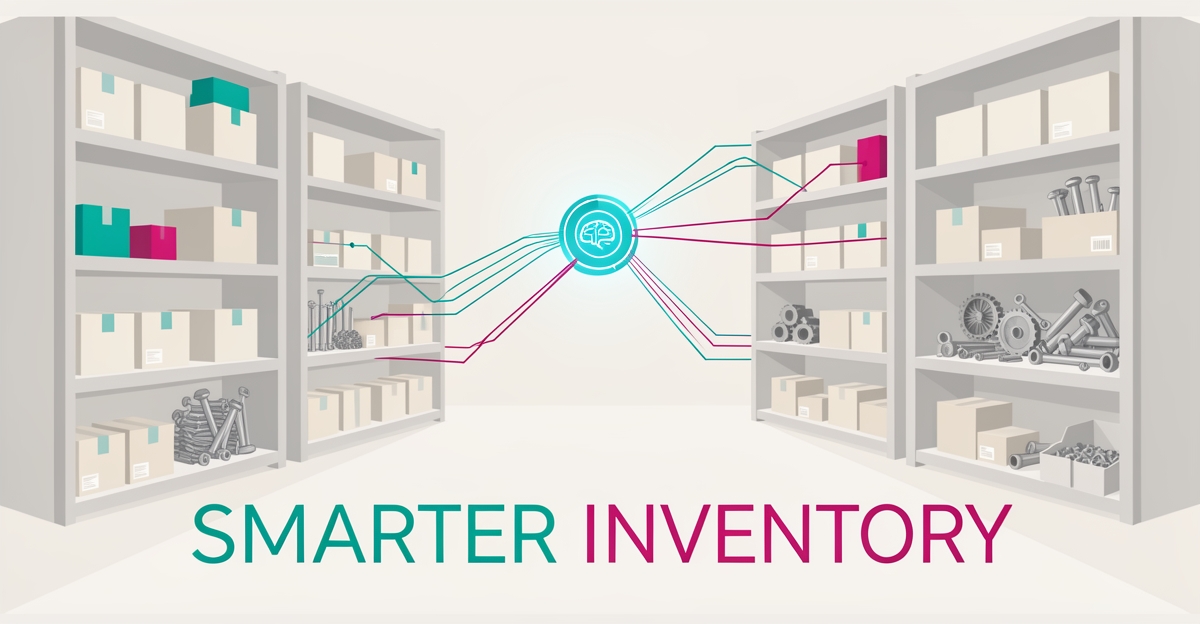
7 Signs Your Hardware Distributor Needs AI for Inventory Management
Key Facts
- AI-driven forecasting typically lifts inventory forecast accuracy from the 60-70% range common with manual methods to 85-95% within months according to implementation data
- Industry research reports AI-powered demand forecasting reducing inventory costs by roughly 22% on average across wholesale distributors industry research shows
- Warehouse AI picking accuracy is reported to reach around 99%, up from roughly 92% before AI implementation according to wholesale statistics
- AI inventory systems are commonly reported to deliver measurable ROI within 90-120 days by automating most manual planning tasks real-world analysis suggests
- Stockout incidents are typically reported to fall from 5-8% of SKUs to under 2% with AI inventory management power tools industry data shows
- Inventory carrying costs are reported to drop meaningfully—often cited near 25-30%—when AI forecasting reaches high accuracy wholesale distribution research suggests
Hire a team member that works 24/7 — for less than a part-time wage.
AI receptionists, SDRs, dispatchers and 99+ roles. Trained on your business, fully managed.
Not sure where to start? Ask our AI planner
The Hidden Costs of Inventory Guesswork in Hardware Distribution
For hardware distributors, inventory guesswork isn't just inefficient—it's a direct drain on profitability and customer trust. When systems rely on manual tracking or outdated forecasting, the financial consequences compound quickly through lost sales, tied-up capital, and eroded supplier relationships.
Stockouts alone cost hardware distributors dearly. Peak-season stockouts have cost distributors major clients, and overstocking ties up working capital in slow-moving SKUs—excess inventory discovered after a poor seasonal forecast can run into the millions of dollars. These aren't isolated incidents. Industry data suggests stockout incidents typically affect 5-8% of SKUs in traditional systems, while overstock value can represent 10-15% of total inventory.
The hidden toll extends beyond immediate lost sales. Poor forecasting accuracy—often stuck around 60% with conventional approaches—leads to inflated carrying costs, with inventory holding expenses commonly consuming 15-25% of inventory value annually. This working capital strain limits flexibility for growth initiatives and increases vulnerability to supply chain disruptions. When distributors constantly react to inventory crises instead of preventing them, operational efficiency suffers across receiving, picking, and fulfillment processes.
These patterns reveal a critical threshold: when inventory management becomes a source of recurring financial leakage rather than a competitive advantage, it's time to evaluate whether AI-driven forecasting and replenishment could transform guesswork into precision. Real-world cases demonstrate how addressing these hidden costs unlocks measurable improvements in cash flow, service levels, and overall distribution resilience.
How AI Transforms Inventory Accuracy and Forecasting for Hardware Distributors
Hardware distributors can’t afford to guess with inventory. Seasonal spikes, fragmented locations, and long lead times turn small forecasting errors into stockouts or millions in excess stock.
AI replaces static rules with models that learn continuously from sales history, seasonality, and real-time signals. AI platforms are typically reported to improve forecast accuracy from 60-70% to 85-95% within months by running thousands of SKU-location micro-forecasts. The shift moves planning from reactive to predictive.
Accuracy gains compound across the warehouse. Inventory accuracy rates are commonly reported to improve from 85-90% to 97-99% with AI, according to power-tools inventory analysis. Picking accuracy is reported to reach around 99% versus roughly 92% pre-AI, and real-time visibility platforms can achieve 99.5-99.9% accuracy.
Stockouts and overstock shrink at the same time. Industry data for hardware distributors suggests stockout incidents falling from 5-8% of SKUs to under 2%, while overstock value drops from 10-15% of total inventory to under 5%. Forecast accuracy improves from around 60% to above 85%, and inventory holding costs are commonly reduced by 15-25%.
Cost impact is measurable and fast. AI implementation is reported to yield an average 15-20% reduction in overall operational costs for wholesalers, with inventory carrying costs dropping meaningfully as AI forecasting accuracy climbs. Automated replenishment engines are commonly cited to cut carrying costs by 20-35% and reduce expedited shipping.
AI systems transform how distributors manage demand by combining multiple inputs:
- Historical sales patterns and seasonality detection
- Market trends, weather, and economic indicators
- Real-time signals from POS, e-commerce, and warehouse execution
- Multi-echelon reorder point optimization across locations
The result is faster, more confident decisions. Distributors have discovered millions of dollars in excess inventory because their systems couldn't predict seasonal demand shifts, and others have lost major clients after peak-season stockouts. AI inventory management changes these outcomes by predicting demand patterns 90 days out and triggering replenishment automatically.
For hardware distributors, these improvements are not theoretical. AI-powered demand forecasting is reported to reduce inventory costs by roughly 22% on average across wholesale distribution, and systems commonly deliver measurable ROI within 90-120 days by automating most manual planning tasks. AIQ Labs builds production-ready AI systems—whether a single inventory workflow rebuild or a full AI operating system—that integrate directly into existing distribution systems to capture these gains.
From Manual Processes to AI-Driven Efficiency: Operational Gains in Warehousing and Order Fulfillment
Warehouse operations in hardware distribution often suffer from slow, error-prone processes that drain resources and frustrate customers. Manual order fulfillment creates bottlenecks, increases labor costs, and leads to costly mistakes in picking and shipping. AI transforms these workflows by introducing automation that works continuously and learns from every transaction.
AI implementation is reported to reduce order processing time by roughly 37% through robotic process automation in wholesale operations, directly accelerating fulfillment cycles. Labor costs in order fulfillment are commonly cited to drop by around 19% as AI handles repetitive tasks like data entry, sorting, and routing, freeing staff for higher-value activities. Throughput is reported to increase by roughly 31% in fulfillment centers using AI-powered systems, allowing distributors to handle more orders without expanding facilities or headcount.
These efficiency gains translate into tangible improvements in accuracy and reliability. Warehouse AI picking accuracy is reported to reach around 99%, a significant increase from the roughly 92% accuracy typical before AI implementation. This near-perfect precision reduces returns, minimizes customer complaints, and builds trust in every shipment. AI-powered systems also optimize pick paths and wave planning, ensuring workers spend less time walking and more time fulfilling orders correctly.
- Faster order processing with reported cycle-time reductions around 37%
- Lower labor costs through roughly 19% reduction in fulfillment effort
- Higher throughput with reported fulfillment output gains near 31%
- Near-perfect picking precision reported at around 99%
AIQ Labs helps hardware distributors achieve these operational gains by building custom AI systems that integrate directly with existing warehouse management tools. Rather than replacing entire infrastructures, our solutions enhance current processes with intelligent automation—delivered through fixed-price Workflow Builds or a broader AI Operating System you own outright. The result is a warehouse that operates with greater speed, accuracy, and cost efficiency—turning inventory management from a cost center into a competitive advantage.
Taking the First Step: How Hardware Distributors Can Implement AI Inventory Systems Without Disruption
Adopting AI doesn't require shutting down operations or replacing your entire tech stack overnight. The most successful hardware distributors treat AI implementation as a phased evolution, not a disruptive overhaul, focusing on data readiness and targeted pilots before scaling.
Start with data hygiene. According to industry research, most adopters cite data quality issues as a primary implementation hurdle. Before deploying any algorithms, conduct a thorough audit of your inventory records, supplier data, and sales history to ensure accuracy. Clean, accessible data forms the foundation that allows AI to cut carrying costs and achieve high inventory accuracy, as noted in recent analysis.
Next, launch a targeted pilot program focused specifically on inventory management rather than attempting a company-wide rollout. This contained approach allows you to prove value quickly—industry data suggests AI systems commonly deliver measurable ROI within 90-120 days by automating most manual planning tasks.
To ensure smooth adoption, follow these proven steps:
- Appoint internal AI champions from your warehouse and procurement teams to lead training and share wins with skeptical colleagues
- Integrate with existing ERP systems using API connections rather than replacing legacy software entirely
- Start with demand forecasting for your top 20% of SKUs before expanding to long-tail inventory
- Establish feedback loops where staff can report AI recommendation accuracy, allowing the system to learn and improve
Partnering with an experienced implementation team helps navigate the technical complexity. AIQ Labs builds inventory solutions that integrate directly into existing distribution systems without vendor lock-in, using a phased approach—Start Monthly, Build in Milestones, or Own It Outright—that moves from discovery to deployment in weeks rather than months. The process mirrors the proven implementation framework of assessing data infrastructure, defining clear objectives, and scaling gradually.
Finally, invest in continuous training. With most companies reporting AI skills gaps, according to wholesale distribution research, ongoing education ensures your team can interpret AI insights and make strategic decisions. By taking these deliberate steps, hardware distributors can modernize operations without the chaos of a hard cutover, turning inventory from a cost center into a competitive advantage.
From Inventory Guesswork to Strategic Advantage
Hardware distributors operating without AI-driven inventory management face a silent profit drain—stockouts erode customer trust, overstock ties up working capital, and forecasting inaccuracies inflate carrying costs by 15-25% annually. The evidence points one direction: AI transforms these pain points into measurable gains, typically boosting forecast accuracy from around 60% to 85-95%, cutting inventory costs by roughly 22% on average, and delivering ROI within 90-120 days by automating most manual planning tasks. For distributors ready to turn inventory from a liability into a competitive lever, the path forward starts with clean data and a targeted pilot. Take the first step with AIQ Labs: complete the 2-minute Fit Check, then book a free 30-minute strategy call to map your biggest bottleneck—no obligation, just clarity on whether AI is the right fit for your business.
Make AI your competitive advantage — not just another tool.
Strategy, implementation and ongoing optimization. One partner, end to end.
Not sure where to start? Ask our AI planner