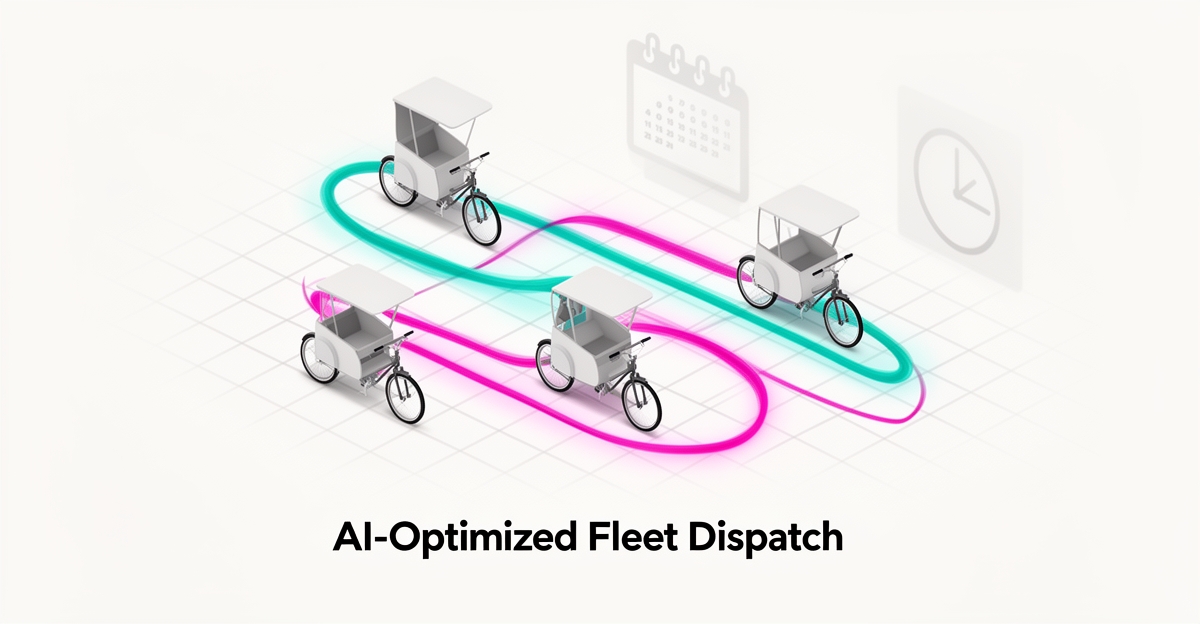
7 Signs Your Pedicab Company Needs AI for Ride Scheduling
Key Facts
- AI reduces scheduling planning time by 40% while increasing completed trip volume by 25%.
- One mid-sized provider cut call abandonment rates by 85% after switching to AI dispatch.
- AI demand prediction and route optimization forecasting accuracy exceeds 95%.
- A rural provider saw a 40% increase in trip bookings by extending service to 24/7 availability using AI.
- AI can boost overall trip capacity by as much as 30% without proportional staff increases.
- One organization grew operations by 150% in two years without significantly increasing administrative staff.
- Missed appointments due to transportation delays cost the U.S. healthcare system $150 billion annually.
What if you could hire a team member that works 24/7 for $599/month?
AI Receptionists, SDRs, Dispatchers, and 99+ roles. Fully trained. Fully managed. Zero sick days.
The Hidden Cost of Manual Scheduling
Your pedicab business thrives on the energy of the streets, but your back office is likely drowning in the chaos of spreadsheet-based dispatch.
Relying on manual scheduling creates a fragile operational model that breaks under the very volatility that drives your revenue.
When demand spikes during festivals or rush hours, static plans and human speed simply cannot keep up.
This leads to double-bookings, frustrated drivers, and missed pickup opportunities that directly bleed your bottom line.
The Revenue Leak of Inefficiency
Manual systems force you to guess rather than know, resulting in significant operational friction and lost income.
A mid-sized provider using AI reduced scheduling errors by 70% and cut call abandonment rates by 85% (https://www.hibambi.com/blog/ai-vs-manual-scheduling-best-for-peak-demand-in-nemt).
These aren't just minor inconveniences; they are direct indicators that your current workflow is costing you customers.
Consider this mini case study: a rural NEMT provider extended service to 24/7 availability using AI, leading to a 40% increase in trip bookings during previously unavailable hours (https://www.hibambi.com/blog/ai-vs-manual-scheduling-best-for-nemt).
Manual dispatch cannot capture this revenue because it lacks the real-time adaptability to handle night shifts or sudden surges efficiently.
Missed appointments due to transportation delays cost the U.S. healthcare system $150 billion annually, highlighting the severe economic impact of scheduling failures (https://www.hibambi.com/blog/ai-vs-manual-scheduling-best-for-peak-demand-in-nemt).
While pedicab stats differ, the principle remains: every missed booking is a direct loss of profit.
The Scalability Trap
Perhaps the most dangerous aspect of manual scheduling is its linear cost structure.
To handle double the volume, you must double your administrative staff, training costs, and wage bills.
This makes growth painful and unpredictable, preventing you from seizing large opportunities like city-wide events.
In contrast, AI handles growing demand via cloud solutions without proportional increases in staff or costs (https://www.hibambi.com/blog/ai-vs-manual-scheduling-best-for-peak-demand-in-nemt).
One organization grew operations by 150% in two years without significantly increasing administrative staff (https://www.hibambi.com/blog/ai-vs-manual-scheduling-best-for-peak-demand-in-nemt).
This decoupling of volume from cost is the key to sustainable expansion in the gig economy.
Real-Time Adaptability vs. Static Plans
Manual systems are reactive; they only respond after a problem occurs.
AI is proactive, analyzing historical data to predict demand and adjust routes before conflicts arise.
AI demand prediction and route optimization forecasting accuracy exceeds 95% (https://www.hibambi.com/blog/ai-vs-manual-scheduling-best-for-peak-demand-in-nemt).
This level of precision allows you to:
- Instantly adjust to last-minute cancellations or traffic changes
- Optimize driver routes to maximize trips per shift
- Reduce planning time by 40% while increasing trip volume by 25% (https://www.hibambi.com/blog/ai-vs-manual-scheduling-best-for-peak-demand-in-nemt)
- Cut operational costs by 20% through improved efficiency (https://www.hibambi.com/blog/ai-vs-manual-scheduling-best-for-peak-demand-in-nemt)
AIQ Labs’ custom workflow automation synchronizes rider demand, driver availability, and route planning to eliminate these manual bottlenecks.
By shifting from reactive guesswork to proactive forecasting, you can transform scheduling from a cost center into a competitive advantage.
Ready to stop bleeding revenue to inefficient manual processes?
Signs 1-3: Operational Failures You Can’t Ignore
Is your pedicab business growing faster than your ability to manage it? If manual scheduling is causing chaos during peak hours, you are leaving money on the table. These three signs indicate your current operational model has hit a ceiling that human effort alone cannot break.
Static scheduling plans crumble when demand spikes. During weekends, holidays, or local events, manual processes rely on human speed, leading to double-bookings and dispatch conflicts that frustrate riders.
Manual systems simply cannot process surge volumes quickly enough to maintain service quality.
- Double-bookings during high-volume periods
- Dispatch delays caused by manual data entry
- Staff burnout from handling sudden volume spikes
A mid-sized provider using AI reduced planning time by 40% and increased trip volume by 25% during these surges (according to Hibambi). AI analyzes historical trends to predict demand, allowing you to adjust driver availability before the rush hits.
This proactive approach prevents the operational gridlock that stalls growth.
Manual scheduling is prone to human error, which directly impacts customer satisfaction and revenue. When calls go unanswered or bookings are mistyped, you lose immediate trust and future business.
High call abandonment is a symptom of slow, inefficient manual workflows that cannot keep pace with incoming requests.
- Missed bookings due to slow response times
- Scheduling conflicts from manual data entry errors
- Poor customer experience from long hold times
The same mid-sized provider cited above cut call abandonment rates by 85% and reduced scheduling errors by 70% (research from Hibambi shows). Additionally, 60% of calls were managed automatically, freeing staff to handle complex issues.
Eliminating these errors stabilizes your revenue stream and improves brand reputation.
Scaling a manual operation usually means doubling your administrative staff for doubled volume. This linear cost structure makes it difficult to expand services or extend hours profitably.
Manual scaling involves high training and wage costs that erode your margins as you grow.
- Doubling headcount to handle increased volume
- High training costs for new administrative staff
- Limited service hours due to staffing constraints
AI allows you to decouple volume growth from cost growth. One organization grew operations by 150% in two years without significantly increasing administrative staff (according to Hibambi). By automating routine dispatch, you can scale efficiently.
AIQ Labs’ custom workflow automation synchronizes rider demand, driver availability, and route planning to maximize utilization and revenue without the burden of proportional headcount increases.
Signs 4-7: The Competitive Advantage of Automation
When manual systems buckle under pressure, the resulting inefficiencies signal that your pedicab business has outgrown its current tools. The final signs point to a critical inflection point where operational constraints are actively suppressing your revenue potential.
Scaling a pedicab fleet manually is a linear cost trap. To handle double the volume, you must double your administrative staff, leading to exponentially higher wage bills and management complexity.
AI decouples volume growth from operational costs. Instead of hiring more schedulers for more rides, AI handles the surge through cloud-based intelligence.
- Metropolitan Medical Transport grew operations by 150% in two years without significantly increasing administrative staff (https://www.hibambi.com/blog/ai-vs-manual-scheduling-best-for-peak-demand-in-nemt).
- Manual scaling requires doubling infrastructure, whereas AI allows for scalable capacity without proportional headcount increases (https://www.hibambi.com/blog/ai-vs-manual-scheduling-best-for-peak-demand-in-nemt).
This efficiency allows you to capture market share without the overhead that typically stifles small transportation businesses.
Manual scheduling relies on human speed and static plans, which inevitably lead to double-bookings and miscommunications during peak times. These errors directly erode customer trust and wallet share.
AI-driven forecasting reduces planning time by 40% while simultaneously increasing trip volume by 25% (https://www.hibambi.com/blog/ai-vs-manual-scheduling-best-for-peak-demand-in-nemt).
- A mid-sized provider reduced scheduling errors by 70% using AI automation (https://www.hibambi.com/blog/ai-vs-manual-scheduling-best-for-peak-demand-in-nemt).
- The same provider cut call abandonment rates by 85% (https://www.hibambi.com/blog/ai-vs-manual-scheduling-best-for-peak-demand-in-nemt).
When customers abandon calls due to busy signals or booking errors, you lose immediate revenue and future loyalty. Eliminating scheduling errors restores reliability.
Pedicab demand is highly volatile, spiking during events, weekends, or tourist seasons. Manual systems cannot instantly adjust to this volatility, resulting in missed opportunities and frustrated riders.
AI demand prediction accuracy exceeds 95%, allowing you to adjust driver availability before spikes occur (https://www.hibambi.com/blog/ai-vs-manual-scheduling-best-for-peak-demand-in-nemt).
- AI dynamically updates routes and schedules instantly to handle last-minute cancellations or traffic changes (https://www.hibambi.com/blog/ai-vs-manual-scheduling-best-for-peak-demand-in-nemt).
- 60% of calls can be managed without human intervention, freeing staff for high-value tasks (https://www.hibambi.com/blog/ai-vs-manual-scheduling-best-for-peak-demand-in-nemt).
By shifting from reactive guesswork to proactive forecasting, you turn volatile demand into a predictable asset.
Operating only during standard hours leaves significant revenue on the table. Manual staffing makes 24/7 availability prohibitively expensive, yet customer demand often extends beyond daylight hours.
Extending service to 24/7 availability using AI led to a 40% increase in trip bookings during previously unavailable hours (https://www.hibambi.com/blog/ai-vs-manual-scheduling-best-for-peak-demand-in-nemt).
- AI can boost overall trip capacity by as much as 30% (https://www.hibambi.com/blog/ai-vs-manual-scheduling-best-for-peak-demand-in-nemt).
- 85% of providers using cloud dispatch solutions see reduced costs within a year (https://www.hibambi.com/blog/ai-vs-manual-scheduling-best-for-peak-demand-in-nemt).
AI transforms your scheduling system from a cost center into a 24/7 revenue driver.
AIQ Labs’ custom workflow automation synchronizes rider demand, driver availability, and route planning to maximize utilization and revenue. By adopting these technologies, you convert operational friction into a sustainable competitive advantage.
Implementation: From Reactive to Proactive
Stop letting manual chaos dictate your daily operations. Transitioning from reactive firefighting to proactive AI management is the single most impactful change a pedicab company can make. By synchronizing rider demand, driver availability, and route planning, you eliminate the guesswork that kills profitability.
Manual scheduling hits a hard ceiling during peak hours. You cannot manually process double the bookings without double the staff and double the errors. AI breaks this limit by handling complex logistics instantly, allowing you to scale volume without scaling headcount.
Consider a mid-sized NEMT provider that switched from manual to AI-driven dispatch. They reduced scheduling errors by 70% and cut call abandonment rates by 85%. This level of precision is impossible with spreadsheets and phone calls alone.
Key benefits of this transition include:
- Reduced Planning Time: AI cuts manual scheduling effort by 40%.
- Increased Volume: Operators see a 25% increase in completed trips.
- Higher Accuracy: Demand prediction and route optimization exceed 95% accuracy.
- Cost Efficiency: One organization reduced overall operational costs by 20%.
Manual systems fail because they are static. They cannot adjust to a sudden cancellation or a traffic jam in real-time. AIQ Labs’ custom workflow automation acts as a dynamic brain, continuously optimizing your fleet based on live data.
How AIQ Labs synchronizes your operation:
- Demand Forecasting: Predicts rider volume using historical data and external trends.
- Dynamic Routing: Instantly adjusts driver paths to minimize wait times and fuel costs.
- Real-Time Adaptation: Handles last-minute cancellations without human intervention.
- Resource Allocation: Automatically assigns the best available driver to the optimal pickup.
The financial impact of these improvements is immediate. A rural provider extended services to 24/7 availability using AI, resulting in a 40% increase in trip bookings during previously unavailable hours. This demonstrates how automation unlocks revenue streams that manual staff simply cannot cover.
Manual scaling is expensive. To double your trip volume manually, you must hire more drivers and dispatchers. AI decouples volume from cost. One metropolitan provider grew operations by 150% in two years without significantly increasing administrative staff.
The strategic advantage of AI scheduling:
- Zero Missed Calls: 60% of calls were managed without human intervention in one case study.
- Capacity Boost: AI can increase total trip capacity by as much as 30%.
- Predictive Maintenance: Proactive insights reduce vehicle downtime and repair costs.
- Scalable Infrastructure: Cloud solutions handle growing demand without IT bottlenecks.
Critically, you retain full control. Unlike SaaS subscriptions that lock you into vendor ecosystems, AIQ Labs delivers True Ownership. You own the custom-built systems, code, and intellectual property. This eliminates recurring licensing fees and gives you complete flexibility to evolve your technology stack.
Why True Ownership matters for your business:
- No Vendor Lock-In: Your data and systems remain yours forever.
- Custom Integration: Built to fit your specific operational workflows.
- Long-Term ROI: One-time investment vs. perpetual subscription costs.
- Competitive Edge: Proprietary systems cannot be copied by competitors.
The industry is moving toward digital transformation. Over 70% of providers using cloud dispatch solutions report improved operational efficiency. As the AI transportation market grows, manual methods will become a liability rather than a competitive advantage.
Signs you are ready for AI implementation:
- Frequent double-bookings during peak demand periods.
- High rates of call abandonment or missed inquiries.
- Inability to offer service outside standard business hours.
- Rising administrative costs as volume increases.
Missed appointments cost the U.S. healthcare system $150 billion annually. While pedicabs aren’t medical transport, the cost of scheduling failure is identical: lost revenue and damaged reputation. Automation ensures every rider is served efficiently.
Prepare for seamless adoption with these steps:
- Audit Current Workflows: Identify bottlenecks in booking and dispatch.
- Define Success Metrics: Set targets for error reduction and volume growth.
- Custom Build: Partner with AIQ Labs for tailored, owned solutions.
- Train Staff: Focus human effort on customer experience, not logistics.
Transform your pedicab company from a reactive service into a proactive, data-driven enterprise. The technology to scale sustainably is ready; all that remains is implementation.
Conclusion: The Strategic Imperative for Growth
The decision to integrate AI into your pedicab operations is no longer a question of technological novelty—it is a calculation of survival and scalability. As the industry shifts toward digital efficiency, manual scheduling methods are becoming a critical liability rather than a competitive advantage.
For pedicab operators, the gap between reactive guesswork and proactive forecasting is where profit margins disappear. Adopting AI is not just an upgrade; it is a necessity for sustainable growth.
Manual systems collapse under the weight of volatility, leading to double-bookings, missed revenue, and frustrated riders. By contrast, automated workflows synchronize rider demand with driver availability in real-time, turning operational chaos into predictable revenue streams.
Relying on spreadsheets or phone calls creates invisible bottlenecks that stunt your business. Research highlights that manual dispatch cannot instantly adjust to last-minute cancellations or traffic changes, causing immediate revenue leakage.
The economic impact of these scheduling failures is severe. Missed appointments due to transportation delays cost the U.S. healthcare system $150 billion annually, a statistic that underscores the massive financial toll of logistical friction. For a pedicab company, every missed booking is a direct hit to your bottom line.
- Planning Time: AI reduces scheduling planning time by 40%
- Trip Volume: Automated systems increase trip capacity by 25%
- Scheduling Errors: Providers using AI cut errors by 70%
These metrics illustrate that inefficiency is not just an annoyance; it is a quantifiable drain on your resources. When your staff spends hours manually reconciling schedules, they are not generating revenue.
One of the most compelling reasons to pivot to AI is the ability to decouple volume growth from cost growth. Manual scaling requires doubling your administrative staff for doubled volume, involving high training and wage costs.
AI handles growing demand via cloud solutions without proportional increases in headcount. This scalability allows you to capture market share without the operational drag of hiring and managing additional personnel.
- Operational Scaling: One provider grew operations by 150% without increasing admin staff
- Cost Reduction: Providers using cloud dispatch see reduced costs within a year (85%)
- Availability: Rural providers extended service to 24/7, boosting bookings by 40%
This capability transforms your business model. Instead of being capped by the number of hours your dispatch team can work, your operation can run continuously, capturing revenue during nights and weekends that were previously untouchable.
AIQ Labs offers a distinct advantage over traditional software vendors. We do not sell white-label chatbots or no-code widgets. We architect custom, production-ready AI systems that your business owns outright.
Our approach eliminates vendor lock-in while providing the engineering excellence required for complex workflows. By integrating your existing tools with advanced multi-agent frameworks, we create a unified operational powerhouse.
- True Ownership: Clients own the code and intellectual property
- Engineering Excellence: Custom code, not limited no-code templates
- Seamless Integration: Deep two-way API connections with your CRM and calendar
This partnership model ensures that your AI infrastructure evolves with your business, providing a durable competitive advantage that generic SaaS subscriptions cannot match.
The signs are clear: if you struggle with peak demand, high no-show rates, or scaling costs, your current system is holding you back. The transition to AI-driven scheduling is the most effective way to secure your market position.
AIQ Labs is ready to help you architect this transformation. Contact us today to discover how we can build your competitive advantage.
Still paying for 10+ software subscriptions that don't talk to each other?
We build custom AI systems you own. No vendor lock-in. Full control. Starting at $2,000.
Frequently Asked Questions
How do I know if my pedicab business is too small for AI scheduling?
Will AI scheduling really help me capture revenue during nights and weekends?
How much can AI actually reduce my scheduling errors and missed calls?
Is owning a custom AI system better than paying for a monthly SaaS subscription?
Can AI really handle last-minute cancellations and traffic changes automatically?
Stop Bleeding Revenue: Automate Your Pedicab Dispatch Today
Pedicab businesses thrive on street-level energy, but manual spreadsheet dispatch creates a fragile operational model that breaks under demand volatility. The hidden costs are undeniable: double-bookings, frustrated drivers, and missed pickups directly erode your bottom line. While the principle holds that every missed booking is lost profit, manual systems lack the real-time adaptability to capture revenue during surges or off-peak hours. At AIQ Labs, we transform these broken workflows into unified, owned digital assets. Our custom workflow automation synchronizes rider demand, driver availability, and route planning to maximize utilization and revenue. Unlike vendors offering point solutions, we provide production-ready systems built on enterprise-grade multi-agent architectures, ensuring true ownership without vendor lock-in. Don’t let linear cost structures limit your growth. Schedule a free AI Audit & Strategy Session to identify high-ROI automation opportunities, or start with a Targeted AI Workflow Fix to see immediate results. Transform your back office into a competitive advantage today.
Ready to make AI your competitive advantage—not just another tool?
Strategic consulting + implementation + ongoing optimization. One partner. Complete AI transformation.