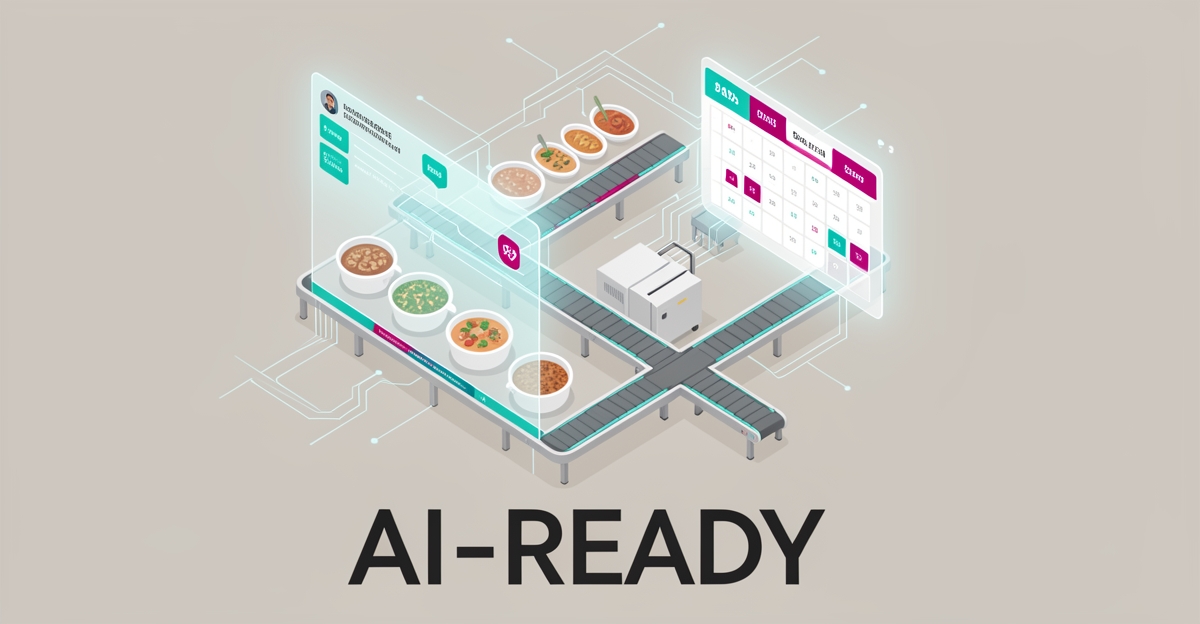
7 Signs Your Specialty Food Company is Ready to Go AI-First in Production Scheduling and Dispatch
Key Facts
- AI-powered predictive maintenance has been shown to reduce machine downtime substantially, often by double digits, while extending equipment lifespan
- AI-driven inventory demand forecasting typically reduces waste for specialty food retailers by double-digit percentages, according to industry analyses
- Early adopters of AI-enabled supply chain management have reported meaningful inventory and logistics cost improvements
- Production planners often spend 15-20 hours weekly on schedule adjustments that AI can complete in minutes
- AI demand forecasting typically delivers initial ROI within 3-6 months for specialty food retailers, per industry data
- As of late 2026, improving production efficiency remains the most commonly cited driver of AI adoption among food companies
- Manual processes scale linearly with staff increases, while AI systems handle complexity without proportional headcount growth
Hire a team member that works 24/7 — for less than a part-time wage.
AI receptionists, SDRs, dispatchers and 99+ roles. Trained on your business, fully managed.
Not sure where to start? Ask our AI planner
The Hidden Cost of Manual Scheduling in Specialty Food Production
Every hour your production planner spends juggling spreadsheets and phone calls, your specialty food operation bleeds money in ways that never appear on a single line item. The true cost of manual scheduling isn't just labor, it's the compounding inefficiencies that grow worse as your business scales.
Manual scheduling creates what operations experts call "decision fatigue cascading." When production planners rely on intuition rather than data, each suboptimal choice triggers downstream problems: rush orders that disrupt carefully planned batches, overtime labor to compensate for poor sequencing, and expedited shipping costs when dispatch delays threaten customer commitments. Industry surveys consistently show that improving production efficiency is the primary driver of AI adoption among food companies, recognition that manual processes have become the bottleneck.
The waste compounds quickly in specialty food manufacturing, where perishable inventory and unpredictable demand cycles create razor-thin margins for error. Manual forecasting methods simply cannot process the variables that drive specialty food demand: seasonal trends, local cultural events, weather patterns, and shifting consumer preferences. Industry analyses indicate that AI-driven inventory demand forecasting can reduce waste by 15-25%, a direct measurement of how much manual scheduling currently costs in spoiled product and stockouts.
Dispatch operations suffer particularly under manual coordination. When schedulers rely on phone calls, text messages, and tribal knowledge to route deliveries, delays multiply. Comparisons of manual versus AI-driven food manufacturing operations reveal that manual processes scale linearly, meaning every increase in volume requires proportional increases in coordination staff, while AI systems handle complexity without adding headcount.
The hidden costs manifest across your operation:
- Production planners spending 15-20 hours weekly on schedule adjustments that AI completes in minutes
- Rush shipping fees eroding margins when manual dispatch misses optimal delivery windows
- Quality issues discovered too late because manual monitoring cannot track variables in real-time
- Customer attrition when inconsistent delivery performance damages hard-won specialty food relationships
Perhaps most damaging is how manual scheduling prevents strategic growth. When your best operations people spend their days firefighting scheduling conflicts, they cannot focus on process improvement, new product launches, or market expansion. The specialty food industry has grown into a market worth well over $200 billion in annual sales, according to the Specialty Food Association, yet companies trapped in manual coordination cannot capture their share of that growth.
AIQ Labs works with specialty food manufacturers to quantify these hidden costs during our initial assessment, often revealing that companies spend far more on operational coordination than they realize. The transition from manual to AI-first scheduling isn't merely about efficiency; it's about redirecting human talent from repetitive coordination to the creative, strategic work that distinguishes specialty food brands in a competitive market.
Why AI-First Scheduling Delivers Measurable Gains in Food Manufacturing
The numbers behind AI-first scheduling aren't speculative, they're already showing up on production floors across the food industry. As of late 2026, improving production efficiency remains the most cited driver of AI adoption among food companies, with data-driven decision-making close behind. These priorities reflect a simple reality: manual scheduling and dispatch can't keep pace with the unpredictable demand cycles that define specialty food manufacturing.
The efficiency gains are measurable and substantial. AI-powered predictive maintenance can decrease machine downtime by 30 to 50% while extending equipment lifespan by 20 to 40%, according to food manufacturing industry research. Food and beverage manufacturers that have implemented AI-driven predictive maintenance report meaningful uptime improvements across production lines. For a specialty producer juggling seasonal peaks and perishable ingredients, recovering that much capacity without new equipment is a decisive competitive edge.
Inventory accuracy improves just as dramatically. Early adopters of AI-enabled supply chain management have reported inventory level improvements of roughly 35%, alongside meaningful reductions in logistics costs and significant service level enhancements. For specialty food retailers specifically, AI demand forecasting typically reduces waste by 15-25% while keeping premium products in stock when customers want them most, and most see initial ROI within 3-6 months.
What makes AI-first scheduling fundamentally different from manual planning is its ability to adapt in real time. Where human planners work from static spreadsheets and historical averages, AI systems process vast amounts of data almost instantaneously, generating optimal plans in minutes rather than hours or days. That means production schedules and dispatch decisions adjust dynamically to demand shifts, supplier delays, and changing conditions, moving from reactive problem-solving to proactive prevention.
The practical benefits compound across operations:
- Schedules that optimize around real-time data instead of last week's assumptions
- Dispatch that adapts automatically to demand shifts and urgent orders
- Predictive maintenance that flags quality issues before they disrupt production
- Planning time cut from hours or days to minutes
The transition doesn't require rip-and-replace. AI operating systems integrate with existing ERP platforms through API connections, automating routine scheduling while flagging anomalies for human review. This is the approach AIQ Labs takes with [Workflow Builds](/workflow-builds): rebuild the single workflow that costs you the most, like scheduling or dispatch, as an owned, AI-driven system, then scale from there. The comparison data is clear: manual processes scale linearly with staff, while AI processes scale without proportional headcount increases.
For specialty food companies watching competitors modernize, the question isn't whether these gains are real, it's whether they'll capture them first.
Your 7-Point Readiness Checklist: Is Your Specialty Food Company AI-Ready?
Specialty food manufacturers are hitting a wall where manual scheduling and dispatch can no longer keep pace with demand volatility. When production plans slip and deliveries miss windows, the cost shows up in waste, overtime, and lost premium sales.
Your operation is likely AI-ready when forecasting errors drive regular overproduction and spoilage. Inventory demand forecasting can reduce waste by 15-25% for specialty food retailers according to industry analysis, yet many teams still rely on spreadsheets and gut feel. Unpredictable demand from seasonal trends and cultural events makes manual planning brittle.
Dispatch delays and missed service levels signal the next threshold. Manual food logistics relies on human judgment and is prone to error, while AI-driven planning processes vast amounts of data almost instantaneously. When dispatchers spend hours re-routing and calling drivers, the business bleeds margin.
A readiness checklist typically surfaces as:
- Forecast accuracy consistently misses by double digits, causing stockouts of premium items and excess waste
- Production schedules change daily with manual rework, increasing overtime and machine downtime
- Dispatch is reactive, with late deliveries and high expedite costs eroding customer trust
- Compliance documentation is manual, creating audit bottlenecks and quality risk
- Data lives in silos across ERP, MES and spreadsheets, preventing real-time visibility
The market pressure is clear. As of late 2026, roughly half of food companies report active AI investment plans, with improving production efficiency cited as a key driver. Organizations that wait risk falling behind as early adopters capture efficiency gains.
Inconsistent scheduling and manual dispatch delays are classic signs that workflows need automation. AI operating systems integrate with the ERP systems you already run, automating routine scheduling and compliance monitoring while flagging quality issues before they affect production.
AIQ Labs sees this pattern across SMB food producers moving from pilots to scaled automation. The transition works best when teams start with quick wins in forecasting and dispatch, build clean data foundations, and expand toward a connected [AI Operating System](/ai-operating-systems) built in phases and owned outright.
First Steps to AI-First Production: From Assessment to Pilot
Starting your AI-first journey in production scheduling begins with a clear assessment of current workflows. Conducting a workflow audit helps identify manual bottlenecks, inconsistent scheduling, and dispatch delays that signal readiness for automation. As of late 2026, roughly half of food companies report AI investment plans, driven by the need to improve production efficiency and reduce operational waste. This foundational step ensures AI solutions target real pain points rather than adding complexity.
A proven quick win is implementing predictive maintenance for production equipment. AI-powered predictive maintenance can decrease machine downtime by 30 to 50% while increasing equipment lifespan by 20 to 40%, directly improving uptime and reducing unexpected failures. Manufacturers using this approach have reported meaningful uptime gains across production lines, demonstrating fast ROI with minimal disruption. Starting here builds confidence in AI capabilities before tackling more complex scheduling decisions.
Integrating AI with your existing ERP systems creates a unified operational backbone. Establishing data integration through API connections allows AI to access real-time production data, inventory levels, and order schedules, enabling dynamic dispatch optimization. This step requires data standardization but lays the groundwork for scalable automation. AIQ Labs supports this phase through its Build in Milestones model, allowing companies to phase implementation, such as connecting ERP data first, then adding predictive dispatch logic, while retaining ownership of each completed component.
Launching a pilot [AI Employee](/ai-employees) for dispatch proves value before scaling. Focused on a defined role like coordinating production starts, managing changeovers, or prioritizing urgent orders, this AI Employee works 24/7, integrates with scheduling tools, and reduces manual dispatch delays. Using the Start Monthly model, businesses can deploy this AI Employee with setup, training, monitoring, and continuous improvements included, typically at around 80% less cost than a human hire. Measuring outcomes like reduced idle time and improved on-time dispatch validates the approach for broader expansion.
Still paying for 10+ subscriptions that don’t talk to each other?
We build custom AI systems you own outright. No vendor lock-in. Full control.
Not sure where to start? Ask our AI planner
Frequently Asked Questions
How do I know if manual scheduling is actually costing my specialty food business money?
What signs show my specialty food company is ready for AI-first production scheduling?
Will AI scheduling work with the ERP system we already use?
What kind of ROI can specialty food manufacturers expect from AI scheduling and dispatch?
Can AI really reduce machine downtime and waste in perishable production?
Is AI adoption only for big food companies or can smaller specialty producers start too?
From Firefighting Schedules to Owning Your Future
If you recognized your operation in even a few of the seven signs above, forecast errors driving spoilage, daily schedule rework, reactive dispatch, siloed data, you're not behind. You're at the exact threshold where AI-first scheduling delivers its fastest returns. The market isn't waiting: as of late 2026, roughly half of food companies report AI investment plans, with production efficiency as the leading driver. The playbook is straightforward: audit your workflows, start with a quick win like predictive maintenance or a dispatch pilot, integrate with the ERP you already run, and scale from there. Most specialty food retailers see initial ROI within 3-6 months, meaning the decision you make this quarter shapes your margins next year. At AIQ Labs, we help companies take that first step with a free 30-minute strategy call: a working session with an AI engineer to map your biggest bottleneck and identify where automation delivers a clear win. If there isn't one, we'll tell you that too. Take the two-minute [Fit Check](/apply), and find out what your operation looks like when scheduling stops being a daily fire drill.
Make AI your competitive advantage — not just another tool.
Strategy, implementation and ongoing optimization. One partner, end to end.
Not sure where to start? Ask our AI planner