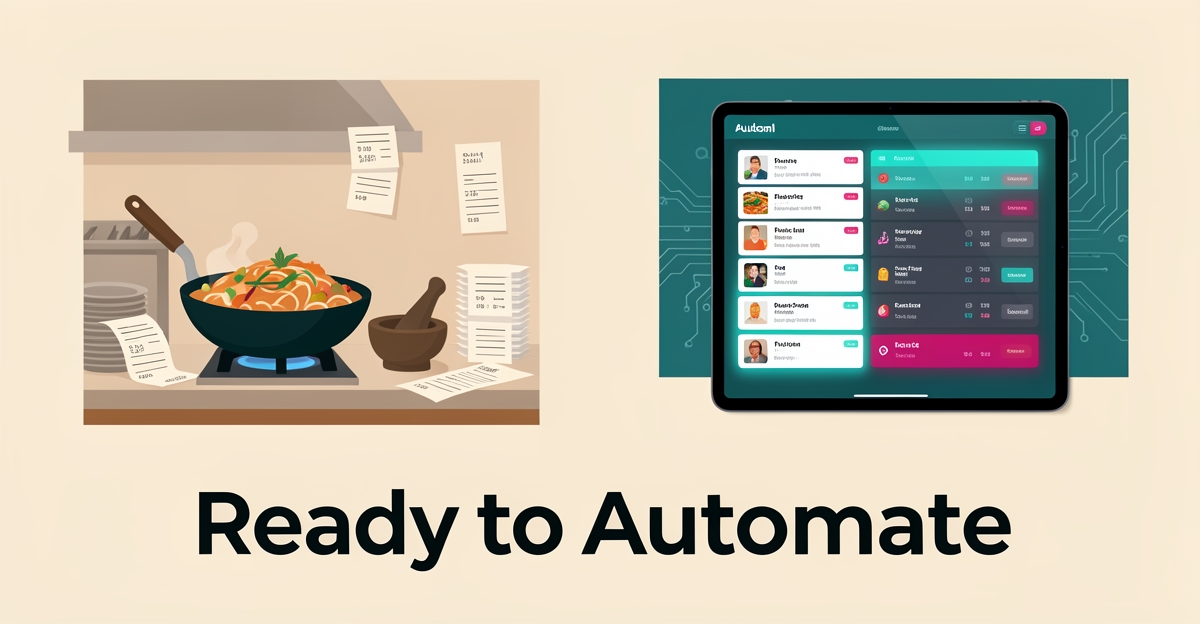
7 Signs Your Thai Restaurant Is Ready to Automate Its Online Ordering & Menu Management
Key Facts
- Manual menu updates across multiple delivery platforms are a leading source of pricing and availability errors
- Better inventory and order tracking typically reduces food waste from overordering and spoilage
- Focused AI workflow builds for restaurants typically go live in weeks, phased and approved as they progress
- Shadow AI adoption by staff creates compliance risks and operational visibility gaps
- Automated menu synchronization prevents selling unavailable dishes across delivery platforms
- Automated order routing eliminates manual re-entry between POS and kitchen workflows
Hire a team member that works 24/7 — for less than a part-time wage.
AI receptionists, SDRs, dispatchers and 99+ roles. Trained on your business, fully managed.
Not sure where to start? Ask our AI planner
The Hidden Cost of Manual Ordering and Menu Management
Manual online ordering and menu management in Thai restaurants often become sources of hidden costs that erode profitability and create operational risk. When staff manually update menus across multiple platforms or process online orders through disconnected systems, errors in pricing, availability, and order details become common, leading to customer complaints, refunds, and wasted food. These repetitive tasks also consume labor hours that could go toward food preparation or guest engagement. More concerning is the rise of shadow AI, where employees adopt unsanctioned tools, free automation scripts or consumer-grade apps, to cope with inefficiencies, creating blind spots in operational visibility and exposing the business to compliance risk. Without centralized oversight, these tools may mishandle customer data, fall short of payment security standards, or generate inconsistent order records that complicate audits and tax reporting. Manual processes also contribute to avoidable labor waste, and poor inventory and order tracking, common in manual setups, can inflate food costs through overordering, spoilage, or inaccurate portioning. These inefficiencies drain resources and increase vulnerability to reputational damage if errors lead to health violations or data breaches. For Thai restaurants aiming to scale or maintain consistency across locations, relying on manual workflows undermines both operational control and long-term resilience. Addressing these hidden costs requires moving beyond ad-hoc fixes toward integrated systems that provide real-time visibility, reduce human intervention, and keep automation under proper management, foundations AIQ Labs builds through AI Workflow Builds tailored to restaurant operations. By replacing fragmented manual processes with owned, intelligent automation, Thai restaurants can eliminate error-prone tasks, reclaim labor capacity, and mitigate the risks of unsanctioned tool use, all while keeping full control over their data and systems. The result is a clearer path to profitability, fewer operational surprises, and a team empowered to focus on delivering authentic Thai hospitality instead of managing paperwork.
Why AI Operating Systems Fit Restaurant Workflows
For a Thai restaurant juggling online orders, inventory, and shift schedules, the difference between surviving and thriving often comes down to how much of the daily grind runs without constant human intervention. This is where a connected AI operating layer earns its place in a restaurant's workflow.
Rather than handling one task in isolation, an AI operating system connects the moving parts of your operation into a single automated layer. These systems automate inventory ordering, staff scheduling, and order management, and they integrate with your existing POS and vendor platforms, meaning you don't have to rip out the tools you already use. The payoff shows up on two fronts: labor hours reclaimed through better scheduling, and food costs reduced through tighter inventory management.
For a restaurant watching margins on pad thai ingredients and coconut milk, those gains compound quickly across a month of service.
What makes this fit restaurant workflows specifically is the nature of the work itself. Restaurant operations are repetitive, rule-based, and time-sensitive, exactly the conditions where automation performs best. Consider what a connected system handles without a manager touching it:
- Reordering inventory when stock runs low, based on real sales data from your POS
- Building staff schedules that match forecasted demand, cutting overtime and understaffing
- Routing online orders directly into the kitchen workflow without manual re-entry
- Keeping menu availability synchronized across platforms so you never sell a dish you can't make
Implementation is faster than most owners expect. A focused workflow build typically goes live in weeks, and the process starts with assessing your current manual operations and identifying where the biggest gains sit before any technology is chosen. The honest caveat: these systems require integration work upfront and ongoing maintenance, which is exactly why phased builds with approval checkpoints work better than big-bang rollouts.
There's also a governance angle worth noting. When restaurant staff adopt AI tools on their own without oversight, a pattern known as "shadow AI", it creates risks around operational visibility and compliance. A deliberately implemented system avoids that problem by putting automation under proper management from day one.
This is the approach AIQ Labs takes: rather than bolting on disconnected tools, the goal is a unified system that fits how your restaurant actually operates, one that reduces human error across ordering, menu updates, and table status tracking while your team focuses on the food and the guests. For restaurants that want managed AI staff handling calls, orders, and routine guest questions, AI Employees cover 99+ roles at a fraction of a human hire's cost.
7 Readiness Signals for Thai Restaurants
Many Thai restaurant owners notice small inefficiencies piling up, missed online orders, outdated menus on delivery apps, or servers spending too much time confirming table availability. These recurring issues often point to deeper operational gaps that manual processes can't reliably fix. When these pain points become daily frustrations rather than occasional hiccups, it's a strong signal that automation could restore control and consistency.
Frequent menu errors across platforms, like showing unavailable dishes or incorrect prices, are a top indicator that your current system lacks synchronization. Better inventory and menu management directly addresses the waste and customer dissatisfaction caused by outdated listings. Similarly, if your team regularly misses online orders due to fragmented notifications or delayed syncing between your POS and delivery apps, workflow automation can eliminate these gaps by creating a single source of truth for all incoming orders.
Inconsistent table status tracking also reveals readiness for automation. When hosts rely on verbal updates or paper logs to manage seating, delays and overbooking become common, especially during peak hours. Automated scheduling and table management reduce idle time and keep availability updated in real time across reservation platforms and floor management systems, precision that's difficult to maintain manually.
Other signs include staff spending excessive time on repetitive tasks like re-entering order details, answering basic menu questions, or manually updating holiday hours across multiple sites. If your team is constantly putting out fires instead of focusing on guest experience, it's likely time to consider AI employees or a workflow build that handles these routine functions reliably. AIQ Labs builds custom AI systems that integrate with existing restaurant software, POS, scheduling, and inventory tools, to create unified, automated workflows that reduce errors and free up staff for higher-value work.
When these signals appear together, menu inaccuracies, lost orders, scheduling strain, and repetitive task overload, they form a clear pattern: your restaurant has outgrown manual management. Addressing them with AI isn't about replacing your team; it's about giving them better tools to deliver consistent, high-quality service without burnout. The right automation pays for itself through reduced waste, fewer errors, and smoother operations.
A Lean Implementation Plan You Can Own
Manual ordering and menu updates slow a Thai restaurant down exactly when speed matters most. A lean rollout replaces ad-hoc fixes with a clear, owned system that reduces human error and improves operational efficiency.
Start by mapping what is actually manual today. Document online order entry, menu price changes, and table status tracking across POS, delivery apps, and staff phones. This audit reveals duplicate entry, missed updates, and the shadow AI risks that appear when staff adopt unsanctioned tools without oversight.
Define the target workflow before choosing technology. Clarify who updates the menu, how orders flow to the kitchen, and where table availability lives. A focused scope prevents scope creep and keeps implementation moving in weeks rather than months.
Choose an integrated AI system built for ownership, not subscription lock-in. The decision often comes down to how you want to pay and control the asset. Start Monthly provides one AI employee with setup plus a flat monthly plan that costs less than a part-time hire, including build, training, integrations, monitoring and improvements. Build in Milestones splits one workflow or department system into phases you approve and pay per phase, keeping everything built so far. Own It Outright delivers a full AI operating system with full ownership of code, agents and data when complete. Current options are outlined on the pricing page.
Implementation follows a practical four-step sequence:
- Assess manual operations and identify improvement areas
- Choose an AI system that integrates with existing POS and vendor platforms
- Train staff on new interfaces and automated workflows
- Monitor and adjust the system as needed
Train staff early and in role-specific sessions. Show hosts how table status updates automatically, servers how online modifications appear in the kitchen display, and managers how menu changes propagate without rekeying. Short, hands-on practice reduces resistance and error.
Monitor performance with operational metrics, not vanity dashboards. Track order accuracy, update latency, and staff time per task to validate ROI against the labor hours and food waste you documented in your audit.
AIQ Labs designs these rollouts as custom builds businesses own and control. The system is deployed, trained on your business, and continuously optimized so the team focuses on service, not spreadsheets.
Still paying for 10+ subscriptions that don’t talk to each other?
We build custom AI systems you own outright. No vendor lock-in. Full control.
Not sure where to start? Ask our AI planner
Frequently Asked Questions
How do I know my Thai restaurant is ready to automate online ordering and menu management?
What kind of cost savings can automation actually deliver for a restaurant?
Isn't shadow AI a risk if my staff already use free automation tools?
How long does it take to implement an AI system in a restaurant?
Will automation replace my team or just add more tech headaches?
What's the first step if I want to try this without committing to a big project?
Turn Hidden Costs into Clear Gains
Manual ordering and menu management drain Thai restaurants through errors, wasted labor, and shadow AI risks, costs that add up fast when margins are tight. Recognizing the seven readiness signals, from platform menu mismatches to repetitive task overload, is the first step toward reclaiming control. By replacing fragmented processes with an owned AI operating system that integrates with your existing POS and vendor tools, you can automate inventory ordering, staff scheduling, and order flow while keeping full control of code, agents, and data. The path forward starts with mapping your current manual workflows, defining your ideal automated process, and choosing a system built for ownership, not lock-in. AIQ Labs helps Thai restaurants make this shift with custom builds that reduce human error, keep automation compliant, and free your team to focus on authentic hospitality. Take the next step with a free 30-minute strategy call to see where automation delivers the clearest win for your operation.
Make AI your competitive advantage — not just another tool.
Strategy, implementation and ongoing optimization. One partner, end to end.
Not sure where to start? Ask our AI planner