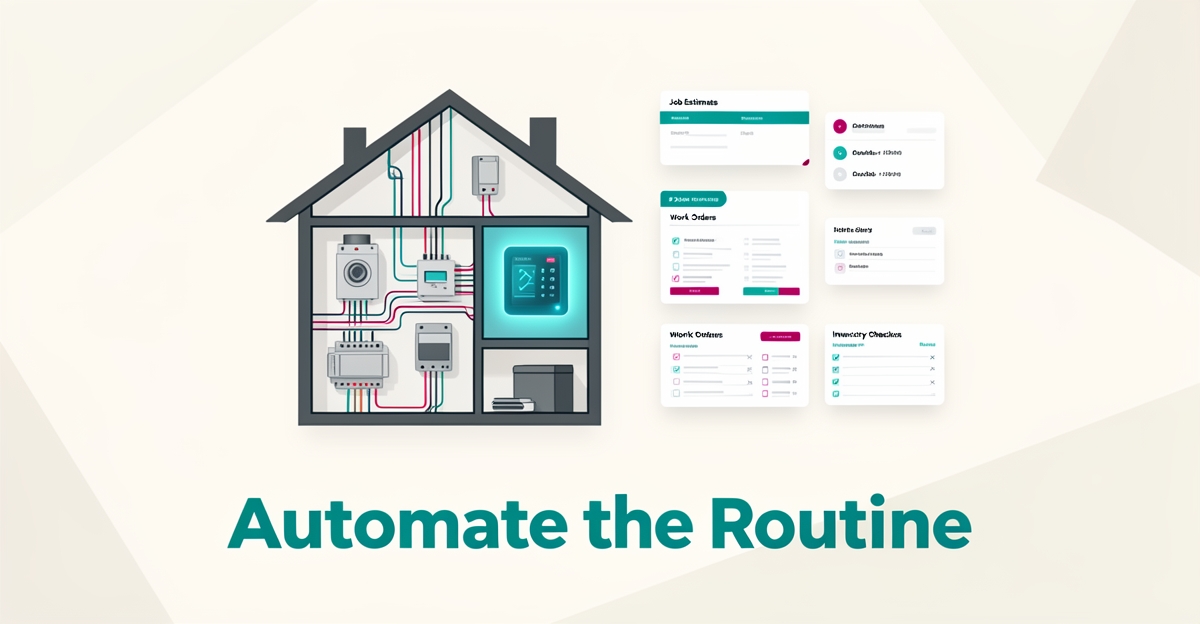
7 Ways AI Can Automate Routine Tasks for Residential Electricians (Without Replacing Your Team)
Key Facts
- Widely cited workflow automation research suggests most workers' repetitive tasks are at least partially automatable according to workflow automation research.
- A majority of organizations have reportedly automated processes in at least one business function per industry analysis.
- The global workflow automation market has been valued in the tens of billions of dollars as of the mid-2020s, with continued strong growth projected through 2030 according to market research.
- AI can automate job estimation, work order logging, and equipment inventory checks for residential electricians.
- AI-powered tools can handle scheduling, email management, and task management for electricians per task automation guidance.
- AIQ Labs has deployed 200+ multi-agent systems and runs four live SaaS products daily, automation built for real operations, not demos.
Hire a team member that works 24/7 — for less than a part-time wage.
AI receptionists, SDRs, dispatchers and 99+ roles. Trained on your business, fully managed.
Not sure where to start? Ask our AI planner
The Hidden Cost of Manual Routine Work in Residential Electrical
Manual admin is quietly eating the hours residential electricians should spend on high-value work. Job estimates, work order logging, and inventory checks pile up between service calls, creating delays and costly errors.
The scale of the problem is not unique to electrical trades. Workflow automation research suggests that most workers spend a significant share of their time on repetitive, time-consuming tasks, tasks that are at least partially automatable. For electricians, that shows up as duplicated data entry, chasing paperwork, and manual follow-ups.
Repetitive work also drains margin. Industry analysis indicates a majority of organizations have already automated processes in at least one business function, and the global workflow automation market, valued in the tens of billions as of the mid-2020s, continues to grow strongly through 2030. The gap between early adopters and manual operations is widening.
In residential electrical, the hidden cost appears in three everyday drains:
- Estimation and quoting that repeats the same measurements, material lookups, and pricing calculations for every job
- Work order logging and documentation that requires manual transcription from field notes to invoices and customer records
- Equipment and inventory checks that rely on spreadsheets and memory, leading to stockouts or over-ordering
Each of these tasks is low-risk for automation and high-impact for time recovery. When AI handles data capture, categorization, and retrieval, electricians gain faster response times and fewer errors without adding headcount.
AI-powered tools can also streamline workflow management by automating task assignments, tracking progress, and identifying bottlenecks. Task automation guidance shows AI can handle scheduling, email management, and task management, freeing up electricians to focus on high-value work that requires human expertise.
This is where AI workflow automation becomes practical for residential operations. AIQ Labs rebuilds the one workflow that costs your business the most, through AI Workflow Builds at a fixed price, delivered in phases, so job estimation, work order logging, and inventory checks run without pulling technicians off the tools. For front-office load, AI Employees can answer calls, book jobs, and dispatch at a fraction of the cost of a human hire.
The result is not replacement, it is amplification. Routine admin stops pulling technicians off the tools, and the business can scale service capacity without scaling overhead.
7 AI Automation Workflows Electricians Can Deploy Now
The gap between knowing AI can help and actually deploying it comes down to concrete workflows. Residential electricians don't need abstract promises, they need systems that handle the paperwork while they handle the wiring.
According to workflow automation research, most workers' repetitive, time-consuming tasks are at least partially automatable. For electrical contractors, that translates into seven specific workflows ready for automation today.
Job estimation tops the list. AI analyzes historical project data, material costs, and labor hours to generate accurate quotes in minutes rather than hours. This eliminates the guesswork that leads to underbidding or lost contracts.
Work order logging follows closely. Instead of technicians handwriting notes or typing updates between jobs, AI captures job details through voice input or mobile forms and syncs them directly to your central system. The result is cleaner records and fewer billing disputes.
Equipment inventory checks become predictive rather than reactive. AI tracks stock levels across trucks and warehouses, automatically flagging when wire, breakers, or fixtures run low. This prevents those mid-job supply runs that kill productivity.
Intelligent data management organizes the chaos of permits, inspection reports, and customer records. AI categorizes documents, extracts key information, and retrieves files instantly when you need them. No more digging through filing cabinets or scrolling through email threads.
Workflow management optimizes how jobs move through your pipeline. AI assigns tasks based on technician availability and expertise, tracks progress in real time, and identifies bottlenecks before they delay projects. Industry analysis projects continued strong growth in the workflow automation market through 2030, driven largely by field service operations adopting these exact systems.
Enhanced communication handles the customer-facing side. AI receptionists answer common questions about service availability, pricing ranges, and scheduling instantly, around the clock. They route complex inquiries to your team with full context attached. This means fewer interruptions during installations and faster response times that win more bids.
Decision support rounds out the seven. AI analyzes patterns across your completed jobs to surface insights: which service types are most profitable, which neighborhoods generate repeat business, where scheduling gaps exist. These data-driven insights guide strategic decisions that previously relied on gut instinct.
The implementation path matters as much as the workflows themselves. Start with a single high-friction process, typically estimation or work order logging, rather than attempting a full overhaul. AIQ Labs builds these as fixed-price workflow builds that connect with your existing dispatch software and accounting tools, ensuring data flows without manual re-entry. When you're ready to connect everything into one operating layer, AI Operating Systems ties the pieces together, built in phases and owned outright.
The electricians who thrive in the next decade won't be those who resist automation. They'll be the ones who deploy it strategically to handle routine tasks while they focus on complex installations, safety compliance, and customer relationships that require human judgment.
From Pilot to Production: A Practical Implementation Path
Moving from a promising pilot to reliable daily use is where most automation efforts stall, and residential electrical firms are no exception. A clear implementation path keeps the focus on real workflows like job estimation, work order logging, and equipment inventory checks.
Start by mapping the repetitive work that drains technician time. Recent workforce analysis suggests most workers spend significant time on repetitive, time-consuming tasks that are at least partially automatable. For electricians, that shows up as manual data entry, duplicate scheduling, and chasing paperwork between the truck and office.
With the task list defined, select tools that fit existing systems rather than replacing them. Industry research indicates a majority of organizations have already automated at least one business function, and the workflow automation market continues to expand through 2030. Integration is the differentiator.
A practical rollout follows a disciplined sequence:
- Identify repetitive tasks that can be automated with clear inputs and outputs
- Select AI tools aligned to those tasks and integrate with CRM, dispatch, and accounting systems
- Train models on relevant job history, work orders, and inventory data for accurate results
- Monitor performance and adjust workflows based on error rates and technician feedback
Integration with existing workflows and systems prevents data silos and manual re-entry. AI systems can process and analyze large volumes of data efficiently, organizing it for insights that support faster estimates and fewer missed items. Seamless connections also enable real-time updates on project status and inventory availability.
Training on relevant data is what makes automation reliable for electrical operations. Models learn from past estimates, material usage, and service notes to improve accuracy over time. Monitoring and evaluation then close the loop, ensuring transparency in AI decision-making and allowing teams to refine the system over time.
AIQ Labs delivers this with a milestone-based approach: you approve each phase before the next begins, and you own the system outright at the end, no vendor lock-in, no rented software. The result is routine tasks handled consistently, manual errors reduced, and technicians freed to focus on high-value, complex jobs that require human expertise.
Amplify Your Team, Don't Replace It
The routine work that drains residential electricians, estimation, work order logging, inventory checks, and paperwork, is exactly where AI delivers the fastest payback without touching the skilled work customers pay for. By automating data capture, categorization, and retrieval, you get faster response times, fewer errors, and more billable hours from the team you already have. The electricians who will lead the next decade are those who deploy automation strategically for high-friction processes first, then scale. Start by mapping one repetitive workflow with clear inputs and outputs, integrate it with your existing dispatch and accounting systems, and train on your own job history for reliable results. AIQ Labs builds these systems at a fixed price, in milestones you approve, with full ownership at the end, so you can move from pilot to production without vendor lock-in. Take the two-minute Fit Check at https://aiqlabs.ai/apply, then book a free 30-minute strategy call at https://aiqlabs.ai/book, or reach the team at [email protected].
Make AI your competitive advantage — not just another tool.
Strategy, implementation and ongoing optimization. One partner, end to end.
Not sure where to start? Ask our AI planner