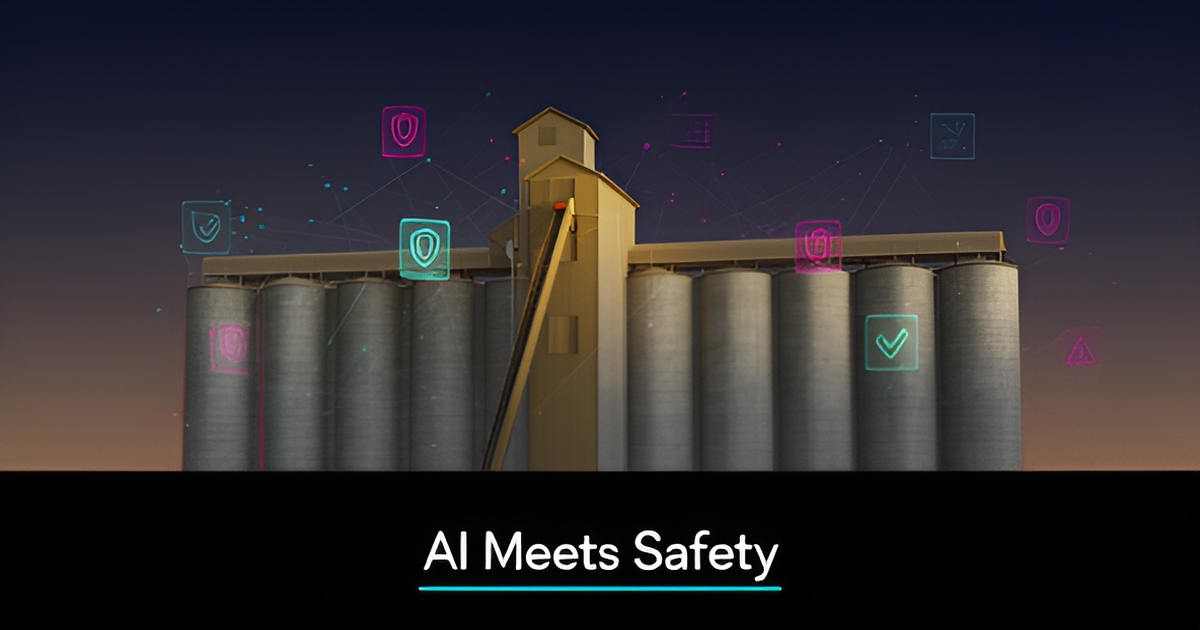
7 Ways AI Can Improve Safety and Compliance at a Grain Elevator
Key Facts
- Industrial deployments of AI-powered vision safety tools have reported near-miss reductions of roughly 48% according to published case study data
- Hazard response times improved by around 65% with AI safety tools in comparable industrial settings based on chemical plant implementation results
- AI-driven PPE monitoring has achieved compliance rates around 95% in power plant operations per power plant case study findings
- Automated safety alerts were reduced by roughly 89% through AI-powered monitoring in high-risk environments as demonstrated in a power plant deployment
- Response time to detected safety violations improved by about 80% with automated AI alerts per power plant case study metrics
- Vision-based safety systems can generate hundreds of alerts per shift for PPE non-compliance or proximity hazards based on legal analysis of AI safety deployments
- In one chemical plant deployment, roughly 90% of incidents in covered areas were automatically logged and reviewed by AI per case study results
Hire a team member that works 24/7 — for less than a part-time wage.
AI receptionists, SDRs, dispatchers and 99+ roles. Trained on your business, fully managed.
Not sure where to start? Ask our AI planner
The Hidden Risks in Grain Elevator Operations
Grain elevator operations face unique safety challenges that traditional approaches often fail to address effectively. Dust accumulation creates explosive atmospheres where even a small spark can trigger catastrophic incidents, while heavy machinery and constant grain movement present ongoing equipment-related risks. Loading and unloading procedures introduce additional hazards as workers navigate confined spaces and manage shifting loads that can collapse or engulf personnel unexpectedly.
These risks are compounded by stringent regulatory requirements from OSHA and industry standards that demand rigorous documentation and proactive hazard identification. Manual inspections and paper-based systems struggle to keep pace with the dynamic nature of grain handling, where conditions change rapidly with weather, grain moisture content, and operational throughput. Relying solely on reactive measures leaves facilities vulnerable to preventable incidents that could have been avoided with earlier intervention.
AI-powered safety systems can transform this reactive cycle by providing continuous monitoring capabilities that human observers simply cannot match. Computer vision technology enables 24/7 surveillance of critical areas, detecting early warning signs like dust accumulation levels, equipment overheating, or unsafe worker positioning before they escalate into emergencies. This shift from periodic checks to constant vigilance represents a fundamental improvement in how grain elevators can manage their most persistent safety threats.
- Real-time hazard detection allows immediate intervention when unsafe conditions emerge
- Automated compliance tracking reduces administrative burden while improving accuracy
- Predictive analytics identify patterns that precede incidents, enabling preventive action
- Continuous monitoring captures safety data that manual inspections routinely miss
- AI-generated reports provide audit-ready documentation for regulatory inspections
The limitations of traditional safety approaches become particularly evident when considering the scale and complexity of modern grain facilities. With operations often running around the clock during harvest seasons, relying on periodic safety walks or manual checklists creates dangerous gaps in coverage. AI systems fill these gaps by maintaining unwavering attention to safety protocols, consistently enforcing PPE requirements, and monitoring restricted zones without fatigue or distraction—capabilities that directly address the core vulnerabilities in grain elevator safety management.
How AI Transforms Safety from Reactive to Proactive
Most grain elevator safety programs operate in hindsight: an incident occurs, a report gets filed, and a corrective action gets assigned. AI flips that sequence entirely. According to safety management research, AI integrates predictive analytics, computer vision, and machine learning into EHS workflows to flag hazards before they become incidents—whether that's a pressure anomaly, missing PPE, or early signs of worker fatigue.
The shift is already visible in comparable industrial settings. A chemical plant case study reported that deploying AI-powered vision safety tools produced roughly a 48% decrease in near-miss incidents and 65% faster hazard response times—across 2,500+ employees, with deployment completed in about two weeks. The plant's EHS director described the prior state plainly: they were "data-rich but insight-poor," sitting on thousands of hours of footage that never prevented anything.
Three capabilities drive this transformation:
- Real-time hazard detection: Computer vision monitors camera feeds continuously, catching unsafe behaviors and conditions that brief human walkthroughs inevitably miss.
- Predictive risk assessment: AI spots patterns and leading indicators across operational data, surfacing risk before it escalates into an incident.
- Automated compliance documentation: Incidents, near-misses, and protocol violations are logged automatically, creating audit-ready records without manual paperwork.
The results compound quickly. A power plant deployment reported a 95% PPE compliance rate and 80% faster response to detected violations through automated alerts. Meanwhile, OSHA compliance analysis notes that AI safety platforms break the exhausting cycle of after-the-fact investigation, replacing it with anticipatory management—critical as electronic reporting mandates tighten for larger employers.
For grain elevators, this means AI can track safety protocols around loading operations, detect unsafe practices at the pit or spout, and generate compliance reports automatically—turning safety from a reactive cost center into a continuous, preventive system. This is precisely the kind of safety-focused AI workflow AIQ Labs builds through its AI Workflow Builds for regulated industrial environments: systems that monitor, flag, and document around the clock while keeping human supervisors in control.
That last point matters legally. As Morgan Lewis analysis emphasizes, AI works best as a decision-support tool—surfacing risks and informing judgment—while human supervisors retain ultimate authority over safety decisions. Proactive doesn't mean hands-off; it means better-informed, faster, and documented.
7 Practical AI Applications for Grain Elevator Safety
AI is not here to replace your safety manager—it is here to give them superhuman vision and tireless attention to detail. When implemented correctly, these systems transform grain elevator operations from reactive incident response to proactive risk prevention.
PPE compliance monitoring uses computer vision to verify hard hats, high-visibility vests, and respiratory protection in real time. In a power plant case study, AI-driven PPE monitoring achieved a reported 95% compliance rate while reducing safety alerts by 89%. Unlike manual spot checks, these systems monitor continuously, flagging violations only when they occur.
Zone intrusion detection creates virtual boundaries around hazardous areas like grain legs, conveyor intakes, and confined spaces. When workers enter restricted zones without authorization, the system triggers immediate alerts. A chemical plant implementation using similar vision AI reported a 48% decrease in near-miss incidents and 65% faster hazard response times.
Unsafe loading practice identification analyzes video feeds to detect dangerous truck positioning, improper tarping, or workers crossing active loading zones. These systems leverage existing CCTV infrastructure, meaning you can upgrade safety without replacing hardware.
Equipment fatigue prediction applies machine learning to sensor data from bearings, motors, and conveyor systems. By identifying vibration anomalies and performance degradation before failure, AI prevents catastrophic breakdowns that endanger workers.
Dust level monitoring combines IoT sensors with AI analytics to track combustible dust accumulation. When levels approach dangerous thresholds, the system alerts supervisors to initiate cleaning protocols before conditions become explosive.
Automated incident reporting captures video clips, timestamps, and environmental data when safety events occur. This creates audit-ready documentation without manual paperwork. In the chemical plant case, roughly 90% of incidents in deployed areas were automatically logged and reviewed.
Regulatory documentation generation uses generative AI to compile OSHA logs, safety meeting records, and compliance reports. As manufacturing safety research indicates, GenAI automates document creation while maintaining audit trails for evolving regulations.
However, AI functions best as a decision-support tool, not a replacement for human judgment. According to legal experts, employers retain ultimate responsibility under OSHA, and safety decisions must remain human decisions informed by AI data. Vision systems can generate hundreds of alerts per shift, so proper governance prevents alert fatigue from obscuring genuine risks.
At AIQ Labs, we build safety workflows that integrate these seven capabilities into unified systems you own outright. Whether you need a single workflow rebuild for PPE monitoring or a comprehensive safety automation layer, we architect solutions that keep your team protected and your documentation audit-ready.
Implementing AI Safety Systems with Human Oversight
Implementing AI safety systems requires a thoughtful approach that prioritizes human judgment over automation. AI should serve as a decision-support tool, not an autonomous decision-maker, ensuring that safety professionals retain ultimate authority over critical interventions. This principle is especially vital in regulated environments like grain elevators, where compliance and liability hinge on demonstrable human oversight. AIQ Labs designs safety workflows that position AI as an advisory layer, augmenting human expertise without replacing it.
Clear governance policies are foundational to responsible deployment. Organizations must define the scope and limits of AI tools, document their advisory nature, and establish escalation protocols for when system outputs require human review. Without such frameworks, the risk of over-reliance increases—particularly when AI generates hundreds of alerts per shift for issues like PPE non-compliance or proximity to hazards, which can overwhelm staff and obscure genuine risks if not properly contextualized. Effective policies ensure that AI outputs are reviewed, validated, and interpreted through human judgment before any action is taken.
Maintaining audit trails is equally essential for compliance and legal defensibility. Safety decisions must be recorded as human judgments informed by AI data, not as directives issued by automated systems. This distinction protects organizations during regulatory scrutiny or litigation, where the focus shifts from whether AI was used to how it was used—and whether human responsibility remained intact. By embedding these practices, grain elevators can harness AI's predictive capabilities while upholding the legal duty of care that employers owe under the OSH Act of 1970, which cannot be delegated to technology vendors or algorithms.
- Establish clear AI safety policies defining tool scope and advisory nature
- Require human review and validation of all AI-generated alerts before action
- Document safety decisions as human judgments informed by AI data
- Create escalation protocols for ambiguous or high-risk AI outputs
- Regularly audit AI performance and human-AI interaction patterns
Still paying for 10+ subscriptions that don’t talk to each other?
We build custom AI systems you own outright. No vendor lock-in. Full control.
Not sure where to start? Ask our AI planner
Frequently Asked Questions
How does AI actually improve safety at a grain elevator compared to what we're doing now with manual inspections?
Will AI replace our safety managers or make safety decisions automatically?
We already have CCTV cameras—can we use those instead of buying new hardware?
What kind of compliance documentation does AI automate for OSHA requirements?
How do we prevent alert fatigue if the system flags hundreds of PPE violations per shift?
What measurable results have similar industrial facilities seen from AI safety monitoring?
From Reactive Checks to Continuous Protection
Grain elevator safety has long been a race against gaps — dust building between inspections, unsafe loading practices missed on a walkthrough, and compliance records assembled after the fact. AI changes the equation by giving teams 24/7 vision for dust accumulation, PPE compliance, zone intrusion, equipment fatigue and unsafe loading behaviors, while automating the documentation OSHA expects. The shift is from periodic checks to continuous, preventive vigilance with human supervisors retaining final authority. That combination is what turns safety from a cost center into an operational advantage: fewer near-misses, faster response, and audit-ready records without adding headcount. If you're evaluating this for your facility, start by mapping your highest-risk moments — pit and spout loading, confined-space access, harvest-season throughput — and define what a human-in-the-loop alert and escalation should look like. AIQ Labs builds safety-focused AI workflows for regulated industrial environments that integrate with existing CCTV and keep ownership with you, whether that's a single workflow rebuild or a fuller operating layer built in phases. Take the 2-minute Fit Check at aiqlabs.ai/apply, then book a free 30-minute strategy call at aiqlabs.ai/book to map your biggest bottleneck and see whether a clear, high-ROI automation win exists. Comparable industrial deployments have reported results like a 48% decrease in near-miss incidents with AI-powered vision safety tools.
Make AI your competitive advantage — not just another tool.
Strategy, implementation and ongoing optimization. One partner, end to end.
Not sure where to start? Ask our AI planner