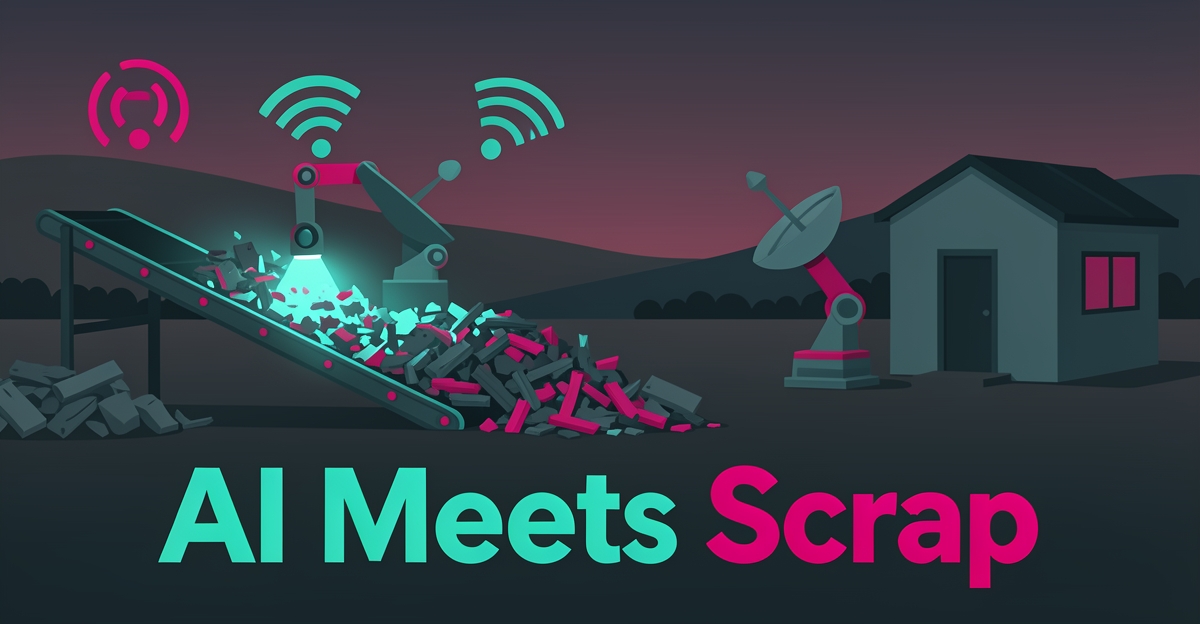
7 Ways AI Can Improve Scrap Metal Operations in Remote or Rural Areas
Key Facts
- Industry research typically reports AI-powered robotic sorting reaching materially higher material identification accuracy than manual hand-picking lines according to comparative sorting research
- Manual hand-picking lines are generally the least accurate sorting method in comparative studies according to comparative sorting research
- AI-powered sorting has been associated with meaningful throughput gains on sorting lines according to industry research
- Process optimization with AI can improve processing capacity without new equipment investments process optimization analysis
- AI implementation has been linked to significant energy cost reductions in recycling facilities process optimization analysis
- Conventional near-infrared optical sorters typically fall between manual and AI-powered sorting on accuracy according to industry research
- AI systems can enable continuous operation despite intermittent connectivity in remote scrap yards industry analysis
Hire a team member that works 24/7 — for less than a part-time wage.
AI receptionists, SDRs, dispatchers and 99+ roles. Trained on your business, fully managed.
Not sure where to start? Ask our AI planner
Remote Scrap Operations Are Strained by Distance and Infrastructure
Remote yards operate where the signal drops before the first load is weighed. Distance turns simple coordination into a daily bottleneck, and the lack of reliable infrastructure forces teams to rely on paper logs, radio check-ins, and manual triage.
Limited connectivity makes real-time communication unreliable. Dispatch updates lag, pricing changes arrive late, and collection crews work with stale information. Mobile data environments are inconsistent across dispersed sites, so cloud-only systems stall when they are needed most.
Dispersed collection sites compound the problem. Drivers cover long routes between rural drop points, transfer stations, and central yards. Without synchronized scheduling, trucks arrive half-empty or sit idle waiting for sorting capacity, inflating fuel use and labor hours.
Manual sorting bottlenecks are especially acute in remote operations. Hand-picking lines are consistently the least accurate sorting method in comparative sorting research, which creates contamination, rework, and lost value. Labor is harder to attract and retain in rural areas, and throughput caps when the crew is small.
Logistics coordination breaks down without visibility. Yard managers juggle inbound scrap, outbound shipments, and equipment maintenance with spreadsheets and phone calls. Delays cascade quickly when a single road closure or weather event isolates a site.
Traditional systems assume constant broadband and co-located teams. They fail when connectivity is intermittent, when sites are offline for hours, and when mobile crews need decisions at the edge. AI that works offline and across disconnected sites is required to keep operations moving.
In rural scrap metal, the core strains show up as:
- Intermittent connectivity and mobile data environments that disrupt cloud-dependent tools
- Dispersed collection sites with long travel times and uneven inbound volumes
- Manual sorting bottlenecks limited by labor availability and lower accuracy rates
- Logistics coordination gaps between drivers, yards, and buyers with no real-time sync
AIQ Labs addresses these constraints through [AI Workflow Builds](/workflow-builds) and [AI Operating Systems](/ai-operating-systems) that handle communication, scheduling, and logistics despite limited infrastructure. The approach prioritizes systems that sync when possible and operate locally when disconnected, keeping workflows intact across rural sites.
The result is a foundation for AI that does not require perfect infrastructure to deliver value. When sorting, dispatch, and yard management can run reliably on mobile data and offline modes, remote operations stop being a liability and start operating with the same control as urban yards.
How AI Delivers Sorting Accuracy, Throughput and Sustainability Gains
Remote yards lose margin when a single mis-sorted load contaminates a whole batch. AI changes that equation by making identification reliable even when staffing is thin and connectivity is intermittent.
AI-powered robotic sorting systems deliver the highest material identification accuracy of the common sorting approaches in real operations, according to industry research. That compares with conventional near-infrared optical sorters in the middle of the pack and manual hand-picking lines at the bottom. Higher accuracy means fewer downgrades and less rework in rural facilities that cannot afford second passes.
Throughput rises without adding shifts. Facilities report a meaningful increase in overall line throughput with AI-powered sorting. The gain comes from consistent pick rates and the ability to run at speeds that would require multiple human sorters to match.
Capacity can grow inside existing footprints. Process optimization analysis points to improvements in processing capacity without additional equipment investments. For remote sites where expansion is costly, that lift protects revenue during seasonal surges.
Energy use falls as waste falls. The same process optimization analysis documents significant reductions in energy costs with AI implementation. Better sorting reduces unnecessary handling, conveyor run time, and reprocessing.
These gains matter more off-grid. Remote operations face limited infrastructure, intermittent mobile data, and long distances between yards and buyers. AI systems built for enterprise system integration can handle communication, scheduling, and logistics despite those constraints.
AIQ Labs designs workflow automation solutions that work across disconnected sites and mobile data environments. Integration focuses on practical outcomes for rural scrap operations:
- Continuous material identification that maintains accuracy with variable lighting and feedstock
- Workflow optimization that predicts maintenance and reduces downtime between service visits
- Remote monitoring and scheduling that keeps yards coordinated without constant on-site staff
- Energy-aware control that aligns line speed with power availability
Together, accuracy, throughput, and energy efficiency create a more sustainable model. Recovering more valuable materials from each load reduces demand for virgin extraction and supports a circular economy. For remote and rural yards, that sustainability is also financial resilience.
7 AI-Powered Improvements for Communication, Scheduling and Logistics
Remote scrap metal operations in rural areas often struggle with fragmented communication, unpredictable scheduling, and inefficient logistics due to limited infrastructure. AIQ Labs addresses these challenges by deploying AI systems designed to function reliably even in disconnected or low-bandwidth environments.
AI-powered sorting and material identification systems typically outperform conventional optical sorters and manual methods on accuracy, which boosts throughput without requiring additional equipment according to industry research. This precision reduces contamination and increases the value of recovered materials, directly improving operational yield in isolated facilities.
Predictive maintenance powered by AI analyzes equipment sensor data to forecast failures before they occur, reducing unplanned downtime and extending machinery life, critical when service technicians are hours away. Intelligent dispatch and route optimization dynamically adjust collection truck routes based on fill levels, traffic, and weather, cutting fuel use and improving on-time pickups across vast service areas.
Mobile-first scheduling platforms enable crews to receive updates, swap shifts, and log work via SMS or basic smartphones, ensuring coordination even when internet access is spotty. Automated pricing and inventory tracking use AI to monitor market fluctuations and stock levels, helping remote yards optimize sales timing and avoid overstocking or shortages.
Voice and chat AI interfaces, what AIQ Labs deploys as [AI Employees](/ai-employees) for roles like dispatchers and coordinators, allow site supervisors and workers to report issues, request parts, or check schedules using natural language over low-bandwidth connections or offline-capable apps, maintaining clear communication without relying on constant connectivity. Finally, AI-driven sustainability reporting automatically tracks energy use, emissions reductions, and material recovery rates, generating compliance-ready reports that support environmental goals and potential incentives, all while operating independently of continuous cloud access.
- AI systems that operate effectively in low-connectivity or offline modes
- Real-time adaptation to changing field conditions
- Reduced dependency on on-site technical expertise
- Scalable solutions tailored to remote site constraints
- Continuous operation despite infrastructure limitations
Implementing AI in Low-Connectivity Environments with AIQ Labs
Bringing AI into a remote scrap yard is less about flashy robotics and more about making the operation run smoothly when the nearest IT support is hours away. The payoff is real, industry analysis shows AI implementation can lift processing capacity without new equipment and meaningfully cut energy costs, but only if the system survives the realities of rural infrastructure.
The first hurdle is system integration. Most scrap operations run a patchwork of scales, inventory spreadsheets, and accounting tools that were never designed to talk to each other. According to Okon Recycling's process optimization research, integration complexity ranks among the top barriers to AI adoption in metal recycling, alongside upfront costs, data privacy concerns, and workforce training gaps.
Low connectivity compounds every one of these challenges. A cloud-dependent system that drops offline twice a day is worse than no system at all. Effective deployments for remote yards typically share a few traits:
- Local processing at the edge, so sorting and identification continue during outages
- Store-and-forward data syncing across disconnected sites when mobile data becomes available
- Graceful fallback modes that keep scheduling and dispatch running without a live connection
- Role-based training so existing staff can operate and oversee AI tools confidently
Data privacy deserves equal attention. Operational data, material volumes, customer pricing, logistics routes, is commercially sensitive, so any AI deployment needs clear ownership of data, audit trails, and human oversight on critical decisions rather than black-box automation.
This is where implementation approach matters more than the technology itself. AIQ Labs builds custom systems that clients own outright, architected to work across disconnected sites and mobile data environments rather than assuming always-on broadband. For operations wary of upfront cost barriers, flexible engagement models help: Start Monthly spreads investment into a flat plan costing less than a part-time hire, Build in Milestones lets you approve and pay per phase, and Own It Outright delivers full ownership of code, agents, and data on completion. See [pricing](/pricing) for how each model works.
The sorting accuracy case alone justifies the effort, comparative industry data consistently shows AI-powered systems outperforming manual lines on material identification accuracy, but capturing that value in a rural yard depends on pairing the technology with workforce training and infrastructure that respects the realities of remote work. Start with a single painful workflow, prove the value offline-capable, then scale from there.
Still paying for 10+ subscriptions that don’t talk to each other?
We build custom AI systems you own outright. No vendor lock-in. Full control.
Not sure where to start? Ask our AI planner
Frequently Asked Questions
How much more accurate is AI-powered sorting compared to manual hand-picking in scrap metal operations?
Can AI improve throughput in remote scrap yards without requiring new equipment?
What energy savings can remote scrap operations expect from implementing AI?
How does AI handle communication and scheduling when internet connectivity is unreliable in rural areas?
Is workforce training a major barrier to adopting AI in remote scrap yards, and how can it be addressed?
What are the main benefits of AI for sustainability in remote scrap metal recycling?
The Signal Doesn't Have to Reach the Yard for the System to Work
Remote scrap operations have always been defined by what they lack: reliable broadband, deep labor pools, and the luxury of a second pass on a contaminated load. AI changes that calculus. The research shows AI-powered sorting outperforming manual lines on accuracy, throughput gains without new equipment, and materially lower energy consumption. But the real breakthrough isn't the robotics, it's the architecture. Systems that process locally, sync when signal returns, and keep dispatch, pricing, and sorting running during outages turn infrastructure gaps from a liability into a managed variable. AIQ Labs builds these systems as owned assets, not rented tools, with flexible engagement models that let a yard start with one painful workflow and scale from proof. The next step isn't a platform evaluation, it's identifying the single bottleneck costing the most margin today. Start with the [2-minute Fit Check](/apply), then a free 30-minute strategy call maps that bottleneck to a concrete automation plan, and if the numbers don't work, we'll say so. No obligation, just clarity on where AI pays for itself first. Questions first? Reach us at [email protected].
Make AI your competitive advantage — not just another tool.
Strategy, implementation and ongoing optimization. One partner, end to end.
Not sure where to start? Ask our AI planner