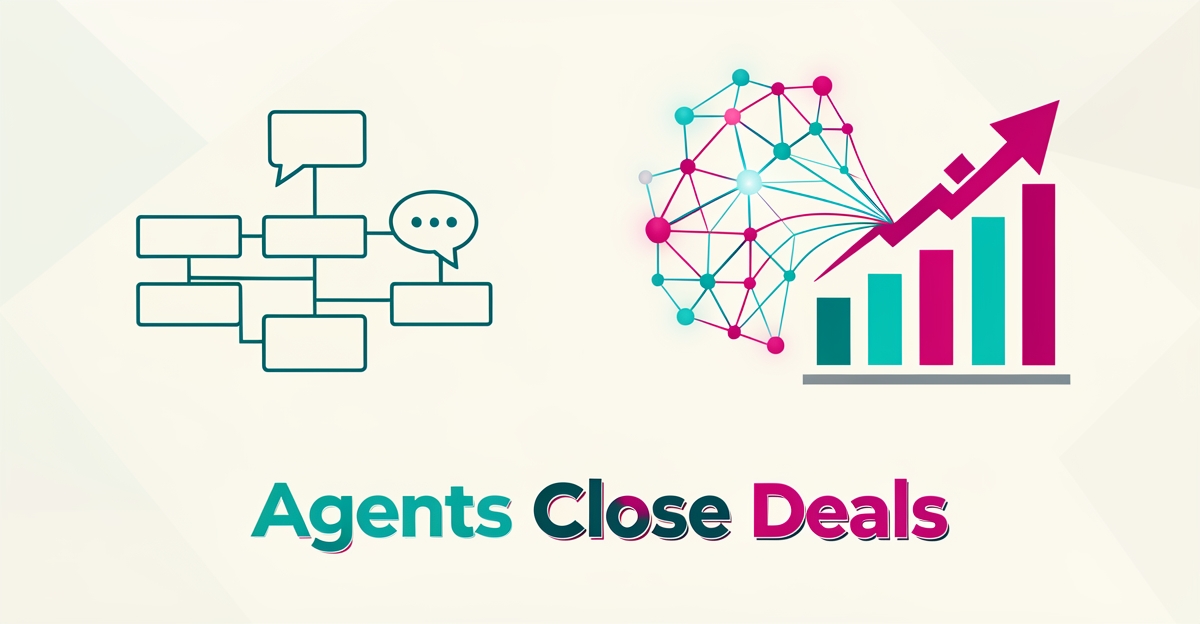
AI Agents vs Chatbots: The Difference That Matters for Revenue
Key Facts
- Chatbots follow scripted decision trees, while AI agents autonomously reason, plan, and execute complex multi-step tasks per NVIDIA's State of AI report.
- 91% of AI-using SMBs say AI boosts their revenue, a Salesforce survey of 3,350 SMB leaders found.
- 88% of enterprises report AI increased annual revenue according to NVIDIA's research.
- 70% of B2B buyers now use LLMs to research purchases, flipping information asymmetry from seller to buyer EY research shows.
- 40% of qualified B2B pipeline now ends in "no decision" as AI-augmented buyers stall deals according to EY.
- 44% of companies were deploying or assessing AI agents in 2025, moving to full deployments by early 2026 NVIDIA reports.
- Buying AI licenses without workflow redesign leaves usage plateaued at drafting emails — "the license is the engine; the workflow is the vehicle" notes one executive guide.
Hire a team member that works 24/7 — for less than a part-time wage.
AI receptionists, SDRs, dispatchers and 99+ roles. Trained on your business, fully managed.
Not sure where to start? Ask our AI planner
The Revenue Gap: Understanding the Limitations of Chatbots
Your chatbot can answer questions all day. The problem is that answers don't book jobs, schedule appointments, or close deals — and that gap is quietly costing you revenue.
Traditional chatbots operate on pre-defined rules, decision trees, and scripted responses. They retrieve information and route inquiries, but they can't act on anything. AI agents are different: they autonomously reason, plan, and execute multi-step tasks based on high-level goals, connecting directly to company data and workflows without manual intervention, as NVIDIA's State of AI report explains.
The distinction shows up clearly in revenue work. A chatbot can define a sales territory. An agent prioritizes regional prospects for the day and drafts the outreach emails, moving from information retrieval to actual task execution. One answers; the other produces pipeline.
The revenue numbers back this up. A Salesforce survey of 3,350 SMB leaders found 91% of SMBs using AI say it boosts revenue, and 87% say AI helps them scale operations. At the enterprise level, 88% of respondents told NVIDIA that AI increased annual revenue.
But there's a catch that explains why so many businesses see no return from their "AI strategy":
- Buying Copilot or ChatGPT licenses gives teams a chat window — without redesigned workflows, usage plateaus at drafting emails.
- The license is the engine; the workflow is the vehicle. Value only appears when AI is embedded at specific steps of a real process.
- Every quarter a manual process runs, you pay its full cost again while competitors bank the cycle-time and margin gains.
Meanwhile, the buyer side is changing faster than most sellers realize. EY's research shows 70% of B2B buyers now use LLMs to research purchases — information asymmetry has flipped from seller to buyer, and 40% of qualified pipeline now ends in "no decision."
This is why the chatbot-versus-agent question isn't academic. A scripted responder can't keep pace with AI-augmented buyers or capture the revenue AI is demonstrably generating. An action-taking system can.
That's the gap AIQ Labs focuses on: not chatbot widgets, but AI employees and workflow builds that execute real tasks end-to-end — booking appointments, qualifying leads, following up on invoices. The difference between answering and acting is, quite literally, the difference between a cost center and a revenue driver.
From Automation to Action: How AI Agents Drive Revenue
From automation to action, AI agents are revolutionizing the way businesses drive revenue. Unlike chatbots, which follow pre-defined rules and scripted responses, AI agents autonomously reason, plan, and execute complex tasks based on high-level goals. According to NVIDIA's State of AI report, AI agents are defined as "advanced AI systems designed to autonomously reason, plan and execute complex tasks based on high-level goals." This distinction is crucial, as it enables AI agents to take independent action across workflows without manual intervention.
The revenue impact of AI agents is significant, with 91% of SMBs using AI reporting revenue gains. Moreover, 88% of enterprises said AI increased annual revenue, while 87% of AI-using SMBs reported improved margins. These statistics demonstrate the potential of AI agents to drive revenue growth and improve operational efficiency.
To harness the power of AI agents, businesses must redesign their workflows to incorporate autonomous decision-making and execution. This requires a hybrid deployment strategy, where AI agents are used for task execution and chatbots are used for FAQs and routing. As Abhi Rathna, Salesforce AI product management director, notes, "For primarily customer-facing scenarios, I think there will be a mix of traditional chatbots and modern generative AI agents."
Some key benefits of AI agents include:
- Autonomous reasoning and planning
- Independent execution of complex tasks
- Improved operational efficiency and revenue growth
By leveraging AI agents, businesses can streamline their operations, improve customer engagement, and drive revenue growth. As EY's research notes, the information asymmetry has now flipped from seller to buyer, challenging not only the sales motion but the revenue engine. To stay competitive, businesses must adopt AI agents and redesign their workflows to incorporate autonomous decision-making and execution. With the right strategy and implementation, AI agents can help businesses drive revenue growth and achieve a sustainable competitive advantage.
Implementing AI Agents for Revenue Growth: A Practical Guide
According to industry research, AI agents outperform chatbots by executing complex tasks rather than merely retrieving information, directly impacting revenue. For SMBs, this distinction is critical—91% of AI-using businesses report revenue gains, with growing companies adopting faster than their peers (source). Implementing AI agents requires strategic planning, but the payoff in efficiency and scalability is undeniable.
Identify high-value automation opportunities by analyzing workflows that consume time or limit growth. AIQ Labs’ AI Workflow Builds target one broken process—like lead follow-up or invoicing—replacing manual steps with custom agents. This approach avoids the "license plateau" where AI tools stagnate at basic tasks (source). For example, an agent can prioritize daily sales prospects and draft outreach emails, transforming reactive tasks into proactive revenue drivers.
Design and deploy custom AI agents using enterprise-grade frameworks. AIQ Labs’ multi-agent systems, built on LangGraph and ReAct, handle complex reasoning and execution across departments. Unlike chatbots, these agents integrate with CRM, accounting, and communication tools, ensuring seamless workflow automation. A 2026 NVIDIA report notes 44% of companies now deploy agents for tasks ranging from legal research to financial reporting, proving their scalability.
- Assess current workflows for bottlenecks and high-impact areas
- Choose between AI Employees (managed agents) or Workflow Builds (custom systems)
- Integrate agents with existing tools via APIs or phased deployment
- Establish governance frameworks to balance automation with human oversight
- Monitor performance and refine agents continuously
Governance is non-negotiable. Research warns against full autonomy in critical decisions, advocating for human-in-the-loop systems. AIQ Labs embeds this philosophy, ensuring agents handle execution while humans retain control over high-stakes choices. Change management follows: training teams and aligning workflows to maximize adoption.
By focusing on action over conversation, AI agents unlock revenue growth that chatbots cannot. AIQ Labs’ managed AI Employees and custom systems empower businesses to automate strategically, avoiding the pitfalls of over- or under-automation. As 70% of B2B buyers now use LLMs to research purchases (source), proactive AI implementation isn’t just an advantage—it’s a necessity.
Still paying for 10+ subscriptions that don’t talk to each other?
We build custom AI systems you own outright. No vendor lock-in. Full control.
Not sure where to start? Ask our AI planner
Frequently Asked Questions
What's the main difference between chatbots and AI agents?
Can AI agents really boost revenue?
Do I need to redesign my workflows to benefit from AI agents?
How do AI agents handle sensitive tasks like billing disputes or legal research?
Should I replace all chatbots with AI agents?
Do AI agents require specialized infrastructure?
Key Takeaways
```json { "title": "From Automation to Advantage", "content": "The distinction between AI agents and chatbots has significant implications for businesses seeking to drive revenue growth. AI agents, with their ability to autonomously reason, plan, and execute complex tasks, offer a competitive ed
Make AI your competitive advantage — not just another tool.
Strategy, implementation and ongoing optimization. One partner, end to end.
Not sure where to start? Ask our AI planner