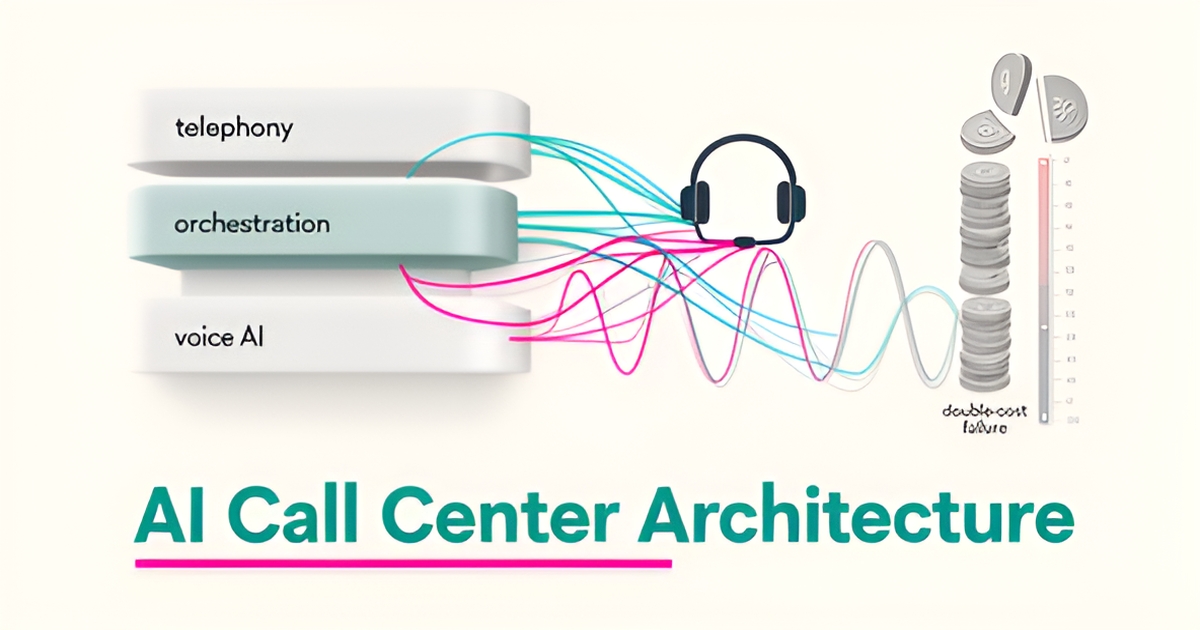
AI Call Center Support: Architecture, Costs & Guide
Key Facts
- Vendors quote ~$0.10/min for AI call center support, but when an AI minute fails and transfers to a human, you pay for both, per detailed cost analysis.
- Only 14% of customer issues were fully resolved in self-service, and just 36% for very simple issues, in Gartner's survey of 5,728 customers cited by zenthos.
- The call center AI market will grow from $2.41B in 2025 to $13.52B by 2034 at a 20.80% CAGR, per Fortune Business Insights.
- Break-even containment is just ~11% against onshore agents but ~43% against offshore teams, making the savings case labor-dependent.
- Deflection rate is the most popular but most misleading contact center metric because it can't distinguish 'AI solved it' from 'the customer gave up,' according to Rasa's practitioner guide.
- A QJE study of 5,179 agents found AI assistance raised issues resolved per hour by 14% overall and 34% for newer agents per the zenthos cost analysis.
- Forrester expects one-third of brands to damage customer experience through premature AI self-service deployment in 2026 per industry analysis.
One AI employee doing one job, 24/7, for less than a part-time wage.
Receptionist, lead follow-up, intake or dispatch. Trained on your business and fully managed. From $700/mo.
What AI Call Center Support Actually Means (and What It Costs You to Get It Wrong)
Most AI call center budgets are built on a number that understates the bill. Vendors quote roughly $0.10 a minute, which looks cheap next to a $35-an-hour human agent, but when the AI minute fails and the call transfers, you pay for both. As one cost analysis frames it, the quoted rate is real and it is the wrong number to budget with, which is why cost per resolved call is the figure that decides whether AI call center support saves money at all.
The market itself is growing fast, and three research firms agree on the direction while disagreeing on the size. Fortune Business Insights sizes the global call center AI market at $2.41B in 2025, reaching $13.52B by 2034 at a 20.80% CAGR. Grand View Research estimates $1.9B in 2024 growing to $7.1B by 2030 at 23.8%. Precedence Research projects $3.98B in 2025 to $30.69B by 2035 at 22.66%. North America leads in all three, with shares of 37.50%, 39.0%, and more than 42%.
What buyers are actually buying falls into four distinct modes, and confusing them is where budgets go wrong:
| Mode | What it does | Where the cost lands |
|---|---|---|
| Tier-1 deflection | Self-service for FAQs, order status, routing, and password resets | Lowest cost per contact, highest volume, weakest resolution rates |
| AI voice agents | Conversational agents that answer inbound calls and complete tasks end to end | Five-layer per-minute stack plus platform fee |
| Agent-assist | Real-time suggestions, summaries, and next-best actions for human agents | Per-seat licensing; no transfer cost, no resolution on its own |
| Human handoff | Escalation to a live agent, with context passed along | Retains full human cost: about $0.73 per minute onshore, $0.25 offshore |
Self-service is where expectations run ahead of results. Gartner's August 2024 survey of 5,728 customers found only 14% of issues fully resolved in self-service, and just 36% for very simple issues. Klarna is the cautionary tale: AI handled two-thirds of chats in its first month in February 2024, and by May 2025 the CEO said the company had gone too far and rehired humans.
That is why measurement discipline decides the outcome. Rasa's practitioner guidance notes that deflection cannot distinguish between the AI solving the problem and the customer simply failing to reach an agent.
The real cost stack has five layers, and the platform fee is usually the largest line:
- Telephony: $0.005 to $0.022 per minute
- Speech-to-text: $0.005 to $0.010 per minute
- LLM inference: $0.005 to $0.16 per minute
- Text-to-speech: $0.012 to $0.04 per minute
- Platform fee: $0.05 to $0.08 per minute
Break-even containment lands near 11% against an onshore team and near 43% against an offshore one, so the savings case depends heavily on which labor you are displacing. At AIQ Labs, that framing shapes how we scope AI call center solutions: we model cost per resolved call, not per minute, before recommending any stack.
The Voice AI Stack, Layer by Layer: A Vendor Comparison
Every "AI call center support" platform you'll evaluate is really five or six services stacked on top of each other, and vendors differ mainly in how many of those layers they've glued together. Break the stack apart before you compare pricing, or you'll end up paying twice for the same layer.
Telephony and SIP trunking comes first: Twilio, Vonage, and Nextiva all sell the pipes, while Five9 is a full cloud contact center platform with its own carrier-grade telephony layer. Five9's June 2026 launch is notable here because it unifies speech, reasoning, and voice generation natively in the telephony platform rather than bolting AI onto it, with guardrails, LLM blinding, and automated post-call evaluations built in (per the company's release).
Streaming ASR (speech-to-text) and text-to-speech sit at the edges of the conversation. LLM orchestration is the brain: it manages turn-taking, tool calls, and escalation logic. Retell AI is a managed option here, bundling orchestration with concurrency (20 simultaneous calls included, then $8/month each, per the Zenthos cost analysis). Knowledge base/RAG feeds the model your actual answers. CRM and telephony integrations (Zendesk, Salesforce) let the agent take real actions mid-call. Observability and QA close the loop with post-call scoring.
Vendor comparison matrix:
| Layer | Managed option | Self-build option |
|---|---|---|
| Telephony/SIP | Twilio, Vonage, Nextiva, Five9 | Twilio programmable voice |
| Streaming ASR | Platform-bundled | Deepgram (~$130M Series C, per Precedence Research) |
| LLM orchestration | Retell AI, Five9 AI Agent Studio | LangGraph/custom |
| TTS | Platform-bundled | Vendor APIs |
| Knowledge/RAG | Platform-bundled | Custom retrieval |
| Integrations | Zendesk, Salesforce connectors | Direct APIs |
| Observability/QA | Five9 automated evaluations | Custom pipelines |
The cost math per the Zenthos cost analysis (list prices checked 23 Sep 2026):
- Telephony: $0.005–$0.022/min
- Speech-to-text: $0.005–$0.010/min
- LLM: $0.005–$0.16/min
- Text-to-speech: $0.012–$0.04/min
- Platform fee: $0.05–$0.08/min, usually the biggest line item, not the AI model
That adds up to roughly $0.07–$0.31/min on a managed platform versus $0.04–$0.10/min self-built. Which brings you to the build-or-buy threshold: below about 100,000 AI minutes per month, buy managed. Above it, the platform fee alone can fund a small engineering team (240,000 minutes × $0.05 = $144,000/year).
One caveat before you self-build: a cheap stack with a thin knowledge base still fails. As the Zenthos analysis puts it, if your knowledge base is thin, containment will be too. Teams like AIQ Labs that architect these stacks tend to spend more time on the retrieval and QA layers than on the model wiring, because that's where resolution rates are actually won.
Cost Per Resolved Call: Benchmarks and a Worked Example
The single most expensive mistake in ai call center support budgeting is trusting the per-minute rate. Vendors quote around $0.10/min, but when a cheap AI minute fails and the call escalates to a human, you pay for both interactions. That's why detailed cost analysis argues that cost per resolved call is the only number that tells you whether AI actually saves money.
The honest methodology stacks five cost layers per AI minute: telephony ($0.005–$0.022), speech-to-text ($0.005–$0.010), LLM tokens ($0.005–$0.16), text-to-speech ($0.012–$0.04), and the platform fee ($0.05–$0.08). Note that the platform fee, not the AI model, is usually the biggest line item. Against that, you set the human baseline: rethinkCX's May 2026 BPO cost index puts onshore labor at $0.73/minute ($35/hr at 80% occupancy) and offshore at $0.25/minute ($12/hr).
Here's the uncomfortable arithmetic. At roughly $0.15/minute in AI costs, break-even containment is only about 11% against an onshore team but about 43% against an offshore one. If your AI minutes climb to $0.30, a fully contained 4-minute call costs $1.20, more than the $1.00 offshore human call, and no containment rate breaks even. This is why "AI is cheaper" claims deserve scrutiny before you sign anything.
Worked example: US contact center, blended $0.15/min AI cost, 4-minute average call
| Volume | Calls/mo | Minutes | AI-only cost | Onshore human | 50% containment (onshore) | Offshore human | 50% containment (offshore) |
|---|---|---|---|---|---|---|---|
| Small | 1,000 | 4,000 | $600 | $2,920 | $1,760 | $1,000 | $800 |
| Mid | 10,000 | 40,000 | $6,000 | $29,200 | $17,600 | $10,000 | $8,000 |
| Large | 50,000 | 200,000 | $30,000 | $146,000 | $88,000 | $50,000 | $40,000 |
The pattern holds at every scale: containment against onshore labor produces dramatic savings, while offshore comparisons demand far higher containment rates to justify the build. The same source's larger worked example (a 40-seat center handling 60,000 calls/month) shows 50% containment cutting onshore costs from $175,200 to $114,600, but barely moving offshore costs from $60,000 to $57,000.
One more threshold matters for buyers. Below roughly 100,000 AI minutes per month, managed platforms (Retell AI, Five9, Vonage and similar ai call center solutions) make sense. Above that, the platform fee alone can fund a small engineering team; at 240,000 minutes/month, a $0.05/min platform fee runs $144,000 a year.
On performance benchmarks, anchor your targets to published ranges rather than vendor promises:
- Productivity: a QJE study of 5,179 agents found AI assistance raised issues resolved per hour by 14% overall, and 34% for newer agents.
- Containment: PODS reported exceeding containment targets in its early Five9 rollout, with expectations of 100,000+ AI-handled service calls by year-end.
- Latency: research on conversation gaps shows most natural replies land under 200ms, and calls tend to derail around the 1-second mark, so treat anything above ~1s response latency as a defect.
- Measurement: use Rasa's KPI formulas (deflection = AI conversations without transfer ÷ total; automation = completed workflows ÷ started) and pair them with CSAT, since deflection alone can't distinguish "AI solved it" from "customer gave up."
When you model your own numbers, include the transfer cost in every scenario and sanity-check your containment assumption against your knowledge base quality; thin content produces thin containment. If you want a second pair of eyes on the math, AIQ Labs builds custom cost models and vendor shortlists as part of its free strategy call, and will tell you plainly if the numbers don't support a build.
Implementation Checklist: From Use-Case Selection to ROI Tracking
A pilot that never reaches production usually fails on measurement, not technology. Rasa's practitioner guide calls deflection rate "the most popular but most misleading metric," because it cannot separate "AI solved the problem" from "the customer couldn't reach an agent" (Rasa). Build the checklist around containment and solution rate, and the rollout decisions get easier.
- Use-case selection: pick one high-volume, low-variance intent. Score candidates on monthly call volume, knowledge-base coverage, and the cost of a wrong answer.
- Data and knowledge prep: as one cost analysis puts it, "your AI is only as good as the answers and system access behind it" (zenthos). Thin knowledge base, thin containment.
- Prompt and voice design: target sub-second response. A 2009 PNAS study found the most common reply gap in human conversation sits under 200ms, and calls derail at roughly one second (zenthos).
- Integration build: connect telephony, CRM, and payment systems before pilot. Tool access is what turns a responder into an agent that completes tasks.
- Pilot and QA: run 500 to 1,000 calls, tag every session, and log bounce rate separately so your denominator is honest.
- Human-in-the-loop escalation: define hard triggers (frustration signals, compliance keywords, third failed intent match) and route warm, with context attached.
- Deployment and ROI tracking: report cost per resolved call, not per minute. Managed versus self-built flips near 100,000 AI minutes per month, where the platform fee alone can fund a small engineering team.
Two numbers keep teams honest. Gartner's August 2024 survey of 5,728 customers found only 14% of issues were fully resolved in self-service, and 36% even for "very simple" issues (zenthos). If your pilot claims 80% containment, check whether it measured resolution or just absence of a transfer.
AIQ Labs runs this sequence in phases through its Build in Milestones model, and operates its own production voice AI in regulated collections, so the compliance and escalation steps come from systems we run rather than a slide deck. Want a custom AI call center cost model, vendor shortlist, and rollout plan? Start with the two-minute Fit Check at aiqlabs.ai/apply, then book a free 30-minute strategy call.
Pitfalls, Compliance, and Change Management
Even a well-designed AI call center support system fails in predictable ways, and knowing those failure modes before launch is cheaper than discovering them in production. The four most common are hallucination, infinite loops, latency, and the deflection-first trap. Hallucination is the most dangerous: an AI voice agent that confidently gives a wrong refund policy or invents an account detail can create liability, not just frustration. Vendors have responded with architectural controls, and PODS credits Five9 with solving "critical challenges around noise handling, turn detection, and hallucination prevention" in its early rollout, according to a Five9 announcement. Infinite loops happen when the agent keeps asking for information it can't retrieve or transfers the caller to another bot. Latency matters more on voice than chat: research on conversation timing shows most reply gaps fall under 200 milliseconds, and at roughly one second, calls start to derail. If your stack adds a second of thinking time, callers hang up.
The deflection-first trap deserves special attention. Deflection measures whether a call reached a human; it says nothing about whether the customer's problem got solved. As one industry analysis puts it, "the savings show up in Q1, but the churn shows up in Q3." Klarna is the cautionary example: its AI handled two-thirds of chats in the first month, but by 2025 the CEO admitted the company had gone too far and rehired humans. Forrester expects one-third of brands to damage customer experience through premature AI self-service deployment in 2026. Measure resolution and CSAT alongside containment, or you'll optimize for the wrong number.
Compliance is architecture, not a checkbox. Three areas need explicit design decisions:
- Disclosure: the EU AI Act's Article 50, effective August 2026, requires AI disclosure with fines up to €15 million or 3% of turnover.
- Outbound calling: the FCC's February 2024 ruling treats AI voices as "artificial voices" under the TCPA, requiring prior express consent before AI-generated outbound calls.
- Payment data: if your agent handles card details, keep sensitive data out of the LLM context entirely, using techniques like the LLM blinding Five9 describes.
Then there's the workforce reality. The instinct to cut headcount aggressively is running ahead of the evidence. Gartner found that half of organizations expecting to significantly reduce their service workforce due to AI will abandon those plans by 2027. In a separate Gartner survey of 321 service leaders, 85% were adding responsibilities to human agents rather than eliminating them. The pattern that holds up: AI absorbs routine volume, humans handle the harder calls that remain, and roles shift toward supervision and exception handling. Plan for fewer calls, but harder ones, and budget your human staffing accordingly.
If you want a realistic view of where these pitfalls would hit your specific operation, AIQ Labs builds custom cost models and rollout plans that account for failure modes, compliance requirements, and staffing changes from day one. Start with the two-minute Fit Check at aiqlabs.ai/apply, and you'll get a free 30-minute strategy call covering your cost model, a vendor shortlist, and a phased rollout plan. If there isn't a clear win, they'll tell you that too.
Still paying for 10+ subscriptions that don’t talk to each other?
We build connected AI systems you own. Pay upfront or on a payment plan; the code is yours once it’s paid off.
Frequently Asked Questions
How much does AI call center support actually cost per minute?
Why is cost per resolved call a better metric than per-minute pricing?
What containment rate do I need for AI call center support to break even?
Should I build my own voice AI stack or buy a managed platform?
Is deflection rate a reliable way to measure AI call center success?
What compliance rules apply to AI call center support?
The Number That Decides Whether AI Call Center Support Pays for Itself
The through-line across every section of this guide is the same: the quoted per-minute rate is real, and it is the wrong number to budget with. Cost per resolved call, five cost layers stacked against your actual human baseline, is what tells you whether AI call center support saves money at all, and the answer flips depending on whether you are displacing onshore or offshore labor. Containment break-even sits near 11% against a $35-an-hour onshore team and near 43% against a $12-an-hour offshore one, which is why the same stack can be a clear win in one center and a loss in another. Layer on measurement discipline, Gartner's August 2024 survey of 5,728 customers found just 14% of issues fully resolved in self-service, and the case for modeling before building becomes hard to argue with. Run the math on your own volumes, hold your containment assumption up against your knowledge base quality, and treat transfer cost as a line item in every scenario. If you want a second set of eyes, AIQ Labs will build the custom cost model and vendor shortlist on a free 30-minute strategy call, and tell you plainly if the numbers don't support a build. Start with the two-minute Fit Check at aiqlabs.ai/apply.
See what AI would actually do in your business, in 60 seconds.
The planner shows which step fits, the agents we’d build and the published price. No email needed.