AI Course Design vs. Human-Led Curriculum: What Works Best for Adult Learners?
Key Facts
- Early randomized controlled trial research on AI-powered tutoring reported learning gains more than double those of traditional active-learning classrooms, though results depend heavily on design quality.
- Industry surveys as of late 2026 suggest the large majority of students and educators already use AI, often through personal accounts outside institutional governance.
- Market analysts widely project global spending on AI in education to reach tens of billions of dollars before the end of the decade.
- AI tutoring tends to boost outcomes by increasing engagement, providing tailored feedback, and supporting skills development, when it is deliberately structured.
- The difference between a content generator and a learning system is architecture, not model choice, pedagogy must be embedded as a constraint layer.
- Unstructured AI use can undermine learning, but well-designed, pedagogically informed AI tutoring improves outcomes, according to education researchers such as Dr. Aviva Legatt.
- Effective AI tutors require structured support, active participation mechanics, adaptive assessments, and personalized feedback tied to specific misconceptions.
Hire a team member that works 24/7 — for less than a part-time wage.
AI receptionists, SDRs, dispatchers and 99+ roles. Trained on your business, fully managed.
Not sure where to start? Ask our AI planner
The False Choice: Why EdTech Teams Think They Must Pick a Side
EdTech teams face mounting pressure to deliver AI-powered course content at speed, while faculty worry that unstructured automation risks diluting learning quality. This tension creates a false choice: ship fast with AI or preserve rigor through human-led design. But with most students and educators already using AI as of late 2026, often outside institutional oversight, the delay in resolving this dilemma carries real cost. Institutions that wait risk falling behind in a market where analysts widely expect global spending on AI in education to reach tens of billions of dollars before the end of the decade.
The core issue isn't whether to use AI, but how to integrate it without sacrificing pedagogical integrity. Faculty concerns are valid: when AI generates content without alignment to learning objectives or instructor oversight, it can promote passive consumption over critical thinking. Yet abandoning AI's speed and scalability ignores its demonstrated ability to boost engagement and personalize learning when guided by educational principles. Research on AI-powered tutoring consistently suggests it improves outcomes when designed with structure, active participation, and pedagogical alignment, proving that the technology itself isn't the problem, but its unguided application.
This is where EdTech teams get stuck: they see AI as either a replacement for human expertise or a threat to it, rather than a force multiplier when thoughtfully governed. The pressure to choose stems from outdated assumptions about AI's role, namely, that automation inherently means reduced quality. But evidence suggests the opposite: when AI systems are built with intentional design, governed by learning science, and paired with human expertise, they accelerate content development without eroding rigor. The real failure isn't using AI, it's deploying it without the scaffolding that ensures it serves, not supplants, the learning process.
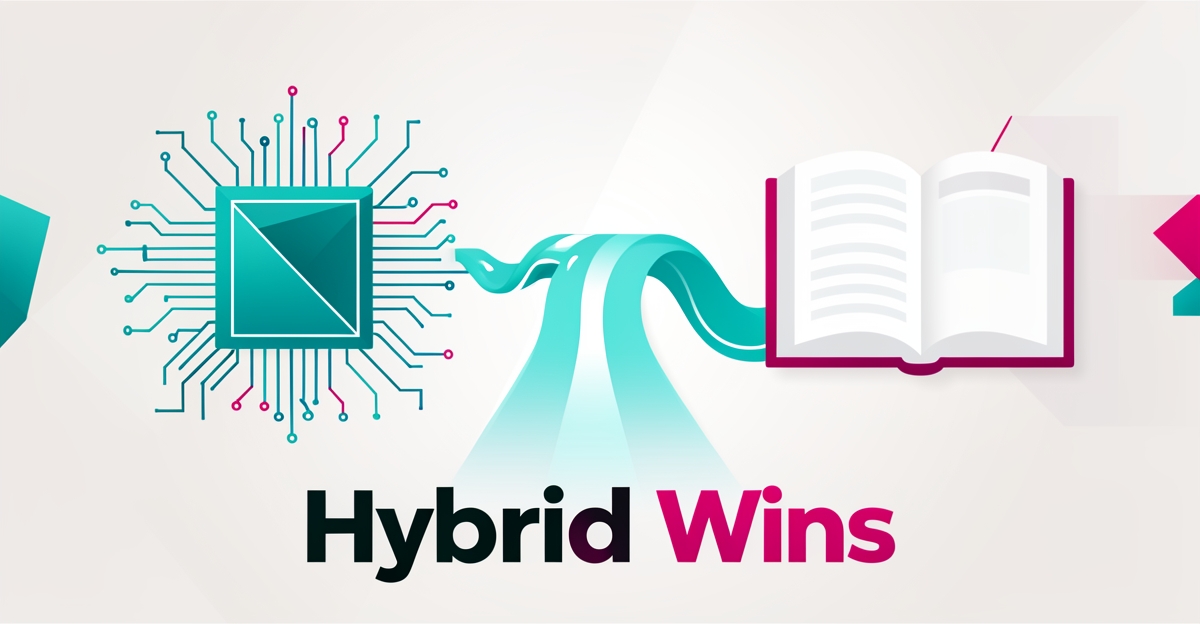
For organizations navigating this tension, the path forward requires redefining the conversation. Instead of framing AI and human-led curriculum as opposing options, the focus should shift to creating hybrid systems where AI handles scalable tasks like draft generation, adaptive assessments, and content tagging, while educators retain control over sequencing, depth, and contextual relevance. This approach doesn't just resolve the false choice; it turns AI into a strategic asset that extends faculty capacity rather than replaces it. And in a landscape where adoption is already widespread and investment is accelerating, the ability to move fast without compromising quality isn't optional, it's essential.
What the Research Actually Says About AI-Led Learning Outcomes
The evidence is no longer purely theoretical. Early randomized controlled trial research on AI-powered tutoring reported learning gains more than double those of peers in traditional active-learning classrooms. That magnitude of improvement shifts the conversation from whether AI belongs in curriculum design to how it should be architected. With market analysts widely projecting global spending on AI in education to reach tens of billions of dollars before the end of the decade, the stakes for getting the design right are substantial.
The mechanism driving these gains isn't automation alone, it's personalization at scale. Research on AI tutoring suggests it boosts outcomes by increasing engagement, providing tailored feedback, and supporting skills development through adaptive learning paths that respond to individual progress in real time. Well-designed systems create a feedback loop where struggle triggers scaffolding, mastery accelerates the pace, and misconceptions are caught before they calcify. This level of responsiveness is functionally impossible in cohort-based instruction without prohibitive instructor-to-learner ratios.
- Structured support through guided questions and scaffolded explanations
- Active participation mechanics that prevent passive consumption
- Adaptive assessments that adjust difficulty to the learner's zone of proximal development
- Personalized feedback tied to specific misconceptions rather than generic correctness
The caveat is decisive: these gains depend entirely on intentional, pedagogically aligned design. Unstructured AI access can undermine learning just as easily as it can accelerate it. Faculty concerns about students outsourcing cognition to chatbots are validated by the data, without guardrails, the path of least resistance wins. At AIQ Labs, we see this distinction play out in every EdTech engagement: the difference between a content generator and a learning system is architecture, not model choice. The winning implementations treat pedagogy as a constraint layer, not an afterthought, embedding learning science into the agent logic, the retrieval strategy, and the evaluation loop from day one.
Where Human-Led Curriculum Design Still Wins
The debate over AI in education often misses a critical point: technology is a tool, not a replacement for instructional strategy. While AI can generate content at scale, human-led curriculum design remains the only way to ensure that learning is governed by mission, pedagogy, and quality.
AI systems lack the inherent ability to align content with institutional values or complex learning objectives. Without human oversight, organizations risk deploying unstructured tools that confuse rather than clarify. Industry analyses as of late 2026 suggest the large majority of students and educators are already using AI, often through personal accounts and outside institutional governance. This "shadow AI" usage highlights exactly why human-led governance is non-negotiable.
Faculty skepticism is not just resistance to change; it is a valid response to the risks of unstructured technology. As Dr. Aviva Legatt has noted, faculty concern is valid, unstructured AI use can undermine learning. However, the research evidence is also clear: well-designed, pedagogically informed AI tutoring improves outcomes. Human designers provide the necessary guardrails to ensure AI supports rather than subverts the learning process.
Human-led design provides the structured support that raw AI generation cannot replicate. This includes scaffolding complex topics, designing adaptive assessments, and ensuring every interaction reinforces course objectives. When humans architect the experience, they can integrate AI to provide personalized feedback while maintaining academic rigor.
AIQ Labs helps EdTech companies navigate this balance by building hybrid systems where human strategy directs AI execution, whether that starts with a single workflow rebuild or grows into a full AI operating system. By focusing on governance and intentional design, organizations can leverage AI for efficiency without sacrificing the quality that drives learner success.
Key areas where human oversight remains essential include:
- Governance: Establishing clear policies for ethical AI use and data privacy.
- Mission Alignment: Ensuring every module supports the institution's core educational goals.
- Structured Support: Designing scaffolded learning paths that guide students through difficulty.
Ultimately, the goal is not to choose between AI and humans, but to use human expertise to direct AI capabilities. By prioritizing pedagogy over automation, leaders can create learning environments that are both innovative and effective.
The Hybrid Blueprint: Five Steps to Blend AI Speed with Human Pedagogy
The most effective adult learning experiences don't choose between AI efficiency and human insight, they combine them. Early controlled research suggests AI tutoring can substantially outperform traditional active learning when designed with intentional pedagogy. This isn't about replacing educators but amplifying their impact through systems that scale personalization without sacrificing depth.
AIQ Labs builds hybrid AI course systems by translating these principles into five actionable steps. First, prioritize structured support through scaffolded explanations and guided questions that help learners build critical thinking incrementally. AI handles initial content breakdown and adaptive assessments, while human instructors refine complexity and anticipate misconceptions based on classroom experience. Second, encourage active participation by designing AI interactions that require learners to apply concepts in real-time scenarios, such as problem-solving simulations or reflective prompts, rather than passive consumption. This aligns with evidence showing engagement increases when AI prompts collaboration and application.
Third, align every AI component with core pedagogical goals. Whether reinforcing course objectives or supporting skill development, AI-generated content must be audited by educators to ensure it complements, not contradicts, established teaching methods. Fourth, design systems that deliver personalized feedback loops: AI analyzes learner responses in real time to suggest resources or adjust difficulty, while instructors review patterns to provide nuanced, context-rich guidance that machines alone cannot replicate. Finally, integrate collaborative features like peer discussion prompts or group project frameworks within the AI interface, fostering the teamwork and discussion proven to enhance critical thinking.
This approach doesn't just accelerate course development, it creates learning environments where AI handles the heavy lifting of personalization and scale, freeing educators to focus on mentorship, complex facilitation, and the irreplaceable human elements of teaching. For EdTech providers, this means delivering courses that are both rapidly deployable and deeply effective, meeting adult learners' need for relevance without compromising rigor. To explore how AIQ Labs can architect such a system for your organization, start with a two-minute Fit Check and a free 30-minute strategy call.
From Pilot to Production: Owning Your Hybrid AI Learning System
Most AI pilots stall because organizations treat them as experiments rather than infrastructure. The difference between a stalled proof-of-concept and a production-grade learning system comes down to intentional design, governance, and alignment with pedagogy, principles that apply whether you're building AI tutoring for adult learners or deploying automated content pipelines.
The stakes are high. Industry research as of late 2026 suggests the large majority of students and educators already use AI, often through personal accounts outside institutional governance. This shadow adoption creates risk and fragmentation. Meanwhile, market analysts widely expect global spending on AI in education to reach tens of billions of dollars before the end of the decade, yet most organizations remain stuck in pilot mode.
Moving to production requires a hybrid architecture you own outright. This means building automated content pipelines that handle research, drafting, and personalization at scale, while embedding human-in-the-loop quality controls for pedagogical review and final approval. Early randomized controlled trial research found students using AI tutors achieved learning gains substantially above those in traditional active learning classrooms, but only when the systems were intentionally designed with structured support and adaptive feedback.
Your production system should include:
- Multi-agent workflows that separate content generation from quality assurance
- Human review checkpoints for pedagogical alignment and brand voice consistency
- Automated personalization engines that adapt to individual learner profiles
- Full audit trails and governance frameworks for compliance and continuous improvement
Ownership matters. When you build on rented platforms or stitched-together no-code tools, you inherit their limitations and roadmaps. A custom-built system gives you complete control over your AI assets, from the underlying models to the integration layer that connects your CRM, LMS, and content repositories.
AIQ Labs approaches this through a phased implementation model. We start with a single critical workflow, perhaps your course content pipeline or learner feedback system, then scale to department-level automation, and finally to a complete AI operating system you own outright. Each phase ships production-ready code with monitoring, guardrails, and human oversight built in from day one.
The path from pilot to production isn't about buying more tools. It's about architecting a hybrid system that blends AI acceleration with human expertise, then owning that system as a strategic asset. If you're ready to move beyond stalled pilots, start with a two-minute Fit Check and a free 30-minute strategy call to map your highest-ROI automation opportunity.
Still paying for 10+ subscriptions that don’t talk to each other?
We build custom AI systems you own outright. No vendor lock-in. Full control.
Not sure where to start? Ask our AI planner
Frequently Asked Questions
Is AI replacing human teachers in course design?
Does AI tutoring actually improve learning outcomes for adult learners?
Isn't unstructured AI use risky for learning quality?
How widespread is AI use in education already?
Where does human-led curriculum design still matter most?
What's driving the investment in AI for education?
The Path Forward for Adult Learning
The debate between AI-generated and human-curated course content isn't a zero-sum game. As we've explored, early controlled research suggests AI tutoring can deliver learning gains well above traditional methods, but only when paired with human oversight that ensures pedagogical alignment and quality control. The most effective approach combines AI's scalability with human expertise to create hybrid systems that accelerate content development without sacrificing rigor. For EdTech leaders, the question isn't whether to adopt AI, but how to implement it thoughtfully. Start by auditing your current curriculum design process to identify where AI can handle routine tasks like drafting and personalization, freeing your team to focus on strategic oversight and learner engagement. If you're ready to build a hybrid system that balances innovation with integrity, AIQ Labs can help you architect a solution tailored to your organization's needs. Begin with a two-minute Fit Check and a free strategy call to map your highest-impact opportunities.
Make AI your competitive advantage — not just another tool.
Strategy, implementation and ongoing optimization. One partner, end to end.
Not sure where to start? Ask our AI planner