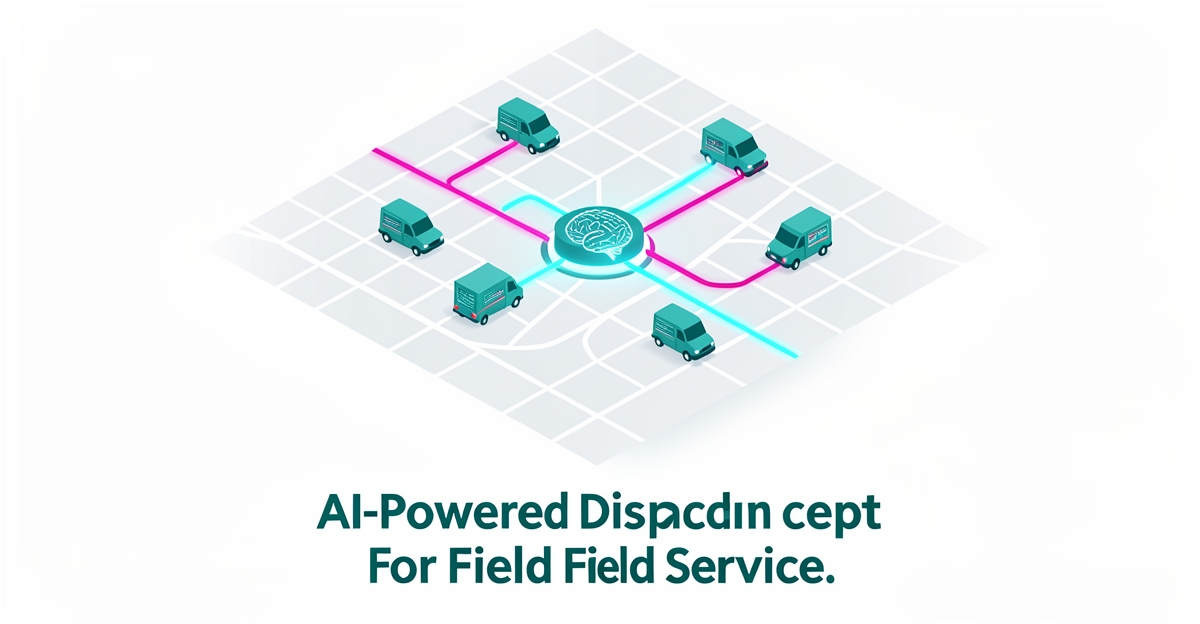
AI Dispatch for Field Service Businesses: Getting the Right Tech Out Faster
Key Facts
- 80% of commercial contractors believe AI will be essential to competitiveness within three years according to research.
- 85% of field service leaders expect AI investments to increase over the next year per Salesforce.
- AI dispatch reduces travel time by 30% and improves on-time arrivals by 25% research shows.
- $475 average cost of a single extra truck roll in the solar industry industry data.
- 79% of service leaders call AI agents fundamental to meeting current business demands Salesforce survey.
- AI could handle 35% of technician admin work, freeing two hours weekly per research.
- 50% of service cases may be resolved by AI by 2027, up from 30% in 2025 industry forecast.
Hire a team member that works 24/7 — for less than a part-time wage.
AI receptionists, SDRs, dispatchers and 99+ roles. Trained on your business, fully managed.
Not sure where to start? Ask our AI planner
The Urgency of AI-Driven Dispatch in Field Service
Every morning a dispatcher at a whiteboard or in a spreadsheet makes dozens of assignment decisions by gut feel, and every one of those decisions costs money. Industry analysts now describe traditional field service models as "becoming obsolete," and the gap between AI-enabled and manually dispatched fleets is widening fast. This isn't a tech upgrade anymore. It's a survival question.
The numbers behind that urgency are hard to ignore. In a survey of 606 commercial contractors, 80% said AI will be essential to staying competitive within three years, while 30% cited outdated technology as a limit on growth. Meanwhile, 85% of field service leaders expect their AI investments to increase over the next year, according to Salesforce's survey of 6,500 service professionals across 40 countries.
What AI dispatch actually delivers explains why the market is moving so quickly. Fully automated dispatch optimization can reduce travel time by up to 30% and improve on-time arrival rates by more than 25%, gains that compound across every job, every day. And when dispatch gets it wrong, the cost is real: a single extra truck roll in the solar industry averages $475, before counting the customer who's left waiting without an update.
The businesses falling behind share a common pattern. Companies with 10–50 technicians often can't justify enterprise platforms like Salesforce Field Service or ServiceNow, so they still run on spreadsheets, email chains, and basic scheduling software. That's precisely the gap AIQ Labs built for, an AI Dispatcher or Service Coordinator AI Employee, deployed on a flat monthly plan that costs less than a part-time hire, with no enterprise implementation timeline.
The window is narrowing. As AI dispatch becomes standard equipment, customers increasingly expect accurate arrival windows, proactive delay notifications, and first-visit resolution, expectations a manual dispatcher simply can't meet at scale. Waiting another year doesn't preserve the status quo; it hands jobs to competitors who moved first.
- 96% of field service leaders plan to use AI for instant access to information
- 79% of service leaders call AI agents fundamental to meeting current business demands
- AI could handle 35% of technician admin work, freeing two hours per week
- 50% of service cases are expected to be resolved by AI by 2027, up from 30% in 2025
The question facing field service owners isn't whether to adopt AI dispatch, it's whether they'll do it while the advantage still counts for something.
Why SMBs Need Smarter Dispatch Tech, Not Enterprise Solutions
The businesses that need AI dispatch most are often the ones least able to buy it. While enterprise giants pour money into sophisticated field service platforms, the 10–50 technician shop, the HVAC contractor with 25 trucks, the plumbing company with three dispatchers drowning in calls, still coordinates jobs through spreadsheets, email chains, and sticky notes.
This gap isn't a small niche; it's a structural flaw in the market. According to industry analysis, enterprise platforms like Salesforce Field Service, ServiceNow, and Microsoft Dynamics carry "enterprise pricing, complex implementation requirements, and long onboarding periods" that mid-sized field service businesses simply cannot justify. So they stay manual, absorbing the costs that come with it.
And those costs are real. Every misassigned job risks an additional truck roll, which averages $475 in the solar industry alone. Meanwhile, 80% of commercial contractors believe AI will be essential to staying competitive within three years, and 30% already cite outdated technology as a growth limitation. The pressure to modernize is building from both directions: rising costs below, competitive threat above.
The irony is that SMBs don't need less technology, they need smarter, right-sized technology. As one field service expert puts it, these teams "do not need an enterprise budget to benefit from AI. They need practical tools that work on a mobile device, connect to the back office, and make the day-to-day coordination of a dispersed team significantly easier."
What right-sized AI dispatch looks like for a growing field service business:
- A single AI Dispatcher or Service Coordinator that handles assignment, scheduling, and follow-up without a six-month implementation
- Flat monthly pricing that costs less than a part-time hire, with the ability to pause or adjust as demand shifts
- Integration with existing tools, CRM, calendars, scheduling software, rather than a rip-and-replace platform migration
- A starting point focused on one broken workflow, expandable in phases as results prove out
This is exactly the gap AIQ Labs built its model around. Its AI Employees, including an AI Dispatcher among 99 supported roles, run on a Start Monthly plan: one role, a flat monthly cost, with build, training, integrations, monitoring, and improvements included. No enterprise contract, no implementation army, no vendor lock-in.
The businesses that close this gap first won't just save money on dispatch. They'll capture the jobs their slower competitors miss, while a competitor reads about AI, the company that deployed it is booking the job. In a market where 85% of field service leaders expect AI investments to increase over the next year, waiting isn't caution, it's conceding ground.
How AIQ Labs Delivers Faster, Smarter Dispatch Implementation
According to industry research, 85% of field service leaders expect AI investments to grow, underscoring the urgency for businesses to adopt smarter dispatch solutions. AIQ Labs addresses this need with a phased approach that prioritizes speed, scalability, and affordability, key differentiators for SMBs navigating the AI dispatch gap.
Starting with a single role, AIQ Labs deploys AI Employees like Dispatchers or Service Coordinators, which operate 24/7 at 80% less cost than human hires. This model directly targets the 10–50 technician segment, a market underserved by enterprise platforms like Salesforce Field Service. By focusing on high-impact workflows, businesses avoid complex implementation hurdles while achieving immediate gains.
As operations mature, AIQ Labs scales with custom systems that integrate real-time data for dynamic technician matching. Research shows AI dispatch reduces travel time by up to 30% and improves on-time arrivals by 25% by analyzing skills, location, and SLAs. This capability transforms dispatchers from logistics managers to relationship-focused strategists, aligning with the shift toward proactive service models.
The process unfolds through flexible payment models: Start Monthly for AI Employees, Build in Milestones for workflow automation, or Own It Outright for full system ownership. This structure ensures businesses can adapt without upfront complexity.
- Begin with one role (e.g., AI Dispatcher) to solve immediate bottlenecks
- Expand to custom systems that optimize routes, predict delays, and automate customer communication
- Scale seamlessly with phased investments, retaining control over AI assets
By grounding implementation in real-world data, such as the $475 cost of a single truck roll or 80% contractor confidence in AI’s competitive necessity, AIQ Labs ensures SMBs gain a strategic edge without enterprise overhead. The result is a roadmap where technology evolves alongside business needs, turning dispatch from a logistical challenge into a competitive advantage.
Still paying for 10+ subscriptions that don’t talk to each other?
We build custom AI systems you own outright. No vendor lock-in. Full control.
Not sure where to start? Ask our AI planner
Frequently Asked Questions
How much can AI dispatching actually save my field service business?
Isn't AI dispatch software only affordable for large enterprise companies?
Will AI dispatching replace my human dispatchers?
How does AI dispatch decide which technician to send to a job?
Is AI dispatch really necessary, or just a nice-to-have right now?
What's the best way for a small field service company to start with AI dispatch?
The Urgent Shift to AI Dispatch for SMBs
The field service industry is at a crossroads, where manual dispatching is no longer sustainable. With 80% of commercial contractors expecting AI to be essential within three years and the cost of errors like a single extra truck roll averaging $475, the urgency to adopt AI-driven solutions is undeniable. For SMBs with 10–50 technicians, the challenge lies in accessing scalable, affordable technology that fits their needs without enterprise overhead. AIQ Labs bridges this gap by offering AI Employees like Dispatchers on a flexible, monthly plan, costing less than a part-time hire and deployable without complex implementation. By starting with one critical workflow, businesses can unlock immediate gains in efficiency, customer satisfaction, and cost savings. The question isn’t whether to adopt AI, but whether to act before competitors do. Take the first step today with a free Fit Check to discover how AI can transform your operations without the risk or complexity of traditional solutions.
Make AI your competitive advantage — not just another tool.
Strategy, implementation and ongoing optimization. One partner, end to end.
Not sure where to start? Ask our AI planner