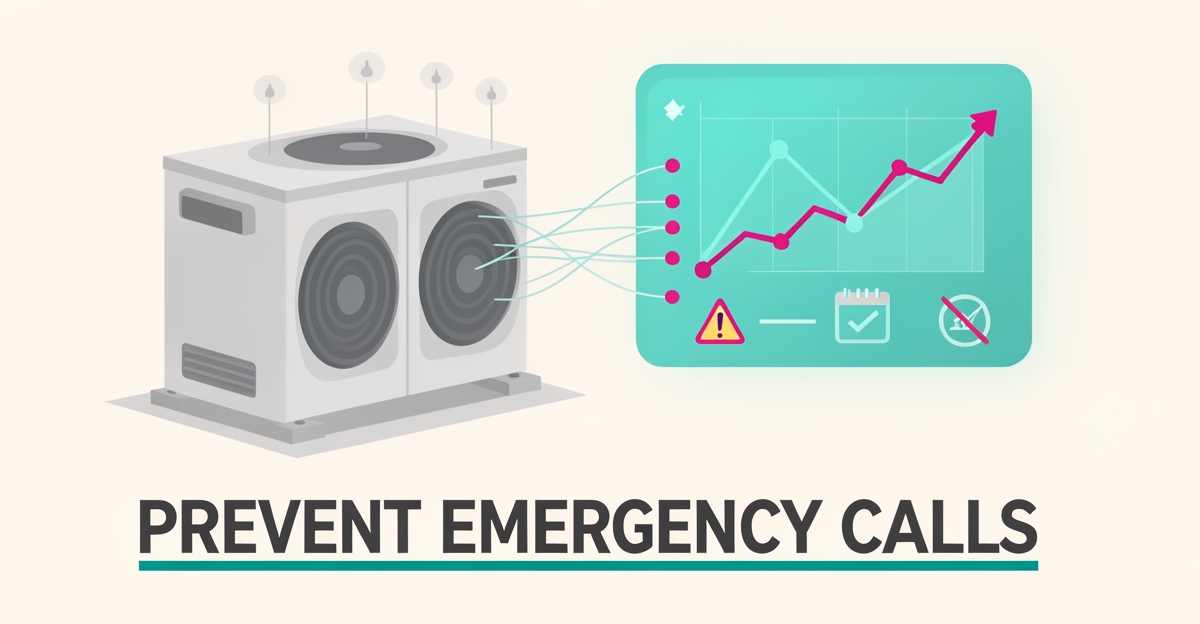
AI-Driven Maintenance Scheduling: How to Prevent Emergency Calls in HVAC Systems
Key Facts
- Industry analyses report AI-driven maintenance can reduce HVAC emergency calls by up to 30% according to Oxmaint
- Emergency HVAC repairs are typically reported to cost several times more than planned interventions per Oxmaint data
- AI-based predictive maintenance has achieved roughly 94% PM compliance for HVAC versus about 61% on calendar-based programs as reported by Oxmaint
- Operations adopting AI condition-based PM have reported reductions in unplanned asset failures of around 68% within the first year per Oxmaint research
- AI predictive maintenance is commonly associated with 25-30% reductions in overall maintenance costs per IBM research
- AI-driven scheduling can reduce total downtime by 35-45% through timely interventions per IBM findings
- Organizations moving to AI condition-triggered maintenance have reported multi-fold ROI within 24 months per Oxmaint analysis
Hire a team member that works 24/7 — for less than a part-time wage.
AI receptionists, SDRs, dispatchers and 99+ roles. Trained on your business, fully managed.
Not sure where to start? Ask our AI planner
The Emergency Call Problem: Why Calendar-Based HVAC Maintenance Fails
Reactive HVAC maintenance isn't just inconvenient, it's expensive. Industry data suggests emergency repairs typically cost several times more than planned interventions, with reactive work consuming a large share of total maintenance spending. Calendar-based preventive maintenance fails between fixed intervals, leaving facilities flying blind as equipment degrades unnoticed until sudden failure strikes. This approach guarantees over-maintenance on healthy units while critical wear goes undetected until it triggers expensive emergency calls. The result is a cycle where technicians spend disproportionate time fighting fires instead of preventing them, eroding both operational efficiency and profitability. AIQ Labs addresses this reactive pattern by building intelligent scheduling systems that predict service needs based on actual usage patterns, temperature data, and repair history, turning guesswork into precision maintenance that prevents emergencies before they occur.
How AI Predictive Maintenance Actually Works for HVAC Systems
HVAC failures rarely announce themselves the day they happen. AI-driven scheduling catches the warning signs weeks earlier by turning continuous sensor data into actionable maintenance windows instead of emergency dispatches.
IoT sensors form the sensing layer. The system continuously monitors filter differential pressure, bearing vibration, refrigerant pressure, and coil temperature to build a live health profile for each unit. AI-driven preventive maintenance guides note HVAC is one of the largest single PM categories in commercial facilities management and a leading source of reactive maintenance cost.
The data stream feeds complementary models:
- Anomaly detection models that learn normal operating signatures and flag statistically significant deviations
- Remaining useful life prediction models that estimate component wear and provide weeks of advance warning
- Edge processing that evaluates thresholds in milliseconds and can trigger automated work orders
Anomaly detection works unsupervised. It scans new vibration, pressure and temperature readings against established baselines and alerts when drift suggests misalignment, blockage or early-stage malfunction. This early flagging is what enables planned intervention instead of emergency response.
Failure prediction adds a planning horizon. Supervised models trained on historical run-to-failure data calculate remaining useful life for bearings, coils and compressors. Maintenance teams receive specific windows to schedule filter changes, coil cleaning or bearing replacement before efficiency loss or failure occurs.
IBM describes the approach as similar to a wearable health tracker. It continuously monitors vital signs, vibration, temperature and pressure, and provides an early warning of potential problems weeks before they manifest. The analogy makes the technology accessible: the system watches equipment the way a health tracker watches a person.
The impact is measurable. Industry research from IBM associates AI-based predictive maintenance with 25-30% reductions in maintenance costs and 35-45% reductions in total downtime. For HVAC and building systems, Oxmaint data reports 94% PM compliance with AI-driven PM versus 61% on calendar-based programmes.
AIQ Labs builds intelligent scheduling systems that integrate with existing maintenance logs and service tools, using usage, temperature data and repair history to predict servicing needs. The result is fewer emergency calls and more predictable operations without replacing the tools teams already use.
The Numbers: What HVAC Operators Gain from AI-Triggered Scheduling
The gap between calendar-based and condition-based maintenance isn't marginal, it's the difference between running a fire department and fireproofing the building. For HVAC operators weighing the switch, the benchmarks from early adopters make a compelling financial case.
Start with compliance. Facilities running AI-driven preventive maintenance on HVAC and building systems have reported PM compliance around 94%, compared to roughly 61% on calendar-based programmes, according to Oxmaint's preventive maintenance analysis. That gap matters because every missed PM is a failure waiting for the next heat wave or cold snap, and an emergency call you didn't plan for.
The failure numbers tell a similar story. Operations that replaced fixed-interval PM with AI condition-triggered maintenance have reported reductions in unplanned asset failures of around 68% within 12 months. The same research shows the emergency repair ratio, the share of maintenance budget consumed by reactive work, dropping meaningfully in that first year. That shift alone transforms cash flow, since emergency HVAC repairs typically cost several times more per event than planned interventions.
The broader cost picture reinforces the case:
- 25-30% reduction in overall maintenance costs, as documented in IBM's research on AI predictive maintenance, because repairs happen only when data shows actual wear
- 35-45% reduction in total downtime, with interventions scheduled during planned lulls rather than mid-crisis
- Multi-fold average ROI within 24 months for operations moving from calendar-based to condition-triggered maintenance
- Substantially faster time from anomaly detection to work order creation when scheduling is automated
Why does AI outperform the calendar so decisively? Because a fixed 90-day interval treats every unit identically, whether it ran 10 hours or 10,000 that quarter. AI scheduling instead reads live signals, filter differential pressure, bearing vibration, refrigerant pressure, coil temperature, and triggers service weeks before efficiency loss or failure, giving prediction models a multi-week planning window.
For HVAC operators, the practical path forward is simpler than the technology suggests. AI predicts when units need servicing based on usage, temperature data, and repair history, reducing emergency calls by up to 30%, and systems like those AIQ Labs builds integrate directly with existing maintenance logs and service tools, so the transition doesn't require ripping out what already works. The benchmarks above aren't projections; they're what operators who made the switch have reported.
Implementation Roadmap: From Sensors to Auto-Generated Work Orders
Implementing AI-driven maintenance scheduling begins with strategic sensor deployment to capture real-time HVAC performance data. Installing vibration, temperature, pressure, and acoustic sensors on critical components like compressors, fans, and coils creates the data foundation needed for predictive analytics. These sensors continuously monitor operational parameters, feeding raw data into the AI system for baseline establishment and anomaly detection. This approach transforms maintenance from reactive fixes to proactive interventions, directly supporting the goal of reducing emergency calls through timely, data-driven service scheduling.
Establishing accurate operating baselines is essential for distinguishing normal variations from genuine failure precursors. Machine learning algorithms analyze historical sensor data to define what "normal" looks like for each specific HVAC unit under various load conditions. This baseline becomes the reference point against which all new data is compared, enabling the system to detect subtle deviations that human operators might miss. With a solid baseline in place, anomaly detection models can reliably flag early warning signs of issues like bearing wear, refrigerant leaks, or airflow restrictions weeks before they escalate into failures.
Once anomalies are detected, automated workflows trigger immediate work order generation, cutting response time dramatically. Integrating the AI system with existing CMMS platforms allows condition-based alerts to auto-populate work orders with asset details, fault classification, and recommended actions. This seamless integration ensures maintenance teams receive actionable insights without manual data entry, accelerating response while maintaining full traceability. Continuous improvement loops then refine the system over time, using maintenance outcomes to reduce false positives and enhance prediction accuracy as the AI learns from real-world equipment behavior.
Getting Started Without a Massive Overhaul: The Phased Approach
Many HVAC businesses hesitate to adopt AI-driven maintenance due to fears of costly system overhauls, but the most effective implementations start small and scale strategically. Rather than replacing existing maintenance logs or dispatch tools, AIQ Labs builds owned systems that integrate directly with current workflows, allowing technicians to continue using familiar interfaces while gaining predictive insights. This phased approach, delivered through AI Workflow Builds with fixed pricing and milestone-based delivery, minimizes disruption and delivers measurable results before expanding to additional assets.
The first step is identifying the highest-cost HVAC units, typically older systems or those in critical environments, where emergency calls drive the greatest financial strain. By focusing AI modeling on these assets first, businesses can target interventions where predictive maintenance delivers the strongest impact, such as reducing emergency repair costs that run several times higher than planned interventions. Early wins here fund broader deployment while building internal confidence in the technology.
Integration begins with connecting AI models to existing service tools and maintenance logs, using real-time sensor data on filter pressure, bearing vibration, and coil temperature to establish baseline performance. When anomalies are detected, the system automatically generates work orders within existing dispatch platforms. This ensures technicians receive actionable alerts without learning new software or changing their daily routines.
As compliance improves, reported at around 94% PM compliance for HVAC systems versus 61% on calendar-based programs, businesses gain the data and momentum to expand AI scheduling to additional units or service types. Each phase builds on the last, creating a self-funding path toward full predictive maintenance that reduces emergency calls and optimizes technician productivity without requiring a massive upfront investment. Start with the 2-minute Fit Check to map your highest-impact starting point, then book a free 30-minute strategy call to see how a phased AI rollout can prevent costly emergency calls in your HVAC operations.
Still paying for 10+ subscriptions that don’t talk to each other?
We build custom AI systems you own outright. No vendor lock-in. Full control.
Not sure where to start? Ask our AI planner
Frequently Asked Questions
How much can AI-driven maintenance reduce emergency HVAC calls?
What is the cost difference between emergency HVAC repairs and planned maintenance?
How does AI predict when HVAC systems need maintenance before failure occurs?
What improvement in preventive maintenance compliance can HVAC operators expect with AI scheduling?
Can AI maintenance systems work with our existing tools without requiring a full overhaul?
What ROI can HVAC businesses expect from switching to AI-driven maintenance?
Key Takeaways
From Firefighting to Fireproofing: Your HVAC Maintenance Evolution Starts Now, The case is clear: calendar-based HVAC maintenance leaves money on the table, with reactive work consuming a large share of maintenance budgets at a cost several times higher than planned interventions. AI-driven scheduling flips that equation, using sensor data, usage patterns, and repair history to predict failures weeks ahead, lift PM compliance, and cut emergency calls by up to 30%. You don't need a rip-and-replace project to get there: a phased build that integrates with your existing tools, starts with your highest-cost units, and expands as the wins compound. Take the 2-minute Fit Check at aiqlabs.ai/apply to find your highest-impact starting point.
Make AI your competitive advantage — not just another tool.
Strategy, implementation and ongoing optimization. One partner, end to end.
Not sure where to start? Ask our AI planner