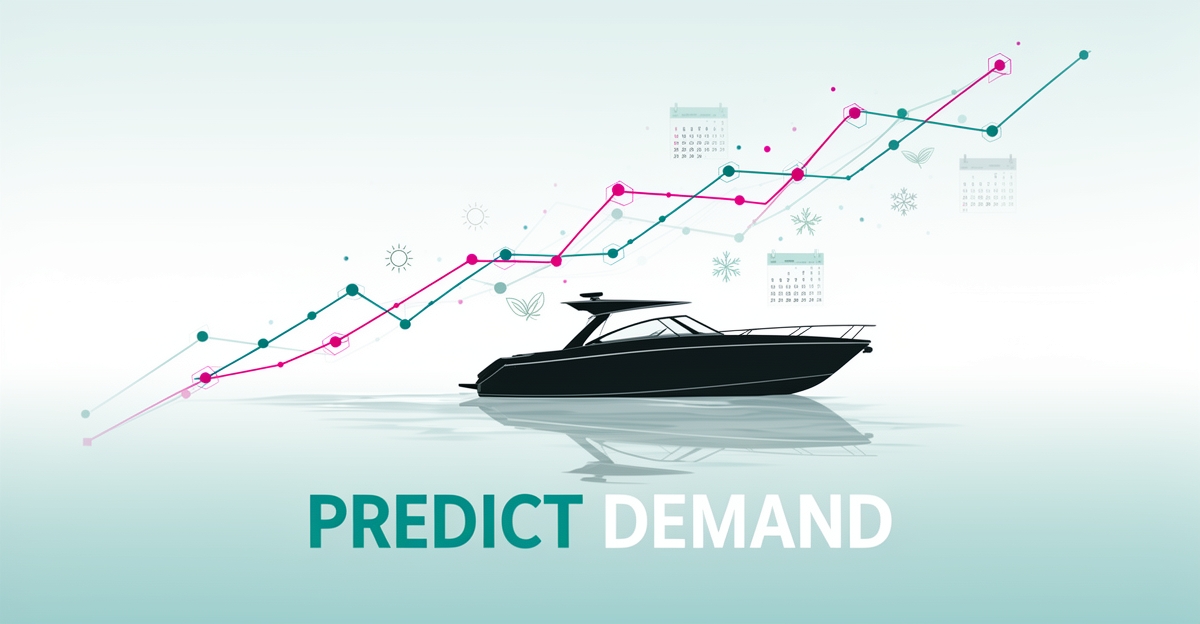
AI-Driven Sales Forecasting for Boat Dealerships: How to Predict Demand
Key Facts
- Marine inventory is high-value, seasonal, and weather-sensitive — the exact conditions where manual forecasting breaks down fastest
- AI forecasting typically trains on 3+ years of historical sales data to establish baseline seasonal patterns
- Good models layer in regional weather, water temperature trends, fuel prices, and local event calendars for dynamic prediction
- Industry analyses of AI-powered inventory optimization commonly point to six-figure annual savings for dealerships that move from gut feel to data-driven ordering
- Forecasts should update weekly as new data arrives, so ordering decisions stay current through the season
- AIQ Labs has deployed 200+ multi-agent systems and runs 4 live SaaS products daily — forecasting is built on production experience, not theory
Hire a team member that works 24/7 — for less than a part-time wage.
AI receptionists, SDRs, dispatchers and 99+ roles. Trained on your business, fully managed.
Not sure where to start? Ask our AI planner
The Cost of Guesswork in Marine Inventory Planning
Relying on gut feel and last year's sales to stock boats is expensive. Marine inventory is high-value, seasonal, and exposed to weather and economic swings, so guesswork quickly turns into carrying costs or lost sales.
Historical averages miss the signals that actually move demand. Dealerships forecasting by intuition routinely face stockouts on hot models while slower units tie up floorplan financing. That imbalance creates lost revenue and excess carrying costs at the same time.
Industry analyses of AI-powered inventory optimization commonly point to six-figure annual savings for dealerships — the money comes from fewer emergency orders, reduced holding costs, and better cash flow through optimized ordering. The exact figure depends on your volume and how far off your current ordering is, which is why we don't quote a fixed number before seeing your data.
The operational risks compound across departments. Without accurate demand signals, sales teams chase leads for models that won't arrive on time, service bays are staffed for volume that never materializes, and marketing spend promotes inventory that sits.
Predictive analytics changes that equation by analyzing historical sales patterns, weather data, economic indicators, and regional boating trends to produce actionable forecasts. An AI Operating System connects those forecasts to your existing tools, so sales, service, and purchasing all work from the same numbers instead of three different spreadsheets.
The cost of guesswork shows up in three persistent ways:
- Stockouts on peak-season models that drive margin, forcing lost sales and customer churn to competitors
- Overstock of slow-moving units that increase floorplan interest and storage costs
- Missed sales opportunities when inventory positioning does not match regional demand shifts
Adoption of AI in marine retail is accelerating, and early adopters are seeing the efficiency gains — better lead alignment, tighter inventory, and service departments that schedule ahead of demand instead of behind it. The dealerships that wait are the ones buying the lesson at full price.
AIQ Labs approaches this through forecasting models that learn seasonal demand, plan inventory, and inform staffing from your dealership's own data. Models are trained on your historical sales, market trends, and regional signals to inform decisions — not replace them.
When demand forecasting is accurate, dealerships reduce stockouts and cut excess inventory while improving cash flow. The result is fewer fire sales at season end, more turns on high-demand models, and a sales team that can focus on customers instead of chasing inventory exceptions.
How AI Forecasting Transforms Demand Prediction in Boat Sales
AI forecasting transforms demand prediction in boat sales by moving beyond static historical averages to dynamic, multi-variable modeling. Traditional methods fail to capture the complex interplay of seasonal boating patterns, regional economic shifts, and weather-dependent demand spikes that characterize marine markets. AI models trained on years of dealership sales data, combined with real-time inputs like temperature trends, fuel prices, and local event calendars, generate forecasts that continuously adapt to changing conditions. This lets dealerships anticipate demand fluctuations with greater precision, reducing both stockouts and overstock.
The downstream effect on sales is direct: when forecasts accurately predict which models will sell in specific regions and seasons, sales teams spend less time managing disappointed customers or explaining delays. Instead, they work high-intent leads with the right boats actually in stock, which improves conversion and customer satisfaction at the same time. The same predictive insights let service departments schedule technicians and order parts ahead of predicted demand waves instead of reacting to them.
The financial benefit comes from inventory turnover. Dealerships using AI-driven forecasting typically see savings through reduced holding costs, less discounting on aged stock, and improved cash flow from faster-moving inventory. The system's value is in weighing multiple factors simultaneously — predicting a surge in pontoon demand from an unusually warm spring in the Great Lakes region while adjusting for a regional economic downturn that suppresses luxury yacht inquiries. By synthesizing historical patterns with external indicators, AI creates forecasts that are not just accurate but actionable across sales, service, and operations.
- Analyzes 3+ years of historical sales data to identify baseline seasonal patterns
- Integrates regional weather forecasts and water temperature trends
- Adjusts for local economic indicators like unemployment rates and disposable income shifts
- Incorporates boating event calendars, fuel price fluctuations, and tourism data
- Updates forecasts weekly as new data streams in, enabling agile decision-making
AIQ Labs builds these forecasting capabilities as custom models that learn from each dealership's unique sales history and keep refining based on real-world outcomes. Unlike generic forecasting tools, they're built to understand the nuances of marine retail — where a single unseasonably cold week can delay spring sales, or a major fishing tournament can create unexpected demand for center consoles in one coastal zone. If forecasting is the workflow costing you the most, it can be rebuilt as a fixed-price AI Workflow Build; if you want forecasting connected to sales, service, and purchasing in one layer, that's an AI Operating System built in phases. Either way, the result is a forecasting engine that doesn't just predict demand — it helps you proactively shape inventory, staffing, and marketing around anticipated market movements, so the right boats are in the right place at the right time without guessing.
Implementing AI Forecasting: From Data to Decision-Making
Adopting AI-driven forecasting doesn't have to be a leap into the unknown. With a structured, phased approach, boat dealerships can move from manual guesswork to predictive precision — without disrupting daily operations.
The first step is data preparation. AI models rely on clean, consistent historical data to identify patterns and generate accurate forecasts. That means consolidating sales records, service logs, inventory turnover, and customer interactions into a unified system. Dealerships that standardize their data are the ones that see the savings — the model is only as good as what it learns from.
Next comes model training. The system analyzes historical sales, seasonal trends, weather patterns, and regional demand signals to predict future behavior. A dealership in Florida might see spikes in center console demand in early spring, while a Great Lakes dealer needs pontoons stocked before summer. These insights drive smarter ordering, better staffing, and more targeted marketing.
Integration with existing systems is critical. Forecasting tools must connect with your CRM, inventory management, and accounting platforms so data flows in real time and nobody re-enters anything by hand. As AI adoption in marine retail accelerates, the dealerships that integrate now are building the lead; the ones that wait are building their competitors'.
Staff adoption is often the biggest hurdle. Teams need to trust and act on AI-generated insights. Start with a pilot focused on one department — sales or service — and expand as confidence grows. AIQ Labs builds in milestones, so each phase proves measurable value before the next one starts. You're never asked to bet the dealership on a promise.
- Clean and consolidate historical sales, service, and inventory data
- Train AI models on seasonal, regional, and behavioral patterns
- Integrate forecasting with CRM and inventory systems
- Launch a pilot program to build staff confidence and refine workflows
Dealerships that follow this path typically see service departments handling more volume without new hires and sales teams converting better because the inventory matches the demand — the size of those gains depends on your starting point, which is exactly what a pilot measures.
AIQ Labs supports dealerships through every phase — from data cleanup to full deployment — so your forecasting system is built on your data, your goals, and your team's readiness. Start with a fixed-price Workflow Build for the one workflow that costs you most, or go all the way to an operating system you own outright.
Still paying for 10+ subscriptions that don’t talk to each other?
We build custom AI systems you own outright. No vendor lock-in. Full control.
Not sure where to start? Ask our AI planner
Frequently Asked Questions
How much money can AI forecasting actually save a boat dealership each year?
Will AI forecasting really improve my sales team's lead conversion?
What data does AI need to forecast boat demand accurately?
Is AI forecasting hard to implement with our existing CRM and inventory systems?
Can AI help my service department without hiring more technicians?
How do we get started with AIQ Labs?
Turn Forecasting into Your Competitive Edge
AI-driven sales forecasting isn't just about predicting demand — it's about aligning inventory, staffing, and marketing with real market signals to eliminate guesswork. Boat dealerships that adopt this approach see fewer stockouts, lower holding costs, and improved cash flow, with the biggest gains going to whoever moves first. By integrating historical sales, weather trends, economic indicators, and regional events, AI turns reactive planning into proactive strategy across sales, service, and operations. The path forward starts with clean data, a phased build, and team adoption — and AIQ Labs builds it that way: fixed-price milestones, no inflated promises, and a system you own outright. If you're ready to move beyond intuition and let data drive smarter inventory decisions, take the 2-minute Fit Check at aiqlabs.ai/apply and book a free 30-minute strategy call to map your highest-impact opportunity.
Make AI your competitive advantage — not just another tool.
Strategy, implementation and ongoing optimization. One partner, end to end.
Not sure where to start? Ask our AI planner