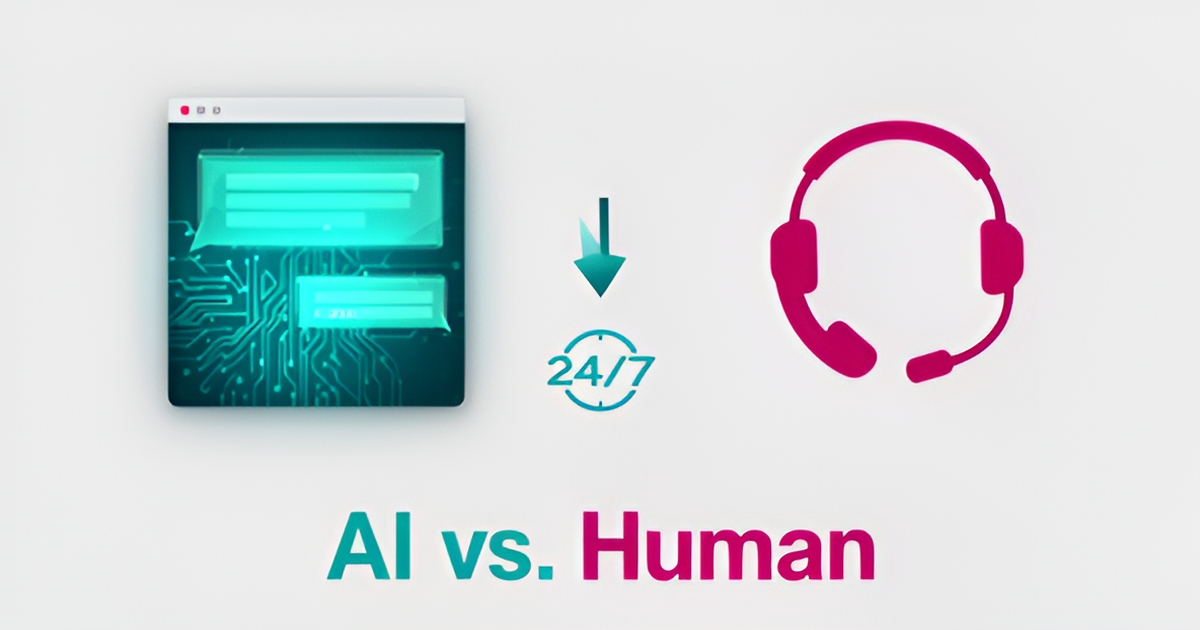
AI Employee vs. Human Agent: Which Is Better for Handling Feed Orders and Inquiries?
Key Facts
- Industry benchmarks consistently show AI-handled service tickets costing a fraction of human-handled ones — often cited at roughly 9x cheaper per interaction
- Customer service is widely reported as the fastest-payback function for AI adoption, with many businesses seeing returns within the first year
- Enterprise adoption of AI agents is high, but only a small share of organizations run them at scale — a production-readiness gap that defines 2026 planning
- AI employees work 24/7/365 at roughly 80% less cost than a comparable human hire, with zero missed calls or sick days
- Vendor-deployed AI agents typically reach production value significantly faster than custom in-house builds
- AI agents reduce response times from hours to minutes while eliminating fatigue-driven errors
- AIQ Labs has deployed 200+ multi-agent systems and runs 4 live SaaS products daily — this is proven infrastructure, not theory
Hire a team member that works 24/7 — for less than a part-time wage.
AI receptionists, SDRs, dispatchers and 99+ roles. Trained on your business, fully managed.
Not sure where to start? Ask our AI planner
The Hidden Cost of Human-Only Feed Inquiry Handling
When a customer calls to place a feed order or ask about delivery logistics, every minute they wait on hold chips away at their loyalty. For small and medium-sized businesses relying exclusively on human agents, these delays are not just inconveniences—they represent a structural financial drain that compounds with every interaction.
The math is stark. Industry research on AI agent costs consistently shows that a customer service ticket handled by a human costs several dollars, while an AI agent resolves the same type of inquiry for a small fraction of that — figures commonly cited around a 9x cost gap per interaction. For an SMB fielding dozens of feed inquiries daily, this gap translates to thousands of dollars in unnecessary operational spend each month, simply to maintain the status quo.
Speed compounds the problem. AI agents can reduce response times from hours to minutes, yet human-only teams remain bound by shift schedules, breaks, and the physical limits of simultaneous call handling. When a potential customer calls at 7 PM to check inventory or modify a standing order, they reach voicemail instead of a resolution—and often dial a competitor instead.
Human-only operations also carry hidden error costs. Fatigue and distraction introduce mistakes in order entry, pricing quotes, and delivery scheduling that require costly corrections and erode trust. Unlike AI systems trained on specific business rules, human agents juggle multiple systems and mental checklists, creating friction that slows every transaction.
The scalability ceiling presents perhaps the greatest risk. Customer service is repeatedly cited as the fastest-payback function for AI deployment, yet many SMBs remain trapped in linear growth models where doubling inquiry volume means doubling headcount. This creates a growth ceiling where success itself becomes an operational burden.
Businesses clinging to human-only models face mounting disadvantages:
- Missed revenue from after-hours calls and delayed responses
- Labor costs that scale linearly with growth rather than efficiently
- Inconsistent service quality due to turnover and training gaps
- Inability to capture data analytics from every customer interaction
AIQ Labs addresses these specific bottlenecks through managed AI Employees — AI Receptionists, Sales Reps, and 99+ other roles that handle feed orders, answer pricing questions, and process inquiries 24/7 at roughly 80% less than the cost of a comparable human hire. Unlike traditional hires, these AI team members never miss a call, never misquote a price, and scale instantly when seasonal demand spikes. For SMBs ready to eliminate the hidden tax of human-only operations, the transition offers not just savings, but survival in an increasingly immediate marketplace.
Why AI Employees Outperform Humans in Feed Order Workflows
When a feed customer calls at 6 a.m. with a delivery question, or a bulk order comes in on a Sunday, the math of coverage changes fast. The data increasingly shows that AI employees don't just match human agents in these workflows — they outperform them on the metrics that matter most.
Start with cost. Industry research on AI agent ROI consistently shows human-handled service tickets costing several times more than AI-handled ones — a gap commonly cited at around 9x per task. For feed operations handling dozens of pricing, availability, and delivery inquiries daily, that gap compounds into thousands of dollars monthly.
Speed to value matters just as much. Customer service is widely reported as the fastest-payback function for AI deployment, with most companies seeing returns within the first year. AI Employees from AIQ Labs are built for exactly this kind of rapid return, arriving pre-trained on your catalog, pricing, and delivery rules rather than starting from scratch.
Then there's availability — the area where no human team can compete. AI agents process orders and inquiries around the clock, scale to any volume without added cost, and eliminate fatigue-driven errors. For feed businesses, that means:
- Every call answered, including evenings, weekends, and peak season surges
- Consistent accuracy on pricing, product specs, and delivery windows
- Instant order processing without hold times or callback delays
- Capacity that scales with demand, not headcount
The governance question is legitimate. Embedding AI agents directly into legacy systems without proper controls creates accountability gaps that can't be defended later. That's precisely why AIQ Labs deploys AI Employees with enterprise-grade safeguards baked in — validation layers, hard capability limits, human-in-the-loop escalation, and complete audit trails on every action.
The result isn't a choice between efficiency and control. It's a managed AI workforce that handles feed orders faster, cheaper, and around the clock — while your human team focuses on the relationships and exceptions that genuinely need them.
Implementing AI Employees for Feed Orders: A Risk-Mitigated Approach
The gap between AI ambition and production reality is stark: most enterprises have adopted AI agents in some form, yet only a small share run them at scale. For SMBs handling feed orders and delivery inquiries, this underscores a critical insight — success depends not on the technology itself, but on how it's deployed. A risk-mitigated approach starts with infrastructure and governance before a single agent goes live.
Customer service is typically the fastest path to measurable value in AI deployment — significantly faster than marketing or engineering use cases. This aligns directly with feed operations, where pricing questions, delivery scheduling, and inventory checks create repetitive, high-volume inquiry patterns. AIQ Labs' Start Monthly payment model is engineered for this reality: a flat monthly plan that costs less than a part-time hire, inclusive of build, training on your specific business rules, tool integrations, monitoring, and continuous improvements — with the ability to pause or adjust anytime. As your needs grow, Workflow Builds can rebuild the one workflow that costs you the most at a fixed price, and AI Operating Systems connect everything into one layer you own outright.
The deployment sequence matters. Vendor-deployed agents typically reach production value significantly faster than custom in-house builds. AIQ Labs applies this principle through a done-for-you model: you provide a job description, and the team architects, trains, and deploys an AI Employee with a dedicated phone number, email address, and chat presence. Integration with existing CRMs, scheduling software, and order management systems happens via standard APIs — no rip-and-replace required.
Governance cannot be an afterthought. As task-specific AI agents become embedded across enterprise applications, the governance gap widens for teams that skip controls. AIQ Labs addresses this through human-in-the-loop controls for critical decisions, validation layers on every action, hard guardrails customized per role, and complete audit trails for compliance review.
- Start with a single, high-volume workflow — feed pricing and availability inquiries
- Define escalation rules for complex orders or credit decisions
- Establish baseline metrics: response time, resolution rate, cost per inquiry
- Deploy with 24/7 monitoring and weekly performance reviews
- Scale to delivery scheduling and reorder automation after a 30-day validation window
The businesses that cross the production-readiness gap share four attributes: pre-deployment infrastructure investment, governance documentation before deployment, baseline metrics captured before pilots, and dedicated business ownership with accountability. This isn't theoretical — it's the difference between the teams that scale and the ones that stall.
Still paying for 10+ subscriptions that don’t talk to each other?
We build custom AI systems you own outright. No vendor lock-in. Full control.
Not sure where to start? Ask our AI planner
Frequently Asked Questions
How much does an AI employee cost compared to a human employee for handling feed orders and inquiries?
How quickly can I expect to see a return on investment from deploying an AI employee for feed order handling?
Can AI employees handle complex feed order workflows like pricing quotes and delivery scheduling accurately?
What happens if an AI employee encounters a feed order inquiry it can't handle, like a complex credit decision?
Do I need to replace my existing systems to use an AI employee for feed inquiries?
Is it risky to deploy AI employees for customer-facing tasks like feed order handling?
Stop Paying the Human-Only Tax on Every Feed Order
The math is unavoidable: every feed order processed by a human agent costs several times more than one handled by an AI employee, while 24/7 availability and error-free accuracy remain structurally impossible for traditional teams. Customer service is consistently the fastest-payback function for AI deployment, yet the gap between adoption and successful scaling separates winners from those stuck in pilot purgatory. The difference lies in governance-first deployment that eliminates risk without sacrificing speed. AIQ Labs bridges this divide through managed AI Employees — pre-trained Receptionists, Sales Reps, and 99+ other roles that integrate with your existing systems, operate under strict validation protocols, and scale instantly with seasonal demand. Rather than replacing your team, they handle the repetitive volume so your humans can focus on complex relationships. Ready to eliminate the hidden tax on every inquiry? Start with the two-minute Fit Check at https://aiqlabs.ai/apply, then book a free 30-minute strategy call at https://aiqlabs.ai/book — or reach the team directly at [email protected].
Make AI your competitive advantage — not just another tool.
Strategy, implementation and ongoing optimization. One partner, end to end.
Not sure where to start? Ask our AI planner