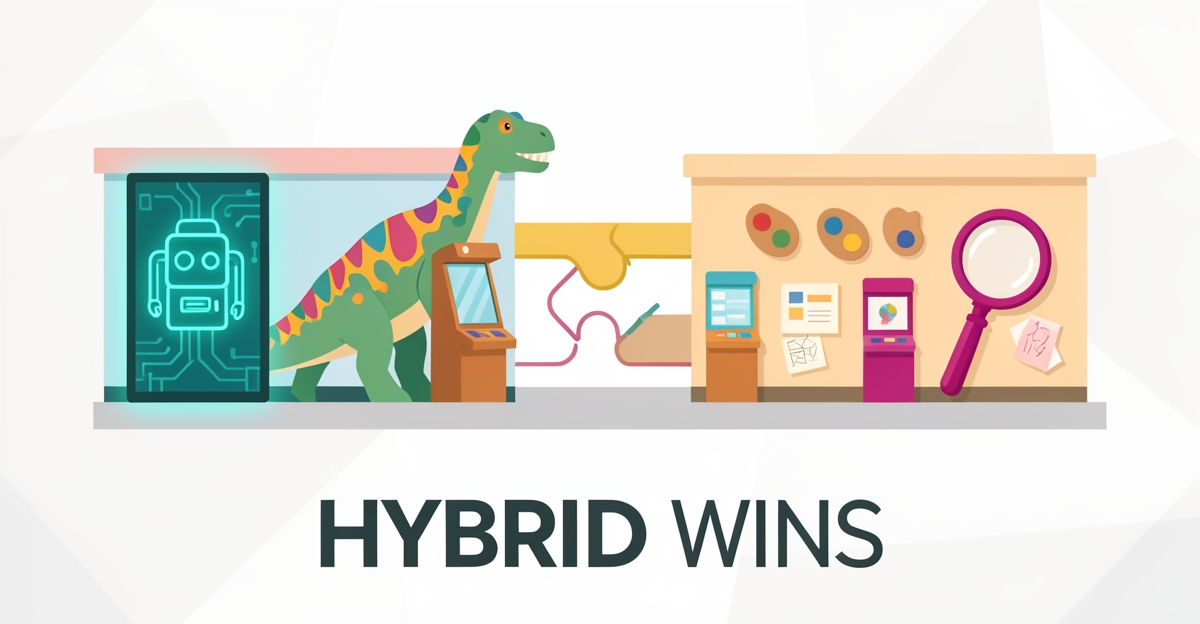
AI Employee vs. Human Guide: Which Is Better for Children's Museums?
Key Facts
- AI systems excel at structured, repeatable tasks, exhibit narration, wayfinding, scheduling and frequently asked questions, while humans remain far stronger at genuinely novel problems, as AI capability research consistently shows
- Human guides bring adaptive judgment: reading a child's frustration, pivoting mid-explanation, and creating unplanned moments of discovery that define memorable visits
- Studies of human-AI collaboration suggest teams combining both tend to outperform either working alone on novel problems
- AI employees typically cost a fraction of a human hire, AIQ Labs' managed AI staff run at roughly 80% less than an equivalent human role
- AIQ Labs has deployed 200+ multi-agent systems and runs 4 live SaaS products daily, this is proven infrastructure, not experimental
Hire a team member that works 24/7 — for less than a part-time wage.
AI receptionists, SDRs, dispatchers and 99+ roles. Trained on your business, fully managed.
Not sure where to start? Ask our AI planner
Introduction
Children's museums sit at the intersection of learning and play, and the choice between human guides and AI employees shapes both cost and experience. As IBM's overview of AI explains, artificial intelligence enables computers to simulate human learning, comprehension and problem-solving, which makes it well suited to routine coverage, while human guides remain essential where judgment, creativity and emotional attunement are required.
The trade-off is not simply price. Human guides deliver high child engagement through adaptation to individual needs, but they are harder to scale and more variable in consistency. AI employees, by contrast, provide consistent and precise information across every interaction, while human guides offer more nuanced, context-dependent responses.
Scalability and consistency pull in opposite directions. AI employees can handle large volumes of tasks and data, scaling easily to peak hours and multiple galleries, whereas human guides scale only with hiring, training and support. Comparative research on AI and human problem-solving highlights the limits of automation: AI systems still struggle with genuinely novel tasks, while humans adapt naturally to the unexpected.
That gap matters for museums. Routine exhibit narration, wayfinding, activity check-ins and scheduling are highly structured. Interactive learning, emotional support and creative facilitation are not. The evidence points to a hybrid model where AI handles routine tasks and humans focus on interactive learning as the most effective approach.
Key tensions museums weigh include:
- Cost: AI employees lower ongoing labor costs for routine coverage, AIQ Labs' managed AI staff run at roughly 80% less than a human hire, while human guides command higher compensation for judgment-intensive work
- Consistency: AI delivers predictable, repeatable information; humans bring nuance with higher variability
- Scalability: AI scales to peak hours and multiple galleries; humans scale with hiring, training and support
- Child engagement: Humans adapt to individual needs for high engagement; AI offers structured, predictable experiences that benefit some learners
The comparison is increasingly relevant as museums explore phased AI adoption. AIQ Labs helps museums build hybrid models through AI Employees for routine coverage and AI Workflow Builds to rebuild the one workflow that costs the most, so human staff can focus on interactive learning. The research consensus is that a hybrid model is the most effective approach.
Designing smarter ways to divide tasks lets AI handle what it is best at and humans focus on what they do better. That division preserves the warmth and creativity children need while using technology to free staff for the moments that matter most.
Key Concepts
When a child's eyes light up at a museum exhibit, the magic often comes from the person guiding them. But as children's museums face budget pressures and staffing challenges, a new question emerges: can AI employees deliver that same spark, or do human guides remain irreplaceable?
The answer lies in understanding what each brings to the table. AI systems are strong in predictable, repeatable scenarios but still struggle with genuinely novel problems, while humans excel at adapting to the unexpected. This gap matters enormously in a children's museum, where unexpected questions and spontaneous learning moments define the experience.
AI employees shine in predictable, repeatable scenarios. An AI activity coordinator can deliver consistent exhibit information, handle routine visitor questions, and scale effortlessly during peak hours. These systems provide structured, predictable experiences that reduce errors and operational costs, exactly what contemporary definitions of AI describe: machines performing tasks commonly associated with intelligent beings, reliably and at volume.
Human guides, however, bring something algorithms cannot replicate: adaptive judgment. They read a child's frustration, pivot mid-explanation, and create those unplanned moments of discovery that define memorable museum visits. The trade-off? Higher costs, limited availability, and natural variability in delivery quality.
The most compelling evidence points toward collaboration rather than replacement. Studies of human-AI collaboration suggest teams combining both tend to outperform either working alone on genuinely novel problems. This hybrid model allows AI to handle routine tasks like scheduling, basic narration, and frequently asked questions, while human guides focus on interactive learning and complex visitor needs.
Consider the practical division of labor:
- AI employees manage exhibit narration, activity coordination, and visitor information during high-traffic periods
- Human guides lead hands-on workshops, respond to behavioral cues, and facilitate deeper learning experiences
- AI systems provide consistent baseline information across all visitor touchpoints
- Human staff handle escalations, special needs accommodations, and creative programming
AIQ Labs helps museums architect this balance through managed AI Employees, receptionists, activity coordinators, dispatchers and 99+ other roles, that identify which tasks benefit from automation and which require human expertise. The goal isn't replacing the human touch, it's amplifying it by removing repetitive burdens.
The evidence is clear: museums that thrive won't choose between AI and human guides. They'll strategically deploy both, letting each do what it does best.
Best Practices
Actionable recommendations for children's museums considering AI integration begin with identifying routine, repetitive tasks where AI employees excel, such as providing standardized exhibit information or managing activity schedules. AI employees can handle large volumes of tasks and scale easily, offering consistency and precision that reduce errors in information delivery, critical for maintaining educational accuracy across high visitor volumes. This allows human guides to redirect their efforts toward areas requiring judgment, creativity, and strategic thinking, such as facilitating hands-on experiments or adapting explanations to diverse learning styles, where human guides demonstrate superior interactive engagement with children.
A hybrid model proves most effective, leveraging AI for consistency and scalability while preserving the irreplaceable value of human interaction. The consistent finding across collaboration research is that optimal outcomes emerge not from replacement but from thoughtful task division. Museums should design clear boundaries: assign AI to narration scripts, check-in procedures, or multilingual support, freeing staff for spontaneous discovery moments and emotional guidance that AI cannot replicate. Training programs should focus on equipping human guides to oversee AI systems, interpret visitor feedback, and create enriched learning pathways that technology alone cannot generate.
Implementation should start small, piloting AI in one high-traffic exhibit or as an activity coordinator during peak hours, then measuring impacts on visitor flow, staff satisfaction, and learning outcomes before expanding. Continuous monitoring ensures the system adapts to visitor needs without compromising the museum's educational mission. By anchoring AI deployment in proven strengths, consistency for AI, adaptability for humans, children's museums can enhance accessibility and engagement without sacrificing the warmth and spontaneity that define meaningful learning experiences. AIQ Labs supports this transition with fixed-price, phased AI Workflow Builds, helping institutions build sustainable hybrid models where technology amplifies, rather than replaces, human expertise.
Implementation
Successfully integrating AI employees into children's museums requires a thoughtful, phased approach that aligns technology with educational goals. Start by identifying routine tasks, such as ticketing, basic exhibit narration, or scheduling group activities, that consume staff time but don't require deep human judgment. AI employees excel at handling these structured, repetitive functions with high consistency and scalability, reducing errors and freeing up human guides for more meaningful work.
Next, design clear role boundaries between AI and human staff. AI can manage initial visitor check-ins, provide multilingual exhibit overviews, or send automated reminders for workshops, while human guides focus on facilitating hands-on activities, answering complex questions, and adapting experiences to individual children's needs. This division leverages the strengths of both: AI delivers reliable, around-the-clock support for baseline interactions, and humans bring creativity, empathy, and spontaneity to learning moments.
Finally, invest in training and change management for human staff. Guides should understand how to oversee AI systems, intervene when needed, and use insights from AI interactions, like frequently asked questions or popular exhibit paths, to improve programming. Pilot the hybrid model in one gallery or during peak hours, measure engagement and staff feedback, then scale based on results. This iterative process ensures the technology enhances, rather than disrupts, the museum's mission of joyful, child-centered learning. AIQ Labs supports this transition through phased builds, you can start monthly, build in milestones, or own the system outright, so museums of any budget can begin where the pain is greatest.
Conclusion
The choice between AI employees and human guides isn't about picking one over the other, it's about designing a system where each plays to their strengths. AI handles structured, repeatable tasks with consistency humans can't match at scale; humans handle novel situations and emotional connection in ways AI still can't replicate. Collaboration outperforms either approach alone, and that synergy is especially valuable in children's museums, where routine narration and activity coordination can be handled consistently by AI, freeing human guides to focus on adaptive, emotionally resonant interactions that spark curiosity.
A hybrid model leverages AI's scalability and consistency, reducing errors in information delivery and enabling around-the-clock availability, while preserving the irreplaceable value of human judgment and creativity. The key to better AI collaboration is designing smarter ways to divide tasks, letting AI handle what it's best at and humans focus on what they do better. This approach not only optimizes resource use but also addresses concerns about job displacement by elevating staff roles toward higher-impact engagement.
For museums exploring this balance, AIQ Labs offers three entry points: AI Employees for managed staff like receptionists and activity coordinators at roughly 80% less than a human hire, AI Workflow Builds to rebuild your single most expensive workflow at a fixed price, and AI Operating Systems for a connected operating layer built in phases and owned outright. Start with the two-minute Fit Check to map your specific opportunities, then book a free 30-minute strategy call. The goal isn't automation for its own sake, but creating experiences where every interaction, whether guided by AI or a person, contributes to deeper engagement and lasting wonder.
Still paying for 10+ subscriptions that don’t talk to each other?
We build custom AI systems you own outright. No vendor lock-in. Full control.
Not sure where to start? Ask our AI planner
Frequently Asked Questions
Can AI employees actually replace human guides in children's museums?
What's the cost difference between AI employees and human guides?
How do AI employees handle unexpected questions from children?
What's the best way to combine AI and human guides in a museum?
Will AI employees provide consistent information across all exhibits?
How do we start implementing AI employees without disrupting our museum's mission?
Design the Hybrid That Keeps Wonder at the Center
The choice isn't AI employees or human guides, it's how intelligently you divide the work. AI delivers consistent, scalable support for routine narration, wayfinding, check-ins and scheduling, while human guides provide the adaptive judgment, creativity and emotional connection children need for meaningful learning. Start small by mapping which tasks are structured and repeatable versus those that require spontaneous facilitation, pilot AI in one high-traffic gallery, and measure impact on flow, staff time and engagement before scaling. AIQ Labs helps museums architect this balance with 200+ multi-agent systems deployed and 4 live SaaS products running daily, through managed AI Employees for routine functions, fixed-price Workflow Builds, or a full AI Operating System built in phases and owned outright. Start the two-minute Fit Check at aiqlabs.ai/apply, then book your free 30-minute strategy call to map your highest-ROI opportunities. Prefer email? Reach the team at [email protected].
Make AI your competitive advantage — not just another tool.
Strategy, implementation and ongoing optimization. One partner, end to end.
Not sure where to start? Ask our AI planner