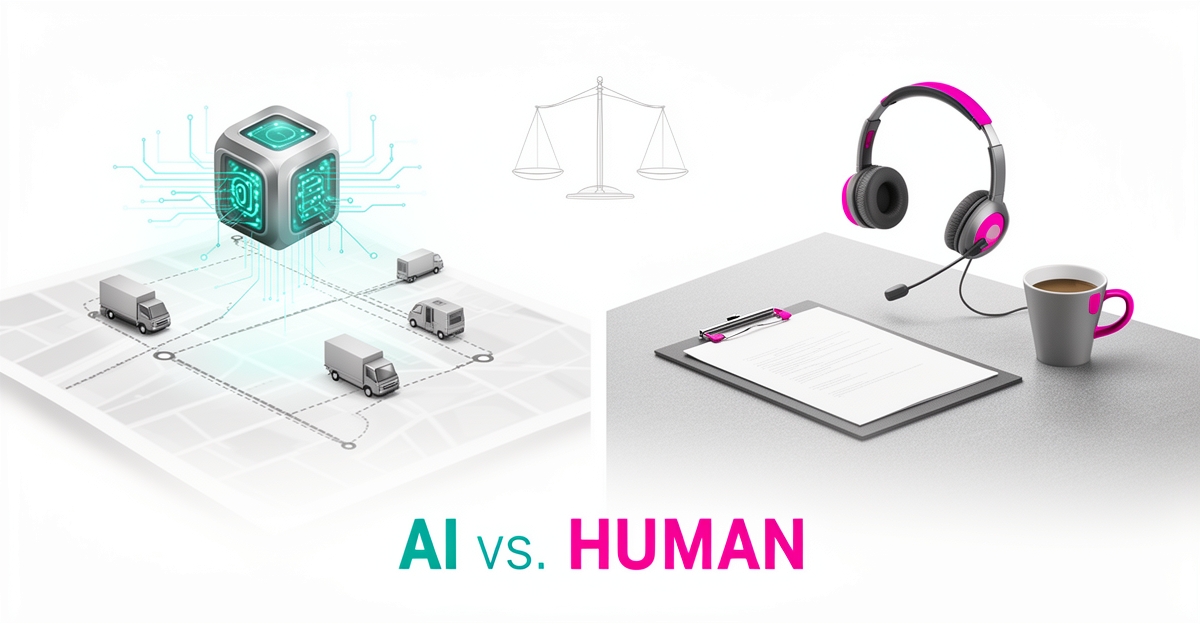
AI Employee vs. In-House Dispatcher: What's Right for Your Small Fleet?
Key Facts
- A human dispatcher struggles to calculate optimal routes for 10 technicians and 50 daily jobs while factoring real-time traffic, skills, and priorities
- AI dispatch tools typically range from roughly $39 to $500 per month, versus $4,000–$7,000+ in monthly cost for a salaried dispatcher
- Rerouting around a traffic bottleneck can save meaningful time each day—often enough to fit in one extra high-margin service call
- Regulators have increasingly penalized companies for using personal data to train AI without consent, making vendor data practices a real due-diligence item
- AI dispatchers operate 24/7/365 while human dispatchers work roughly 40 hours weekly, with fatigue, sick days, and missed after-hours calls
Hire a team member that works 24/7 — for less than a part-time wage.
AI receptionists, SDRs, dispatchers and 99+ roles. Trained on your business, fully managed.
Not sure where to start? Ask our AI planner
The Human Bottleneck: Why Manual Dispatch Breaks at Scale
The human dispatcher's cognitive ceiling becomes the operational bottleneck as fleet complexity grows. When managing just 10 technicians and 50 jobs simultaneously, a human dispatcher cannot reliably calculate optimal routes while factoring in real-time traffic, technician skills, and job priorities. This constraint forces reactive decision-making, where last-minute changes like cancellations or traffic delays require manual re-planning that consumes valuable time and creates inefficiencies.
These cognitive limits directly impact revenue potential and operational costs. AI systems overcome this by processing multiple variables at once, enabling proactive adjustments such as rerouting a technician around a traffic bottleneck—time that can be used for an additional high-margin service call. For small fleets, this daily efficiency gain compounds into meaningful revenue uplift and fuel savings that manual dispatch simply cannot match at scale.
- Simultaneous optimization of technician location, skill sets, and vehicle inventory
- Real-time traffic analysis and dynamic route recalculation
- Automatic reassignment of jobs following cancellations or delays
AIQ Labs recognizes that breaking through this human bottleneck requires more than just software—it demands a strategic approach to AI integration that aligns with a fleet's unique operational rhythm. By evaluating dispatch challenges through the lens of cognitive scalability rather than just cost, small fleet owners can identify where AI employees deliver measurable performance gains that human teams cannot sustain as volume increases. This shift from manual planning to AI-driven optimization transforms dispatch from a reactive cost center into a proactive revenue driver.
The True Cost Comparison: Salary vs. Subscription
Small fleets feel every dollar of overhead, and dispatch is one of the first places costs compound. A full-time dispatcher brings salary, benefits, training, and limited hours, while an AI employee shifts the model to a predictable subscription that works 24/7/365.
A human dispatcher typically costs $35,000–$55,000+ in annual salary, plus 25–35% for benefits and taxes, plus recruiting and onboarding costs that often run into the thousands. The monthly burden lands at $4,000–$7,000+ for 40 hours a week—with missed after-hours calls, sick days, and vacation gaps on top.
AI dispatch software replaces that fixed overhead with variable subscriptions. As of late 2026, entry-level routing and dispatch platforms typically start around $39–$69 per month, with more capable last-mile and enterprise-oriented tools reaching roughly $500 per month. That is a subscription range of roughly $39–$500/month versus a salaried headcount.
The math changes cash flow. Human cost is fixed whether jobs are up or down, and scales linearly with fleet size. AI cost scales with seats or usage—and with a managed AI employee, build, training, integrations, monitoring, and improvements are included in a flat monthly plan with the ability to pause or adjust anytime. For small fleets, the shift from fixed payroll to subscription frees working capital for fuel, maintenance, and growth.
Availability compounds the difference. A human dispatcher is limited to working hours and prone to fatigue and error. An AI dispatcher operates 24/7, handles last-minute cancellations automatically, and re-routes around traffic without manual phone calls. Even modest daily time savings—rerouting around a single bottleneck—can create room for one extra high-margin service call per day.
Cognitive load is another hidden cost. A human dispatcher cannot realistically calculate optimal routes for 10 technicians and 50 daily jobs simultaneously while factoring traffic and skill requirements. AI processes those variables in real time and updates ETAs automatically.
Cost comparison highlights for small fleets:
- Fixed vs variable: Salary + benefits vs a predictable monthly subscription
- Hours vs coverage: 40 hrs/week with downtime vs 24/7/365 operation
- Scaling: Hire and train new staff vs instant scalability without headcount
- Adaptability: Manual re-planning on cancellations vs automatic re-assignment
AIQ Labs helps owner-operators evaluate cost, flexibility, scalability, and performance to make an informed decision based on unique operational needs. The true cost is not only the invoice—it is cash flow stability, missed revenue from idle technicians, and the ability to grow without adding fixed overhead.
Operational Agility: Real-Time Optimization vs. Reactive Planning
Operational agility separates reactive dispatching from proactive optimization. Human dispatchers constantly play catch-up, scrambling to replan routes after last-minute cancellations or traffic snarls disrupt their carefully laid schedules. This manual replanning consumes valuable time and often results in idle technicians or missed opportunities, especially when juggling multiple variables like technician location, skill sets, and job priorities simultaneously. AIQ Labs recognizes this pain point for small fleets seeking to maximize every billable hour.
AI dispatchers transform this reactive cycle into proactive efficiency. By continuously analyzing real-time data—traffic conditions, technician proximity, job urgency, and vehicle availability—AI systems make instant routing decisions that humans simply cannot compute at scale. For instance, when a traffic bottleneck emerges, an AI dispatcher can proactively reroute a technician around the delay, often saving close to an hour per incident. That time savings directly enables fitting in one additional high-margin service call daily, a compounding advantage that boosts revenue without adding headcount. The system also handles cancellations autonomously, immediately reassigning freed-up technicians to the next highest-priority nearby job to eliminate downtime.
This level of dynamic optimization is out of reach for human dispatchers operating within cognitive limits. A human cannot realistically calculate optimal routes for 10 technicians across 50 daily jobs while factoring in real-time traffic and skill requirements—yet AI handles this multi-variable puzzle continuously. The result is consistent operational agility: AI doesn't just respond to disruption; it anticipates and neutralizes it before it impacts schedules. For small fleets where every minute counts, this proactive edge turns reactive firefighting into strategic advantage, ensuring technicians spend more time on revenue-generating work and less time waiting for new assignments. To explore how AI employees deliver this operational agility for your specific fleet, start the fit check to assess your automation opportunities.
Security, Compliance, and the Hidden Risks of AI Dispatch
When deploying an AI dispatcher, small fleet owners must confront regulatory and cybersecurity risks that extend far beyond operational efficiency. Regulators in recent years have imposed substantial fines on major technology companies for using personal data to train AI models without proper consent, and the majority of AI-related penalties to date have stemmed from unlawful data practices. This regulatory environment means that any AI dispatch solution handling customer locations, technician schedules, or payment details could expose a business to liability if the vendor's data handling violates privacy laws like GDPR or CCPA. For small fleets operating on tight margins, such fines could be catastrophic, making vendor scrutiny not just prudent but essential.
Security vulnerabilities present an equally pressing concern. High-profile incidents—such as attackers using stolen credentials to push fraudulent emergency alerts through a government notification system—underscore a universal truth: automated systems controlling critical communications, like those managing vehicle routing, driver assignments, or customer notifications, are high-value targets for cyberattacks. If compromised, an AI dispatch platform could be manipulated to reroute vehicles maliciously, leak sensitive customer data, or disrupt service entirely, turning a tool designed for efficiency into a vector for operational and reputational harm.
To mitigate these risks, fleet owners should adopt a structured evaluation framework before selecting an AI dispatch provider. First, verify that the vendor's data privacy policy explicitly prohibits using customer or employee data for AI model training without consent, and request documentation of their compliance with relevant regulations. Second, assess their cybersecurity protocols, including encryption standards for data in transit and at rest, multi-factor authentication for system access, and regular third-party penetration testing. Third, confirm whether the platform supports audit trails and role-based access controls to monitor who can view or alter dispatch data. Finally, prioritize vendors that offer transparent incident response plans and clear data ownership terms—ensuring that, in the event of a breach, the business retains control over its information and can act swiftly to contain damage. This due diligence transforms security from an afterthought into a foundational element of AI adoption.
Making the Switch: A Practical Framework for Small Fleets
Switching dispatch is a bet on whether your fleet is ready to trade cognitive overload for real-time optimization. Small fleets feel the pain first when a human dispatcher can't juggle technician location, skill sets, vehicle inventory and traffic at once.
Start with size and complexity. Industry analysis typically points to a threshold around 10 vehicles, where losses from fuel and wasted time may exceed subscription costs. Below that, entry-level tools starting around $39–$69 per month offer accessible pricing, often without annual contracts.
Map your operational needs before comparing vendors. Last-mile delivery, home service scheduling, and multi-day routing each demand different capabilities. Per-task pricing can quietly erode margins, while long-term contracts penalize fluctuating fleet sizes.
Integration is where AI proves or fails in the field. Verify APIs to your CRM, ERP and accounting tools like QuickBooks or Xero so job creation, dispatch and invoicing flow without manual re-entry. Real-time adaptability matters more than feature lists.
Test for change handling. The value shows up when a customer cancels and the system instantly reassigns the technician to the next highest-priority nearby job, or reroutes around a bottleneck to avoid downtime. Run that exact scenario during any trial or pilot before you commit.
Pricing model pitfalls deserve scrutiny:
- Per-task fees that scale with volume and punish high-volume, low-margin work
- Multi-year minimum contracts that lock in costs as fleet size fluctuates
- Per-driver pricing that becomes expensive as you add technicians
- Setup fees bundled with subscriptions that hide true first-year cost
Security and data privacy are non-negotiable. Regulators have repeatedly penalized companies for using personal data to train AI without consent, and most AI-related fines to date involve unlawful data use. Choose a provider with clear consent protocols and audit trails.
A low-risk way to validate is to pilot one role first. AIQ Labs offers a Start Monthly model for an AI employee with build, training, tool integrations, monitoring and improvements included, and the ability to pause or adjust anytime. That structure mirrors how small fleets should test dispatch automation: prove ROI on a defined workflow before scaling. If your bottleneck goes beyond dispatch into scheduling, invoicing, or follow-up, a targeted workflow build can rebuild the single costliest process first.
If you want a structured assessment, start the Fit Check at https://aiqlabs.ai/apply for a free 30-minute strategy call to map your biggest bottleneck and identify high-ROI automation opportunities.
Still paying for 10+ subscriptions that don’t talk to each other?
We build custom AI systems you own outright. No vendor lock-in. Full control.
Not sure where to start? Ask our AI planner
Frequently Asked Questions
How much time can an AI dispatcher save by rerouting around a traffic bottleneck, and how does that translate to revenue?
What is the typical monthly cost range for AI dispatch software compared to hiring a human dispatcher?
At what fleet size does it become more cost-effective to use AI dispatch over a human dispatcher?
What are the main security and compliance risks when using an AI dispatcher for a small fleet?
Can an AI dispatcher handle last-minute job cancellations and reassignments without manual intervention?
What should I look for in an AI dispatch platform's integration capabilities with my existing tools?
The Bottom Line: Dispatch Smarter, Not Harder
The choice between an AI employee and a human dispatcher isn't about replacing people—it's about breaking through the cognitive ceiling that limits how efficiently a small fleet can operate. When a single dispatcher can't optimize routes for 10 technicians across 50 jobs while factoring in traffic and skills, the business leaves money on the table through wasted fuel, idle technicians, and missed high-margin calls. AI dispatchers process those variables in real time, work 24/7 without fatigue, and scale instantly with your fleet, all for a subscription cost that undercuts a full-time salary. That said, due diligence matters: verify that your vendor's data practices won't expose you to the regulatory penalties that have increasingly targeted AI-driven data misuse. AIQ Labs helps small fleet owners navigate this decision by evaluating cost, security, integration, and ROI against their unique operational needs. If you're ready to find out whether an AI dispatcher is the right fit, start the Fit Check at https://aiqlabs.ai/apply for a free 30-minute strategy call.
Make AI your competitive advantage — not just another tool.
Strategy, implementation and ongoing optimization. One partner, end to end.
Not sure where to start? Ask our AI planner