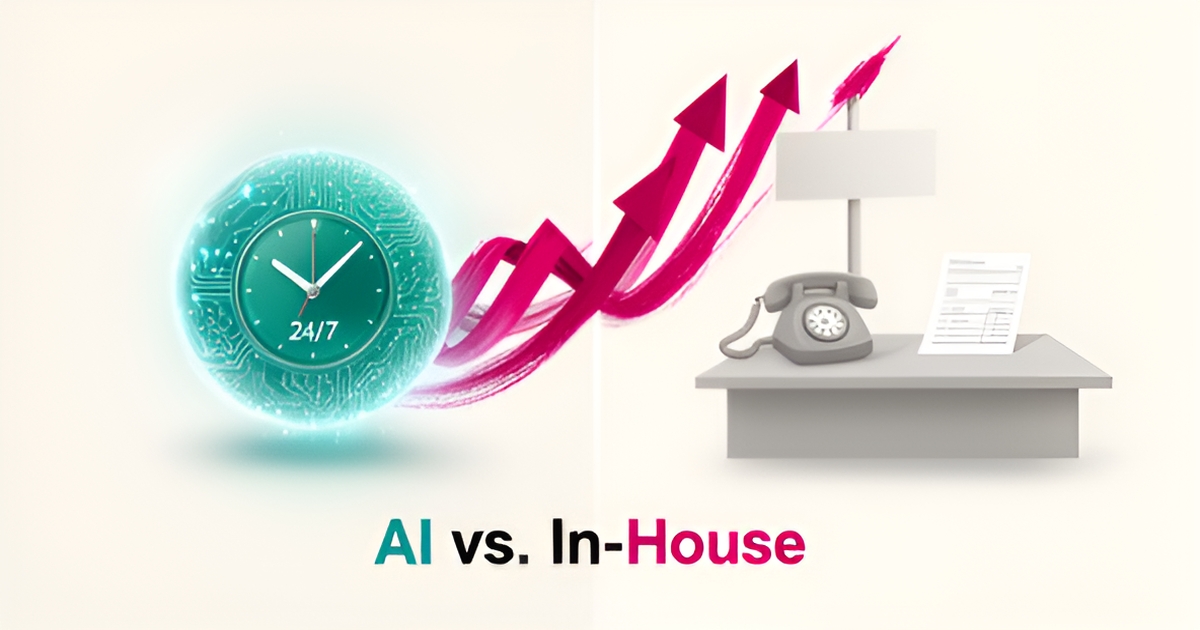
AI Employee vs. In-House Staff: Which Is Better for Sign Painting Inquiries?
Key Facts
- AI is technology that enables machines to simulate human learning, comprehension, problem solving, decision-making and autonomy per IBM
- AI agents can work 24/7 without fatigue, ensuring no inquiry goes unanswered
- Routine intake and screening tasks are widely considered prime candidates for automation, with processing times often cut from hours to seconds
- Industry projections suggest a large share of routine work activities will be automated by 2030, reshaping task mixes within roles rather than eliminating job titles outright
- AIQ Labs AI Employees typically cost around 80% less than an equivalent human hire while working 24/7/365 per AIQ Labs
Hire a team member that works 24/7 — for less than a part-time wage.
AI receptionists, SDRs, dispatchers and 99+ roles. Trained on your business, fully managed.
Not sure where to start? Ask our AI planner
The Hidden Cost of Manual Inquiry Handling in Sign Painting
For sign painting businesses, the true cost of handling initial inquiries with in-house staff goes far beyond salaries—it includes missed opportunities, inconsistent availability, and inefficient use of skilled labor. When a potential client calls after hours or on a weekend with a question about pricing or availability, that lead often slips away simply because no one is there to respond. AI agents can work 24/7 without fatigue, ensuring no inquiry goes unanswered—a critical advantage for capturing leads outside standard business hours. This constant availability directly addresses a key gap in human-staffed operations, where limited hours result in lost revenue and frustrated prospects.
Beyond availability, the operational burden of manual inquiry handling ties up valuable staff time on repetitive, low-value tasks. Employees spend hours answering the same basic questions—“What’s your rate per square foot?” or “Do you do vehicle wraps?”—time that could be better spent on complex design consultations, on-site measurements, or closing high-value contracts. Routine tasks like initial inquiry handling are widely seen as prime candidates for automation as AI adoption accelerates through the decade. Automating these repetitive functions not only frees up human talent for higher-impact work but also reduces the risk of burnout and inconsistency in response quality.
The financial implications are equally significant. Maintaining full-time staff for inquiry handling incurs fixed costs—salaries, benefits, training, and management overhead—regardless of inquiry volume. During slow periods, these costs represent underutilized capacity; during peak times, staff become overwhelmed, leading to delayed responses and missed leads. In contrast, AI employees offer a scalable, variable-cost model that adjusts to demand without requiring additional hiring or training. AI can dramatically speed up intake and screening processes—often cutting them from hours to seconds—while operating at a fraction of the cost of human equivalents. For sign painting businesses, this means capturing more leads, responding faster, and allocating human expertise where it matters most: in the studio, on the job site, and in face-to-face client consultations.
How AI Employees Transform Initial Inquiry Workflows
The distinction between an AI assistant and an AI agent is the difference between a helper and a worker. While assistants wait for your next prompt, true AI agents autonomously pursue goals, breaking complex tasks into subtasks and executing workflows without constant human direction.
For a sign painting business, this means an AI agent can own the entire initial inquiry workflow. It qualifies incoming leads, gathers specifications like dimensions and materials, provides instant quotes, and schedules consultations—operating 24/7 without fatigue or missed calls.
The efficiency gains are measurable. Routine data processing and customer intake tasks are among the first to be automated as AI adoption spreads, and businesses implementing AI screening and inquiry handling typically report processing times cut from hours to seconds.
Unlike human staff, AI agents scale instantly to handle inquiry surges. Whether you receive five quote requests or fifty, the system maintains consistent response quality without the burnout and turnover that plague high-volume administrative roles. This scalability proves particularly valuable for seasonal sign businesses or those expanding into new markets.
AIQ Labs builds these AI employees to handle specific operational roles—such as estimator assistants or inquiry handlers—that integrate directly with your existing CRM and scheduling tools. These agents work continuously, capturing after-hours inquiries that would otherwise go to voicemail, ensuring zero missed opportunities while your human team focuses on complex custom designs and client relationships.
The workflow transformation typically covers:
- Instant lead qualification based on project scope and budget
- Automated gathering of specifications (dimensions, materials, location)
- Real-time quote generation for standard sign packages
- Direct calendar booking for site visits or consultations
- Seamless escalation to human experts for complex custom work
By automating these routine touchpoints, sign shops eliminate the bottleneck of manual inquiry handling. The result is a faster response time that captures leads at their peak interest, while your skilled craftspeople dedicate their expertise to the creative and strategic work that truly requires human judgment.
The Hybrid Model: AI for Volume, Humans for Value in Sign Painting
A sign painting shop can’t afford to miss an inquiry at 9 p.m., but it also can’t afford to pay a human to answer “How much for a 10-foot banner?” a hundred times a day.
The data shows work is being reshaped inside roles, not erased. Industry projections suggest a large share of routine work activities will be automated by 2030, with the unit of change being the task mix, not the job title.
That mix maps cleanly onto sign painting inquiries. Routine, codified tasks like initial triage, spec collection, standard quoting and scheduling are high-volume and repetitive. AI agents handle those 24/7 without burnout, scale instantly during promo spikes, and keep cost predictable. Human staff remain essential for custom design consultation, on-site measurement, color matching and closing high-value deals where judgment and trust close the sale.
A hybrid model preserves expertise while capturing efficiency. The winning pattern is augmentation, not replacement: automate the repetitive intake work, and keep people for the judgment-heavy work where their skills compound.
In practice for sign painting:
- AI manages the front door: answers FAQs, qualifies leads, gathers dimensions and artwork needs, provides instant preliminary estimates
- Humans own the value work: custom design review, site visits, material recommendations, negotiation and final close
- Handoff is clean: AI escalates only complex or high-value projects with full context, so staff spend time selling, not screening
Cost and scalability follow the same logic. AI operates continuously and handles surges without hiring, while in-house teams carry fixed salary, benefits and training overhead. That’s why businesses are shifting repetitive inquiry work to agents and keeping people for strategic, relationship-intensive work.
AIQ Labs builds this hybrid approach through managed AI employees that work alongside human teams for sign painting and other SMB workflows, handling volume at the top of funnel while protecting the human expertise that builds reputation and margin. The result is faster response, lower overhead and better use of skilled staff where they matter most.
Still paying for 10+ subscriptions that don’t talk to each other?
We build custom AI systems you own outright. No vendor lock-in. Full control.
Not sure where to start? Ask our AI planner
Frequently Asked Questions
How does an AI employee differ from a regular chatbot for handling sign painting inquiries?
Can an AI employee really work 24/7 without missing after-hours inquiries for my sign painting business?
Will using an AI employee for initial inquiries reduce my staffing costs compared to hiring in-house?
What specific tasks can an AI employee handle in the sign painting inquiry process before escalating to a human?
Is there a risk that relying on AI for inquiries will hurt my ability to train junior staff or develop expertise?
How quickly can an AI employee respond to a quote request compared to a human staff member?
Work Smarter With the Right Front Door
For sign painting businesses, the question isn’t AI versus people, it’s which work belongs to whom. AI employees handle the high-volume, repetitive front door work — 24/7 inquiry triage, spec collection, instant quotes and scheduling — so skilled craftspeople stay focused on custom design, site visits and closing high-value deals. That hybrid model cuts response delays, captures after-hours leads, and removes fixed overhead during slow periods while scaling instantly during surges. Map your inquiry workflow, identify the routine steps an AI employee can own end-to-end, and reserve human time for judgment and relationship work. If you want a clear view of where automation fits your shop, take the two-minute Fit Check at https://aiqlabs.ai/apply, then book a free 30-minute strategy call at https://aiqlabs.ai/book.
Make AI your competitive advantage — not just another tool.
Strategy, implementation and ongoing optimization. One partner, end to end.
Not sure where to start? Ask our AI planner