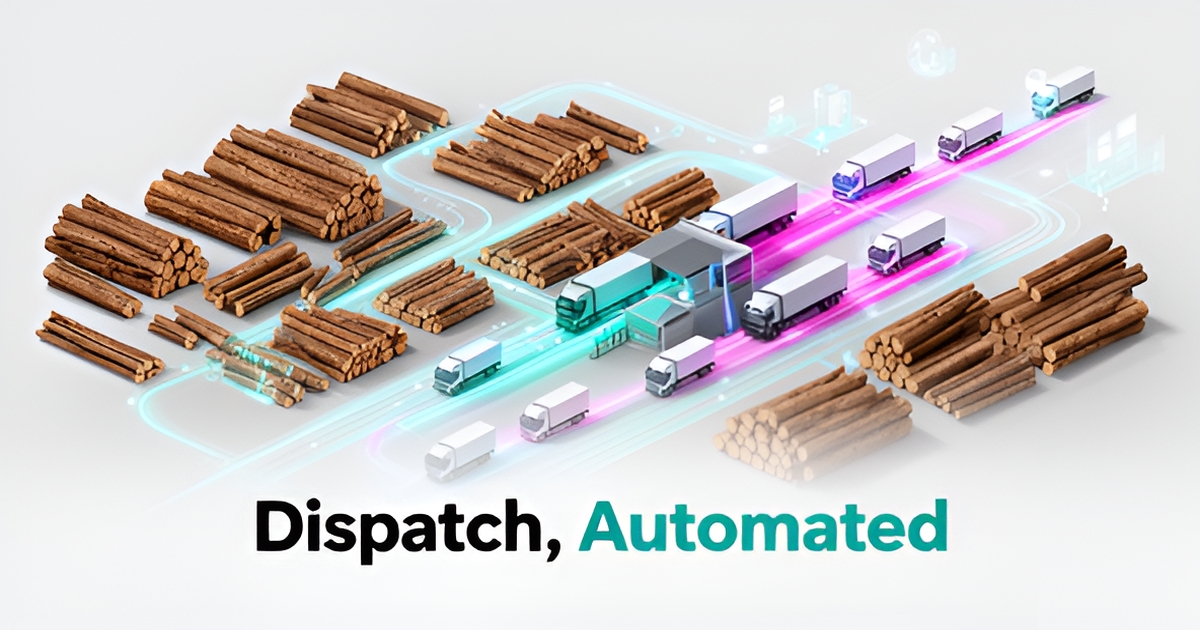
AI Employees for Sawmills: How a Dispatch AI Can Optimize Fleet and Delivery Operations
Key Facts
- AI dispatchers can manage routes, track shipments, and alert teams to delays with minimal human oversight
- Modern route optimization software handles dozens of constraints such as vehicle capacity, driver hours, and delivery time windows
- AIQ Labs AI employees typically cost roughly 80% less than an equivalent human hire while maintaining accuracy in fleet operations
- Dynamic routing algorithms calculate the best routes and schedules from real-time data and constraints, and adjust automatically as conditions change
- Operational complexity is widely recognized as a margin killer — simplifying dispatch workflows frees skilled staff for higher-value work
Hire a team member that works 24/7 — for less than a part-time wage.
AI receptionists, SDRs, dispatchers and 99+ roles. Trained on your business, fully managed.
Not sure where to start? Ask our AI planner
The Hidden Cost of Sawmill Delivery Chaos
Sawmill dispatchers face daily chaos that quietly erodes profits: overbooking conflicts, rigid schedules that collapse when a truck breaks down, and last-minute order changes that force frantic rescheduling. These aren't minor hiccups—they're systemic issues that turn delivery operations into a constant firefight, draining both time and margins.
Static planning simply cannot absorb the real-world disruptions inherent in timber logistics. When a cancellation hits or traffic snarls a route, manual dispatchers scramble to patch together new plans, often creating ripple effects of delays and misallocated resources. This reactive cycle isn't just inefficient—it directly attacks profitability by multiplying labor hours without improving outcomes. Operational complexity is widely recognized as a margin killer: it dilutes focus, drives unnecessary costs, and erodes the very margins sawmills rely on to stay competitive.
The hidden cost compounds in the labor itself. Skilled dispatchers spend hours each day juggling spreadsheets, making phone calls, and manually adjusting routes—work that could be automated but instead pulls experienced staff from higher-value tasks. AI dispatchers can manage routes, track shipments, and alert teams to delays with minimal human oversight, so the alternative isn't just possible—it's already proven in operations where complexity once ruled.
- Overbooking and scheduling conflicts create costly overlaps and delays
- Static plans fail when faced with cancellations, breakdowns, or traffic disruptions
- Manual dispatch labor typically consumes 20+ hours weekly that could be redirected
- Real-time adaptation requires dynamic systems, not rigid schedules
What an AI Dispatcher Actually Does in a Sawmill Operation
Sawmill delivery is a moving target of trucks, timber orders, and tight windows. An AI dispatcher replaces static spreadsheets with continuous, autonomous control of the fleet.
The system generates dynamic routes across dozens of constraints such as vehicle capacity, driver hours, mill loading slots, and customer time windows. It balances urgent and non-urgent stops in real time and re-optimizes when conditions change, rather than waiting for a human planner.
Real-time shipment tracking is built in. The AI monitors each load from yard to customer, logs proof of delivery, and maintains live visibility for operations and sales teams. AI dispatchers can manage routes, track shipments, and alert teams to delays with minimal human oversight, making the process largely hands-off for sawmill staff.
Automatic delay alerts are triggered without manual checks. When traffic, weather, breakdowns, or last-minute cancellations occur, the dispatcher notifies crews and customers immediately and proposes alternatives. A dynamic routing algorithm is a mathematical model that calculates the best routes and schedules based on real-time data and constraints.
Continuous re-optimization happens on its own. The algorithm learns from historical patterns and adapts to new requests, cancellations, and disruptions—adjusting to changing conditions such as traffic, weather, or urgent requests, and automatically updating assignments and directions.
In practice the AI dispatcher handles:
- Dynamic route generation for multi-stop timber deliveries with complex time constraints
- Live shipment tracking and automated delay alerts to crews and customers
- Instant re-routing for breakdowns, traffic disruptions, and urgent orders
- Constraint management to prevent overbooking and scheduling conflicts
This autonomy reduces manual dispatch work. AI employees typically cost roughly 80% less than a human hire while maintaining accuracy in fleet and delivery operations. For sawmills struggling with delivery scheduling and tracking, that means fewer missed windows and less overtime.
AIQ Labs deploys these capabilities as a managed AI employee that works alongside teams, handling dispatch, tracking, and alerts 24/7. The result is faster deliveries, fewer errors, and lower labor cost without adding headcount.
The Numbers: Labor Savings, Utilization Gains, and Delivery Reliability
The economics are straightforward: an AI dispatcher typically costs roughly 80% less than staffing the same role with a person, without sacrificing accuracy in route management or shipment tracking. This isn't theoretical—it's the direct outcome of automating a role that traditionally requires constant human oversight for scheduling, delay alerts, and real-time adjustments. For sawmills operating on tight margins, this shift reallocates significant budget toward growth or resilience.
Beyond labor savings, operational metrics tend to improve substantially when complexity is reduced through AI-driven simplification. Teams spend less time firefighting delivery issues and more time on value-added tasks, and disruptions get identified and addressed faster before they cascade into missed commitments. These gains stem from the AI dispatcher's ability to continuously optimize routes, manage dozens of constraints in real time, and adapt instantly to breakdowns, weather, or last-minute order changes—capabilities that static planning systems simply cannot match.
The cumulative effect is a shift from reactive to proactive operations, where margin expansion follows naturally. With fewer delays, better asset utilization, and lower overhead, sawmills can convert dispatch from a cost center into a source of reliability and competitive advantage. Crucially, the AI employee delivers this 24/7/365—no missed delays, no sick days, and no scheduling gaps—ensuring consistent performance that human teams, no matter how skilled, cannot guarantee around the clock. This relentless availability turns delivery predictability from an aspiration into a standard.
Deploying an AI Dispatcher Without Disrupting Your Mill
The biggest risk in deploying an AI dispatcher isn't the technology—it's the human transition. Experience with dynamic routing implementations shows that without structured change management, algorithm rollouts can trigger demotivation among veteran crews who feel their expertise is being replaced.
Start by connecting the AI to your existing fleet management and scheduling tools via API rather than replacing them. The system should integrate with your current CRM and ERP infrastructure to access real-time data on truck locations, job details, and traffic conditions. This allows the AI to handle the dozens of constraints typical in modern route optimization—including complex time windows and multi-stop deliveries—while your team keeps the interfaces they already know.
Structure the rollout to support your dispatchers, not sideline them. Position the AI as a tool that eliminates the stress of static plans failing when last-minute orders, cancellations, or traffic disruptions hit. When dispatchers see the algorithm handling routine recalculations—freeing them to manage exceptions and customer relationships—resistance typically fades.
Follow this phased approach to maintain operational stability:
- Launch with a single dispatch workflow, such as morning outbound lumber deliveries, before expanding to complex multi-stop routes
- Run the AI in parallel with human dispatchers for two weeks to validate accuracy against real-world constraints
- Establish clear escalation protocols where humans retain authority over priority customers and emergency rerouting
- Review performance metrics weekly with your crew to demonstrate how the system reduces their cognitive load
AIQ Labs structures these deployments through a Start Monthly model that eliminates large upfront capital risk. You get a fully trained AI dispatcher—built, integrated with your tools, and monitored continuously—for a fraction of the cost of a traditional hire. Because the system works 24/7 without sick days or turnover, mills typically see labor costs roughly 80% lower than staffing a traditional dispatch desk, while maintaining the accuracy your customers expect. If dispatch is just one of several broken workflows, a Workflow Build can rebuild it at a fixed price, in phases.
The goal isn't full automation on day one. It's establishing a single source of truth for your fleet data that learns your operation's unique patterns. Once the AI proves it can handle your standard delivery workflows without creating chaos for your drivers, scaling to cover your entire dispatch operation becomes a straightforward expansion rather than a leap of faith.
Still paying for 10+ subscriptions that don’t talk to each other?
We build custom AI systems you own outright. No vendor lock-in. Full control.
Not sure where to start? Ask our AI planner
Frequently Asked Questions
How does an AI dispatcher actually handle sawmill deliveries differently than spreadsheets?
Can an AI dispatcher really cut labor costs without losing accuracy?
What happens when a truck breaks down or an order changes last minute?
Will my dispatchers resist if we automate dispatch?
How much time does manual dispatch take away from skilled staff?
What operational improvements can I expect beyond cost savings?
From Firefighting Dispatch to Predictable Delivery
Sawmill delivery chaos isn't a staffing problem, it's a planning problem. Static schedules collapse under breakdowns, cancellations, traffic and last-minute orders, forcing skilled dispatchers into hours of manual rework that erodes margins and reliability. An AI dispatcher replaces that reactive cycle with continuous, autonomous control: dynamic multi-stop routing across dozens of constraints, live shipment tracking, automatic delay alerts, and instant re-optimization with minimal human oversight. The result is fewer missed windows, better asset utilization, and dispatchers freed to manage exceptions and customers instead of spreadsheets. AIQ Labs delivers this as a managed AI employee that works alongside your team 24/7, typically at roughly 80% less cost than a human hire while maintaining accuracy in fleet and delivery operations. If delivery scheduling and tracking are a bottleneck, start with a focused pilot on one outbound workflow, run it in parallel with your current process, and measure the impact on on-time performance and labor hours. Take the 2-minute Fit Check at https://aiqlabs.ai/apply, then book a free 30-minute strategy call to map your biggest dispatch bottleneck and identify a high-ROI automation path. You can also reach the team at [email protected].
Make AI your competitive advantage — not just another tool.
Strategy, implementation and ongoing optimization. One partner, end to end.
Not sure where to start? Ask our AI planner