AI for Beverage Compliance: How Co-Packers Can Automate Labeling and Regulatory Documentation
Key Facts
- Misdeclared allergens and incorrect nutrition facts remain a leading cause of food and beverage recalls, and manual labeling is where most of these errors originate.
- Automated label generation typically eliminates the large majority of manual data-entry errors in beverage compliance workflows.
- AI-generated ingredient disclosures can cut document processing time significantly compared to manual preparation.
- Multi-jurisdictional rule engines can adapt a single formulation to FDA, Health Canada, and EU labeling standards simultaneously.
- AIQ Labs has deployed 200+ multi-agent systems and runs 4 live SaaS products daily, compliance automation is built on production experience, not theory.
Hire a team member that works 24/7 — for less than a part-time wage.
AI receptionists, SDRs, dispatchers and 99+ roles. Trained on your business, fully managed.
Not sure where to start? Ask our AI planner
The Hidden Cost of Manual Beverage Labeling and Compliance
Co-packers in the beverage industry face mounting pressure to meet labeling and regulatory requirements across FDA, Health Canada, and EU standards. Manual processes for generating ingredient disclosures, allergen statements, and compliance documentation are slow and prone to human error, creating real operational risk. When regulations change or formulations are updated, teams must rework labels across dozens or hundreds of SKUs, each with its own market-specific mandates. The result is costly rework, delayed batch releases, and in the worst cases, recalls triggered by a misdeclared allergen or an incorrect nutrition panel.
The hidden cost extends beyond labor hours. Manual compliance workflows slow batch release cycles, increase dependency on specialized staff, and create bottlenecks during peak production periods. In low-margin, high-volume beverage co-packing, that lost throughput matters. For co-packers handling private-label brands, even minor labeling inaccuracies can damage client relationships and trigger contractual penalties. And as regulatory scrutiny intensifies, documentation increasingly needs to be auditable and traceable across global supply chains, something spreadsheets and copy-paste label templates were never built to do.
- Manual labeling increases the likelihood of misdeclared allergens or incorrect nutrition facts, a leading cause of food and beverage recalls.
- Regulatory updates require rework across hundreds of labels, draining internal resources and delaying product launches.
- Inconsistent documentation complicates audits and increases exposure to penalties under FSMA, SFCR, and EU FIC regulations.
AIQ Labs helps co-packers eliminate these risks with AI Workflow Builds that automatically generate compliant labels, ingredient lists, and regulatory documentation from real-time formulation data. Each build targets the one workflow that costs you the most, at a fixed price, delivered in phases, reducing manual intervention, keeping documentation audit-ready, and accelerating time-to-market.
How AI Eliminates Errors and Speeds Up Beverage Compliance Workflows
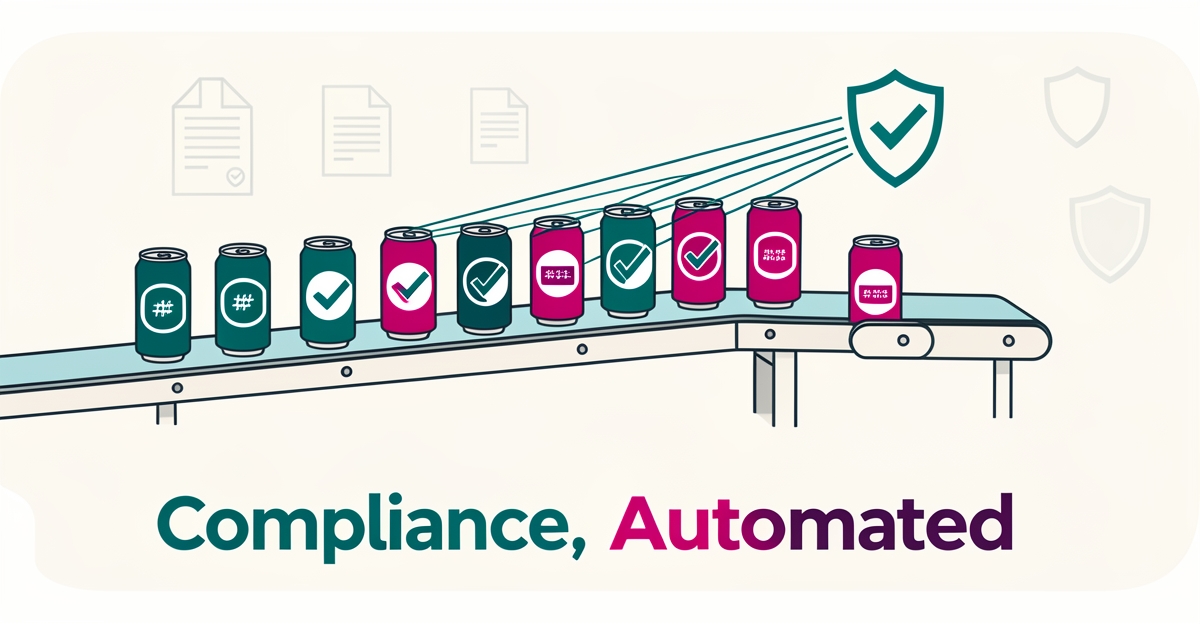
AI-powered systems are removing costly errors from beverage compliance by automating label generation, ingredient disclosures, and regulatory filings with consistent, rules-based accuracy. These systems reduce manual data entry, minimize human oversight overhead, and help ensure every batch meets FDA, Health Canada, or EU requirements without adding delays. By integrating AI into document processing, co-packers gain faster turnaround while maintaining regulatory adherence across global markets.
The mechanics are straightforward. A formulation change flows into the system once; the AI generates updated ingredient statements, allergen declarations, and nutrition panels for every jurisdiction you sell in, flags any compliance gaps before production, and produces the audit trail alongside the label. Instead of a specialist cross-checking three versions of the same label, the system validates against current rules for all markets at once. AI adoption is now mainstream across industries, most large organizations use AI in at least one business function as of late 2026, and agentic systems in particular are moving from experiments into production deployments.
- Automated label creation eliminates most manual data-entry errors
- AI-generated ingredient disclosures cut document processing time substantially
- Regulatory filing automation produces consistent, audit-ready documentation
- Real-time validation catches compliance gaps before production starts
- Multi-jurisdictional rule engines adapt one formulation to FDA, Health Canada, and EU standards
AIQ Labs builds production-ready systems that embed these capabilities directly into beverage compliance workflows. With 200+ multi-agent systems deployed and 4 live SaaS products the company runs daily, these aren't prototypes, they're systems built to hold up under real production pressure. By replacing manual checks with intelligent validation, co-packers avoid costly recalls, accelerate time-to-market, and maintain regulatory confidence across all product lines.
Implementing AI Compliance Systems: From Pilot to Full Ownership
For co-packers navigating complex beverage labeling regulations, implementing AI compliance systems works best as a structured, phased approach that minimizes risk while building long-term capability. Start with a targeted workflow fix, automating ingredient disclosure verification or allergen labeling checks, for example, so your team can validate AI accuracy in a controlled environment before scaling. This aligns with AIQ Labs' Build in Milestones payment model: each phase delivers tangible, working software, and you can stop or adjust based on proven results without losing what you've already paid for.
Once the first workflow proves reliable, typically cutting manual label review time significantly, co-packers can integrate the AI system with existing ERP or MES platforms to create a single source of truth for regulatory data. This integration uses deep two-way API connections, so data flows between labeling systems, quality control modules, and compliance databases without disrupting current operations. The documentation the system produces is structured to be audit-ready from day one, which simplifies FSMA, SFCR, and EU FIC reporting.
Scaling to full ownership means expanding the system across all labeling workflows, nutritional facts, claim validation, and multilingual disclosures, while establishing governance for continuous optimization as regulations evolve. This is where an AI Operating System comes in: one connected operating layer, built in phases and owned outright. Co-packers who own their system eliminate vendor lock-in, retain full control over updates when regulations change, and can add AI Employees, managed AI staff that work alongside human teams to monitor compliance in real time at a fraction of the cost of a human hire. The end result: labeling shifts from a reactive bottleneck into a proactive, auditable advantage, every batch meets regulatory standards, and your staff focuses on growth instead of rework.
Still paying for 10+ subscriptions that don’t talk to each other?
We build custom AI systems you own outright. No vendor lock-in. Full control.
Not sure where to start? Ask our AI planner
Frequently Asked Questions
How much time and money does manual beverage labeling actually cost co-packers?
Can AI really cut labeling errors for FDA, Health Canada, and EU compliance?
What kind of ROI do co-packers see from automating compliance?
Is AI adoption for compliance already mainstream or still experimental?
Will implementing AI disrupt our current ERP or MES systems?
Do we have to buy the whole system upfront or can we start small?
Turn Compliance Into a Competitive Edge
Manual beverage labeling is a hidden drag on co-packers: error-prone processes, regulatory rework across FDA, Health Canada, and EU standards, and bottlenecks that delay batch release and erode client trust. AI changes that equation by automating label generation, ingredient disclosures, and filings with real-time validation, cutting manual errors, compressing processing time, and keeping documentation audit-ready. A phased approach, starting with a targeted workflow fix, integrating with ERP/MES for a single source of truth, then scaling to a system you own outright, lets teams prove accuracy, de-risk adoption, and retain control as regulations evolve. The result is faster time-to-market, lower operational risk, and compliance that supports growth instead of slowing it. If you're ready to find your biggest compliance bottleneck, start the 2-minute Fit Check at https://aiqlabs.ai/apply, then book a free 30-minute strategy call with an AI engineer. No pitch, just a working session to map your highest-ROI automation opportunity. Prefer email? Reach the team at [email protected].
Make AI your competitive advantage — not just another tool.
Strategy, implementation and ongoing optimization. One partner, end to end.
Not sure where to start? Ask our AI planner