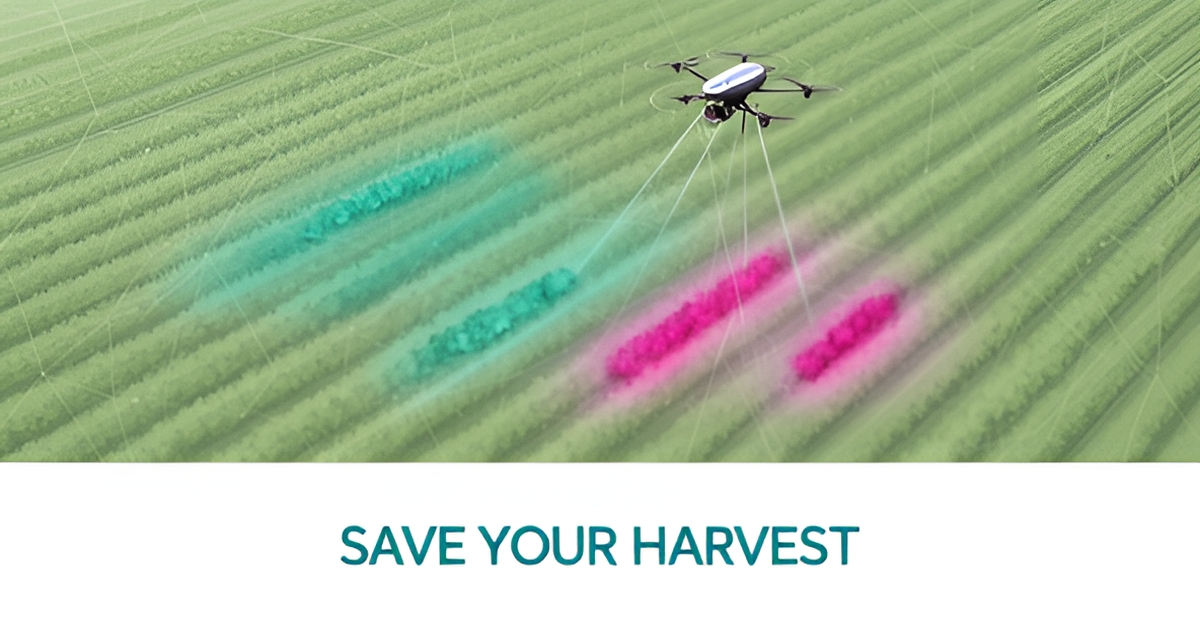
AI for Crop Health: How Early Disease Detection Can Save Harvests
Key Facts
- Published research reports AI disease detection models reaching accuracy in the low-90-percent range when identifying crop diseases from satellite and aerial imagery, sometimes before visible symptoms appear.
- Commercial agricultural AI platforms typically analyze millions of agricultural data points daily for disease and weather forecasting.
- Manual inspection is fundamentally error-prone because pathogens can spread beyond containment before symptoms become visible to the naked eye.
- The AgroVisionNet framework combines drone imagery with IoT sensor data to outperform standard models like VGG16 and ResNet50.
- Edge computing enables real-time disease detection on NVIDIA Jetson Nano devices using TensorFlow Lite, reducing cloud dependency in the field.
- A widely reported Microsoft and AgriPilot.ai program in India was credited with roughly a 20% yield increase for small-scale farmers through AI-driven satellite and drone analysis.
- AI systems generate Grad-CAM heat maps that visually highlight disease-affected zones, enabling targeted treatment instead of blanket pesticide spraying.
Hire a team member that works 24/7 — for less than a part-time wage.
AI receptionists, SDRs, dispatchers and 99+ roles. Trained on your business, fully managed.
Not sure where to start? Ask our AI planner
Why Manual Crop Inspection Fails Modern Farms
Even the most experienced agronomist cannot walk every field every day. On a modern farm spanning hundreds of hectares, manual crop inspection becomes a race against time that humans are structurally destined to lose.
According to research published in Scientific Reports, manual field inspection is so time-consuming and difficult that it requires trained specialists, yet remains fundamentally human-error-prone because diseases are difficult to detect with the naked eye. The study notes that by the time symptoms become visible to human inspectors, pathogens have often already spread beyond the point of containment.
The mathematics of scale work against traditional methods. A single missed outbreak can devastate an entire season's yield, yet comprehensive manual scouting requires labor hours that simply do not exist during critical growth windows. Climate change intensifies this pressure by expanding the geographic range and lifecycle of crop pathogens, while large-scale operations create uniform environments where disease can spread rapidly once established.
Manual inspection fails modern agriculture for three critical reasons:
- Detection lag: Visual symptoms typically appear days or weeks after infection, allowing diseases to establish before intervention begins
- Attention fatigue: Human inspectors cannot maintain consistent vigilance across thousands of acres, leading to missed early-stage infections
- Scalability limits: Labor constraints make daily comprehensive monitoring physically impossible for large operations
These limitations explain why agricultural AI systems are now reporting disease-identification accuracy approaching the low-90-percent range from satellite and aerial imagery—often catching issues before visible symptoms emerge. Unlike human scouts, these systems process millions of data points daily, identifying subtle spectral changes that precede visible damage.
The financial stakes could not be higher. When a single undetected outbreak can destroy an entire harvest, relying solely on human observation becomes a gamble no modern operation can afford. This reality is why forward-thinking farms are turning to AI-powered monitoring systems that combine satellite imagery with ground-level sensor data. AIQ Labs builds these systems as workflow builds—rebuilding the one monitoring workflow that costs you the most, at a fixed price, in phases—so proactive intervention replaces guesswork.
How AI Detects Disease Before Symptoms Appear
Early disease signs hide in data long before a farmer can see them in the field. AI systems now combine multiple sensing layers to catch those invisible signatures and trigger intervention while containment is still possible.
The core technical approach pairs overhead imaging with ground-level environmental context. High-resolution drone imagery and satellite data capture canopy texture, shape and color variations that the human eye often misses. In-field IoT sensors add time-aligned readings for temperature, humidity and soil moisture. The AgroVisionNet framework shows this multimodal fusion of visual plus environmental data addresses a key gap in vision-only models.
A hybrid CNN-Transformer backbone extracts spatial features from drone images while an adaptive fusion layer integrates sensor readings. Research on AgroVisionNet demonstrates this multimodal design achieves higher classification accuracy and F1-score compared to widely used models including VGG16, ResNet50, Inception V3 and DenseNet121. The system also generates Grad-CAM plots that visually highlight disease-affected areas, giving agronomists interpretable outputs for decision-making.
Real-time field use depends on moving inference off the cloud. Edge computing makes that practical. The model runs feasible inference on an NVIDIA Jetson Nano using TensorFlow Lite, enabling real-time, field-deployable monitoring rather than cloud-dependent processing. This edge capability supports continuous scanning across large, heterogeneous areas without latency or connectivity constraints.
Accuracy at scale is improving as data volume grows. As of late 2026, published research reports AI disease detection models reaching accuracy in the low-90-percent range from satellite and aerial imagery, and commercial platforms routinely process millions of agricultural data points daily for forecasting, feeding the same data pipelines that power disease prediction.
The workflow typically combines:
- Drone and satellite imagery for early visual anomalies before visible symptoms appear
- IoT sensor streams for microclimate and soil conditions that drive pathogen development
- Edge processing for immediate alerts and on-farm action without cloud dependency
- Interpretable heatmaps that show exactly where risk is concentrated
This is where AI changes farm operations. AIQ Labs builds custom systems that turn raw aerial and environmental feeds into actionable crop health intelligence—whether as a single workflow build or as part of a broader AI operating system that connects monitoring, alerts and treatment planning in one layer you own outright.
Together, multimodal fusion, edge deployment and interpretable outputs create a detection loop that is faster, more objective and scalable across diverse crops and field conditions.
From Detection to Action: Turning Insights Into Targeted Intervention
Detection without action is just data. The real value of crop health AI emerges when insights move from a dashboard to the field fast enough to stop a disease before it spreads.
AI systems designed for agriculture translate complex imagery and sensor streams into outputs agronomists can use immediately. Instead of raw probabilities, models generate visual heat maps and affected zone identification that pinpoint where intervention is needed. This interpretability is built in: systems generate Grad-CAM plots that visually highlight disease-affected areas, providing outputs that agronomists can use directly for decision-making.
That clarity enables precision treatment. Early detection allows teams to treat only the affected zones rather than entire fields, reducing pesticide use while protecting yield. Published research reports detection accuracy approaching the low-90-percent range from satellite and aerial imagery, and forecasting platforms routinely process millions of agricultural data points daily.
The shift from blanket spraying to targeted response is already producing results. A widely reported Microsoft-AgriPilot.ai program in Maharashtra, India was credited with roughly a 20% increase in crop yields for small-scale farmers through AI-driven satellite and drone analysis, with insights delivered in local languages to make advanced science accessible.
Turning detection into action requires outputs that fit existing farm workflows:
- Heat maps and affected zone maps that show exactly where disease pressure is highest
- Time-aligned sensor fusion that combines drone imagery with temperature, humidity and soil moisture context
- Edge-ready inference that enables real-time monitoring in the field without constant cloud dependency
- Actionable alerts with recommended intervention windows and treatment scope
These features reduce cognitive overload for farm teams and support proactive interventions that protect yields and reduce pesticide use. When AI analyzes satellite imagery and sensor data to detect early signs of crop diseases before they spread, the enriched farm data becomes a decision engine rather than a report.
AIQ Labs builds these systems so detection is interpretable and immediately usable—agronomists can act on the same day a risk is identified. Payment is straightforward: start monthly, build in milestones, or own the system outright. No fake prices, no surprises.
The result is a tighter loop between sensing and stewardship. Early, localized action preserves healthy plants, limits chemical inputs, and sustains long-term soil and crop health.
Building a Custom Crop Health Monitoring System for Your Operation
Off-the-shelf crop monitoring tools rarely match the mix of crops, field layouts, and equipment already in use on a working farm. A custom system starts with your operation, not a generic dashboard.
Building begins with mapping existing data sources and the specific disease pressures for your region. Weather stations, soil sensors, and equipment telematics are integrated with drone or satellite imagery to create a multimodal view of field health. Research shows this fusion approach addresses a key gap in visual-only systems. The AgroVisionNet framework combines high-resolution drone imagery with in-field IoT sensor data such as temperature, humidity, and soil moisture for early detection across heterogeneous fields.
A practical implementation path moves from pilot to production. Start with one high-value block or crop type to validate detection thresholds and alert workflows. Edge-capable models enable real-time inference in the field rather than waiting for cloud processing. The same study notes inference is feasible on low-end hardware like an NVIDIA Jetson Nano using TensorFlow Lite, supporting field-deployable monitoring without constant connectivity.
Once the pilot proves value, the system scales across the operation. Custom models are trained on your canopy images, variety traits, and historical disease events so identification improves with local data. Interpretability matters for agronomists in the field. Grad-CAM plots can visually highlight disease-affected areas, providing decision-ready outputs instead of black-box scores.
Integration is what makes alerts actionable. A custom crop health system can:
- Enrich weather and soil sensor streams with imagery-based disease risk scores
- Push prioritized alerts into existing farm management software and equipment telematics
- Trigger targeted scouting routes and variable-rate treatment maps
- Log interventions for compliance and yield impact tracking
Accuracy and timeliness drive adoption. Published research reports AI disease detection models reaching accuracy in the low-90-percent range from satellite and aerial imagery, while commercial platforms routinely process millions of agricultural data points daily for forecasting. Early detection before visible symptoms appear enables proactive preventative measures and reduces pesticide use.
Scalability across diverse crops is essential for mixed operations. AI solutions using drones, satellite imagery, and smartphone cameras allow fast, affordable monitoring of crop health, water stress, nutrient deficiency, and disease without expensive field surveys. In Maharashtra, a Microsoft-AgriPilot.ai program using satellite and drone analysis was credited with roughly a 20% increase in crop yields for small-scale farmers.
AIQ Labs builds custom crop health systems that integrate with your existing data sources and scale from pilot plots to full operation coverage—delivered as a fixed-price workflow build or a phased AI operating system you own outright. With 200+ multi-agent systems deployed and four live SaaS products we run daily, the build approach is proven, not theoretical.
Still paying for 10+ subscriptions that don’t talk to each other?
We build custom AI systems you own outright. No vendor lock-in. Full control.
Not sure where to start? Ask our AI planner
Frequently Asked Questions
How accurate are AI systems at detecting crop diseases compared to manual inspection?
Can AI disease detection work in real-time on a farm without constant internet connectivity?
What makes AI better than human scouts at catching diseases early?
Will an AI monitoring system work with my existing farm equipment and data sources?
How do I know the AI isn't just giving me a black-box probability score I can't act on?
What kind of real results have farms seen from AI-driven crop monitoring?
The Field Has Changed — Your Monitoring Should Too
Manual scouting served agriculture well when fields were smaller and disease pressure was predictable. Today, the math no longer works: by the time symptoms are visible, the infection has often already moved beyond containment. AI changes that equation by detecting spectral shifts in canopy health days before the human eye can catch them—published research reports accuracy approaching the low-90-percent range from satellite and aerial imagery, with commercial platforms processing millions of data points daily. The technology is proven, from multimodal fusion models running on edge devices to interpretability tools that put decision-ready heat maps in agronomists' hands. The Microsoft-AgriPilot.ai program in Maharashtra showed what this looks like at scale: a reported 20% yield increase for smallholders through targeted, data-driven intervention. The gap between detection and action is where harvests are saved or lost. AIQ Labs builds custom crop health systems that integrate directly into your workflows so alerts become actions the same day—delivered as a fixed-price workflow build or a phased AI operating system you own outright. Ready to see what early detection could protect on your operation? Take the two-minute Fit Check at aiqlabs.ai/apply and we'll map the highest-ROI entry point in a free 30-minute strategy call — no obligation, just clarity.
Make AI your competitive advantage — not just another tool.
Strategy, implementation and ongoing optimization. One partner, end to end.
Not sure where to start? Ask our AI planner