AI for Equipment Damage Reporting: How Rental Firms Can Automate Claims & Reduce Disputes
Key Facts
- AI damage reporting connects photo capture, severity assessment, report generation, and billing into one continuous, auditable workflow.
- Evidence-backed documentation, where the customer sees the same images and data the billing team sees, is the single biggest driver of fewer disputes.
- Adoption of AI in equipment damage reporting is still in early stages as of late 2026, making a phased pilot the recommended entry point.
- AIQ Labs has deployed 200+ multi-agent systems and runs 4 live SaaS products daily, proof the automation approach works in production, not just theory.
- Custom-built systems you own outright avoid vendor lock-in and adapt as regulations and billing rules shift.
Hire a team member that works 24/7 — for less than a part-time wage.
AI receptionists, SDRs, dispatchers and 99+ roles. Trained on your business, fully managed.
Not sure where to start? Ask our AI planner
The Costly Reality of Manual Damage Reporting in Equipment Rental
Equipment rental firms face mounting pressure from manual damage reporting processes that drain resources and erode customer trust. When inspections rely on paper forms or disconnected digital tools, human error becomes inevitable, missed damages, inconsistent assessments, and delayed billing cycles create friction at every step. This operational drag not only increases administrative burden but also opens the door to disputes that damage long-term client relationships. Without a standardized, automated approach, firms struggle to maintain consistency across locations and teams, turning what should be a straightforward claims process into a source of contention.
The financial toll of these inefficiencies is significant. Manual reporting contributes to billing delays that strain cash flow, with some firms experiencing payment cycles extended by weeks due to incomplete or contested damage documentation. Dispute rates stay high as customers challenge subjective assessments or lack of evidence, leading to prolonged negotiations and potential revenue leakage. Unresolved disputes often escalate, requiring managerial intervention and further delaying resolution. These pain points are compounded by the absence of real-time data sharing between field staff, billing departments, and customer service teams, creating silos that hinder timely decision-making.
Common challenges in manual damage reporting include:
- Inconsistent damage classification due to lack of standardized criteria
- Delayed claim initiation from physical form handling and data entry bottlenecks
- Limited photo evidence capture leading to unverifiable damage claims
- Increased labor costs from repetitive administrative tasks
- Poor audit trails complicating dispute resolution and compliance tracking
These systemic issues demand more than incremental fixes, they require intelligent automation purpose-built for equipment damage workflows. By replacing manual processes with AI-driven systems that automatically generate reports, assess damage severity using visual analysis, and trigger billing workflows, rental firms can transform a costly liability into a streamlined, transparent operation. The shift isn't just about efficiency, it's about building trust through consistency, reducing friction in customer interactions, and reclaiming operational control in an increasingly competitive market.
How AI Automates Damage Claims from Detection to Billing
When a rented excavator comes back with a cracked hydraulic line or a scuffed boom, the traditional damage claim process is slow, subjective, and a frequent source of customer friction. AI changes that by turning damage detection, documentation, and billing into a single automated workflow that both the rental firm and the customer can trust.
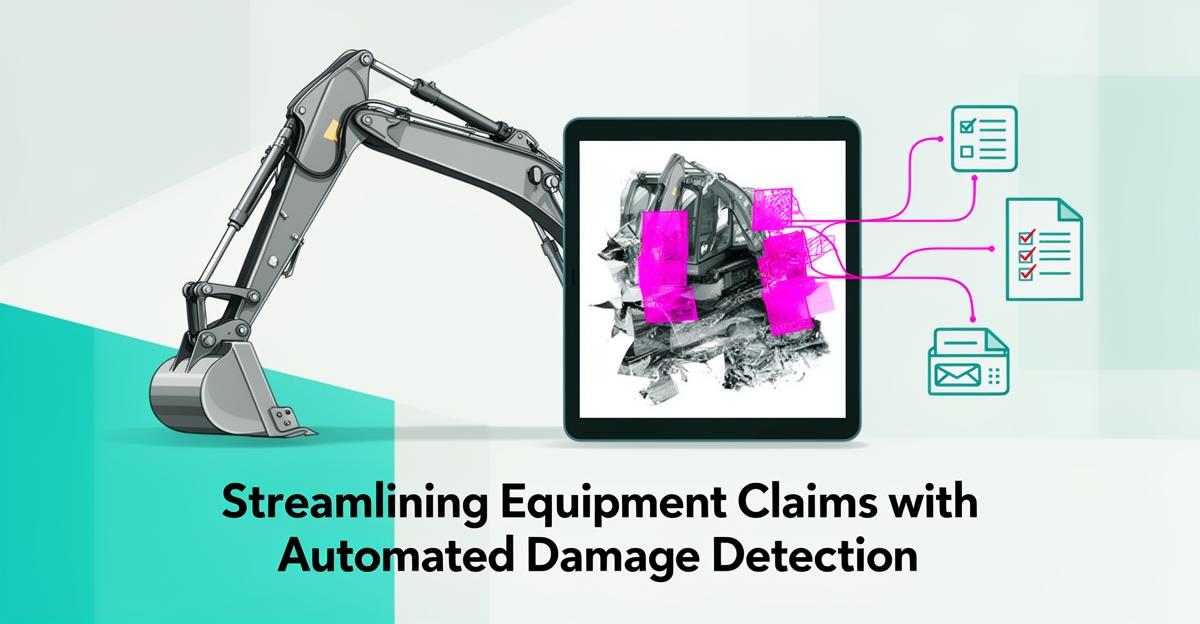
The workflow begins at check-in, where computer vision captures images of the equipment and compares them against baseline photos taken at checkout. AI systems can assess damage severity automatically, flagging differences between return condition and original state and eliminating the guesswork that fuels most disputes. This is the same pattern behind modern generative AI systems, models that can see, describe, and reason over images are now practical building blocks for rental operations, as IBM's overview of AI capabilities makes clear.
Once damage is detected, natural language processing takes over the documentation burden. Instead of a technician writing up a report from memory, the system generates a structured damage report that describes the issue, its severity, and its likely cause, complete with supporting imagery. This is where transparency becomes a competitive advantage: customers receive the same evidence-backed documentation the billing team sees, which removes the "he said, she said" dynamic that erodes trust and stretches resolution timelines.
From there, rule-based engines close the loop by triggering the billing workflow. Because severity classifications map directly to predefined charge schedules, the invoice is generated from the same data that produced the damage report, keeping every dollar of the claim traceable to documented evidence. Rental firms that adopt this approach can expect meaningful operational gains:
- Faster claim resolution, since detection, reporting, and billing happen in one continuous workflow
- Fewer disputes, because customers see objective, image-backed documentation rather than subjective staff assessments
- Reduced administrative burden, as NLP-generated reports replace manual write-ups
- Consistent billing outcomes, driven by rules rather than individual judgment calls
It's worth noting that adoption of AI in equipment damage reporting is still in its early stages as of late 2026, with many firms actively exploring the potential benefits and challenges. Regulatory developments in some markets, such as changes to service tax rates on rental and leasing services, add another layer of complexity that automated, well-documented billing workflows can help firms navigate. Implementation also demands careful evaluation of data quality, system integration, and cybersecurity before committing to a solution.
For rental firms ready to move past the exploration stage, the key is building a system that fits their actual workflow rather than bolting on a generic tool. AIQ Labs specializes in exactly this kind of end-to-end automation, whether that's a focused AI Workflow Build that rebuilds your damage-claims workflow at a fixed price, or a broader AI Operating System that connects inspections, billing, and customer communications in one layer. When the entire claim rests on objective evidence, disputes shrink and customer relationships survive the occasional dented bucket.
Implementing AI Damage Reporting: A Practical Path for Rental Firms
Rental firms are under pressure to process damage claims faster while keeping customers satisfied and costs predictable. AI-powered damage reporting turns a manual, dispute-prone workflow into an automated, auditable process that starts at return and ends with billing.
A practical rollout begins with mapping the existing return-to-invoice journey and identifying the data points AI can capture automatically. That means connecting photos, telematics, inspection notes and rental agreements so the system can assess damage severity and trigger the correct workflow without human re-keying. Integration with existing systems is critical; firms must carefully evaluate data quality, system integration and cybersecurity before scaling.
Phased adoption reduces risk and builds trust with teams and customers. Most firms are still exploring AI in damage reporting, with use still in early stages as organizations test benefits and challenges. A controlled pilot on a single equipment class or location proves accuracy, establishes guardrails for data ownership and privacy, and creates the audit trail needed for transparent claims processing.
Implementation typically follows a clear sequence:
- Discovery and data readiness assessment to align photos, condition reports and billing systems
- Integration with CRM, accounting and rental management platforms for seamless data flow
- Pilot deployment with human-in-the-loop validation to refine severity scoring and billing rules
- Full rollout with monitoring, retraining and continuous optimization
Ownership and scalability matter more than point solutions. AIQ Labs builds systems that businesses own outright, replacing subscription chaos with unified digital assets. Managed AI employees can handle report generation, severity assessment and billing initiation around the clock, typically at a fraction of the cost of additional administrative hires, while a custom-built system lets you retain full control over severity rules, charge schedules, and future development without vendor lock-in. Payment is straightforward too: start monthly, build in milestones, or own the system outright.
Regulatory and cost context also shapes rollout planning. Tax treatment of rental and leasing services continues to evolve in several markets, and accurate, automated claims create the auditable billing trails that support compliance and transparent billing as rules change. Firms that already have structured, evidence-backed claim records adapt to new requirements far faster than those relying on scattered paperwork.
When AI handles documentation, assessment and workflow initiation, disputes fall and customer trust rises. Firms gain operational efficiency, fairer claims processing and faster cycle times, while teams focus on high-value exceptions rather than repetitive paperwork.
Still paying for 10+ subscriptions that don’t talk to each other?
We build custom AI systems you own outright. No vendor lock-in. Full control.
Not sure where to start? Ask our AI planner
Frequently Asked Questions
How does AI actually automate the damage reporting process from start to finish?
Will AI damage reporting really reduce disputes with customers, or just shift the arguments?
What kind of integration work is needed to make AI damage reporting work with our existing rental management and accounting systems?
Is AI damage reporting mature enough for practical use, or is it still experimental?
How does automated damage reporting help with tax compliance and changing regulations?
Do we lose control of our data and workflows if we adopt an AI damage reporting system?
From Dispute-Prone to Data-Driven: The New Standard for Damage Claims
Manual damage reporting is no longer just an operational headache, it's a competitive liability. AI transforms the return-to-invoice workflow by replacing subjective assessments with computer vision, automating report generation through NLP, and linking severity directly to billing rules. The result: faster resolution, fewer disputes, and a transparent process that protects both revenue and customer relationships. Firms that adopt a phased approach, starting with data readiness, piloting on a single equipment class, and integrating with existing CRM and accounting systems, gain control without disruption. Ownership matters: custom-built systems you own outright eliminate vendor lock-in and adapt as regulations and billing rules shift. AIQ Labs has deployed 200+ multi-agent systems and runs 4 live SaaS products daily, so this isn't theory, it's a proven build pattern. The next step isn't more research. It's identifying your highest-friction claim type and testing automation there. Take the 2-minute Fit Check at aiqlabs.ai/apply, then book a free 30-minute strategy call, no pitch, just a clear map of where AI delivers measurable ROI.
Make AI your competitive advantage — not just another tool.
Strategy, implementation and ongoing optimization. One partner, end to end.
Not sure where to start? Ask our AI planner