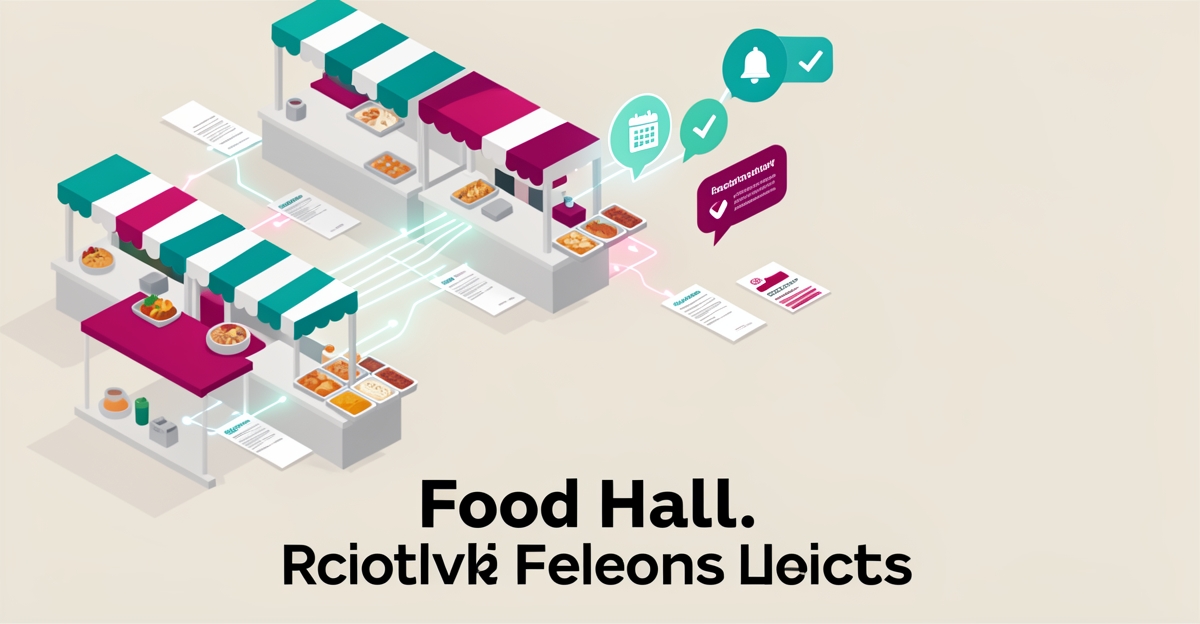
AI for Food Hall Vendor Communication: How to Automate Invoices, Alerts, and Follow-Ups
Key Facts
- Restaurant operators are increasingly directing budget toward AI and automation, with industry surveys consistently showing strong investment intent
- Food halls typically charge vendors 8-15% of gross sales as percentage rent, creating complex invoicing demands
- A majority of operators expect automation to help address labor shortages, per the National Restaurant Association
- Most operators believe technology will augment rather than replace human workers, reducing staffing concerns
- Food halls with central bar programs generate meaningfully more revenue than food-only venues, amplifying coordination complexity
Hire a team member that works 24/7 — for less than a part-time wage.
AI receptionists, SDRs, dispatchers and 99+ roles. Trained on your business, fully managed.
Not sure where to start? Ask our AI planner
The Hidden Cost of Manual Vendor Communication in Food Halls
Food hall operators are drowning in repetitive admin while trying to curate a thriving multi-vendor destination. Every invoice, percentage rent calculation, platform fee and follow-up becomes a manual task multiplied across dozens of independent businesses.
Managing communications across multiple independent vendors is a core operational burden. A modern food hall is a curated, managed multi-vendor destination with a unified design identity, central bar program, and hall operator overseeing guest experience, vendor mix, programming, and often technology infrastructure. That coordination is operationally demanding in ways that leased food courts are not.
Revenue complexity drives the workload. Food halls employ more complex structures including percentage rent (typically 8-15% of gross sales), base rent plus percentage models, per-order platform fees on digital orders, and bar program revenue. Each model requires accurate sales reporting, timely invoicing, and consistent follow-ups.
Manual processes create hidden costs that scale with growth. The US food hall market has expanded steadily since 2023, with new projects opening every year. As of late 2026, operators face increasing pressure to standardize vendor communication without adding headcount.
Labor shortages make the problem urgent. Per the National Restaurant Association, a large share of operators anticipate that technology and automation will become more common to address labor shortages, with automation proving essential for managing repetitive tasks like order processing, inventory management, and customer service inquiries. Manual vendor follow-ups fall squarely in this category.
The cost shows up in three ways:
- Time spent on repetitive invoicing, payment reminders and follow-ups instead of vendor growth and guest experience
- Inconsistent timing and tone across vendors, eroding trust and professionalism
- Delayed cash flow from late payments and missed collections on percentage rent and platform fees
Industry momentum is clear. Restaurant executives surveyed by Deloitte report they are likely to increase AI investments, driven by benefits including enhanced customer experience, smoother operations, and more impactful loyalty programs. Adoption is accelerating across the food automation market broadly.
For food halls, the opportunity is to replace fragmented manual outreach with fully managed AI workflows that ensure consistent, timely, and professional vendor interaction. AIQ Labs deploys these workflows for automated invoice generation, payment reminders, and follow-up communications without manual intervention, creating standardized processes that improve cash flow management and vendor relationships. For halls that want to start with a single high-friction process, a fixed-price workflow build targets exactly the one workflow that costs the most.
How AI Workflows Solve Vendor Communication at Scale
Food hall operators juggle dozens of independent vendors, each with its own invoicing cadence, payment terms, and communication preferences. Manual follow-ups create delays, inconsistent messaging, and cash flow friction that scales poorly as the hall grows.
AI workflows replace that manual patchwork with fully managed automation that runs invoices, alerts, and follow-ups on a predictable schedule. The approach mirrors how restaurants are already adopting AI at scale, with most executives surveyed by Deloitte saying they are likely to increase AI investments in the next fiscal year.
Automation is driven by labor and consistency needs, not hype. Many operators anticipate technology and automation will become more common to address labor shortages, while a majority believe technology will augment rather than replace human labor. For vendor communications, augmentation means staff focus on relationships while the system handles repetition.
At scale, food halls face a coordination problem that food courts do not. Modern halls use percentage rent, platform fees, and bar programs that require continuous data exchange between operator and vendor. Fully managed AI workflows ensure that exchange is timely, professional, and auditable without adding headcount.
AIQ Labs deploys these workflows as production-proven multi-agent systems, over 200 deployed to date. The same architecture used in demanding industries like collections is adapted for vendor operations, with validation layers, human-in-the-loop escalation, and complete audit trails.
What changes in practice:
- Invoice generation triggers automatically from sales data, POS exports, or percentage rent calculations, then delivers to the correct vendor channel on a consistent schedule.
- Payment alerts are sent at configurable intervals before due dates, with dynamic follow-up sequences that adjust tone and channel based on vendor history.
- Follow-ups are logged, deduplicated, and routed to human staff only when exceptions occur, preserving relationship quality.
- All interactions are stored with timestamps and digital signatures for compliance and dispute resolution.
The result is consistent, auditable delivery with no missed cycles. That consistency improves cash flow predictability for the operator and reduces friction for vendors who receive clear, professional communications every time.
Industry momentum supports the shift. Adoption is accelerating across order processing, inventory, and administrative tasks. For food halls, automating vendor communication is a foundational step toward operating a curated multi-vendor destination without operational drag.
With workflows fully managed, operators maintain control and ownership while reducing manual work. Teams review exceptions, not routine messages, and vendor relationships improve through reliable, respectful automation. Operators who want a broader connected layer across billing, staffing, and reporting can graduate to a full AI operating system, built in phases and owned outright.
Implementing AI Vendor Communication: From Assessment to Optimization
Implementing AI vendor communication in a food hall isn't a single switch you flip, it's a sequence. The operators seeing the best results start by understanding where manual work actually lives, then build automation on top of systems they already use. With AI adoption accelerating across restaurant operations, the timing matters: moving deliberately now positions a hall ahead of a wave that's only growing.
Phase 1: Assess the current workflow. Before any automation, map how vendor communication happens today. Track time spent generating invoices manually, chasing late payments, and fielding vendor questions. This mirrors what automation experts recommend across restaurant operations: analyze repetitive tasks, identify bottlenecks, and survey staff about tedious work before choosing tools. For a food hall operator coordinating percentage rent (typically 8-15% of gross sales) across dozens of independent vendors, this assessment usually reveals hours of weekly administrative drain.
Phase 2: Integrate with existing tools. AI should connect to the accounting and communication platforms already in place, QuickBooks for invoicing, Twilio for SMS and voice, not replace them. Deep two-way API integration is what turns disconnected tools into a single operational workflow, and it's the difference between a system that runs itself and one that creates more admin work. The average QSR already juggles well over a dozen technology vendors, so consolidation matters as much as capability.
Phase 3: Deploy managed AI employees. Once integrated, a managed AI agent can handle invoice generation, payment reminders, and follow-up alerts around the clock, consistently, professionally, and without a human remembering to send them. This is the model behind AIQ Labs' AI employees: fully managed AI staff trained on the hall's specific vendor terms and tone, monitored and improved continuously, at a fraction of the cost of an equivalent human hire. The restaurant industry is moving the same direction; Deloitte's survey of restaurant executives found most plan to increase AI investments in the next fiscal year.
Phase 4: Establish governance and optimize. Automation needs guardrails. That means audit trails for every communication, human-in-the-loop escalation for sensitive vendor conversations, and clear limits on what the AI can decide on its own. Governance is one of the top gaps operators report when adopting AI, so building it in from day one prevents problems later.
A practical rollout looks like this:
- Document current invoice, reminder, and follow-up processes, including time costs
- Connect AI workflows to QuickBooks, Twilio, and existing POS data
- Deploy managed AI communication with defined escalation rules
- Review performance monthly and expand to new workflows as trust grows
The National Restaurant Association notes that a large share of operators expect automation to become more common as a response to labor shortages, and most believe technology will augment rather than replace human staff. A phased approach honors both: it removes the repetitive work while keeping operators in control. For food halls ready to start, a free strategy call can map the highest-ROI workflow first, with real numbers provided in writing before any commitment.
Still paying for 10+ subscriptions that don’t talk to each other?
We build custom AI systems you own outright. No vendor lock-in. Full control.
Not sure where to start? Ask our AI planner
Frequently Asked Questions
How does AI automation actually reduce the time food hall operators spend on vendor invoicing and follow-ups?
What specific revenue models in food halls make vendor communication more complex than in traditional food courts?
Will using AI for vendor communication replace my existing accounting or POS systems like QuickBooks?
How reliable are AI-generated invoices and payment reminders compared to manual processes?
What happens if a vendor has a unique payment term or exception that the AI might not handle correctly?
Is there evidence that restaurant operators are actually investing in AI for tasks like vendor communication?
The Operator's Advantage: Turning Vendor Chaos into Predictable Cash Flow
Food hall operators who automate vendor communication aren't just saving hours on invoicing and follow-ups, they're building a financial operating system that scales. The shift from manual reminders to managed AI workflows means percentage rent, platform fees, and bar program revenue are collected on schedule, every cycle, without the operator chasing payments or vendors guessing due dates. As of late 2026, the operators who standardize now will spend their time curating vendor mix and guest experience instead of reconciling spreadsheets. AIQ Labs deploys fully managed AI workflows that handle invoice generation, payment alerts, and escalation paths, integrating with QuickBooks, Twilio, and POS data, so the system runs itself and teams only step in for exceptions. The next step is simple: map your current communication workflow, identify the highest-volume friction point, and automate that one first. Start the two-minute Fit Check at aiqlabs.ai/apply to see exactly which workflow delivers the fastest ROI, with real numbers provided in writing before any commitment.
Make AI your competitive advantage — not just another tool.
Strategy, implementation and ongoing optimization. One partner, end to end.
Not sure where to start? Ask our AI planner