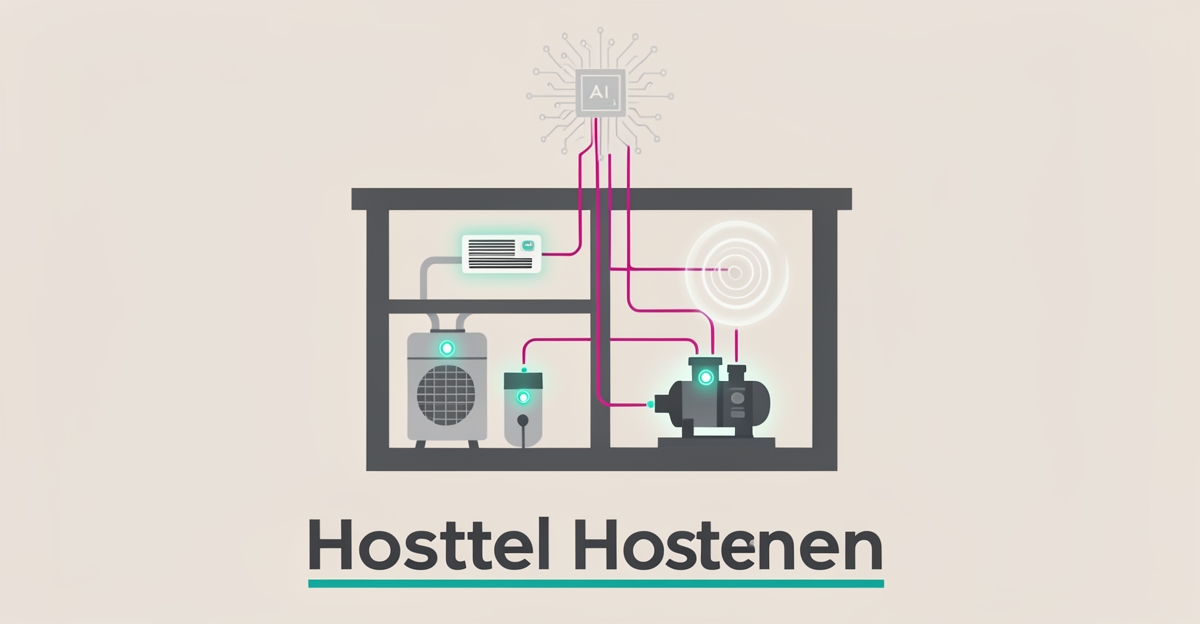
AI for Hostel Maintenance: Predicting Equipment Failures Before They Happen
Key Facts
- AI-powered predictive maintenance can reduce equipment downtime by 30-50% and cut maintenance costs by up to 40% when implemented well.
- Traditional preventive maintenance has a blind spot: 30-40% of failures occur between scheduled intervals.
- Industrial manufacturers lose an estimated $50 billion annually in unplanned downtime caused by reactive maintenance.
- A European offshore wind operator detected bearing degradation 45-120 hours before failure, cutting emergency repairs by 67%.
- In predictive maintenance projects, roughly 70% of effort goes into data engineering, not model building.
- A significant share of organizations that start predictive maintenance programs, one widely cited figure is 58% of those beginning in 2022, abandon them or see no measurable ROI within 18 months.
- Institutions using AI-driven hostel management systems report a 40% reduction in administrative workload and 30% improvement in space utilization.
Hire a team member that works 24/7 — for less than a part-time wage.
AI receptionists, SDRs, dispatchers and 99+ roles. Trained on your business, fully managed.
Not sure where to start? Ask our AI planner
The Hidden Cost of Reactive Maintenance in Hostels
A burst pipe at 2 a.m., a boiler that dies mid-winter, Wi-Fi that drops during peak check-in, for hostel operators, equipment failure rarely announces itself politely. And when it does arrive, it arrives at the worst possible moment, with guests already in the building and revenue already on the line.
Most hostels still operate on one of two maintenance models: reactive ("fix it when it breaks") or preventive ("fix it before it fails on a fixed schedule"). Both sound reasonable. Both quietly drain money. Reactive maintenance is risky and expensive at scale, producing unpredictable downtime and emergency repair costs, while traditional preventive maintenance has a blind spot of its own, research shows that 30-40% of failures occur between scheduled intervals, meaning equipment can break down precisely because it was "just serviced."
The financial weight of this approach is well documented. Industrial manufacturers lose an estimated $50 billion annually in unplanned downtime caused by reactive maintenance, and while a hostel operates at a smaller scale, the pattern is identical: one failed HVAC compressor or kitchen refrigeration unit can shut down revenue-generating space for days. Preventive schedules also waste resources on premature replacements of parts that still have useful life left, inflating costs without improving reliability.
The guest experience cost is harder to quantify but just as real. A hostel's reputation lives and dies on consistency, hot showers, working locks, reliable internet. When failures happen randomly, service quality becomes inconsistent, and reviews reflect it.
The alternative is maintenance driven by actual equipment condition rather than the calendar. AI systems can analyze historical maintenance records alongside real-time sensor data, temperature, vibration, power draw, to flag subtle degradation patterns that humans would miss, triggering alerts and work orders before a breakdown occurs. When implemented correctly, this approach can reduce equipment downtime by 30-50% and cut maintenance costs by up to 40%. The lesson from other industries is instructive: a European offshore wind operator used machine learning on existing sensor data to detect bearing degradation 45-120 hours before failure, cutting emergency repairs by 67% and paying back its investment in roughly 14 months.
For hostels, the practical starting point is the one experts recommend across sectors: focus on the 20% of assets causing 80% of downtime costs, typically HVAC, water heaters, kitchen equipment, and network infrastructure. AIQ Labs builds this kind of capability as part of its AI Workflow Builds, rebuilding the one workflow that costs you the most, and for multi-site operators, its AI Operating Systems connect maintenance data into one owned operating layer. The point in every case is the same: schedule repairs on your terms rather than the equipment's.
The hidden cost of reactive maintenance isn't the repair bill, it's everything around it: lost bookings, emergency premiums, and guests who never come back. Predictive maintenance turns those costs into a manageable, planned line item.
How AI-Powered Predictive Maintenance Works for Hospitality Equipment
Predictive maintenance turns hostel equipment from a source of surprise outages into a managed risk. By connecting sensor telemetry with historical maintenance logs, AI models spot degradation patterns long before guests notice a cold shower or slow Wi-Fi.
AI systems monitor equipment in real time, identifying signs of potential failure before breakdowns occur. According to industry research, AI can reduce equipment downtime by 30-50% and cut maintenance costs by up to 40% when implemented correctly. That shift from reactive fixes to proactive action protects service quality and revenue.
The approach is fundamentally a data discipline. As LinkedIn content from Whitespectre explains, predictive maintenance requires connecting physical signals, historical context, and response workflows effectively. Machine telemetry captures vibration, temperature, pressure, current draw and performance signals, while data flow systems clean and organize sensor data for comparison over time.
Model selection depends on data availability and failure modes. Time-series forecasting models such as LSTM and GRU work when you have sequential sensor data and want to predict remaining useful life, typically requiring 50+ failure cycles or 6-12 months of high-frequency logs. Anomaly detection models like Isolation Forest and Autoencoders identify deviations from normal patterns without historical failures, typically requiring 30+ days of normal operation. Survival analysis models predict failure probability over time with sparse data, needing operating hours and failure events but not continuous streams.
Building the system follows a practical pipeline. Implementation guidance notes that roughly 70% of effort goes into data engineering, not model building. A minimum viable model can typically be built in 8-12 weeks using existing SCADA or IoT data before investing in new sensors.
Key components in a hostel deployment include:
- Sensor integration for HVAC, Wi-Fi infrastructure and kitchen appliances capturing temperature, vibration, current draw and network metrics
- Edge preprocessing to filter signals locally, reducing bandwidth and improving latency
- Pattern detection using machine learning to identify subtle changes humans would miss
- Early warning systems that flag small deviations before they become downtime
- Action workflows that trigger alerts, inspections, work orders and replacement decisions automatically
Real-world results show the value of this discipline. A European offshore wind operator using LSTM models on existing SCADA data detected bearing degradation 45-120 hours before failure in 6 of 7 test cases and achieved a 67% reduction in emergency repairs. For hostels, the same principles apply to compressors, boilers, access points and refrigeration units.
AIQ Labs has deployed 200+ multi-agent systems, including predictive models that help hostels maintain high service quality and avoid costly downtime by focusing on the 20% of assets causing 80% of downtime costs. Continuous learning updates models as machines age and conditions change, keeping predictions reliable over time.
Implementing AI Maintenance in Hostels: A Practical 12-Week Roadmap
The difference between hostels that see ROI from AI maintenance and the large share of organizations that abandon predictive maintenance programs without measurable results comes down to one thing: a structured implementation plan. Rushing into model building without the right foundation is the most common failure mode, and it's entirely avoidable.
A well-designed roadmap follows the sequence proven across industrial deployments, adapted to hostel realities. The critical insight from the AI Predictive Maintenance Guide 2026 is that roughly 70% of effort goes into data engineering, not model building, which means your first weeks should focus on data, not algorithms.
Here is a practical 12-week roadmap:
Weeks 1–2: Asset Selection. Identify 5–10 high-impact assets, typically HVAC units, water heaters, and Wi-Fi infrastructure. Map available data sources, calculate downtime costs, and build a prioritization matrix. Focus on the 20% of assets causing 80% of downtime costs, and you'll typically see returns in the first year.
Weeks 3–4: Data Pipeline Development. Extract 12+ months of historical maintenance data, build time-alignment scripts, and label past failures. The goal is a clean dataset with 20–50 engineered features. Skip this step and your model will learn noise instead of failure patterns.
Weeks 5–6: Model Development. Train 2–3 model types and evaluate accuracy, precision, and recall. Model choice depends on your data: anomaly detection models like Isolation Forests need only 30+ days of normal operation and typically build in 6–8 weeks, while LSTM networks for predicting remaining useful life generally require 50+ failure cycles and 12–16 weeks.
Weeks 7–8: Threshold Tuning. Run models on test data, tune alert thresholds, and validate with your maintenance team. Expect initial false alarm rates of 15–30% from anomaly detection, the wind turbine case study in the research refined false alarms from 12% down to 4% through iteration.
Weeks 9–10: Integration. Build the inference pipeline and connect predictions directly into your CMMS so alerts automatically trigger work orders. Prediction without action is just reporting, the workflow must change behavior.
Weeks 11–12: Production Deployment. Launch monitoring dashboards and establish feedback loops so models keep learning as equipment ages.
This phased approach mirrors how AIQ Labs structures its own deployments, discovery and architecture first, development and integration second, then deployment, training, and ongoing optimization, with payment tied to milestones rather than open-ended hourly billing. The payoff justifies the discipline: correctly implemented predictive maintenance typically reduces equipment downtime by 30–50% and cuts maintenance costs by up to 40%. For hostels ready to move from reactive repairs to condition-based maintenance, the fastest first step is the two-minute Fit Check at aiqlabs.ai/apply, followed by a free 30-minute strategy call to map which assets offer the clearest first win.
From Surprise Failures to Planned Upkeep
Reactive repairs and rigid schedules both bleed money because they respond to the calendar or to a crisis, not to actual equipment health. AI-powered predictive maintenance changes that by connecting sensor telemetry and historical maintenance logs to spot degradation early, letting hostel operators schedule work on their terms and protect the consistency guests expect. The 20% of assets that drive 80% of downtime, HVAC, water heaters, kitchen equipment and network infrastructure, are the clearest first wins, and a focused 12-week build using existing data can move operations from surprise outages to condition-based maintenance. If you're evaluating where to start, map your highest-cost failure points, audit the data you already collect, and test a minimum viable model before adding sensors. AIQ Labs builds exactly this kind of focused, phased capability, whether as a standalone workflow rebuild or as part of a broader AI operating system you own outright. Start the two-minute Fit Check at https://aiqlabs.ai/apply, then book a free 30-minute strategy call to map your biggest bottleneck and identify a high-ROI first win. Prefer email? Reach the team at [email protected].
Make AI your competitive advantage — not just another tool.
Strategy, implementation and ongoing optimization. One partner, end to end.
Not sure where to start? Ask our AI planner