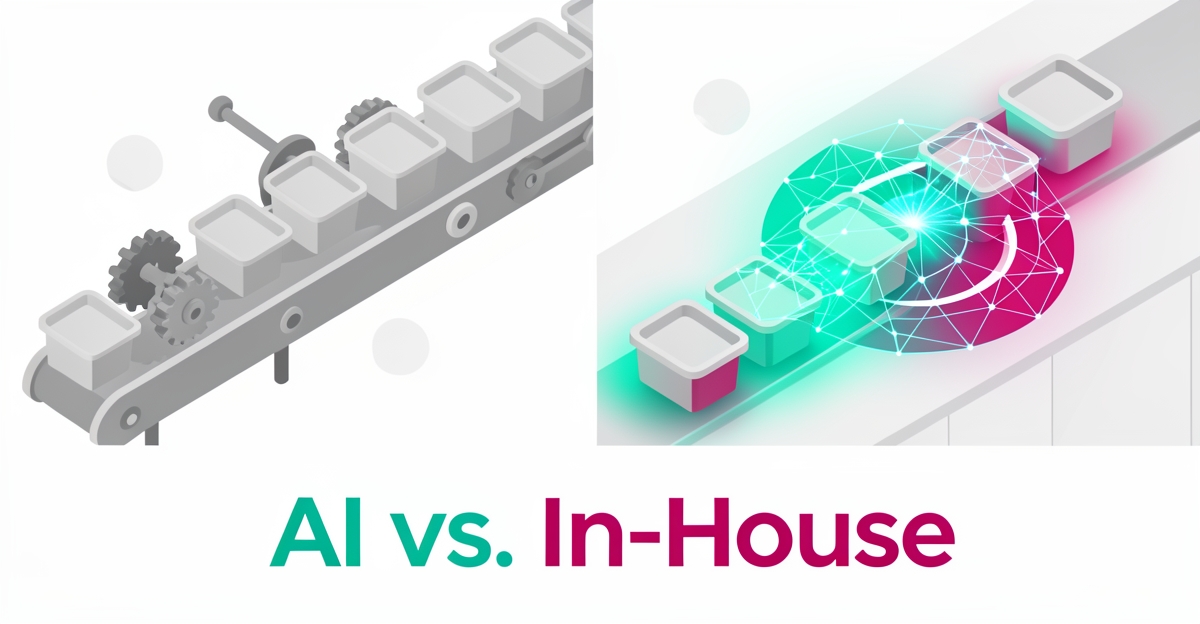
AI for Meal Prep: A Comparison of In-House Automation vs. AI-Powered Solutions
Key Facts
- AI-powered solutions can typically be scaled up or down based on platform capabilities
- Building an in-house automation team can be expensive to maintain
- Managed AI solutions are often more cost-effective for small and medium-sized businesses
- In-house automation can be limited by team size and resources
- Setting up in-house automation is typically complex and resource-intensive
- AI-powered solutions can be relatively simple to set up and maintain
- AI agents like Sous Chef have demonstrated automated recipe sourcing and ingredient list validation
Hire a team member that works 24/7 — for less than a part-time wage.
AI receptionists, SDRs, dispatchers and 99+ roles. Trained on your business, fully managed.
Not sure where to start? Ask our AI planner
The Meal Prep Automation Bottleneck SMBs Face
Many small and medium-sized businesses in the meal prep industry find themselves trapped in a cycle of manual, repetitive tasks that hinder growth and efficiency. From recipe sourcing to ingredient list compilation, these workflows can be time-consuming and prone to errors, especially as the business scales.
A widely shared example illustrates this challenge: a developer built an AI agent called Sous Chef to simplify her family's meal prep. The agent pulls recipes from trusted websites, ensures complete ingredient lists, and delivers them straight to her inbox. This demonstrates the potential of AI to automate and streamline meal prep tasks.
However, for SMBs, the decision to automate meal prep workflows is not straightforward. They must choose between building an in-house automation team or adopting a managed AI solution. This decision creates budget and scalability pressure, as each option has its own set of challenges:
- Scalability: In-house automation can be limited by team size and resources, while AI-powered solutions can typically be scaled up or down depending on the platform or tool used.
- Budget: Building and maintaining an in-house automation team can be expensive, whereas AI-powered solutions can be cost-effective, especially for SMBs.
- Complexity: Setting up and maintaining AI-powered solutions can be relatively simple, but in-house automation can be complex and resource-intensive.
The choice between in-house automation and AI-powered solutions is not just about technology; it's about aligning with the business's long-term goals and constraints. AIQ Labs helps businesses navigate this decision by evaluating both options and choosing the one that best fits their budget, scalability needs, and strategic objectives.
For businesses looking to streamline their meal prep workflows, the key is to identify tasks that can be automated and choose the right tools or platforms. Whether it's building a custom AI agent or leveraging a managed solution, the goal is to reduce manual effort, minimize errors, and free up resources for growth and innovation.
By understanding the bottlenecks in their meal prep workflows and the available automation options, SMBs can make informed decisions that drive efficiency and scalability. The right choice can transform meal prep from a manual, time-consuming process into a streamlined, automated operation that supports business growth.
In-House Automation vs AI-Powered Solutions Compared
For meal prep operations, choosing between building an in-house automation team and adopting an AI-powered solution involves weighing scalability, budget, and complexity. An in-house team offers direct control but faces limitations in scaling due to team size and resource constraints. In contrast, AI-powered solutions provide flexibility to scale up or down based on the platform's capabilities, making them adaptable to changing business needs. Regarding budget, maintaining an internal automation team often requires significant ongoing investment in talent and infrastructure, while managed AI solutions can be more cost-effective, particularly for small and medium-sized businesses seeking to avoid large upfront expenditures. Complexity also differs: setting up and sustaining in-house systems demands specialized expertise and continuous maintenance, whereas AI-powered platforms typically streamline deployment and reduce operational overhead.
AIQ Labs supports businesses in evaluating these trade-offs through its current service lineup. An AI Employee gives you a managed AI staff member, such as a dispatcher or operations coordinator, without the cost of a human hire. An AI Workflow Build rebuilds the one workflow that costs you the most, at a fixed price and in phases. And an AI Operating System connects everything into one operating layer you own outright. By assessing scalability, budget impact, and implementation complexity against these options, organizations can determine whether internal development or a managed AI approach better serves their meal prep automation objectives.
The Sous Chef example, built with the phidata framework, illustrates how AI agents can automate recipe sourcing and ingredient verification, demonstrating the practical potential of managed solutions to simplify meal prep workflows. Integrating AI agents with complementary tools like NOSH can further enhance functionality, creating a more comprehensive automation ecosystem. Ultimately, the decision hinges on matching the solution's strengths to the organization's specific context, whether prioritizing customization and control or favoring agility and reduced operational burden. AIQ Labs assists in this evaluation by mapping internal capabilities against vendor offerings, ensuring the chosen path supports sustainable AI adoption and measurable outcomes in meal prep processes. Scalability and budget are consistently the critical factors in choosing between in-house automation and managed AI solutions, reinforcing the need for a structured evaluation process.
How AI Agents Like Sous Chef Simplify Meal Prep
Over the holidays, developer Aishwarya Raghavan built Sous Chef, an AI agent using phidata to simplify her family's meal prep, demonstrating how AI can streamline kitchen workflows. The agent pulls recipes from trusted websites, validates ingredient lists for completeness, and delivers them directly to her inbox, automating repetitive planning tasks. This practical example shows how an AI-powered solution can handle end-to-end meal prep coordination with minimal manual intervention.
By leveraging phidata's framework, Sous Chef exemplifies a lightweight, scalable approach to AI agent development that avoids the overhead of building an in-house automation team. The system's design allows for easy integration with complementary platforms like NOSH, which could manage inventory, scheduling, or grocery ordering to create a full meal prep ecosystem. Such integrations highlight how managed AI solutions can connect disparate tools into a unified workflow without requiring deep internal engineering expertise.
For businesses evaluating AI for operational tasks like meal prep, this case underscores the trade-offs between in-house development and managed solutions. While building custom systems offers control, it demands significant time and technical resources, challenges that limit scalability for most SMBs. In contrast, platforms like phidata reduce complexity, enabling faster deployment and iteration, especially when paired with domain-specific tools.
AIQ Labs helps organizations assess these options through its three entry points, AI Employees, Workflow Builds, and AI Operating Systems, guiding them toward solutions that align with their budget, scalability needs, and long-term goals. Whether automating a single workflow like meal prep or overhauling entire departments, the right approach balances immediate usability with sustainable growth.
To explore how AI agents like Sous Chef can simplify your operations, start with the two-minute Fit Check to identify high-ROI automation opportunities tailored to your business.
Choosing the Right Build Path for Budget and Scale
Choosing the right build path for AI-powered meal prep starts with aligning your approach to your budget and growth plans. Businesses can opt for in-house development, a Start Monthly AI Employee, a Build in Milestones approach, or Own It Outright, each offering different trade-offs in control, cost, and scalability. The decision hinges on identifying which meal prep tasks are ripe for automation, such as recipe aggregation, ingredient list validation, or delivery scheduling, and matching them to the appropriate implementation model. For example, automating recipe pulls from trusted sources and ensuring complete ingredient lists, core functions demonstrated in the Sous Chef agent, can be efficiently handled through a managed AI Employee or a phased milestone build, reducing the need for deep in-house expertise.
When selecting a platform, prioritize tools that support integration and iterative refinement, like phidata, which was used to build the Sous Chef agent and can be extended with complementary systems such as NOSH for end-to-end meal prep automation. Begin by mapping out your current workflow to pinpoint repetitive, time-consuming steps, then evaluate whether a Start Monthly model offers faster deployment with lower upfront risk, or if owning the system outright better supports long-term customization and ownership. AIQ Labs supports this evaluation through its Workflow Builds and AI Operating Systems offerings, helping businesses assess readiness and design a roadmap that balances immediate needs with future scale.
Testing and refining the solution is critical to ensure reliability and user adoption. Start with a pilot focused on a single automated task, like generating weekly meal plans with verified ingredients, then gather feedback, adjust prompts or integrations, and gradually expand functionality. Whether building in-house or using a managed service, continuous optimization based on real-world use ensures the AI agent evolves with your meal prep needs. This iterative approach not only improves accuracy but also builds confidence in the system's ability to scale, making it easier to justify further investment in automation across other operational areas.
Still paying for 10+ subscriptions that don’t talk to each other?
We build custom AI systems you own outright. No vendor lock-in. Full control.
Not sure where to start? Ask our AI planner
Frequently Asked Questions
What are the main differences between building an in-house automation team and using a managed AI solution for meal prep workflows?
How can an AI agent like Sous Chef simplify meal prep tasks for businesses?
Is it expensive to implement AI-powered meal prep automation for a small business?
What should I consider when choosing between in-house development and a managed AI service for meal prep automation?
Can I start small with AI automation for my meal prep business and scale later?
How does AIQ Labs help businesses decide on the right AI automation path for meal prep?
From Bottleneck to Breakthrough: Choose Your Meal Prep Automation Path
Meal prep automation for SMBs comes down to a practical trade-off between control and agility. In-house automation offers direct ownership but can be limited by team size, higher ongoing costs, and the complexity of building and maintaining systems. Managed AI-powered solutions, like the Sous Chef agent built with phidata to pull recipes, validate ingredients and deliver plans to inbox, show how a lightweight, scalable approach can reduce manual effort and errors without the overhead of an internal team. The right choice hinges on your budget, scalability needs, and long-term goals, not just the technology itself. Map your repetitive workflows first, test a single high-ROI task such as recipe aggregation or ingredient verification, then decide whether a Start Monthly AI Employee, Build in Milestones, or Own It Outright model fits your context. AIQ Labs can help you evaluate both paths across its three service entry points. Start the Fit Check at https://aiqlabs.ai/apply for a free 30-minute strategy call to map your biggest bottleneck and identify the automation approach that fits.
Make AI your competitive advantage — not just another tool.
Strategy, implementation and ongoing optimization. One partner, end to end.
Not sure where to start? Ask our AI planner