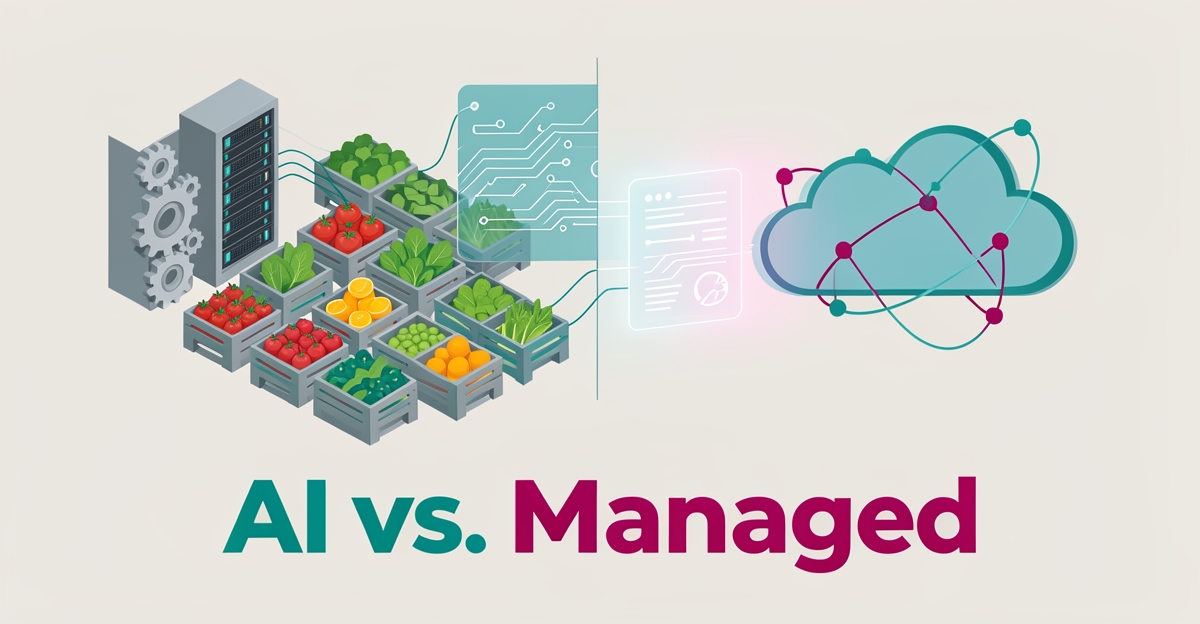
AI for Produce Wholesalers: A Comparison of In-House Automation vs. Managed AI Employees
Key Facts
- Roughly half of wholesale distributors have piloted AI projects in recent years. Industry research
- Far fewer small wholesale distributors have fully implemented AI systems, leaving a gap between experimentation and operational impact. Industry research
- AI implementation has been reported to reduce overall operational costs by 15-20% for wholesalers. Industry research
- AI-powered demand forecasting has been reported to cut food waste by 15-25% in the produce industry. Sector research
- Computer vision systems have been reported to reduce labor costs by 30-40% in produce quality grading. Industry analysis
- Well-configured AI agents can handle routine calls in about a minute, versus 10+ minutes for a human virtual assistant. Source comparison
- Dynamic pricing optimization has been reported to increase margins by 8-12% for produce wholesalers. Produce industry research
Hire a team member that works 24/7 — for less than a part-time wage.
AI receptionists, SDRs, dispatchers and 99+ roles. Trained on your business, fully managed.
Not sure where to start? Ask our AI planner
The Margin Squeeze Driving AI Decisions in Produce
Produce wholesalers operate in an environment where razor-thin margins leave little room for error, and the pressure to adopt AI keeps intensifying. Industry research suggests that roughly half of wholesale distributors have piloted AI projects, yet only a fraction of small wholesalers have fully implemented systems, a significant gap between experimentation and operational impact. That hesitation comes at a cost, because the sector faces mounting challenges from perishability, volatile demand, and rising operational complexity.
The financial stakes are clear: AI implementation has been reported to reduce overall operational costs by 15-20%, cut inventory carrying costs meaningfully, and reduce waste in perishable goods by as much as 25%. For businesses where a single percentage point of improved efficiency can determine profitability, these gains are not incremental, they are existential. Yet the path to realizing them is obstructed by persistent barriers, including data quality issues cited by a majority of adopters, legacy system integration delays, and a widespread AI skills gap.
These challenges force a critical strategic decision: whether to invest in building an in-house AI system or to adopt managed AI employees who can deliver targeted outcomes faster and with less technical overhead. The choice hinges not only on cost and speed but on long-term control, scalability, and the ability to maintain data integrity in an environment where inconsistent inputs can undermine even the most advanced models. For produce wholesalers navigating this tension, the solution must balance immediate needs with sustainable advantage, without locking them into rigid dependencies or exposing them to avoidable risk.
In-House Automation vs Managed AI Employees: Trade-Offs
Produce wholesalers face a real fork in the road: build an AI system in-house or plug in a managed AI employee that works today. The choice shapes control, cost, and how fast waste and margin leaks get closed.
In-house automation promises full ownership and deep customization. It also demands solving foundational problems first. Industry research shows a majority of adopters cite data quality issues in wholesale AI implementations, while many report data silos hindering rollouts. Add a persistent AI talent gap and legacy system integration delays, and the build path becomes a multi-quarter project for most SMBs.
Managed AI employees flip the burden. The provider owns model training, monitoring, and maintenance while the wholesaler gets a role-based agent that plugs into existing tools. That reduces technical risk and accelerates time-to-value for repetitive, high-volume tasks like dispatch, order review, and intake.
Speed and accuracy differences show up in real workflows. One comparison notes that well-configured AI agents can process routine calls in about a minute, versus 10+ minutes for a human virtual assistant. For produce, where perishability compresses decision windows, that gap translates directly to fill rates and spoilage.
Trade-offs crystallize across five dimensions:
- Control: In-house gives full model and data ownership; managed offers configuration within a proven service.
- Cost and talent: Build requires hiring scarce AI specialists; managed runs on a flat plan with no recruiting overhead, typically around 80% less than the cost of a comparable human hire.
- Time to value: In-house typically takes months for training and integration; managed deploys in days or weeks for defined roles.
- Maintenance: In-house teams must retrain and monitor models continuously; managed includes updates as part of service.
- Governance: Both models need clean data and clear accountability, but managed shifts infrastructure risk to the provider.
AIQ Labs reflects this reality with a hybrid approach. Through AI Employees, wholesalers can deploy managed AI staff, receptionists, SDRs, dispatchers, order reviewers, and 99+ other roles, without recruiting overhead. Through Workflow Builds, they can rebuild the one workflow that costs the most, at a fixed price and in phases. That lets produce wholesalers start with fast wins from a managed agent and later extend into owned workflows as data maturity grows.
The decision is less about ideology than operational readiness. Firms with strong data pipelines and dedicated engineering can justify build. Most SMB wholesalers benefit from managed speed first, then layer ownership where competitive advantage demands it.
High-Impact AI Use Cases for Produce Wholesalers
Produce wholesalers live on margin, waste, and speed. AI is now proving it can move all three at once, but how you deploy it, build in-house or run a managed AI employee, changes the cost, timeline, and control you get.
Computer vision quality grading is the highest-impact starting point. Camera systems grade and sort fruit and vegetables by ripeness and defects, and industry analysis has reported labor cost reductions of 30-40% in produce quality grading per industry analysis. An in-house build gives full model ownership and customization for unique SKUs, but requires data pipelines, camera integration, and ongoing retraining. A managed AI employee can launch faster for defined grading lanes with monitoring included.
Demand forecasting for perishables directly protects profit. Machine learning models that analyze seasonality, weather, and customer history have been reported to reduce food waste by 15-25% in the produce industry per sector research, with wholesale distribution data showing waste reductions of up to 25% in perishable goods. Building in-house offers deep integration with ERP and owned data, yet data quality issues and legacy system delays stall many of these projects. Managed forecasting tools integrate with current inventory systems and lower technical burden.
Dynamic pricing and cold chain monitoring lift margin with less risk. AI-driven pricing adjusts in real time to inventory levels, freshness, and market conditions, and has been reported to increase margins by 8-12% for produce wholesalers per produce industry research. Predictive cold chain monitoring can prevent a meaningful share of temperature-related losses. Both use cases benefit from rapid deployment via managed AI, while in-house builds provide proprietary pricing logic and full ownership.
Automated order processing closes the loop. Industry statistics show AI-driven automation has cut order processing time substantially in wholesale operations, with AI chatbots handling a majority of routine customer inquiries and reducing labor costs in order fulfillment. This is a classic managed AI employee fit, an AI Order Reviewer or Dispatcher can be deployed in days and work 24/7/365.
High-impact use cases map to the build vs managed choice:
- Computer vision quality grading, high waste reduction, high implementation complexity
- Demand forecasting for perishables, strong margin gains, needs clean historical data
- Dynamic pricing optimization, reported 8-12% margin lift, requires real-time market data
- Cold chain monitoring, prevents temperature-related loss, benefits from IoT + AI integration
- Automated order processing, faster processing, fast to deploy as managed AI
AIQ Labs supports both paths: managed AI Employees for faster time to value, and Workflow Builds for the highest-cost workflow rebuilt in phases, letting wholesalers match complexity to capability.
A Hybrid Roadmap for Flexibility and Ownership
For produce wholesalers navigating AI adoption, the path forward doesn't require an all-or-nothing choice between building everything in-house or outsourcing entirely. Many find the most practical route begins with managed AI employees to achieve quick wins, then transitions toward owned systems as internal capabilities and confidence grow. This hybrid approach aligns with the reality that most distributors face an AI talent gap, making immediate full-scale development unrealistic. Industry research confirms that starting small, such as deploying an AI Dispatcher to handle call routing or an AI Order Reviewer to validate purchase accuracy, allows businesses to demonstrate value within weeks, not months, while avoiding the steep learning curve of foundational AI work.
AIQ Labs' hybrid model supports this evolution through three payment structures designed for changing needs. Wholesalers can begin with Start Monthly for an AI Employee, covering build, training, tool integration, and ongoing optimization, for a fraction of the cost of a human hire. As processes stabilize and trust in the technology builds, they can shift to Build in Milestones, approving and paying for each phase of a custom system, like an AI-powered inventory forecaster or dynamic pricing engine, as it ships. Eventually, the Own It Outright model enables full ownership of the code, agents, and data, eliminating long-term dependency while preserving the flexibility to scale or pivot. For wholesalers ready to connect forecasting, pricing, ordering, and dispatch into one system, AI Operating Systems deliver that connected layer in phases, owned outright. This progression ensures investment aligns with proven results, reducing risk for businesses operating on thin margins where even a 15-20% reduction in operational costs from AI can be transformative. Data shows such savings are achievable, but only when implementation matches organizational readiness.
Throughout this journey, data governance remains a shared responsibility that cannot be overlooked. Whether using a managed AI Employee or developing an in-house system, wholesalers must answer critical questions: Can we trust the data feeding these systems? Is ownership of AI outputs and accountability for errors clearly defined? And are access controls standardized to prevent security risks? Experts warn that AI amplifies existing data flaws, making authoritative but incorrect decisions more dangerous than obvious failures. By starting with managed services where the provider handles model maintenance and monitoring, while the wholesaler focuses on supplying clean, authorized data, businesses can build governance muscle before assuming full control. This staged approach turns AI adoption from a technical gamble into a strategic advantage, rooted in flexibility, ownership, and operational truth.
Still paying for 10+ subscriptions that don’t talk to each other?
We build custom AI systems you own outright. No vendor lock-in. Full control.
Not sure where to start? Ask our AI planner
Frequently Asked Questions
What are the main differences between building an in-house AI system and using managed AI employees for a produce wholesaler?
How much can AI reduce operational costs and waste for produce wholesalers, and what data supports this?
What are the biggest barriers to AI adoption for small produce wholesalers, and how do they affect the decision to build vs. buy?
Can managed AI employees really outperform human workers or virtual assistants in tasks like order processing or call handling?
Is it possible to start with managed AI employees and later transition to owning a custom AI system?
What high-impact AI use cases should produce wholesalers prioritize, and which are best suited for managed vs. in-house deployment?
Pick Speed Now, Own Advantage Later
For produce wholesalers, AI isn't a luxury, it's the lever that closes the margin gap created by perishability, volatile demand and rising complexity. The question isn't whether to adopt, but how fast you can prove value without getting trapped by data quality issues, legacy integration delays and an AI talent gap that stalls most in-house builds. Managed AI employees deliver immediate wins on repetitive, high-volume work like dispatch and order review, while a custom build gives you proprietary control where it matters most. The most resilient path is a staged hybrid: start with a managed agent for fast, measurable waste and cost reduction, then layer owned systems as data maturity grows. AIQ Labs supports that evolution with managed AI employees you can deploy in days, fixed-price workflow builds, and AI operating systems you own outright. Data governance remains your responsibility either way, clean inputs and clear accountability decide whether AI scales profit or amplifies risk. Start the 2-minute Fit Check at https://aiqlabs.ai/apply for a free 30-minute strategy call to map your highest-ROI bottleneck, and get clarity on whether build, buy, or both fits your readiness. Industry data shows AI can deliver a 15-20% reduction in operational costs for wholesale distributors when implementation matches organizational reality.
Make AI your competitive advantage — not just another tool.
Strategy, implementation and ongoing optimization. One partner, end to end.
Not sure where to start? Ask our AI planner