AI for Property Inspections: Automating Bird Hazard Assessments in Real Time
Hire a team member that works 24/7 — for less than a part-time wage.
AI receptionists, SDRs, dispatchers and 99+ roles. Trained on your business, fully managed.
Not sure where to start? Ask our AI planner
The Hidden Cost of Manual Bird Hazard Inspections
Bird hazards are one of the most overlooked risks on a commercial or residential property. Nests block drainage and ventilation systems, droppings corrode roofing materials and solar panels, and nesting activity near electrical equipment creates fire risk. Left unchecked, a small nesting problem turns into water damage, failed inspections, and liability exposure.
The traditional response is a manual roof check: someone climbs a ladder, walks the roofline, and writes down what they see. That approach has three problems. It's slow, it puts workers at height (a real safety and insurance cost), and it's subjective, two inspectors can look at the same roof and produce different risk assessments. When a dispute arises with a tenant, buyer, or insurer, a handwritten note doesn't hold up well.
There's also a timing problem. Manual inspections are periodic. A nest can be established, grow, and cause damage in the weeks between scheduled visits. By the time someone notices, remediation costs have already multiplied. The businesses that absorb these costs, property managers, facility services firms, real estate operators, typically don't have a system for catching bird hazards early. They have a calendar and a ladder.
How AI Enables Real-Time Bird Hazard Detection
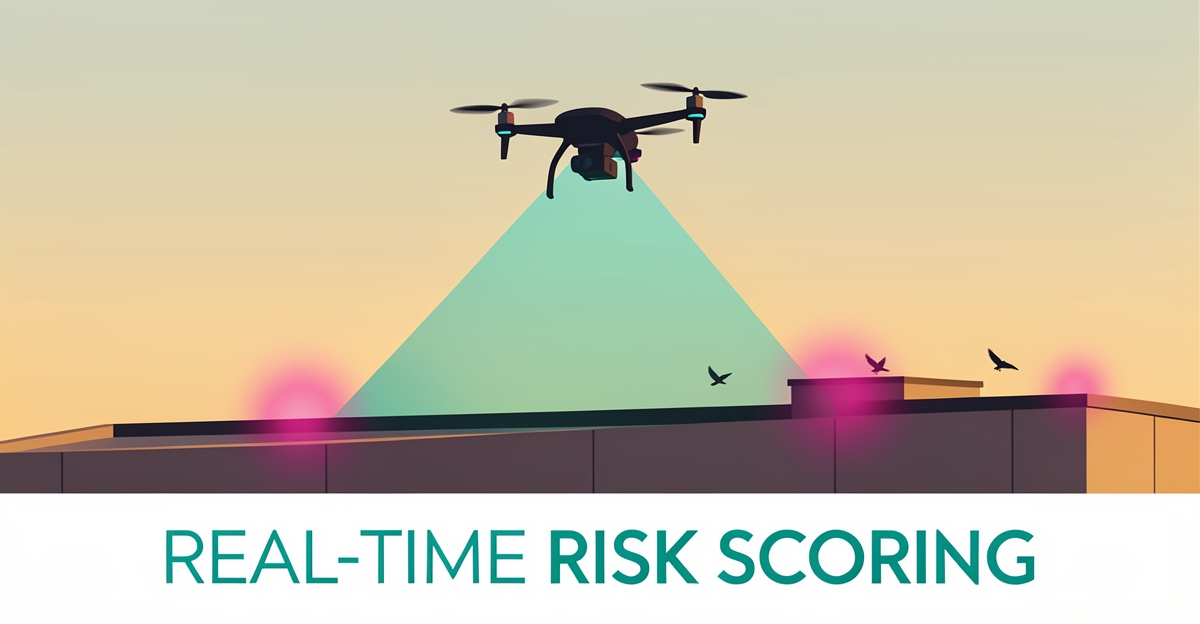
The core shift is from periodic human observation to continuous, instrumented monitoring. Modern inspection drones carry high-zoom optical cameras and thermal payloads, so a single flight captures both visible evidence (droppings, nesting material, structural damage) and heat signatures that reveal active nests inside roof structures or equipment housings. Acoustic sensors add a second signal: bird calls and movement noise, detected around the clock even when no drone is in the air.
AI models do the interpretation. Computer vision models trained on inspection imagery flag nests, guano accumulation, and damage patterns in the footage as it's captured. Audio analysis models recognize species-specific calls and movement sounds, which matters because different birds carry different risks, some species are protected, which changes what remediation is legally allowed. The output isn't a pile of raw photos; it's a structured risk score with the supporting evidence attached, delivered while the drone is still in the air or shortly after.
This combination changes the economics of the inspection itself. A drone pass takes minutes instead of hours, no one goes on the roof, and every finding is timestamped, geolocated, and documented. For firms running recurring inspections across a portfolio of properties, that repeatability is the real value: the same data captured the same way every time, so risk trends are comparable month over month rather than dependent on who happened to do the walk-through.
From Data to Action: Implementing AI-Powered Bird Hazard Assessments
Here's the honest part: as of late 2026, there is no single off-the-shelf product that does end-to-end real-time bird hazard assessment. The components exist, inspection drones with optical and thermal payloads, acoustic monitoring hardware, and mature vision and audio AI models, but connecting them into one workflow that produces actionable reports is custom integration work.
That integration typically has three layers. First, data capture: scheduled drone flights (docking stations now allow autonomous, recurring flyovers without a pilot on site) plus fixed acoustic sensors for continuous coverage. Second, analysis: models that classify imagery, detect acoustic patterns, and score risk against your criteria, nest proximity to electrical equipment, protected-species flags, accumulation thresholds. Third, action: the risk scores and evidence flow into your existing systems, triggering work orders, tenant notifications, or remediation quotes automatically instead of sitting in a PDF nobody reads.
Building that pipeline is exactly the kind of workflow problem AIQ Labs solves. If recurring inspections are the workflow costing you the most, a Workflow Build rebuilds it at a fixed price, in phases. If you want bird hazard monitoring as one part of a connected property operations layer, inspections, work orders, reporting, all in one system, an AI Operating System is the heavier-duty route, built in phases and owned outright. And if you'd rather start by handing the monitoring and reporting work to a managed AI team, AI Employees can run the recurring assessment workflow at a fraction of the cost of a human hire.
Whichever entry point fits, the first step is the same: a 2-minute Fit Check to see whether your inspection workflow is a good candidate. If it is, the next conversation is a free 30-minute strategy call to map the build.
Still paying for 10+ subscriptions that don’t talk to each other?
We build custom AI systems you own outright. No vendor lock-in. Full control.
Not sure where to start? Ask our AI planner
Frequently Asked Questions
How can AI help automate bird hazard assessments in property inspections?
What technologies are needed to build an AI-powered bird hazard assessment system?
Is there an off-the-shelf AI system available today for real-time bird hazard assessments in property inspections?
How does AI improve the quality and trustworthiness of property inspection reports for bird hazards?
Can AI enable continuous monitoring for bird hazards instead of relying on periodic inspections?
What are the main challenges in implementing an AI system for bird hazard assessments?
Turning Bird Hazards from Guesswork into Data-Driven Action
AI turns bird hazard assessments from a reactive, manual process into a real-time, predictive service. By combining drone-based visual and thermal inspections, acoustic anomaly detection, and intelligent data analysis, property professionals can identify nesting risks, structural damage, and potential liabilities before they escalate. The result is faster inspections, safer operations, and objective documented reports that build client trust and reduce disputes. For property management, real estate, and facility services businesses, that means lower remediation costs and a stronger competitive edge. If you're ready to explore how custom AI can automate a critical workflow like hazard assessment, start with the 2-minute Fit Check, then book a free 30-minute strategy call to map your biggest opportunity.
Make AI your competitive advantage — not just another tool.
Strategy, implementation and ongoing optimization. One partner, end to end.
Not sure where to start? Ask our AI planner