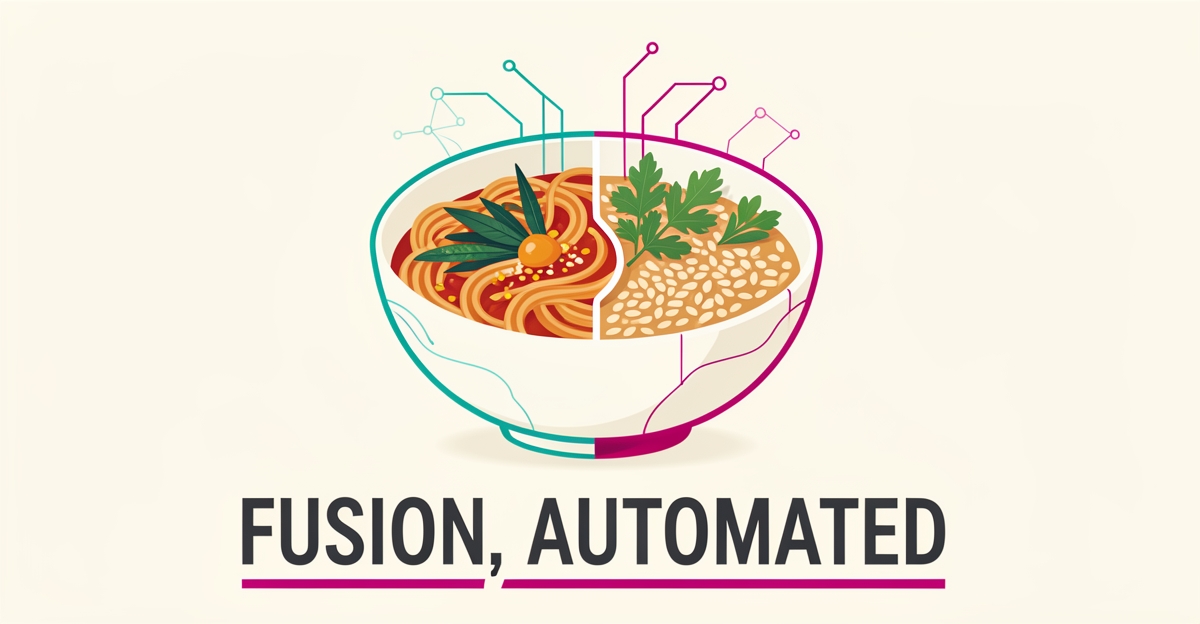
AI for Recipe Development: How Fusion Cuisine Can Be Invented and Automated
Key Facts
- The AI recipe generation market is projected to grow from roughly USD 418.5 million in 2024 to around USD 3 billion by 2033 according to market forecasts.
- AI recipe generation is forecast to grow at a 22.7% CAGR through 2033 based on market research.
- A large majority of food and beverage manufacturers, 78% in one industry survey, are turning to automation to combat labor shortages according to industry analysis.
- 48% of capital spending in the food and beverage sector was directed toward automation projects in recent industry research per industry findings.
- 70% of food and beverage manufacturers cite productivity as the top benefit of automation according to industry findings.
- Centralized recipe management using SQL databases helps ensure consistency from ERP systems down to the manufacturing execution floor per industrial automation insights.
- Well-integrated AI-powered recipe systems can significantly reduce operational errors while freeing chefs to focus on plating and quality control.
Hire a team member that works 24/7 — for less than a part-time wage.
AI receptionists, SDRs, dispatchers and 99+ roles. Trained on your business, fully managed.
Not sure where to start? Ask our AI planner
The Fusion Challenge: Why Traditional Recipe Development Falls Short
Fusion cuisine promises bold creativity, but turning that vision into reality often stalls in the kitchen. Traditional recipe development relies heavily on chef intuition and iterative testing, a process that can take weeks to perfect a single dish. This manual approach struggles to keep pace with consumer demand for novel, culturally inspired flavors while balancing authenticity and innovation. The result is a bottleneck where promising fusion concepts either stall in development or require unsustainable chef hours to bring to market.
These limitations become especially pronounced when scaling fusion concepts across multiple locations or menu iterations. Without systematic methods to capture and replicate nuanced flavor pairings, restaurants risk inconsistency that undermines brand trust. Industry analysis has found that 78% of food and beverage manufacturers are turning to automation to address labor shortages according to industry research, a trend driven by the same pressures squeezing culinary teams. When recipe creation depends solely on individual expertise, it becomes difficult to preserve institutional knowledge or train new staff efficiently.
The challenge intensifies when attempting to integrate regional flavor profiles at scale, a core requirement for authentic fusion cuisine. Manual methods lack the computational power to analyze thousands of ingredient interactions across diverse culinary traditions, limiting chefs to what they can recall or experiment with in real time. This constraint not only slows innovation but also increases the risk of cultural missteps when combining traditions without deep, data-informed understanding. As a result, many fusion attempts remain safe iterations rather than true breakthroughs, failing to capture the excitement diners seek.
Meanwhile, the market for AI-driven recipe generation is accelerating, with forecasts projecting a 22.7% CAGR toward roughly $3 billion by 2033 based on market research. This growth reflects increasing recognition that automation can overcome the scalability and consistency barriers of manual development. For fusion cuisine specifically, AI offers a way to systematize creativity, analyzing flavor compounds, cooking techniques, and cultural preferences to generate novel combinations that honor tradition while pushing boundaries. Rather than replacing chefs, these tools augment their expertise, turning inspiration into executable recipes faster and more reliably than ever before.
How AI Generates Culturally Inspired Fusion Recipes at Scale
AI is reshaping how fusion cuisine is created by analyzing vast datasets of global flavor profiles to generate novel, culturally inspired combinations at scale. Machine learning models identify subtle patterns in ingredient pairings across regional cuisines, enabling AI to suggest innovative dishes that respect culinary traditions while introducing unexpected harmonies. Natural language processing allows these systems to interpret complex recipe texts, ingredient descriptions, and cultural context from diverse sources, ensuring generated recipes are not only novel but also authentic to their inspirations. Generative models then synthesize this understanding into entirely new recipe concepts, optimized for local tastes and dietary preferences without requiring manual chef intervention.
AIQ Labs builds custom AI systems trained on specific regional flavor profiles to power this innovation, supporting food businesses in launching market-tailored fusion dishes efficiently. These systems leverage multi-agent architectures to research, validate, and refine recipe ideas continuously, reducing reliance on trial-and-error development. By automating the ideation phase, chefs and product teams can focus on refinement and execution, accelerating time-to-market for new menu offerings. This approach aligns with broader industry trends where 70% of food and beverage manufacturers cite productivity as the top benefit of automation, demonstrating how AI-driven recipe generation directly addresses operational efficiency goals.
The scalability of AI-powered fusion recipe development is further enhanced through integration with recipe management systems that store, optimize, and track performance data across iterations. Machine learning algorithms improve over time by analyzing user feedback, sales data, and seasonal ingredient availability, creating a self-optimizing cycle for menu innovation. The AI recipe generation market is projected to grow at a CAGR of 22.7% through 2033, reflecting strong demand for tools that combine culinary creativity with automated scalability. As a result, businesses can consistently introduce culturally resonant fusion dishes that meet evolving consumer expectations for novelty and authenticity, all while reducing the manual effort traditionally required in recipe development.
From Concept to Menu: Implementing AI Recipe Systems in Real Kitchens
Moving an AI recipe system from a promising prototype to a fully operational kitchen asset requires more than just generating creative ingredient pairings. It demands a structured implementation strategy that connects culinary creativity with back-of-house precision.
With the recipe generation AI market projected to grow from roughly USD 418.5 million in 2024 to around USD 3 billion by 2033, restaurants and food manufacturers are shifting from experimentation to full-scale deployment. Successful implementation hinges on bridging the gap between digital innovation and physical execution.
The foundation of this transition lies in robust data ingestion and model training. AI systems must analyze vast datasets of regional flavor profiles, ingredient chemical compounds, and cultural cooking techniques to generate viable fusion concepts. However, generating the recipe is only the first step. To function in a real kitchen, these digital outputs must integrate seamlessly with existing operational workflows.
This is where the concept of centralized recipe management becomes critical. As highlighted in industrial automation insights, effective recipe management relies on centralizing data, often using SQL databases, to ensure consistency from the ERP system down to the manufacturing execution system (MES). Whether in a high-volume manufacturing plant or a boutique restaurant group, the AI must feed its generated recipes into a structured system that inventory, procurement, and kitchen staff can actually use.
Implementing this level of integration typically follows a phased approach, aligned with AIQ Labs' current service lineup so the technology serves operational goals:
- AI Workflow Builds to rebuild the one workflow that costs the most, such as recipe ideation and documentation, delivered at a fixed price and in clear phases. Learn more at aiqlabs.ai/workflow-builds.
- AI Employees that act as digital sous-chefs, automating documentation, scaling, and nutritional analysis of new dishes without manual data entry, at roughly 80% less cost than a human hire. See aiqlabs.ai/ai-employees.
- AI Operating Systems to connect recipe generation, inventory, and kitchen operations into one operating layer the business owns outright, built in phases. Details at aiqlabs.ai/ai-operating-systems.
The business case for this comprehensive approach is compelling. According to industry research, 48% of capital spending in the food and beverage sector has been directed toward automation, with 78% of manufacturers leveraging these technologies specifically to combat labor shortages. By deploying custom AI systems that businesses own outright, culinary teams can cut operational errors significantly while freeing chefs to focus on plating and quality control rather than administrative recipe management. Payment models are flexible: start monthly with AI Employees, build in milestones with a Workflow Build, or own the system outright with an AI Operating System, details at aiqlabs.ai/pricing.
Ultimately, the goal is a closed-loop system where AI not only invents the menu but also optimizes it based on real-world performance. By connecting creative generation tools with inventory forecasting and supplier data, kitchens can automatically adjust recipes based on ingredient availability or cost fluctuations. This creates a resilient, self-optimizing culinary operation where innovation happens continuously, not just during seasonal menu changes.
Still paying for 10+ subscriptions that don’t talk to each other?
We build custom AI systems you own outright. No vendor lock-in. Full control.
Not sure where to start? Ask our AI planner
Frequently Asked Questions
How does AI create fusion recipes without losing cultural authenticity?
Is AI recipe generation just a trend or is the market actually growing?
Can AI help with labor shortages in kitchens and food manufacturing?
How do AI-generated recipes actually get used in a real kitchen?
Will AI replace chefs?
What does it cost to implement an AI recipe system?
Where Flavor Meets the Future
AI is no longer a theoretical advantage in fusion cuisine, it's the operational backbone turning cultural inspiration into consistent, scalable menu innovation. By analyzing thousands of ingredient interactions across global traditions, custom AI systems generate novel recipes that honor authenticity while accelerating development from weeks to days. Integrated with centralized recipe management, these tools close the loop between ideation, inventory, and execution, cutting errors and freeing culinary teams to focus on craft over administration. The market reflects this shift: AI recipe generation is projected to reach roughly $3 billion by 2033, driven by the same labor and scalability pressures reshaping commercial kitchens today. For restaurants and food brands ready to move beyond pilot projects, the path forward starts with a clear view of where automation delivers the highest return. Start the two-minute Fit Check at aiqlabs.ai/apply to map your biggest bottleneck, then book a free 30-minute strategy call at aiqlabs.ai/book, no pitch, just a working session to identify your clearest win.
Make AI your competitive advantage — not just another tool.
Strategy, implementation and ongoing optimization. One partner, end to end.
Not sure where to start? Ask our AI planner