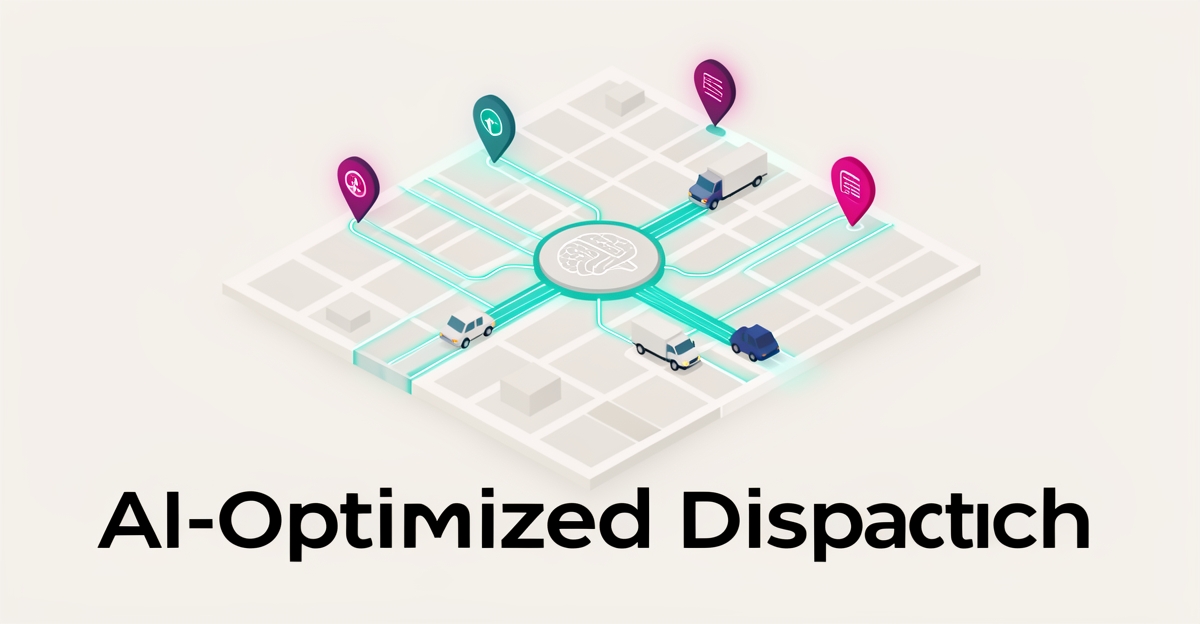
AI for Repair Scheduling: How to Reduce Technician Idle Time and Improve Efficiency
Key Facts
- AI-optimized routing typically cuts technician drive time by a meaningful margin, often in the 25-35% range reported across field service operations.
- Missed inbound calls are a common revenue leak for contractors running manual dispatch, especially when dispatchers are tied up rescheduling jobs.
- Smart scheduling and estimation typically increases average ticket value by making sure techs arrive prepared and on time.
- A growing share of contractors now use AI in meaningful operational ways, often by enhancing rather than replacing existing systems.
- Hybrid AI-human scheduling models tend to outperform full automation for complex repairs.
Hire a team member that works 24/7 — for less than a part-time wage.
AI receptionists, SDRs, dispatchers and 99+ roles. Trained on your business, fully managed.
Not sure where to start? Ask our AI planner
The Hidden Cost of Manual Repair Scheduling
Manual scheduling looks cheap until you measure the downtime it creates in the field. Dispatchers juggle spreadsheets, phone calls, and last-minute changes, and technicians pay the price in wasted miles and uneven days.
Inefficient routing is the most visible leak. Without optimization, technicians drive farther than necessary between jobs, burning hours that could be billable. Field service operations that adopt routing optimization typically report drive time reductions in the 25-35% range, a direct signal of how much manual planning wastes.
Uneven workload distribution compounds the problem. Some techs finish early while others stay late, creating idle time on one side and overtime or missed SLAs on the other. Manual boards rarely balance skill match, travel time, and estimated repair time together, so capacity looks full but productivity is not.
Missed inbound calls turn into missed revenue. When a dispatcher is tied up rescheduling or updating a job in real time, the phone rings out, and every unanswered call is a job a competitor may book instead.
The hidden costs show up across the operation:
- Drive time waste that reduces jobs completed per day
- Technician idle time between poorly sequenced appointments
- Dispatch bottlenecks that cause missed calls and delayed confirmations
- Uneven skill-to-job matching that extends repair times
These symptoms are linked. When routing is manual, rebooking takes longer, calls go unanswered, and the schedule drifts through the day. Companies that move to structured field service software consistently report productivity gains and easier growth as a result.
AI can address this by intelligently assigning repairs based on technician location, current workload, and estimated repair time. As part of a broader [AI Workflow Build](/workflow-builds), scheduling systems can continuously rebalance assignments as conditions change instead of locking in a static morning plan.
AIQ Labs builds custom scheduling systems that integrate with existing dispatch tools and field apps, replacing spreadsheet dispatch with owned, production-ready automation. With 200+ multi-agent systems deployed, the goal is not to remove human judgment but to eliminate the manual friction that creates idle time and missed opportunities.
When scheduling stops being reactive, service completion rates improve and technicians spend more time on tools and less time in traffic.
How AI Scheduling Eliminates Idle Time Through Smart Assignment
Every minute a technician spends waiting for their next assignment or driving across town is revenue lost. AI-powered scheduling eliminates this waste by automatically matching jobs to the right technician based on real-time location, current workload, and estimated repair duration.
Traditional dispatch relies on manual coordination and guesswork, often leaving technicians idle between jobs or crisscrossing territories inefficiently. AI scheduling systems analyze multiple variables simultaneously, traffic patterns, job complexity, technician skill sets, and parts availability, to create optimized schedules that keep teams productive throughout the day.
The impact is measurable. Operations that implement AI-driven routing typically see drive time reductions in the 25-35% range, which translates directly to more jobs completed per day and faster response times for customers.
The productivity gains extend beyond routing. When scheduling, dispatch, and customer communication run on one connected layer, dispatchers stop firefighting and start managing capacity. That is the difference between a point tool and a true [AI Operating System](/ai-operating-systems) for field operations.
AI scheduling drives efficiency through several core mechanisms:
- Dynamic job assignment that matches repairs to technicians based on proximity, expertise, and current schedule
- Predictive duration modeling that estimates how long each repair will take based on historical data
- Automatic schedule adjustments when jobs run long or cancellations occur
- Intelligent clustering that groups nearby appointments to minimize travel
- Real-time traffic integration that reroutes technicians around delays
The financial impact extends beyond labor efficiency. When technicians arrive on time with the right parts and information, they can present additional service options more effectively. Home service operators who optimize scheduling and estimation typically see average ticket value rise in the 15-25% range.
AIQ Labs builds custom scheduling systems that integrate directly with existing dispatch tools and field apps, creating a unified workflow without forcing teams to abandon familiar platforms. The AI learns from your specific operation, which technicians excel at certain repairs, how long different job types actually take, which routes cause delays, and continuously refines its assignments.
This adaptive capability matters because repair work is inherently unpredictable. A routine maintenance call can uncover major issues. Parts arrive late. Customers reschedule. AI scheduling handles these disruptions instantly, reshuffling assignments to minimize downtime and keep every technician productive.
The result is a scheduling operation that runs itself, freeing dispatchers to handle exceptions and customer relationships while the system manages the complex optimization math that humans simply cannot process in real time.
Implementing AI Scheduling: A Hybrid Approach for Field Services
Implementing AI scheduling effectively requires more than just deploying technology, it demands a thoughtful integration that respects both automation strengths and human expertise. While AI can reduce technician drive time through optimized routing and workload balancing, the most sustainable efficiency gains come from combining algorithmic precision with experienced judgment in complex scenarios. This hybrid model ensures that routine assignments benefit from AI's speed and data processing, while edge cases, such as multi-skill repairs, emergency overrides, or customer-specific constraints, remain under human oversight.
To begin implementation, field service providers should first audit their current dispatch workflows to identify pain points like excessive idle time, uneven technician utilization, or frequent rescheduling due to poor time estimates. AIQ Labs supports this phase by mapping existing processes against AI-ready data inputs, including technician location, skill sets, real-time job status, and historical repair durations. This assessment ensures the AI system is trained on accurate, operationally relevant data rather than generic assumptions, increasing the likelihood of adoption and accuracy from day one.
Integration with existing tools is critical for minimizing disruption. Rather than replacing legacy dispatch software, AI scheduling layers can connect via APIs to platforms already used for work order management, GPS tracking, and customer communication, allowing technicians to continue using familiar field apps while benefiting from smarter backend assignments. This approach aligns with where the industry is heading: a growing share of contractors now use AI meaningfully, often by enhancing rather than overhauling their current systems. A phased rollout further reduces risk: start with a single service type or geographic zone, monitor key metrics like jobs completed per day and SLA compliance, then expand based on validated results.
Throughout the process, maintain human-in-the-loop controls for high-complexity decisions. For example, AI might suggest the nearest available technician for a standard HVAC fix, but a dispatcher should review assignments involving specialized certifications, parts availability, or urgent customer needs. This balance prevents over-reliance on automation while still capturing its core benefits, such as higher average ticket value when scheduling includes smart upsell opportunities like preventive maintenance recommendations. By anchoring AI in human expertise, field services achieve not just short-term efficiency, but a resilient, adaptive scheduling system that scales with business growth.
Still paying for 10+ subscriptions that don’t talk to each other?
We build custom AI systems you own outright. No vendor lock-in. Full control.
Not sure where to start? Ask our AI planner
Frequently Asked Questions
How much can AI scheduling reduce technician drive time?
Why do contractors miss inbound calls with manual scheduling?
Will AI scheduling replace human dispatchers?
Can AI scheduling improve revenue beyond efficiency gains?
What's the best way to implement AI scheduling without disrupting current operations?
Do most field service companies see real productivity gains from AI scheduling?
Every Idle Hour Is a Job You Didn't Book
Manual scheduling doesn't fail loudly, it leaks quietly through wasted drive time, uneven workloads, and missed calls that never become booked jobs. As this article showed, AI scheduling attacks each of these leaks directly: less drive time through optimized routing, dynamic reassignment when the day goes sideways, and dispatchers freed to handle exceptions instead of shuffling spreadsheets. The payoff compounds as the system learns your operation. The path forward doesn't require ripping out your current tools. Start by auditing your dispatch workflow for idle time and rescheduling bottlenecks, then pilot AI scheduling in one zone or service type with human oversight on complex assignments. That's exactly how AIQ Labs approaches it: custom scheduling systems that integrate with your existing dispatch tools and field apps, systems you own outright, not subscriptions you rent. If technician idle time is costing you jobs every week, take the two-minute Fit Check at [aiqlabs.ai/apply](/apply) and book a free 30-minute strategy call. It's a working session with an AI engineer to map your biggest bottleneck, and if there's no clear win, we'll tell you that too.
Make AI your competitive advantage — not just another tool.
Strategy, implementation and ongoing optimization. One partner, end to end.
Not sure where to start? Ask our AI planner