AI for Scrap Metal: Why Most Businesses Fail at Automation (And How to Avoid It)
Key Facts
- 68% of metal executives cite data silos as the top AI challenge according to industry research
- 72% of AI projects in the steel industry are affected by skills gaps recent data shows
- 55% of SMEs are deterred from AI adoption in metals due to high implementation costs industry statistics reveal
- AI implementations in metals yield 25-35% productivity gains in rolling mills performance data confirms
- One MRF cut contamination by 30% within three months using AMP Robotics case studies document
- TOMRA sensor systems recovered an extra 8% copper yield, covering costs in under 18 months real-world implementations show
- The global AI market in metals is projected to grow from $1.2 billion in 2023 to $5.8 billion by 2030 market analysis projects
Hire a team member that works 24/7 — for less than a part-time wage.
AI receptionists, SDRs, dispatchers and 99+ roles. Trained on your business, fully managed.
Not sure where to start? Ask our AI planner
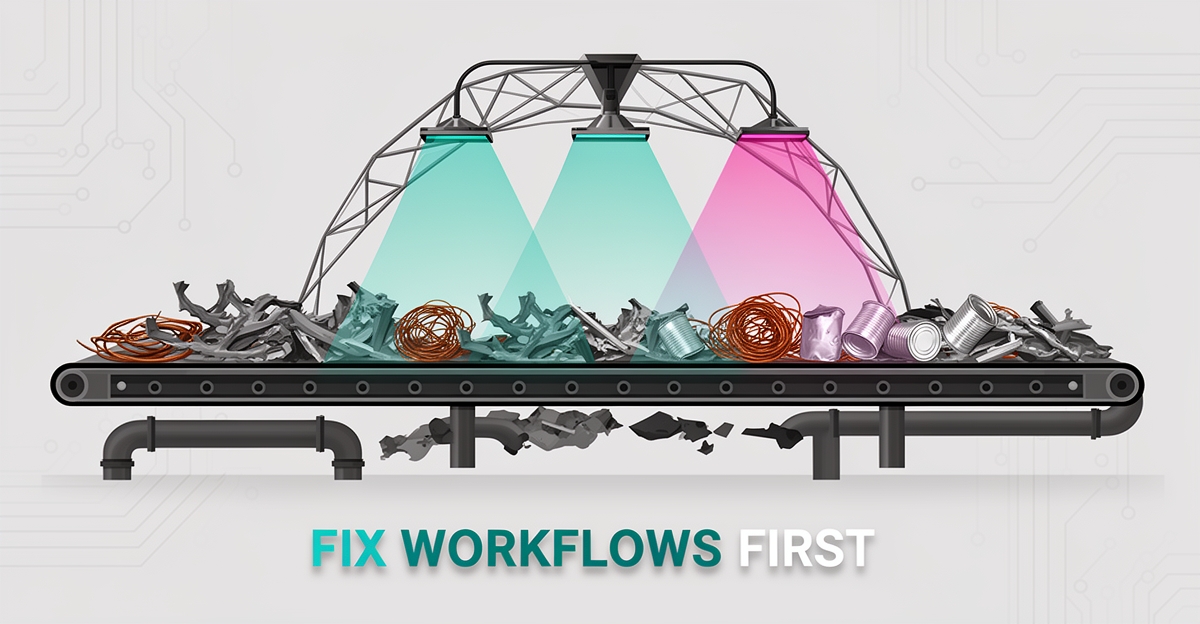
The Workflow Trap: Why AI Accelerates Broken Scrap Processes
Bolting AI onto a messy yard is how scrap operations turn a small inefficiency into a big, expensive one. When intake, sorting and grading run on disconnected systems, AI simply accelerates the confusion.
The core problem is workflow, not the model. As industry research explains, AI only creates value when it fixes the workflow. If the process is unclear, AI can accelerate confusion at scale rather than deliver returns.
Scrap metal businesses feel this pain first at the gate. Drivers log arrivals in one system, scales feed another, and graders record prices in spreadsheets. That fragmentation shows up in the data: industry statistics show 68% of metal executives cite data silos as the top AI challenge. Without a single source of truth, computer vision models train on partial labels and sensor systems make decisions on stale grades.
The skills gap compounds the trap. recent data finds 72% of AI projects in the steel industry are affected by skills gaps. Teams can install robotic picking or XRF sorting, but lack the internal capability to maintain feed rates, clean camera views and retrain models as scrap streams shift. The result is drift, downtime and loss of trust on the floor.
Value leaks at every handoff when AI is layered on top:
- Intake data never reaches sorting, so alloy identification is based on assumptions not measurements
- Grading rules live in tribal knowledge, creating inconsistent pricing and contamination
- Maintenance and retraining are skipped, letting model accuracy decay within months
Fixing the workflow means mapping scrap streams first, then designing the system around them. That is where change management and training matter more than the tool choice. AIQ Labs supports this approach through AI Workflow Builds focused on phased deployment and workflow optimization, with tailored implementation plans for scrap metal operations.
The practical shift is from “where can we deploy AI?” to “where do existing workflows force skilled people to do routine work?” When intake, sorting and grading are unified and staff are trained to operate and supervise the system, AI stops amplifying broken processes and starts capturing recovery.
Start the Fit Check, https://aiqlabs.ai/apply leading to a Free 30-Minute Strategy Call, https://aiqlabs.ai/book
What Actually Works: Proven AI for Scrap Sorting and Recovery
What Actually Works: Proven AI for Scrap Sorting and Recovery
Not all AI solutions deliver equal value in scrap metal operations, success depends on matching the right technology to the specific workflow challenge. AMP Robotics excels in mixed scrap streams by combining computer vision with robotic arms to achieve fast, precise separation of ferrous, non-ferrous, and specialty metals, with one MRF reporting a 30% reduction in contamination within three months of deployment according to industry case studies. For operations requiring exact alloy identification, TOMRA’s sensor-based systems using NIR and XRF technology recover valuable materials like copper with proven results, one plant gained an extra 8% copper yield, covering sensor lease costs in under 18 months as documented in real-world implementations. Custom ML pipelines built with TensorFlow or PyTorch offer tailored accuracy for unique scrap profiles but demand engineering resources for ongoing maintenance and retraining.
- AMP Robotics: Best for high-speed picking in mixed streams
- TOMRA: Ideal for precise alloy identification and recovery
- Custom ML: Suited for operations with specialized scrap composition needs
When properly matched to workflow needs, these technologies drive measurable outcomes, AI implementations in metals processing consistently deliver 25-35% productivity gains and reduce scrap rates by up to 28% through improved quality control based on industry performance data. However, realizing these benefits requires more than just installing equipment; it demands workflow optimization, staff training, and change management, areas where AIQ Labs supports scrap metal operations through AI Workflow Builds and phased deployment strategies to ensure technology adoption aligns with operational reality. Without addressing these human and process factors, even the most advanced AI tools risk accelerating existing inefficiencies rather than resolving them.
The Pilot-to-Scale Playbook for Scrap Operations
Most scrap metal operations struggle with AI automation not because the technology fails, but because they deploy it onto broken workflows. When AI accelerates inefficient processes, it amplifies confusion rather than creating value. The research shows that 68% of metal executives cite data silos as the top AI challenge, while 72% of AI projects in the steel industry are affected by skills gaps, highlighting that organizational and workflow issues, not technology limitations, are the primary barriers to success.
A practical implementation sequence begins with mapping scrap streams to identify contamination points and material characteristics. This foundational step ensures AI solutions target actual operational pain points rather than hypothetical inefficiencies. Following stream mapping, businesses should run a 4-6 week on-site pilot to collect real-world data and test tools under actual operating conditions. Extended testing periods allow for proper evaluation of AI performance in dynamic scrap environments where material composition and flow rates vary significantly.
Successful pilots measure lift in recovery rates and reduction in contamination to establish baseline metrics for ROI calculation. Before scaling, companies must redesign workflows to eliminate bottlenecks and redundancies, embedding AI where repeatable tasks occur rather than bolting it onto broken processes. Change management and staff training are critical throughout this sequence, preparing teams for new ways of working builds trust and ensures sustainable adoption. AIQ Labs supports this transformation with AI Workflow Builds and tailored change management strategies to align with scrap metal operations’ unique workflow complexities. By focusing on workflow optimization first and investing in people alongside technology, businesses avoid the pilot stall that traps most automation efforts in the scrap industry. AI only creates value when it fixes the workflow, making this sequence essential for measurable results. Pilot testing should last at least 4-6 weeks to capture operational variability and validate performance improvements.
- Map scrap streams to identify contamination sources and material flow patterns
- Run 4-6 week on-site pilots to test AI tools under real conditions
- Measure recovery lift and contamination reduction to quantify ROI
- Redesign workflows before deployment to eliminate inefficiencies
- Implement change management and training to sustain adoption
Avoiding Cost, Data and Adoption Pitfalls in Scrap Metal AI
AIQ Labs helps scrap metal businesses overcome the most common barriers to AI adoption by addressing cost, data, and adoption challenges head-on. Many SMEs hesitate to invest in AI due to high upfront costs, with 55% deterred by implementation expenses alone. Beyond finances, data quality issues plague 67% of metal AI deployments, while skills gaps and resistance to change further slow progress. These pitfalls often lead to stalled pilots or failed rollouts, wasting resources and eroding confidence in AI’s potential.
To reduce risk, AIQ Labs recommends a gradual deployment strategy that starts with measurable pilots focused on specific workflow bottlenecks, such as contaminant detection or alloy sorting, before scaling across operations. This approach allows businesses to validate ROI early, refine models with real-world data, and build internal expertise without overwhelming teams. Paired with targeted staff training and change management support, this method ensures employees understand how AI complements their roles rather than replaces them, increasing adoption and long-term success.
By combining phased implementation, hands-on training, and tailored consulting, AIQ Labs protects investment and drives sustainable transformation. Their AI Workflow Builds model integrates assessment, development, integration, governance, adoption, and scaling, all designed for the unique complexity of scrap metal operations. This end-to-end support helps businesses avoid costly missteps and unlock AI’s full potential. To explore how this approach fits your operation, start the Fit Check at https://aiqlabs.ai/apply for a free 30-minute strategy call with an AI engineer.
Still paying for 10+ subscriptions that don’t talk to each other?
We build custom AI systems you own outright. No vendor lock-in. Full control.
Not sure where to start? Ask our AI planner
Frequently Asked Questions
Why do most scrap metal businesses fail when they try to automate with AI?
Is data really the biggest problem for AI in scrap metal?
How long should we pilot AI sorting before scaling it?
Which AI solution is best for scrap sorting and recovery?
Will AI actually improve productivity and reduce waste?
What stops smaller scrap yards from adopting AI?
Turn AI from a Cost Center into Your Competitive Advantage
The scrap metal industry’s AI journey isn’t about chasing the latest tech, it’s about fixing the workflow first. As the data shows, 68% of metal executives point to data silos as the top barrier, and 72% of AI projects stall due to skills gaps, proving that broken processes amplify inefficiency when AI is layered on top. Success comes from mapping scrap streams, running 4-6 week pilots to measure real recovery lifts, and redesigning workflows before deployment, so AI automates repeatable tasks instead of accelerating confusion. AIQ Labs supports this shift through AI Workflow Builds, combining change management, training, and phased deployment tailored to your operation. Start with a clear picture of your opportunity: take the two-minute Fit Check at https://aiqlabs.ai/apply, then schedule your free 30-minute strategy call to see where AI can actually move the needle for your business.
Make AI your competitive advantage — not just another tool.
Strategy, implementation and ongoing optimization. One partner, end to end.
Not sure where to start? Ask our AI planner