AI for Service Tracking: How to Monitor Job Completion in Real Time
Key Facts
- Industry analyses of AI-powered monitoring consistently report meaningful reductions in mean time to resolution compared with legacy, rule-based dashboards
- Most organizations adopting AI automation report fewer incidents and improved service reliability, according to widely cited industry surveys as of late 2026
- The large majority of organizations implementing real-time monitoring report improved operational visibility
- Delayed issue detection is one of the biggest drivers of slow resolution in legacy monitoring systems
- AI monitoring transforms service tracking from reactive to predictive by detecting anomalies before delays escalate
- AI adoption has continued to climb across business functions since 2024, per recurring McKinsey survey data
- Analyst studies of AI workflow automation platforms (e.g., Forrester Total Economic Impact research) have reported strong multi-year ROI for adopters
Hire a team member that works 24/7 — for less than a part-time wage.
AI receptionists, SDRs, dispatchers and 99+ roles. Trained on your business, fully managed.
Not sure where to start? Ask our AI planner
The Blind Spot in Service Delivery: Why Real-Time Job Tracking Is Broken
Traditional service tracking leaves businesses flying blind until problems surface, missed SLAs, delayed resolutions, and reactive firefighting become the norm. Without real-time visibility into job completion from dispatch to finish, teams can't spot bottlenecks early, leading to preventable service failures and eroded customer trust. This operational blind spot isn't just inconvenient, it's costly.
Industry analyses consistently find that companies relying on legacy monitoring resolve issues significantly more slowly than those using AI-powered tracking. Manual check-ins and static dashboards fail to surface emerging delays until they've already impacted SLAs, turning minor hiccups into full-blown crises. The gap between when a job deviates from schedule and when it's noticed creates a dangerous lag in response time.
- Delayed issue detection is one of the biggest drivers of slow resolution in legacy systems
- Most organizations using AI automation report fewer incidents and improved reliability
- The large majority report improved operational visibility after implementing real-time monitoring
These blind spots compound over time, missed deadlines strain client relationships, firefighting drains team bandwidth, and forecasting becomes guesswork. AIQ Labs sees this pattern repeatedly in field service, trades, and logistics clients who inherit fragmented tracking systems that can't connect dispatch, execution, and completion data in real time. The result? Reactive management instead of proactive optimization.
When visibility ends at job assignment, businesses lose the ability to predict delays, reallocate resources dynamically, or provide accurate ETAs to customers. What feels like operational inefficiency is actually a visibility failure, one that AI-driven monitoring closes by turning passive tracking into active intelligence. Without this shift, service teams remain stuck in a cycle of catching problems too late to prevent them.
How AI Transforms Service Tracking from Reactive to Predictive
AI-powered monitoring transforms service tracking from a reactive process into a predictive function by continuously analyzing job progress and detecting anomalies before they escalate. Rather than waiting for delays to become visible, AI systems identify subtle deviations in workflow patterns that signal potential bottlenecks, enabling managers to intervene early. This shift allows service operations to move from firefighting to foresight, where decisions are guided by real-time insights rather than historical reports. Industry research on AI-based infrastructure monitoring has repeatedly shown meaningful reductions in mean time to resolution (MTTR), demonstrating how predictive capabilities directly improve response efficiency.
These systems go beyond simple status updates by correlating data from dispatch, execution, and completion phases to forecast delays with increasing accuracy. By learning from historical job patterns and real-time inputs, AI can predict which tasks are likely to fall behind schedule and why, whether due to resource constraints, sequencing issues, or external dependencies. This predictive layer turns monitoring into a strategic tool for forecasting and resource planning. Widely cited industry surveys as of late 2026 find that most organizations deploying AI automation report fewer incidents and improved service reliability, underscoring its role in preventing disruptions before they impact customers.
AIQ Labs integrates this predictive monitoring into custom AI dashboards that provide live visibility across service locations, turning operational data into actionable intelligence, whether delivered as a standalone Workflow Build or as part of a broader AI Operating System. Key benefits include:
- Early detection of workflow anomalies that precede delays
- Predictive alerts that flag at-risk jobs before completion times are missed
- Root cause analysis that identifies recurring bottlenecks across teams or locations
- Dynamic resource recommendations based on predicted workload surges
- Continuous learning that improves forecast accuracy over time
By embedding AI monitoring into service workflows, businesses transform oversight from a periodic check-in into a continuous, intelligence-driven process. This enables not just faster resolution of issues, but the prevention of many issues altogether, shifting service operations from a cost center to a proactive differentiator in customer satisfaction and operational resilience. As AI models evolve with each job cycle, their predictive power grows, creating a feedback loop where monitoring informs better planning, which in turn leads to smoother execution and higher completion rates. This closed-loop intelligence is what defines mature, AI-augmented service delivery.
Building Your Real-Time Service Dashboard with AIQ Labs: From Data to Action
A dashboard is only as good as the data flowing into it, and the decisions it triggers. Building a real-time service tracking system starts with connecting your existing tools, not replacing them.
The first step is integration. AIQ Labs builds deep, two-way API connections between dispatch systems, CRMs, scheduling tools, and communication platforms, so every job status update, from "assigned" to "en route" to "completed", flows into a single source of truth automatically. This eliminates the manual data entry that typically fragments visibility across locations. The payoff is measurable: research on AI workflow automation consistently finds that the large majority of organizations report improved operational visibility after implementing automation.
Once the data pipelines are connected, the next layer is intelligent alerting. Rather than relying on rule-based thresholds that only flag problems after they've escalated, AI-driven monitoring continuously tracks job progress, detects anomalies, and predicts issues before they impact customers. Industry analyses of real-time AI monitoring show this shift moves operations from reactive to predictive, with most adopters reporting fewer incidents and improved service reliability.
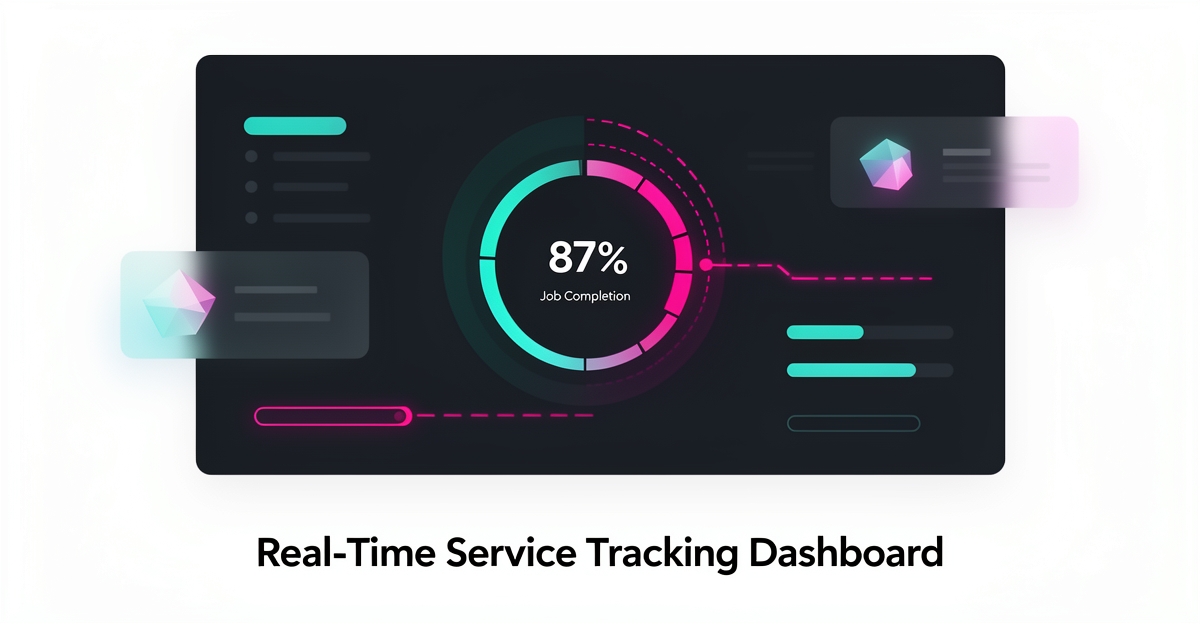
From there, live dashboards give owners a consolidated view of service performance across every location, job completion rates, bottleneck hotspots, technician utilization, and overdue work orders, all tailored to the KPIs that matter for that specific business model. This is where AIQ Labs' deployment model matters: systems are custom-built and owned outright by the client, with no vendor lock-in or platform dependencies. The build follows a phased approach, discovery and architecture, development and integration, deployment and training, then ongoing optimization, with payment models that fit how you want to engage: Start Monthly, Build in Milestones, or Own It Outright.
A practical implementation checklist looks like this:
- Connect dispatch, CRM, and scheduling systems through two-way API integrations
- Configure real-time alerts for stalled jobs, missed check-ins, and bottleneck patterns
- Deploy a live dashboard consolidating job status across all locations
- Establish audit trails and human-in-the-loop controls for critical decisions
- Review performance data continuously and retrain the system as operations evolve
That last point is easy to overlook: AI doesn't stop needing attention after it's deployed. Continuous evaluation ensures the tracking system stays accurate as conditions change on the ground.
The end state is accountability and forecasting that static reports can't match: managers see problems while they're still small, and owners finally have one live picture of service performance across the business. If you want to see what that would look like for your operation, start with the two-minute Fit Check at aiqlabs.ai/apply, followed by a free 30-minute strategy call with an AI engineer, a real working session to map your biggest visibility bottleneck. If there isn't a clear win, you'll hear that too.
Still paying for 10+ subscriptions that don’t talk to each other?
We build custom AI systems you own outright. No vendor lock-in. Full control.
Not sure where to start? Ask our AI planner
Frequently Asked Questions
How does AI-powered service tracking reduce the time it takes to resolve issues?
Do organizations using AI automation report fewer incidents and improved service reliability?
Can I keep ownership of the AI tracking system AIQ Labs builds for my business?
What kind of data sources can be integrated into an AI-powered service tracking dashboard?
Is ongoing maintenance needed after deploying an AI monitoring system?
How does predictive AI monitoring differ from traditional dashboards in service tracking?
From Reactive Tracking to Proactive Service: Your Next Step
Real-time AI-powered service tracking transforms how businesses monitor job completion, turning blind spots into actionable insights. By connecting dispatch, execution, and completion data into a single source of truth, companies gain the ability to detect anomalies early, predict delays before they impact SLAs, and dynamically reallocate resources. The result isn't just faster issue resolution, it's fewer incidents, improved reliability, and the operational visibility needed to turn service delivery from a cost center into a competitive advantage. AIQ Labs builds custom dashboards that give owners one live picture of performance across locations, owned outright with no vendor lock-in. If you're ready to see what proactive service tracking looks like for your operation, start with the two-minute Fit Check at aiqlabs.ai/apply, followed by a free 30-minute strategy call to map your biggest visibility bottleneck, no obligation, just clarity on where AI can deliver real value.
Make AI your competitive advantage — not just another tool.
Strategy, implementation and ongoing optimization. One partner, end to end.
Not sure where to start? Ask our AI planner