AI for Termite Companies: How to Automate Client Onboarding and Service Planning
Key Facts
- Industry research suggests fewer than a third of organizations have accurate visibility into their AI software spend, so budget with a clear strategy before adopting tools
- A majority of companies report wasted AI spend increasing year over year, point solutions that don't integrate are the usual culprit
- General-purpose AI assistants like Google Gemini and ChatGPT offer free tiers, but they don't connect to your field operations on their own
- AIQ Labs has deployed 200+ multi-agent systems and runs 4 live SaaS products daily, automation built for real operations, not demos
- AI Employees typically cost around 80% less than an equivalent human hire while covering reception, scheduling, and follow-up around the clock
Hire a team member that works 24/7 — for less than a part-time wage.
AI receptionists, SDRs, dispatchers and 99+ roles. Trained on your business, fully managed.
Not sure where to start? Ask our AI planner
The Hidden Cost of Manual Onboarding in Termite Services
Termite work is urgency-driven. A homeowner finds winged swarmers in the kitchen, searches for help, and calls two or three companies. The first one to answer with a concrete inspection time usually wins the job. If your office staff is juggling phones, data entry, and paper schedules, that lead goes to voicemail, and voicemail rarely converts.
The costs compound quietly:
- Slow response times. Leads that aren't answered within minutes cool off fast. Every missed call during peak season is a lost contract.
- Inconsistent follow-up. Inspection quotes get typed into a spreadsheet, a text thread, and a CRM, then forgotten. Manual follow-up depends on someone remembering to do it.
- Service planning by memory. Termite treatment isn't one-and-done; it's inspections, treatments, warranties, and annual renewals. Tracking those cycles by hand means missed renewals and lost recurring revenue.
- Staffing overhead. Hiring another coordinator to handle call volume costs a full salary, benefits, and training time, before they handle a single lead well.
None of this is a technology problem your team created. It's the natural ceiling of doing everything manually. The fix isn't more software subscriptions bolted onto each other, it's a connected system that handles the repetitive work end to end.
AI-Powered Journey Optimization: From Inquiry to Service Delivery
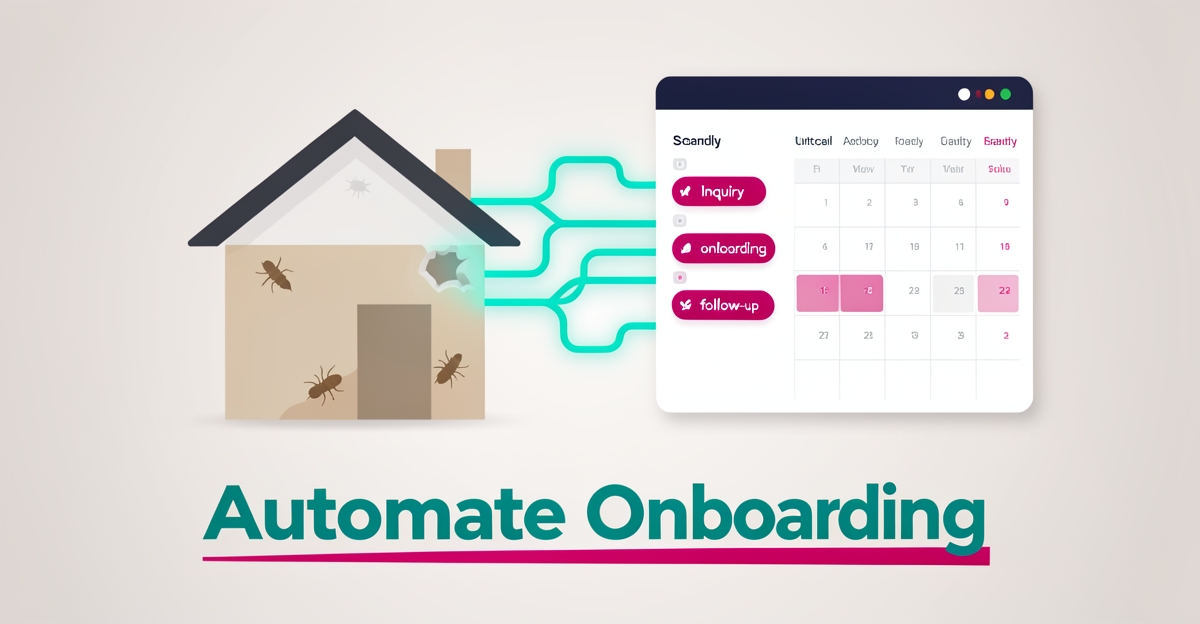
Effective automation for a termite company isn't one chatbot on your website. It's a set of AI agents that each own a stage of the client journey and hand off cleanly to the next:
1. Instant Inquiry Response
An AI receptionist answers every call, text, and web form within seconds, 24/7, including the evenings when homeowners actually discover termite damage. It qualifies the lead (property type, signs of activity, urgency), answers common questions about treatments and warranties, and books the inspection on the spot.
2. Personalized Onboarding
Once the inspection is booked, the system sends the right prep instructions, confirms the appointment, and collects property details before the technician ever arrives. Because the AI remembers every interaction, each client gets communication tailored to their situation, a slab foundation rental property gets different guidance than a crawlspace family home.
3. Service Planning and Scheduling
AI dispatchers route technicians by geography, treatment type, and equipment needs, and automatically build the follow-up calendar: post-treatment checks, warranty inspections, annual renewals. No renewal gets missed because no human has to remember it.
4. Follow-Up That Converts
After the inspection, the system sends the quote, follows up at sensible intervals, and flags hesitant leads for a human call. This is where most termite companies leak the most revenue, and where consistent, automated follow-up pays for itself fastest.
AIQ Labs delivers this through AI Employees, managed AI staff covering reception, scheduling, dispatch, and 99+ other roles, typically at around 80% less cost than a human hire.
Implementation Framework: Integrating AI with Field Operations
The biggest mistake pest control companies make with AI is buying disconnected point tools, a scheduling app here, a chatbot there, without a strategy. That's exactly how companies end up with wasted AI spend and tools nobody uses. A better approach is phased:
Phase 1: Fix the Most Expensive Workflow
Start with the single workflow that costs you the most, usually lead response and booking. With AI Workflow Builds, AIQ Labs rebuilds that one workflow at a fixed price, in milestones, so you see results before committing further. Measure it: call answer rate, time-to-first-response, booked inspections per week.
Phase 2: Connect the Pieces
Once the first workflow proves itself, connect scheduling, follow-up, and field coordination into one operating layer. An AI Operating System ties your phones, CRM, and dispatch together so data flows without re-entry, and you own the system outright, with no per-seat rental forever.
Phase 3: Keep Humans Where They Matter
AI handles volume, speed, and consistency. Your licensed technicians and managers handle judgment: treatment decisions, tricky negotiations, and the trust-building that closes big commercial jobs. The goal is a team where nobody spends their day doing work a machine does better.
Not sure which phase fits your company? The 2-minute Fit Check gives you a straight answer before you spend anything.
Still paying for 10+ subscriptions that don’t talk to each other?
We build custom AI systems you own outright. No vendor lock-in. Full control.
Not sure where to start? Ask our AI planner
Frequently Asked Questions
How can AI actually improve client onboarding for a termite control company?
What AI tools are best for scheduling termite inspections and service appointments?
Will AI replace my office staff or just make their jobs easier?
How much should I budget for AI automation in my pest control business?
Can AI really help convert more termite inspection leads into paying customers?
What's the biggest mistake companies make when adopting AI for customer service?
Turning Inspection into Action: Your AI-Powered Onboarding Starts Now
Automating client onboarding and service planning with AI isn't about replacing your team, it's about amplifying their expertise by eliminating repetitive tasks, personalizing every interaction, and ensuring no lead falls through the cracks. For termite companies, that means faster response times, consistent follow-ups, and service plans tailored to each property's risks, while your staff focuses on protecting homes and building trust. The companies that win in this space won't be the ones with the most software, they'll be the ones with a connected system that actually runs the journey from first call to annual renewal. Start by pinpointing where automation delivers the biggest impact in your operation, whether that's instant lead response, intelligent scheduling, or field team coordination. Take the first step with a free, no-pressure conversation: Start the 2-minute Fit Check, or book a free 30-minute strategy call to explore how AIQ Labs can help you turn inquiry into lasting client relationships.
Make AI your competitive advantage — not just another tool.
Strategy, implementation and ongoing optimization. One partner, end to end.
Not sure where to start? Ask our AI planner