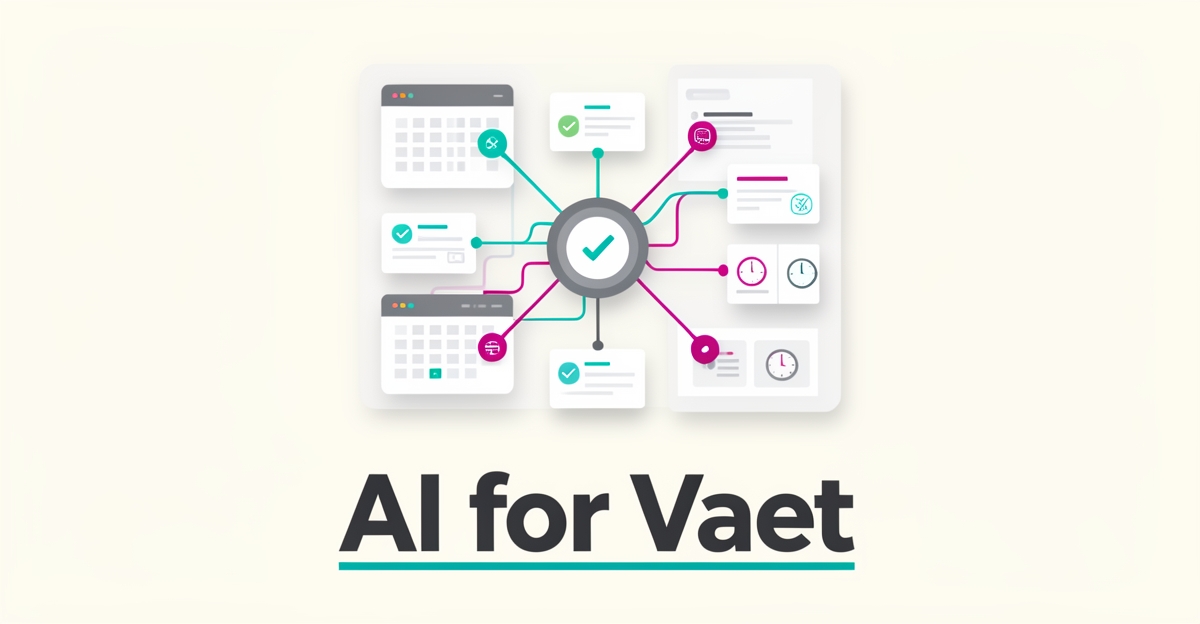
AI for Valet: How to Build a Smart, Scalable Event Management System
Key Facts
- Manual event workflows, data entry, fragmented tools, missed deadlines, create a hidden tax on every RFP response, guest list update, and valet dispatch log
- Scalable AI infrastructure rests on four layers: compute, storage, networking, and orchestration
- AIQ Labs has deployed 200+ multi-agent systems and runs 4 live SaaS products daily on infrastructure proven under real load
- AI should act as a decision co-pilot that builds evidence-linked briefs, not inflate text only to compress it later
- Most operators still ask "which AI tool should I use?", the better question is "which part of my workflow is still manual?"
Hire a team member that works 24/7 — for less than a part-time wage.
AI receptionists, SDRs, dispatchers and 99+ roles. Trained on your business, fully managed.
Not sure where to start? Ask our AI planner
The Hidden Cost of Manual Event Workflows
Event management teams often operate under the illusion that their workflows are efficient, but the reality is far more costly. Manual processes like data entry, fragmented tool usage, and missed deadlines are not just inconveniences, they are significant drains on time, resources, and opportunity. These inefficiencies compound across events, creating a hidden tax on every RFP response, guest list update, and valet dispatch log.
The pattern is well documented across service businesses: complex deliverables like RFP responses typically consume well over a hundred labor hours each, and deadlines slip when coordination depends on email chains and spreadsheets rather than real-time systems. This isn't just about working harder, it's about working within a system designed to fail at scale.
- Manual data entry consumes hours that could be spent on guest experience or logistics planning
- Fragmented systems force teams to re-enter the same information across CRM, scheduling, and billing tools
- Missed deadlines erode client trust and lead to lost revenue opportunities
- Lack of real-time visibility means issues are caught too late to prevent
- Repetitive tasks prevent staff from focusing on high-value, strategic event decisions
For valet and event operations, these inefficiencies manifest in delayed vehicle retrievals, incorrect guest assignments, and billing discrepancies, all stemming from workflows that still rely on spreadsheets, email chains, and manual handoffs. AIQ Labs sees this pattern repeatedly: the most advanced event concepts are undermined by the most basic operational gaps. The solution isn't working harder within the broken system, it's rebuilding the system itself to eliminate the hidden cost of manual work.
Architecting a Scalable AI Infrastructure for Event Operations
A valet system that can't scale fails at exactly the wrong moment, peak arrival, hundreds of guests, zero patience. Building AI infrastructure that holds up under that pressure requires understanding the four foundational layers: compute, storage, networking, and orchestration.
These layers combine hardware and software designed to build, deploy, and monitor AI systems at scale. The compute layer, GPUs, TPUs, and multi-node clusters, determines inference latency, which matters when a valet dispatch decision needs to happen in seconds, not minutes. The storage layer holds event data, guest records, and model artifacts in object storage and distributed file systems, where high throughput directly translates to faster processing.
Networking ties it all together. For event operations, the networking layer serves three functions: synchronizing distributed compute, connecting storage to processing systems, and routing inference traffic through API gateways that feed mobile check-in apps and dispatch consoles in real time.
For handling the flood of data a large event generates, an AI-optimized data lake architecture is the proven pattern. It layers raw and processed data, adds a feature store for model-ready inputs, and supports both stream ingestion and batch pipelines. That means guest flow telemetry and vehicle arrival patterns can feed real-time inference while historical data trains better forecasting models. Cloud-native platforms, like AWS SageMaker, Azure ML, and Google Vertex AI, extend this with serverless ingestion and auto-scaling, so capacity expands during a Saturday gala and contracts during a quiet Tuesday.
The orchestration lesson applies beyond infrastructure. Don't ask, "Which AI tool should I use?" Ask, "Which part of my workflow is still manual?" For valet operations, that means automating the repetitive spine of the job, check-in logging, dispatch routing, status updates, rather than bolting AI onto isolated tasks.
Key infrastructure decisions for event-scale AI include:
- Start with single-node GPU workloads for prototyping dispatch models before scaling to distributed clusters
- Use stream ingestion for real-time guest flow data and batch pipelines for post-event analysis
- Build observability from day one, monitoring model drift, latency, and pipeline events ensures reliability in production
- Segment networks and encrypt datasets to protect guest and payment data
This is the approach we apply at AIQ Labs, where we've deployed 200+ multi-agent systems and run 4 live SaaS products daily on cloud-native infrastructure, patterns proven under real load, not just in diagrams. The same architecture that powers large-scale automation and voice AI translates directly to event operations that need real-time visibility across every vehicle, guest, and attendant. If you want to see how this applies to a single high-cost workflow, our AI Workflow Builds rebuild the one process that costs you the most, at a fixed price.
Redesigning Workflows: From Task Automation to Intelligent Systems
Redesigning valet workflows begins with a fundamental shift in mindset: moving beyond using AI for isolated tasks like transcribing guest calls to reimagining entire operational sequences as intelligent, reusable systems. The most effective AI applications don't just speed up existing processes, they eliminate, restructure, and redesign work from the ground up. This means treating guest check-in, vehicle tracking, and payment processing not as discrete steps to automate, but as interconnected components of a cohesive system where AI acts as a decision co-pilot, clarifying intent and generating fit-for-purpose outputs like real-time dispatch summaries or automated payment confirmations.
The foundation of this redesign lies in identifying where manual effort still bottlenecks the workflow. Instead of asking which AI tool to deploy, valet operators should ask which part of their process remains manual, whether it's logging vehicle details, coordinating handoffs between attendants, or reconciling payments post-event. Across service industries, a large share of teams still handle these deliverables entirely by hand, which highlights a widespread opportunity to replace repetitive, error-prone steps with intelligent automation. By mapping these manual touchpoints, valet operations can target AI where it delivers the highest impact, such as using vision AI to track vehicle locations in real time or natural language processing to interpret special guest requests from pre-event communications.
Building these intelligent systems requires more than plugging in AI tools; it demands a workflow-centric architecture. Teams should create reusable components, like an AI-powered guest preference synthesizer that pulls from CRM data and past event history to generate personalized welcome messages, or a dynamic vehicle routing agent that optimizes attendant assignments based on real-time lot occupancy and flight arrival times. These systems gain power through chaining: for example, a guest's RSVP triggers a preference check, which informs vehicle preparation, which then updates the attendant dashboard and triggers a payment link upon departure. This mini-agent workflow approach ensures consistency and scalability across events of varying size.
Critically, AI must augment, not replace, human judgment. AI should not inflate text only to compress it later; instead, it should act as a collaborator that builds evidence-linked briefs, flags inconsistencies in vehicle logs, or suggests optimal staffing levels based on historical no-show rates. Keeping humans in the loop ensures outputs align with service standards and safety protocols, particularly when handling VIP guests or high-value vehicles. Observability is equally vital: monitoring system metrics like inference latency or data pipeline errors helps maintain reliability during peak event loads, ensuring the AI system scales gracefully without introducing new points of failure.
For valet operators aiming to implement this shift, AIQ Labs offers a pathway to redesign workflows end-to-end, from guest arrival to final vehicle return, through managed AI Employees for roles like dispatchers and coordinators, or a fully connected AI Operating System built in phases and owned outright. By treating AI not as a task-level add-on but as the operational nervous system of the valet service, businesses can transform fragmented manual processes into a unified, intelligent workflow that delivers consistent, high-touch service at scale.
Start the Fit Check, apply at aiqlabs.ai/apply to begin mapping your workflow's manual steps and identifying high-ROI automation opportunities with a free 30-minute strategy call.
Implementation: Integrating AI with Existing Event Tech Stacks
Connecting AI to your current event technology stack requires a deliberate approach that prioritizes seamless data flow and operational continuity. Rather than replacing existing systems, AIQ Labs focuses on building intelligent layers that enhance CRM platforms, mobile check-in applications, and scheduling software through standardized integration protocols. This methodology ensures that valet operations gain real-time visibility without disrupting established workflows or requiring staff to learn entirely new interfaces.
The foundation of this integration relies on protocols like the Model Context Protocol (MCP) to establish secure, bidirectional connections between AI agents and external tools like HubSpot, Salesforce, or custom event management platforms. Simultaneously, multi-agent frameworks such as LangGraph enable specialized agents to collaborate on complex tasks, like dynamically adjusting valet staffing based on real-time attendance data or generating personalized attendee communications, while maintaining clear audit trails. These architectures are designed for enterprise scalability, allowing systems to handle fluctuating event demands without performance degradation.
Critical to successful implementation is embedding observability and human-in-the-loop controls from the outset. Teams monitor key metrics such as agent response latency, data synchronization accuracy, and decision confidence scores to maintain visibility into pipeline events and system performance. For high-stakes actions, such as processing VIP access requests or modifying parking allocations, configurable escalation paths ensure human supervisors review and validate AI-generated recommendations before execution. This balance of automation and oversight delivers the greatest value when AI acts as a decision co-pilot rather than a fully autonomous operator, particularly in environments where contextual nuance impacts customer experience. By anchoring integration in these principles, event managers can transform fragmented tech stacks into cohesive, intelligent networks that scale with their operational needs.
Still paying for 10+ subscriptions that don’t talk to each other?
We build custom AI systems you own outright. No vendor lock-in. Full control.
Not sure where to start? Ask our AI planner
Frequently Asked Questions
How much time can AI actually save my event team on manual tasks?
Do I need to replace my current event management software to use AI?
What infrastructure do I need to handle real-time valet dispatch during peak events?
Will AI replace my valet attendants and event staff?
How do I start automating my valet operations if everything is currently manual?
Can AI workflows adapt when event requirements change at the last minute?
Make AI your competitive advantage — not just another tool.
Strategy, implementation and ongoing optimization. One partner, end to end.
Not sure where to start? Ask our AI planner