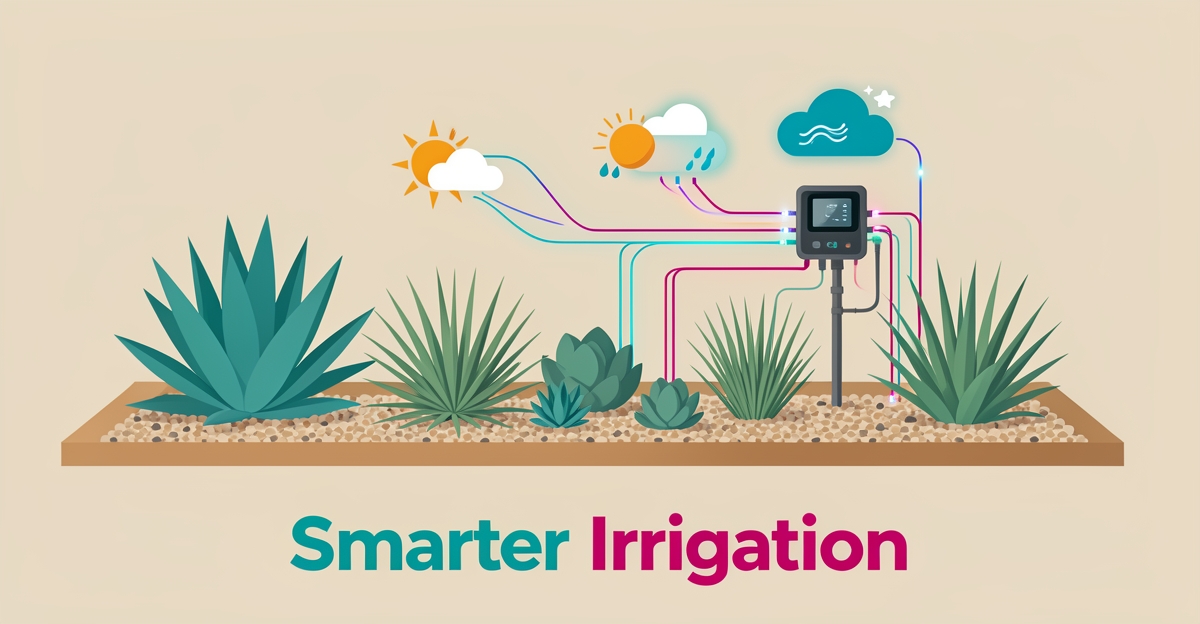
AI for Xeriscaping: How to Automate Weather-Based Irrigation Scheduling
Key Facts
- Over-irrigation is a leading source of water waste in drought-adapted zones, especially during rainy seasons
- Manual timer adjustments can consume a significant share of a technician's week when managing 10+ sites
- Improper irrigation is a common driver of plant stress and replacement costs in xeriscaped installations
- AI weather models can generate forecasts in seconds on GPU hardware, versus hours for traditional numerical systems
- Hyperautomation combines process automation, AI, and machine learning to execute processes with minimal human intervention
- AI-driven automation toolsets adapt to new problems with reduced reliance on manual oversight
Hire a team member that works 24/7 — for less than a part-time wage.
AI receptionists, SDRs, dispatchers and 99+ roles. Trained on your business, fully managed.
Not sure where to start? Ask our AI planner
Why Static Irrigation Schedules Fail Xeriscaping Operations
Static irrigation schedules force xeriscaping operations into a constant battle against weather reality, wasting water and stressing plants despite their drought tolerance. Fixed timers apply water on a calendar basis, ignoring real-time conditions like rainfall, humidity, and evapotranspiration rates. This approach fundamentally misunderstands how drought-adapted landscapes function, leading to overwatering during cool periods and underwatering during heat spikes.
The operational costs of manual scheduling compound quickly when teams manage multiple sites across varying microclimates. Technicians spend hours each week physically adjusting timers at each location, creating labor inefficiencies that scale with portfolio size. Organizations implementing AI-driven automation typically see reduced reliance on human intervention for routine tasks, freeing skilled staff for higher-value activities like plant health assessment and client consultation. Without automation, xeriscaping teams remain trapped in reactive maintenance cycles rather than proactive landscape optimization.
Financially, static schedules drain resources through both wasted water and avoidable plant replacement costs. Overwatering not only increases utility bills but also promotes root rot in drought-tolerant species designed for infrequent deep soakings. Conversely, underwatering during unexpected heatwaves stresses plants, making them susceptible to pest infestations and requiring costly replacements. These inefficiencies directly contradict xeriscaping's core purpose of creating resilient, low-water landscapes that thrive on natural precipitation patterns.
- Over-irrigation is a leading source of water waste in drought-adapted zones, especially during rainy seasons
- Manual timer adjustments can consume a significant share of a technician's week when managing 10+ sites
- Improper irrigation is a common driver of plant stress and replacement costs in xeriscaped installations
AIQ Labs addresses these challenges through AI Workflow Builds that rebuild the irrigation workflow as one automated system, dynamically adjusting schedules based on real-time weather data and soil moisture readings. This approach transforms irrigation from a fixed cost center into a responsive operation that aligns with xeriscaping principles while reducing both water consumption and labor overhead. The result is healthier landscapes, lower operational expenses, and teams able to focus on strategic landscape design rather than timer adjustments.
How AI Weather Forecasting Enables Predictive Irrigation
Modern AI weather models are transforming how xeriscaping teams approach irrigation by delivering hyper-local forecasts in seconds through GPU acceleration. Unlike traditional physics-based models that require hours on supercomputers, these AI systems infer results rapidly, enabling real-time adjustments to watering schedules based on evolving conditions. This shift allows landscapers to move from reactive to predictive irrigation, using data-driven insights to apply water only when and where it's truly needed.
AI-powered forecasting excels through ensemble modeling, generating many weather scenarios instead of just a few deterministic outcomes. By running numerous possible precipitation, temperature, and humidity trajectories, these models quantify uncertainty and improve risk assessment for extreme events like droughts or sudden downpours. This probabilistic approach is especially valuable for xeriscaping, where overwatering wastes resources and underwatering stresses drought-adapted plants. AI doesn't replace physics, it compresses complex simulations into usable timeframes for operational decision-making.
The integration of real-time data fusion further enhances forecast accuracy, allowing AI models to correlate satellite imagery, radar volumes, ground sensors, and historical climatology. This multi-modal input helps predict evapotranspiration rates and soil moisture dynamics with greater precision, directly informing irrigation timing and volume. For xeriscaping professionals, this means fewer site visits, reduced water waste, and healthier plant outcomes, all grounded in adaptive, continuously learning systems. By leveraging these capabilities, teams can build irrigation schedules that respond not just to today's weather, but to the full spectrum of what might come tomorrow.
Building a Business Process Automation System for Irrigation
Irrigation stops being a calendar task when sensor data, weather forecasts and valve controls run as one automated workflow. For xeriscaping teams, business process automation turns manual checks into a closed-loop system that reacts to real conditions without daily human oversight.
Business process automation refers to the technology-enabled automation of business processes. Three main approaches dominate: traditional software development for integrating applications, robotic process automation that uses software robots to emulate human-computer interaction, and hyperautomation that combines process automation, artificial intelligence and machine learning to discover, validate and execute processes automatically with no or minimal human intervention.
Robotic process automation is designed to streamline workflows by delegating repetitive tasks to software agents, allowing human workers to focus on more complex and strategic activities. In irrigation, RPA handles the repetitive collection and logging of soil moisture, flow meters and valve status from disparate IoT devices.
The decision layer is where predictive analytics changes the outcome. AI-driven engines interpret historical and real-time weather data to create dynamic irrigation schedules that save water and improve plant health. GPU-powered weather forecasting delivers faster, more accurate predictions, with forecasts that once required supercomputers now generated in seconds. That speed enables scenario forecasting with ensemble models that generate many possible weather outcomes to plan for extreme events and reduce risk.
Hyperautomation ties collection, decision and execution together, combining process automation, artificial intelligence and machine learning to execute organizational processes automatically with no or minimal human intervention. For irrigation this means:
- IoT sensors stream soil moisture and weather data via automated collection agents
- AI models ingest real-time insights and ensemble forecasts for up-to-the-minute decision making
- Valve controllers execute watering schedules automatically, with human-in-the-loop overrides for exceptions
With the increasing adoption of artificial intelligence, organizations are implementing AI-driven technologies that can process natural language, interpret unstructured datasets and interact with users. AI-driven automation toolsets are designed to adapt to new types of problems with reduced reliance on human intervention. The result is hyperautomation that compresses forecast-to-action latency from days to minutes.
AIQ Labs builds these systems as owned infrastructure, not a subscription widget, so xeriscaping teams retain control over data, models and valve logic. Payment is structured in milestones, so you pay for working phases rather than a monolithic project.
The operational benefit is measurable: fewer manual site visits, consistent water application aligned to plant stress, and auditable logs for compliance and reporting. When sensor collection, AI interpretation and physical actuation are automated as one business process, irrigation becomes a resilient, self-optimizing operation.
Integrating Real-Time Data Streams for Adaptive Scheduling
Adaptive irrigation stops being guesswork when real-time streams, historical patterns, and AI forecasts converge into one decision engine. Xeriscaping teams can shift from fixed schedules to responsive watering that matches soil, plant, and weather conditions as they change.
Multi-modal data fusion is the core technique. AI ingests satellite imagery, Doppler radar volumes, ocean buoys and atmospheric soundings, ground IoT sensors, and historical climatology, then correlates spatial-temporal patterns across modalities. This is the approach behind AI-accelerated numerical weather prediction, which enables rapid ensemble generation instead of a single deterministic path.
Historical weather patterns provide the baseline climate context for a site. Real-time sensor data adds ground truth: soil moisture, temperature, humidity, and evapotranspiration rates from the landscape itself. AI forecast outputs add the forward look, turning short- and medium-range predictions into watering windows. Fused together, the system learns when a predicted heat spike will deplete soil moisture faster than the plant can tolerate.
Speed matters for operational use. Modern AI weather models generate forecasts in seconds instead of hours, and that latency drop lets schedules update continuously rather than on fixed cycles.
The fusion pipeline typically combines:
- Historical climatology and site-specific evapotranspiration baselines for seasonal norms
- Live IoT sensor feeds for soil moisture, temperature and humidity at zone level
- AI weather forecasts and ensemble scenarios for rain, wind and temperature shifts
- Spatial-temporal correlation layers that link microclimate variation to plant stress signals
With faster models, teams can run large numbers of scenarios cheaply, making high-resolution, site-specific forecasts practical for operations.
This is where predictive analytics and forecasting translate into water savings and healthier plants. AIQ Labs fuses historical and real-time data into dynamic irrigation schedules as part of a broader AI Operating System when teams want irrigation connected to the rest of their operations. The result is watering timed to need, not to a calendar, with duration adjusted to actual soil conditions and imminent weather.
Business process automation principles apply here too. As with hyperautomation combining AI and machine learning to discover, validate and execute processes with minimal human intervention, irrigation scheduling becomes an autonomous workflow that learns and improves over time.
Deploying Your AI Irrigation System: From Pilot to Production
Starting with high-value xeriscaping properties allows businesses to validate AI-driven irrigation scheduling with measurable impact before wider rollout. A phased approach minimizes disruption while building confidence in the technology's ability to adapt to local microclimates and plant water needs. AI-driven systems are designed to adapt to new types of problems with reduced reliance on human intervention, a capability that is critical for handling variable weather patterns in xeriscaping environments.
Integration with existing irrigation controllers and business systems forms the technical foundation for scalable deployment. AIQ Labs enables deep two-way API integrations that create seamless operational workflows between soil moisture sensors, weather stations, and property management platforms. This connectivity allows the AI system to continuously ingest real-time data, including GPU-powered weather forecasts that generate predictions in seconds on local hardware, and adjust irrigation schedules dynamically for precision watering decisions.
Tracking ROI through specific metrics ensures the pilot delivers business value before scaling. Key performance indicators include water savings, labor hours saved on manual scheduling adjustments, and plant health indicators like reduced stress symptoms and improved growth rates. Businesses should establish baseline measurements during the pilot phase, then compare against post-implementation data to quantify improvements. AI-powered process transformation is most defensible when tied to demonstrable outcomes across operational metrics, directly applicable to irrigation efficiency gains.
Scaling from single-site pilots to portfolio-wide automation requires standardized processes and change management frameworks. Successful expansion involves documenting lessons learned from the pilot, creating role-specific training materials for irrigation technicians, and establishing clear governance for AI oversight. Driving adoption requires team training programs customized to each role and performance metrics that track success. This structured approach ensures consistent implementation across diverse property types while maintaining the system's ability to learn from localized conditions and improve over time.
Still paying for 10+ subscriptions that don’t talk to each other?
We build custom AI systems you own outright. No vendor lock-in. Full control.
Not sure where to start? Ask our AI planner
Frequently Asked Questions
How does AI-based irrigation scheduling actually save water for xeriscaping compared to traditional timers?
Will I need to replace my existing irrigation controller to use an AI-powered system?
How much time can xeriscaping teams save by switching from manual timer adjustments to AI-driven scheduling?
Is AI weather forecasting accurate enough to rely on for irrigation decisions in xeriscaping?
What kind of ROI should I expect from implementing an AI irrigation system for my xeriscaping business?
How does the system handle unexpected weather changes like sudden heatwaves or storms?
From Guesswork to Growth: The Future of Smart Xeriscaping
Static irrigation schedules waste water, strain resources, and undermine xeriscaping's promise of resilience. By contrast, AI-driven systems that fuse real-time weather data, soil moisture, and predictive analytics transform irrigation into a self-optimizing process, cutting water use, slashing labor hours spent on manual adjustments, and reducing the plant stress that leads to costly replacements. This shift isn't just about efficiency; it's about aligning operations with the natural rhythms drought-adapted landscapes depend on. For xeriscaping teams ready to move from reactive fixes to proactive landscape health, the path forward starts with a focused conversation. Take the two-minute Fit Check at aiqlabs.ai/apply, then book a free 30-minute strategy call to explore how AI automation can solve your specific irrigation challenges, no obligation, just clarity on where the real wins lie.
Make AI your competitive advantage — not just another tool.
Strategy, implementation and ongoing optimization. One partner, end to end.
Not sure where to start? Ask our AI planner