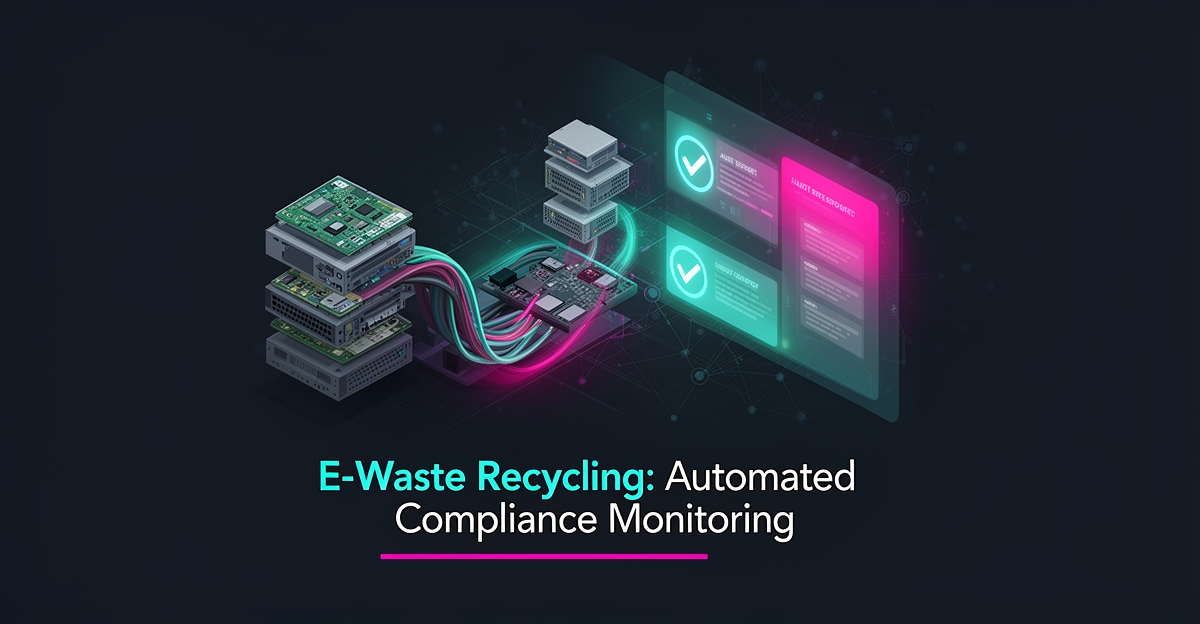
AI-Powered Compliance Tracking: How E-Waste Firms Can Stay Audit-Ready
Key Facts
- The global Environmental Management Systems market was reported at over $29 billion in 2024, with projections near $65 billion by 2031 according to BayTech Consulting
- EHS software spending has reportedly been accelerating at a 14.6% CAGR toward roughly $4.5 billion by 2029 per BayTech Consulting analysis
- 93% of compliance professionals surveyed agreed that AI and cloud-based tools remove human error and outperform manual processes per Sprinto's compliance automation research
- AI document control has reportedly reduced declaration processing from 3-4 hours to 10-15 minutes, cutting manual communication time by up to 85% per Digicust's AI document control studies
- EcoVadis reports processing roughly 30 million documents monthly using AI, with hundreds of sustainability analysts leveraging these tools for ESG assessments according to EcoVadis AI platform data
- Route optimization platforms can reportedly reduce fuel costs by 15-25%, with some regional haulers claiming 12-18% savings within the first month per waste management tool comparisons
- AI-powered sorting systems reportedly achieve 85-95% accuracy in controlled environments, with some vendors claiming 93-97% accuracy for material identification per industry benchmarking studies
Hire a team member that works 24/7 — for less than a part-time wage.
AI receptionists, SDRs, dispatchers and 99+ roles. Trained on your business, fully managed.
Not sure where to start? Ask our AI planner
The E-Waste Compliance Trap: Why Manual Tracking Is Failing Audits
E-waste firms are walking into audits armed with spreadsheets while regulators, customers, and investors demand real-time proof of compliance. That gap between what auditors expect and what manual tracking can deliver is where penalties, lost contracts, and reputational damage are born.
The pressure comes from three directions at once, a "triple threat" that manual processes were never designed to withstand. First, regulatory complexity keeps compounding. Firms must navigate the EPA's Resource Conservation and Recovery Act (RCRA) for hazardous waste, ISO 14001 environmental management standards, and a patchwork of rules governing emissions, water discharge, and disposal. Each framework demands its own documentation trail, and each audit tests whether those trails hold together.
Second, the economics of manual compliance are deteriorating. Landfill tipping fees keep climbing, transportation costs squeeze margins, and the labor hours required to maintain spreadsheet-based tracking grow with every new client and waste stream. What once consumed a few hours a week now consumes entire roles.
Third, stakeholders have changed the standard of proof. Investors now treat ESG metrics as indicators of long-term viability, demanding transparent, data-backed environmental reporting rather than annual summaries assembled after the fact.
The market's response confirms where the industry is heading:
- The global Environmental Management Systems market was reported at over $29 billion in 2024, with projections near $65 billion by 2031
- EHS software spending has reportedly been accelerating even faster, climbing at a 14.6% CAGR toward roughly $4.5 billion by 2029
- 93% of compliance professionals surveyed agreed that AI and cloud-based tools remove human error and outperform manual processes
That capital is not flowing toward better spreadsheets. It is flowing toward systems that treat compliance as a continuous, automated function rather than a periodic scramble. According to the BayTech Consulting analysis, the traditional separation between compliance and operational performance is obsolete, the most reliable path to audit readiness is running a well-documented, efficient operation in the first place.
Manual tracking fails audits for a simple reason: it produces evidence after the fact, assembled from memory and fragmented files. When compliance automation research shows that continuous monitoring compresses months of audit preparation into weeks, the contrast is stark. Spreadsheet-based firms reconstruct their compliance story under deadline pressure, while AI-equipped competitors generate it as a byproduct of daily operations.
This is precisely the gap AIQ Labs addresses through AI Workflow Builds, rebuilding the one compliance workflow that costs you the most, at a fixed price and in phases, so you replace reactive documentation with continuous, automated evidence collection. The question for e-waste firms is no longer whether to automate compliance tracking, but how quickly they can close the gap before their next audit tests it.
From Cost Center to Compliance Engine: What AI Tracking Actually Does
The most effective compliance systems don't feel like compliance systems at all, they feel like operational excellence. Modern AI creates an intelligence layer that continuously monitors waste classifications, disposal timelines, and regulatory changes, transforming compliance from a cost center into a natural byproduct of efficient operations.
This shift represents a fundamental rethinking of how e-waste firms approach regulatory obligations. According to BayTech Consulting, the traditional separation between compliance and performance is obsolete. The most effective way to ensure compliance is to run a highly efficient and well-documented operation.
AI tracking systems deliver this convergence through three core capabilities:
- Continuous monitoring of waste streams and disposal timelines, flagging deviations before they become violations
- Automated classification that adapts to regulatory changes without manual reprogramming
- Real-time documentation that generates audit-ready reports as operations unfold, not after the fact
The impact on accuracy is substantial. Research from Sprinto's compliance automation guide found that 93% of respondents agreed AI compliance tools remove human error while automating manual tasks. This isn't just about speed, it's about building a reliable foundation for audit readiness.
Scale matters too. EcoVadis reports processing roughly 30 million documents monthly using AI, with hundreds of sustainability analysts leveraging these tools for ESG assessments. This volume would be impossible to manage manually, yet AI handles it while maintaining consistency.
The efficiency gains extend beyond document processing. Digicust's AI document control reportedly reduced declaration processing from 3-4 hours to 10-15 minutes, cutting manual communication time by up to 85%. For e-waste firms managing complex disposal chains, this translates to faster turnaround without sacrificing accuracy.
At AIQ Labs, we embed this intelligence layer directly into your operations. Rather than bolting on compliance as an afterthought, we architect solutions where regulatory adherence emerges naturally from well-orchestrated workflows. The result is an operation that stays audit-ready not through heroic effort, but through systematic design.
The Audit-Ready Architecture: Continuous Monitoring and Automated Evidence
Audit readiness stops being a scramble when evidence is collected continuously instead of compiled on demand. E-waste firms face overlapping obligations under EPA's RCRA and ISO 14001, and an audit-ready architecture turns operational data into defensible proof in real time.
The blueprint starts with API-driven evidence collection that runs continuously instead of point-in-time reviews. Systems pull waste type classifications, disposal timelines, chain-of-custody records, and regulatory change feeds through APIs from weighbridges, manifests, and transport logs. Compliance automation replaces manual spreadsheet-driven processes with real-time tracking, and Sprinto's model shows how this compresses months of compliance work into weeks while providing live dashboards for control status.
Automated report generation maps evidence directly to specific controls. RCRA hazardous waste handling requirements and ISO 14001 environmental management clauses are codified as control rules, so the platform assembles the right documents, signatures, and timestamps automatically when an audit request arrives. Industry research notes the traditional separation between compliance and performance is obsolete because effective compliance requires a highly efficient, well-documented operation.
Real-time compliance dashboards give operations and leadership shared visibility. Dashboards surface exceptions such as late disposals, missing manifests, or classification mismatches before they become findings, and maintain complete audit trails for every data change, approval, and system action. AI document control has reportedly reduced processing time from 3-4 hours to 10-15 minutes per declaration, with up to an 85% reduction in manual communication time.
Trust and accountability are preserved with human-in-the-loop governance. EcoVadis principles emphasize keeping humans in the loop, with every AI insight validated by expert analysts and processes made transparent about where AI assists and where people lead. This approach aligns with survey findings that 93% of respondents agreed AI and cloud compliance programs remove human error and automate manual tasks.
An audit-ready architecture typically includes:
- Continuous API ingestion from operational systems for waste classification, transport, and disposal events
- Control mapping to RCRA, ISO 14001 and other frameworks with automated evidence packaging
- Real-time dashboards and alerts for risk, timeline, and documentation gaps
- Immutable audit trails and human-validated overrides for critical decisions
AIQ Labs builds systems that continuously monitor environmental compliance and generate audit-ready reports, reducing manual effort and compliance risk. The result is continuous monitoring that proves compliance every day, not just at audit time, and a documented, defensible posture under regulatory scrutiny.
Implementation Roadmap: Deploying AI Compliance Without Disrupting Operations
The journey to AI-powered compliance tracking starts with understanding your specific needs and how they connect to existing operations. Begin by mapping your compliance requirements, such as EPA's RCRA or ISO 14001 standards, and identifying data sources from weigh scales, fleet GPS, and ERP systems that can feed into an AI platform. This assessment phase ensures the solution addresses real pain points rather than adding complexity. As noted in industry research, the most effective compliance strategy runs a highly efficient and well-documented operation, where technology serves oversight rather than replacing it according to BayTech Consulting.
Integration should prioritize interoperability and ownership to avoid vendor lock-in. Connect AI modules to current systems using open APIs, pulling real-time weight data from scales, location feeds from fleet trackers, and transaction logs from ERP platforms, to create a unified compliance dashboard. Start with route data, which typically stabilizes within 60-90 days as the AI learns collection patterns and traffic variables per waste management tool comparisons. Predictive systems for maintenance or disposal timelines typically require longer calibration, often 3-6 months, to accumulate sufficient failure or degradation signals for reliable forecasts.
Structure the rollout in milestones rather than a big-bang deployment. AIQ Labs' Build in Milestones model delivers each phase at a fixed price with a working system at every step, so compliance improvements land incrementally without disrupting daily operations. For firms ready to go further, an AI Operating System connects compliance monitoring with dispatch, reporting, and customer workflows in one owned layer, built in phases and owned outright.
Throughout rollout, maintain realistic expectations about AI's role. While automation can reportedly reduce manual reporting effort substantially and compress audit preparation from hours to minutes per document control studies, it cannot determine risk acceptability or validate complex regulatory interpretations. Human oversight remains essential for judgment calls, especially when AI flags anomalies that require contextual understanding of business risk tolerance. Build internal validation loops where staff review AI-generated reports before finalizing audit submissions, ensuring outputs align with both data and operational reality. This balanced approach delivers audit readiness without disrupting daily workflows.
Staying Ahead of Regulators: Turning Compliance Data into Competitive Advantage
Forward-thinking e-waste firms are discovering that compliance data isn't just a regulatory burden, it's a strategic asset that fuels competitive differentiation. According to BayTech Consulting, the global Environmental Management Systems market was reported at over $29 billion in 2024 and projected to reach nearly $65 billion by 2031, reflecting a fundamental shift where waste management is increasingly viewed as a data-rich frontier for advantage rather than a cost center. This transformation is driven by the convergence of operational efficiency and regulatory compliance, where the most effective way to ensure adherence is to run a highly efficient and well-documented operation.
AI-powered compliance tracking enables this shift by continuously monitoring environmental compliance, waste type classifications, disposal timelines, and regulatory changes, turning what was once a manual, error-prone process into a source of real-time, audit-ready intelligence. As Sprinto's research found, 93% of respondents agreed that AI and cloud compliance programs remove human error, automate manual tasks, and prove more effective and efficient, while 95% of businesses surveyed had established or were trying to build a culture of compliance. These systems don't just satisfy auditors; they generate the granular, evidence-backed ESG and sustainability reporting that investors and enterprise customers now demand as a prerequisite for partnership.
- Automated evidence collection eliminates last-minute audit scrambles by maintaining continuous documentation trails
- Real-time dashboards transform compliance monitoring from reactive to proactive risk management
- Integrated reporting aligns operational data with ESG frameworks like ISO 14001 and global sustainability standards
AIQ Labs builds systems designed specifically for this reality, client-owned platforms with full audit trails and human-in-the-loop controls that ensure every compliance insight is both accurate and actionable. Unlike off-the-shelf solutions that create dependency, our approach delivers systems you own outright, scaling with your business while embedding compliance into your operational DNA. The result is audit readiness that doesn't just prevent penalties, it becomes a visible demonstration of responsibility that resonates with stakeholders increasingly focused on environmental performance.
To explore how your e-waste operation can transform compliance data into a competitive advantage, start with the two-minute Fit Check at https://aiqlabs.ai/apply, followed by a free 30-minute strategy call at https://aiqlabs.ai/book to map your highest-ROI automation opportunity. This working session identifies where AI-powered compliance tracking can deliver immediate value, no obligation, just clarity on your path to becoming audit-ready while building the ESG credibility that wins contracts and attracts investment.
Still paying for 10+ subscriptions that don’t talk to each other?
We build custom AI systems you own outright. No vendor lock-in. Full control.
Not sure where to start? Ask our AI planner
Frequently Asked Questions
How does AI-powered compliance tracking actually reduce manual effort for e-waste firms?
What specific regulations do AI compliance systems help e-waste firms track?
Can AI really improve accuracy in compliance tracking compared to manual methods?
How does continuous monitoring turn compliance from a cost center into a competitive advantage?
What happens if I don't have perfect data, will AI still work for my e-waste operation?
How long does it take to see results from implementing AI compliance tracking?
Make Audit Readiness Your Operating System, Not Your Scramble
E-waste compliance is no longer a periodic scramble for spreadsheets and signatures. It is a continuous operational discipline shaped by compounding regulations, rising costs, and stakeholder demands for real-time ESG proof. AI-powered tracking closes that gap by turning waste classifications, disposal timelines, and regulatory changes into automated evidence that is collected daily, mapped to RCRA and ISO 14001 controls, and ready when auditors arrive. The shift moves compliance from a cost center to a byproduct of efficient, well-documented operations, and it is why 93% of surveyed respondents agreed that AI and cloud compliance programs remove human error and automate manual tasks according to compliance automation research. For e-waste firms, the next step is to map your specific requirements to existing data sources, prioritize API-driven evidence collection, and keep human-in-the-loop governance for judgment calls. AIQ Labs builds custom, client-owned systems that embed this continuous monitoring directly into waste and recycling operations, delivered in milestones at fixed prices, and owned outright so there's no vendor lock-in. Start with the two-minute Fit Check at https://aiqlabs.ai/apply, then book a free 30-minute strategy call at https://aiqlabs.ai/book to identify your highest-ROI automation opportunity and build an audit-ready posture that wins contracts and investment.
Make AI your competitive advantage — not just another tool.
Strategy, implementation and ongoing optimization. One partner, end to end.
Not sure where to start? Ask our AI planner