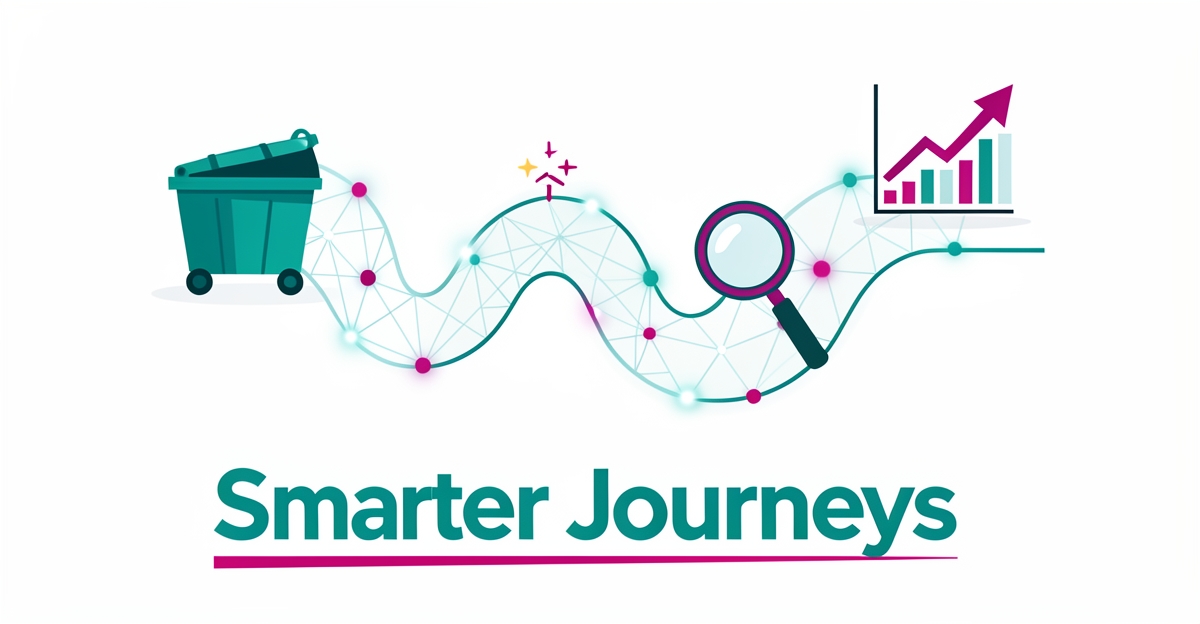
AI-Powered Customer Journey Mapping for Dumpster Cleaning Services
Key Facts
- Traditional journey maps take days or weeks to build but are typically outdated before completion according to Nielsen Norman Group research cited by HubSpot
- AI-powered journey mapping can shorten sales cycles through automated qualification and timely outreach per monday.com
- Personalized AI-driven follow-ups at key decision points are reported to lift conversion rates meaningfully per monday.com
- Teams can save significant weekly hours by automating routine communications with AI per monday.com findings
- Roughly 70% of successful AI transformation effort must focus on people and processes, not tools per Boston Consulting Group's 10-20-70 rule, cited by Miro
- AI journey mapping typically requires 60-90 days of baseline data before building predictive models per Winsome Marketing methodology
- AI can analyze customer sentiment in minutes versus hours of manual review per HubSpot
Hire a team member that works 24/7 — for less than a part-time wage.
AI receptionists, SDRs, dispatchers and 99+ roles. Trained on your business, fully managed.
Not sure where to start? Ask our AI planner
Why Traditional Journey Maps Fail Dumpster Cleaning Businesses
Most dumpster cleaning businesses have a journey map problem they don't even know about. The map hanging on the wall, or buried in a forgotten slide deck, describes a customer who doesn't actually exist.
According to Winsome Marketing, traditional journey maps are "expensive lies", beautifully designed artifacts built on assumptions, averages, and aspirational thinking rather than real behavioral data. Customers don't follow them. They discover services through unexpected channels, ghost for months, then suddenly book. They skip steps entirely.
For a dumpster cleaning business, this plays out in predictable ways. The map says customers find you through Google ads, request a quote, compare options, then book. Reality looks different: a property manager sees your truck at a neighboring complex, searches your name three weeks later, reads two reviews, and calls directly. Your map never accounted for that path.
The core failures of traditional journey mapping run deep:
- Static by design, the map captures a moment in time and never updates as behavior shifts
- Assumption-based, built from what the team believes happens, not what data shows
- Descriptive, not predictive, it tells you what customers did, never what they'll do next
- Disconnected from operations, the insights never reach the systems that actually communicate with customers
The time investment makes this worse. A Nielsen Norman Group survey cited by HubSpot found that traditional journey mapping takes days or weeks to complete, a significant effort for a document that's typically outdated before the ink dries.
monday.com frames the contrast well: traditional journey mapping is a paper map, static and quickly outdated. AI-powered journey mapping works like a GPS, it reroutes when conditions change, remembers patterns, and gets smarter the more it's used.
For service businesses like dumpster cleaning companies, where customer relationships hinge on repeat bookings and timely communication, this distinction matters enormously. A static map can't tell you that a customer who booked a one-time clean after a tenant turnover is now primed for a quarterly service contract. It can't flag that commercial clients who receive a follow-up text within two hours of service tend to rebook at higher rates. Those insights live in your data, but only if you have systems that capture and analyze them.
This is precisely where AI-driven customer journey optimization changes the equation. At AIQ Labs, this is the foundation of how we approach customer journey optimization, replacing guesswork with systems that learn from every interaction and adapt in real time. The question isn't whether your current journey map is wrong. It's whether you're ready to find out how wrong it is.
How AI Turns Every Touchpoint Into a Living Map
AI transforms customer journey mapping from a static exercise into a dynamic, real-time system that evolves with customer behavior. Instead of relying on assumptions, AI analyzes actual interactions across every touchpoint, website visits, quote requests, service calls, and post-service check-ins, to uncover patterns and predict next steps. This approach turns journey maps into living tools that guide personalized engagement and operational improvements.
By applying machine learning for pattern recognition, natural language processing for sentiment analysis, and predictive analytics for forecasting behavior, businesses can move from reactive to proactive service delivery. AI identifies which sequences of actions, such as visiting a pricing page followed by a quote request, signal high intent, enabling timely interventions. It also detects sentiment shifts in customer communications, flagging frustration or satisfaction before they escalate. These insights allow dumpster cleaning services to tailor follow-ups, adjust service offerings, and reduce friction at critical moments.
The impact is measurable: AI-powered journey mapping can shorten sales cycles through automated qualification and timely outreach, while personalized engagement at key decision points is reported to lift conversion rates meaningfully. Teams also save hours every week by automating routine tasks like data entry, follow-up scheduling, and feedback analysis, time that can be redirected toward strategy and customer relationship building. For dumpster cleaning providers, this means more efficient operations, higher customer satisfaction, and stronger advocacy from clients who feel understood at every stage of their journey. AI journey mapping works more like a GPS app that reroutes when traffic hits, remembers your shortcuts, and gets smarter the more you use it, continuously refining the path forward based on real-world behavior.
If you'd rather not build this yourself, a managed approach can work too. AIQ Labs deploys [AI Employees](/ai-employees), receptionists, SDRs, and dispatchers that handle follow-ups and qualification around the clock, or rebuilds your single costliest workflow with a fixed-price [AI Workflow Build](/workflow-builds).
A 7-Step Framework to Map and Automate Your Customer Journey
A traditional journey map can take days or weeks to build, and by the time it's finished, customers have already stopped following it. For dumpster cleaning services, a practical, step-by-step framework turns that static guesswork into a living system that predicts what each customer needs next.
The framework below, adapted from a detailed AI journey mapping methodology, translates directly to a dumpster cleaning business.
Step 1: Define micro-conversions. Look beyond the macro conversion (a booked cleaning) to smaller signals of progress: a quote request form started, a pricing page viewed twice, a reply to a follow-up email. These micro-conversions become the foundation for AI pattern recognition.
Step 2: Implement tracking. AI can only find patterns in data you actually collect. Track website visits, quote requests, phone inquiries, and service history. Most businesses radically under-track behavioral signals, leaving AI blind to key decision moments.
Step 3: Collect baseline data and build cohorts. Plan for a 60-90 day data collection period before building any predictive models. Then segment customers by outcome, for example, recurring residential accounts that renewed, one-time cleanups that never returned, and commercial inquiries that went quiet.
Step 4: Identify patterns and predictive signals. Machine learning surfaces which behavioral sequences predict a booking: homeowners who request quotes in early spring, property managers who respond within 48 hours, or customers who open seasonal emails but never click through.
Step 5: Build next-best-action models. These models predict what each customer is likely to do next and which intervention works best, a reminder, a discount offer, or a personal call.
Step 6: Automate personalized follow-ups. Connect insights to your communication tools so actions trigger automatically:
- Seasonal cleanup reminders timed to each customer's historical booking pattern
- Churn-risk alerts when a recurring account skips its usual quarterly service
- Re-engagement outreach for quote requests that stalled past 14 days
- Post-service review requests sent only to customers whose sentiment signals are positive
Step 7: Measure, iterate, and scale. The payoff justifies the discipline: businesses using AI-driven personalization and timely follow-ups report meaningful conversion improvements, and sales reps reclaim hours every week by automating routine communications, according to monday.com research.
One caveat: technology is only part of the equation. Boston Consulting Group's "10-20-70 rule" holds that 70% of successful AI transformation effort should focus on people and processes, not tools. That's why AIQ Labs pairs every custom journey system with training, monitoring, and ongoing optimization, so the framework keeps learning as your customers do.
Avoiding the Pitfalls: Data Quality, Security, and the Human Element
For dumpster cleaning services, the promise of AI-powered journey mapping hinges on more than just sophisticated algorithms, it demands solid data foundations, robust security practices, and a clear understanding that technology amplifies, rather than replaces, human judgment. Before scaling AI initiatives, businesses must confront common pitfalls that derail even the most promising implementations, starting with the reality that roughly 70% of successful AI transformation effort should focus on people and processes, not just technology, as highlighted by Boston Consulting Group's 10-20-70 rule cited in Miro. This means investing in staff training, refining workflows, and fostering cross-departmental collaboration to ensure insights from AI tools translate into actionable service improvements.
Data quality forms the bedrock of reliable AI journey mapping, requiring adherence to four essential standards: completeness, accuracy, consistency, and timeliness, as emphasized by monday.com. For small service businesses, disconnected systems often create critical gaps, customer information scattered across scheduling tools, invoicing software, and communication platforms prevents AI from building a unified view of the customer journey. Without addressing these foundational issues, AI analysis risks producing misleading patterns based on incomplete or stale data, undermining efforts to personalize touchpoints from initial inquiry to post-service follow-up. Equally vital are data security cautions; sensitive customer details should never be fed into public AI engines without proper safeguards, and businesses must utilize licensed platforms that prohibit model training on proprietary information, a practice HubSpot explicitly recommends to prevent unintended exposure.
Ultimately, AI functions most effectively as a partner to human expertise, not a substitute. As Miro observes, while AI provides the analytical engine to detect behavioral patterns and predict next steps, the real value emerges when teams interpret these insights to refine service scripts, adjust scheduling protocols, or design targeted retention efforts. For dumpster cleaning services, this collaborative approach ensures that automation enhances the human touch, such as empathetic follow-ups after a service call, rather than eliminating it, turning data-driven intelligence into lasting customer loyalty. Strengthening these foundations first allows AI to scale responsibly, delivering measurable improvements in satisfaction and repeat business without compromising trust or operational integrity.
From Map to Loyalty: Turning Repeat Customers Into Advocates
The real power of AI journey mapping emerges not in the map itself, but in how it transforms post-service interactions into opportunities for retention and advocacy. By analyzing behavioral patterns from completed services, such as response timing to satisfaction surveys or frequency of repeat bookings, AI identifies the precise moments when customers are most receptive to engagement. This enables dumpster cleaning services to trigger personalized check-ins, review requests, or loyalty offers based on actual satisfaction signals rather than arbitrary timelines. For example, AI can detect when a customer's post-service sentiment indicates high delight, perhaps through positive language in a follow-up message or rapid re-engagement, and automatically prompt a review request at that peak moment, significantly increasing the likelihood of positive feedback. Personalized outreach driven by behavioral data is consistently reported to improve conversion outcomes, a principle that applies directly to turning satisfied customers into repeat clients and advocates.
AI further strengthens loyalty by enabling proactive win-back campaigns for lapsed customers. Instead of generic reactivation emails, AI analyzes historical journey data to pinpoint why specific customers disengaged, whether due to service timing, communication gaps, or unmet expectations, and tailors re-engagement efforts accordingly. This might involve offering a discounted deep-clean for clients who previously canceled after a single service, or adjusting service frequency reminders for those who lapsed due to scheduling conflicts. By treating each customer's journey as unique, businesses move beyond one-size-fits-all tactics to interventions that feel relevant and timely. As noted in industry insights, AI journey mapping works like a GPS that "reroutes when traffic hits, remembers your shortcuts, and gets smarter the more you use it", continuously refining engagement strategies based on real-time behavior.
Ultimately, these AI-driven loyalty tactics don't just retain customers; they turn them into vocal advocates. When service experiences are consistently personalized and responsive, customers are far more likely to refer friends, leave unsolicited positive reviews, or engage with referral programs. The data confirms that a truly great experience doesn't just secure a repeat purchase, it builds the kind of trust that fuels word-of-mouth growth. For dumpster cleaning operators looking to harness this potential, the first step is identifying where their current journey creates friction or missed opportunities. AIQ Labs offers a free 30-minute strategy call to map your biggest bottleneck, whether it's post-service follow-up, review generation, or win-back efficiency, and explore how AI-powered journey mapping can turn satisfied customers into your strongest growth engine. Start with the Fit Check at https://aiqlabs.ai/apply to begin.
Still paying for 10+ subscriptions that don’t talk to each other?
We build custom AI systems you own outright. No vendor lock-in. Full control.
Not sure where to start? Ask our AI planner
Frequently Asked Questions
Why do traditional customer journey maps fail for dumpster cleaning businesses?
How long does it take to build a traditional journey map versus an AI-powered one?
What kind of data do I need to collect before AI can predict customer behavior for my dumpster cleaning service?
Will AI replace my team's judgment in managing customer relationships?
What measurable results can a dumpster cleaning business expect from AI-powered journey mapping?
Is my customer data safe when using AI for journey mapping?
Your Customers Already Wrote the Map, Are You Reading It?
Traditional journey maps describe a customer who doesn't exist. AI-powered mapping replaces that static guesswork with a living system, one that tracks micro-conversions, spots behavioral patterns, predicts next steps, and automates personalized follow-ups at exactly the right moment. The payoff is real: businesses using AI-driven personalization report meaningful conversion gains, while teams reclaim hours every week from routine communications. For a dumpster cleaning service, that's the difference between chasing quotes that went cold and knowing which property manager is ready to sign a quarterly contract. But success depends on more than tools, clean data, proper safeguards, and human judgment matter most, which is why AIQ Labs pairs every custom journey system with training and ongoing optimization. Whether you want a managed AI receptionist or SDR through [AI Employees](/ai-employees), a fixed-price rebuild of your costliest workflow, or a full connected [AI Operating System](/ai-operating-systems) you own outright, the path starts the same way: take the free two-minute Fit Check at aiqlabs.ai/apply, then book your 30-minute strategy call. We'll map your biggest bottleneck together, and if there isn't a clear win, we'll tell you that too.
Make AI your competitive advantage — not just another tool.
Strategy, implementation and ongoing optimization. One partner, end to end.
Not sure where to start? Ask our AI planner