AI-Powered Customer Retention: How to Keep HVAC Clients from Switching Providers
Key Facts
- 85% of CX leaders say customers will drop brands over unresolved issues according to G2 research
- 93% of shoppers are more likely to remain loyal to brands delivering personalized experiences per Antavo, 2026
- 38% of consumers cite poor product quality as a reason to not return to a brand per G2 data
- 52% of consumers say good deals and promotions drive loyalty according to G2, 2026
- 87% of CX leaders say AI agents are key to improving customer interactions per G2, 2026
- 38% of G2 Proactive Customer Retention reviews highlight churn reduction as the main benefit per G2 data
- 35% of G2 Proactive Customer Retention reviews point to automation as a key value driver according to G2, 2026
Hire a team member that works 24/7 — for less than a part-time wage.
AI receptionists, SDRs, dispatchers and 99+ roles. Trained on your business, fully managed.
Not sure where to start? Ask our AI planner
Why HVAC Clients Switch Providers and What It Costs
HVAC businesses face a critical challenge: keeping clients from switching providers when service gaps and unresolved issues erode trust. Research shows that 85% of CX leaders say customers will drop brands over unresolved issues, making proactive problem-solving essential for retention in competitive home services markets. This is especially true in HVAC, where repair frequency and service history directly impact customer satisfaction and loyalty decisions.
Service history gaps create significant retention risks for HVAC companies. When technicians lack access to complete maintenance records, they miss opportunities to identify recurring problems or recommend timely preventive care. This disconnect frustrates customers who expect their provider to understand their system's unique needs. Similarly, repair frequency triggers often signal underlying issues that, if left unaddressed, push customers to seek alternatives. Industry data reveals that 38% of consumers cite poor product quality as a reason to not return to a brand, a metric that translates directly to HVAC when repeated repairs suggest systemic failures.
Unresolved complaints represent the most immediate churn trigger in the HVAC sector. Customers experiencing repeated service failures or inadequate follow-up are primed to switch providers at the first better offer. The data confirms this vulnerability: 52% of consumers say good deals and promotions drive loyalty, meaning HVAC businesses must consistently demonstrate value beyond pricing to retain clients. Without systems to track service patterns and predict at-risk relationships, companies react to churn after it happens rather than preventing it through personalized engagement strategies. AI-powered retention tools change this dynamic by analyzing service history, repair frequency, and feedback to identify risks early and trigger proactive maintenance offers before customers consider switching.
How AI Predicts Churn and Personalizes Retention for HVAC
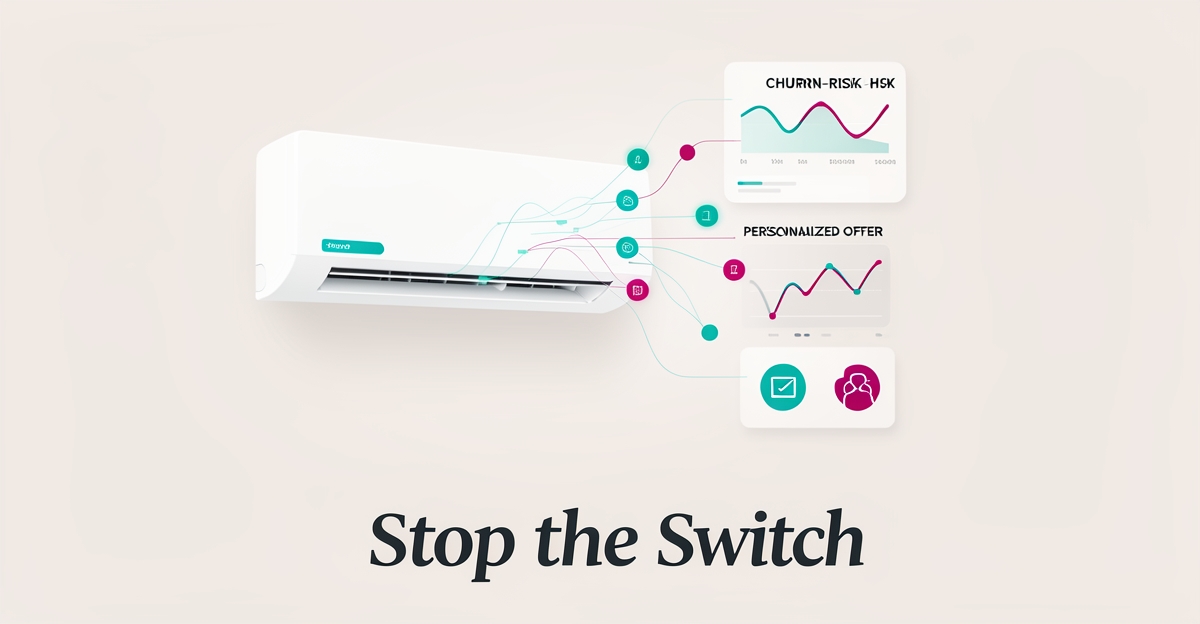
HVAC clients rarely announce they're leaving, they just stop calling for service. AI turns that silent drift into an early warning system by connecting service history, repair frequency, and feedback patterns into a churn risk score that teams can act on before the next season.
Predictive analytics scan each account for signals that human reviews miss. Repeated repairs on the same unit, widening gaps between scheduled maintenance, and negative sentiment in post-service notes all raise risk. Industry research shows 87% of CX leaders say AI agents are key to improving customer interactions, and 85% say customers will drop brands over unresolved issues. In HVAC, unresolved comfort issues translate directly into lost maintenance contracts.
Once risk is flagged, personalization makes outreach relevant instead of generic. AI groups customers by problem type, equipment age, and service history, then recommends the right retention lever, a proactive maintenance plan, a loyalty discount, or a technician callback. Customer retention data notes 38% of G2 Proactive Customer Retention reviews highlight churn reduction or retention as the main benefit, with 35% pointing to automation as a key value driver.
Automation handles the repetitive follow-up so technicians stay in the field. Systems can trigger service reminders, schedule tune-ups around a homeowner's availability, and surface the exact parts history to the dispatcher. This frees human agents for high-touch conversations where empathy matters most.
AIQ Labs builds these systems for field services through three entry points: AI Employees for managed AI staff like dispatchers and retention specialists, AI Workflow Builds to rebuild the one retention workflow that costs you the most, and AI Operating Systems when you want one connected layer across the whole business. The result is repeat clients turned into long-term partners, with churn predicted and maintenance plans offered proactively.
Typical AI-driven retention workflows for HVAC include:
- Churn risk scoring from service history, repair frequency, and feedback sentiment
- Automated, personalized outreach with maintenance plan offers timed to equipment age
- Real-time behavioral triggers that prompt dispatcher or AI employee follow-up
- Continuous learning from outcomes to refine risk models and messaging
The result is proactive engagement instead of reactive recovery. Teams can prioritize at-risk accounts, preserve customer lifetime value, and reduce churn without adding headcount. With predictive analytics guiding outreach, HVAC providers keep clients loyal through smarter service, not just lower prices.
From Risk Signal to Retention Action: A Practical HVAC Playbook
Spotting a churn risk means nothing if your team never acts on it. The gap between "we think this customer might leave" and "we saved them" is where retention is won or lost, and AI closes that gap faster than any manual process ever could.
The playbook starts with identifying at-risk customers by analyzing service history, repair frequency, and customer feedback. When an HVAC system shows three repairs in eighteen months or a customer's feedback turns lukewarm, AI flags the account before the customer ever calls a competitor. This is the foundation of real-time behavioral triggers, which convert data signals into immediate action.
Once a risk signal fires, the next step is a tailored offer. AI-powered systems predict churn and present relevant solutions, a maintenance plan matched to the customer's equipment age and repair patterns, not a generic pitch. Personalization matters here: research shows 93% of shoppers are more likely to remain loyal to brands that deliver personalized experiences. Automation handles the repetitive follow-ups, seasonal tune-up reminders, post-service check-ins, renewal nudges, freeing your team for high-touch conversations that actually require a human.
The final layer is always-on support. When a customer has an issue at 9 p.m. on a Friday, waiting until Monday morning is how accounts quietly slip away. G2 reports that 85% of CX leaders say customers will drop brands over unresolved issues, while 87% say AI agents are key to improving customer interactions. AI voice and chat agents trained on your service history can answer questions, book appointments, and escalate genuine emergencies around the clock.
Here's the sequence in practice:
- Score every account using service history, repair frequency, and feedback signals to surface churn risk early.
- Trigger tailored maintenance plan offers automatically when risk signals or seasonal windows hit.
- Automate repetitive follow-ups, reminders, renewals, satisfaction checks, so technicians focus on fieldwork.
- Deploy AI agents for 24/7 phone, chat, and SMS coverage with human handoff for complex issues.
This is where ownership of the system matters. Many retention tools are rented subscriptions that lock your data inside someone else's platform. AIQ Labs takes a different approach: AI Employees for dispatch, scheduling, and customer support at roughly 80% less cost than a human hire, AI Workflow Builds to rebuild your highest-cost retention workflow at a fixed price, and AI Operating Systems built in phases and owned outright, no vendor lock-in. You can Start Monthly, Build in Milestones, or Own It Outright, whichever fits how you want to pay. Across engagements, the pattern holds: a manual retention workflow becomes an automated, AI-driven system the client owns.
The result is a retention engine that never sleeps, flagging risk, personalizing offers, and keeping customers engaged long after the invoice is paid.
Building a Retention System HVAC Businesses Own and Scale
Moving from pilot to scalable retention requires a system HVAC businesses can truly own and grow with. AIQ Labs builds custom AI retention platforms that integrate directly with dispatch and CRM tools, turning fragmented data into a unified view of customer health. This foundation allows businesses to shift from reactive service calls to proactive retention strategies that prevent churn before it starts. With 200+ multi-agent systems deployed and four live SaaS products AIQ Labs runs daily, the build approach is proven in the field, not just on paper.
The system begins with AI analyzing service history, repair frequency, and customer feedback to predict churn risk. By identifying patterns, such as declining maintenance adherence or repeated emergency repairs, AI flags at-risk clients early. Businesses can then deploy tailored interventions, like personalized maintenance plan offers or priority scheduling, backed by data showing 93% of shoppers stay loyal to brands delivering personalized experiences according to industry research. Automation handles repetitive follow-ups, freeing technicians to focus on high-value interactions.
Scaling this capability means deploying managed AI Employees like the AI Retention Specialist and AI Dispatcher, which work 24/7 to execute retention workflows without adding headcount. These agents integrate with common field-service tools via API, updating customer profiles in real time and triggering outreach when churn signals emerge. Unlike point solutions, AIQ Labs' approach ensures businesses own the system outright, no vendor lock-in, no subscription chaos. Through the Build in Milestones model, HVAC companies can start with a single workflow, such as automated maintenance reminders, and expand to a full AI Operating System as ROI proves out. This structure supports sustainable growth, turning retention from a cost center into a scalable competitive advantage. Take the 2-minute Fit Check, then book a free 30-minute strategy call to map your retention gaps and explore how owned AI systems can keep clients from switching providers.
Turn Retention Risk into Your Competitive Advantage
HVAC businesses lose clients not because of price, but because of unresolved issues and missed signals that go unnoticed until it's too late. By using AI to analyze service history, repair frequency, and customer feedback, companies can shift from reactive fixes to proactive retention, offering personalized maintenance plans before customers even consider switching. Automation handles routine follow-ups, while AI Employees provide 24/7 support, freeing your team to focus on high-value service. The result is stronger loyalty, higher lifetime value, and a retention system you own and scale. To see how this works for your business, take the 2-minute Fit Check at aiqlabs.ai/apply, then book a free 30-minute strategy call to map your retention gaps and explore owned AI solutions that keep clients from switching providers.
Make AI your competitive advantage — not just another tool.
Strategy, implementation and ongoing optimization. One partner, end to end.
Not sure where to start? Ask our AI planner