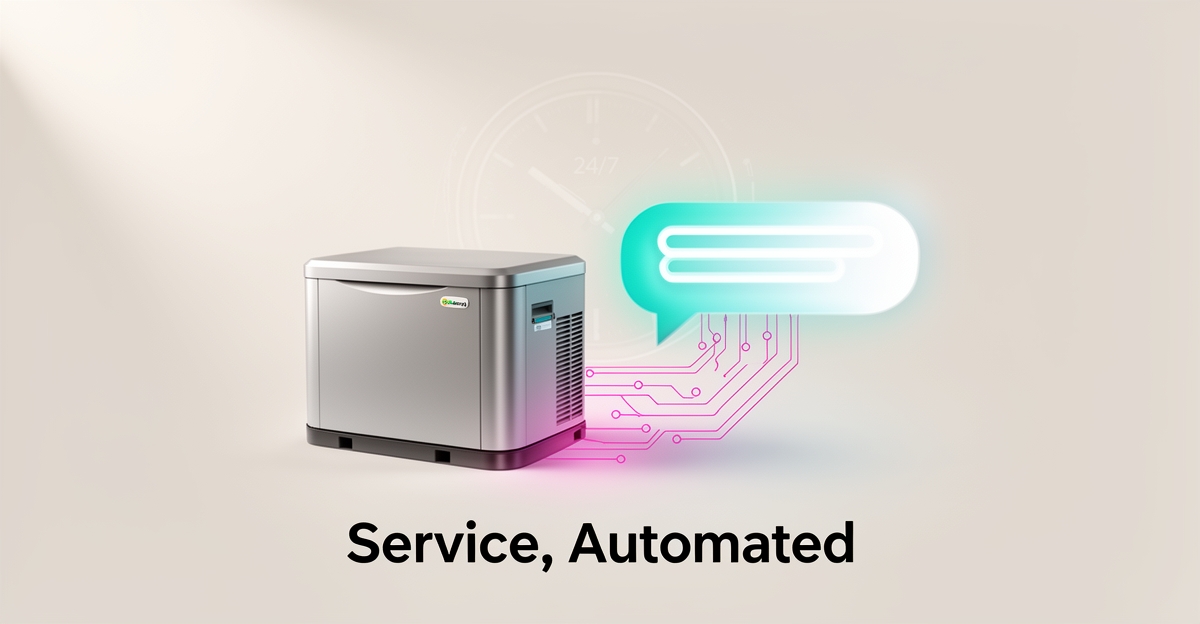
AI-Powered Customer Service: How Generator Companies Can Handle Inquiries Without Hiring More Staff
Key Facts
- Industry projections suggest AI will handle roughly half of all customer service cases by 2027.
- Service teams using AI typically report meaningful time savings on routine cases, freeing capacity for complex work.
- Analyses of AI customer service deployments suggest a large share of routine tickets can be automated.
- Service teams increasingly expect agentic AI to lift upsell revenue through contextual recommendations.
- Most service reps using AI say it creates growth opportunities rather than replacing their role.
- AI Customer Service Representatives can answer installation and maintenance questions 24/7 without adding headcount.
Hire a team member that works 24/7 — for less than a part-time wage.
AI receptionists, SDRs, dispatchers and 99+ roles. Trained on your business, fully managed.
Not sure where to start? Ask our AI planner
The Staffing Trap: Why Generator Companies Can't Scale Customer Service the Old Way
Generator companies live in a constant inbound cycle. Installation timelines, maintenance schedules, and power capacity questions arrive all day, and each one pulls a technician or sales rep away from revenue work.
That volume creates a staffing trap. Hiring more people raises payroll, training, and turnover costs, while service quality still slips during peaks, after hours, and weekends. The old model forces a choice between slow responses and an unsustainable headcount.
The burden is measurable. Industry projections as of late 2026 suggest AI is on track to handle roughly half of all customer service cases by 2027, and teams using AI consistently report spending less time on routine cases, capacity that shifts to complex work instead.
Routine inquiries dominate generator support. Analyses of AI customer service deployments suggest a large share of routine tickets can be automated. That is the exact category generator companies field most often: installation windows, service intervals, load calculations, and warranty checks.
Without automation, teams absorb the cost. Staff repeat the same answers, chase incomplete information, and stay on call to cover nights and weekends. The result is higher cost per inquiry and slower first response, even as customer expectations rise.
AI changes the equation by handling the repetitive layer while preserving human expertise for high-value issues. An AI Customer Service Representative can answer common questions about installation timelines, maintenance, and power needs 24/7, route complex cases to humans, and log context back into CRM and scheduling tools.
The staffing-vs-service dilemma becomes solvable when routine work is automated. Companies can maintain response speed without adding headcount, and reps can focus on upsell, troubleshooting, and retention.
Typical repetitive inquiries that drain generator teams include:
- Installation timeline and site readiness checks
- Maintenance schedules, service intervals, and parts availability
- Power capacity sizing and load calculation questions
- Warranty status, service history, and appointment rescheduling
These are high-volume, low-variance tasks ideal for automation. AI-powered chatbots and virtual assistants can deliver consistent answers, reduce ticket volume, and ensure coverage outside business hours.
For generator companies, the trap is not a lack of demand for support. It is relying on people to handle work that does not require people. AIQ Labs deploys AI Employees, like AI Customer Service Representatives, to handle inbound inquiries 24/7, so teams scale service without scaling staff.
What AI-Powered Customer Service Actually Does for Generator Companies
Your phone rings at 9 PM on a Tuesday. A homeowner’s power just flickered out during a storm, and they’re frantically searching for a backup generator installation timeline. Instead of hitting voicemail, an AI-powered virtual assistant answers instantly, assesses their square footage and power needs, and books a site assessment for Thursday morning. This is the new reality of customer service for generator companies.
Modern AI chatbots do far more than recite generic FAQs. They actively walk customers through complex technical decisions, such as calculating whole-home power requirements based on HVAC tonnage and well pump specifications. They provide real-time updates on installation timelines, automatically factoring in permit processing delays and equipment availability. When a commercial client needs to schedule quarterly maintenance for a 150kW diesel unit, the AI checks technician availability, reserves the slot, and sends confirmation details without human intervention.
The operational impact is measurable. Teams using AI typically report meaningful time savings on routine cases, while industry analysts project AI will handle roughly half of all customer service inquiries by 2027. For generator businesses, this translates to captured leads that would otherwise move to competitors during after-hours emergencies.
Here is what AI-powered customer service handles autonomously for generator companies:
- Answering technical specification questions about fuel consumption rates, noise levels, and automatic transfer switch compatibility
- Scheduling preventive maintenance visits and emergency repair dispatches directly into your calendar system
- Qualifying high-intent buyers by gathering property details, budget parameters, and installation timelines before routing to sales
- Providing 24/7 status updates on parts orders and permit applications
These systems excel at pattern recognition across thousands of interactions. When a customer describes their 3,000-square-foot home with a home office and medical equipment, the AI instantly recommends appropriate kW capacities and available inventory. It distinguishes between a casual inquiry about portable units and an urgent request for a standby system before hurricane season, escalating the latter to your senior consultants immediately.
The technology creates capacity rather than replacement. Deployments that pair AI triage with human expertise consistently show faster response times and higher customer satisfaction, primarily because first responses drop from hours to seconds. Most service representatives using AI say it creates new growth opportunities by freeing them from repetitive data entry. Your master electricians and power consultants focus on complex load calculations and commercial installations while the AI manages the initial triage.
AIQ Labs deploys these capabilities through AI Customer Service Representatives that integrate directly with your existing CRM and scheduling software. These AI employees work continuously, handling the surge of inquiries that follows major weather events when your human staff is already deployed to emergency installations. They capture every lead, answer every technical question, and ensure no potential customer encounters a busy signal during their moment of need.
The Revenue Case: Cost Savings and Upsell Opportunities You're Leaving on the Table
Generator companies lose revenue every time an after-hours call goes unanswered or a pre-sale question lingers without a response. Missed inquiries mean lost emergency service contracts and abandoned installation projects, direct hits to the bottom line. AI-powered customer service transforms these missed opportunities into measurable gains by handling routine interactions 24/7 without expanding headcount.
Industry analyses have long projected that AI-powered customer service can dramatically reduce support costs compared with traditional call center operations, with some estimates reaching 80% savings on automated interactions. For generator businesses, this means redirecting resources from repetitive queries about installation timelines or maintenance schedules toward high-value activities like emergency dispatch and system design consultations. AIQ Labs deploys AI Customer Service Representatives that integrate directly with scheduling and CRM systems to capture leads and book service appointments around the clock, typically at a fraction of the cost of a human hire.
Beyond cost savings, agentic AI creates new revenue streams by identifying upsell opportunities during routine interactions. Service teams increasingly expect agentic AI to lift upsell revenue through contextual recommendations, such as suggesting transfer switches during generator sizing conversations or maintenance plans after troubleshooting common issues. These AI employees learn from historical sales data to recognize patterns where complementary products or services address unspoken customer needs, turning support chats into qualified sales opportunities without increasing staff workload.
The financial impact compounds when considering availability. Human agents working standard shifts miss a significant share of potential customer interactions occurring outside business hours, precisely when generator emergencies peak. AI-powered support eliminates this gap, ensuring every inquiry receives an immediate response whether it's 2 PM or 2 AM. This constant availability captures emergency service contracts that would otherwise go to competitors and prevents installation leads from cooling off during delayed follow-ups.
For generator companies operating in seasonal markets or disaster-prone regions, this reliability translates directly to protected revenue streams. When storms approach and power outages loom, customers need instant answers about generator availability, installation timelines, and emergency service options. AI systems scale instantly to handle surges in inquiries without the delays or costs associated with temporary staffing increases, ensuring no opportunity is lost to capacity constraints.
By automating routine support tasks, generator businesses free human agents to focus on complex consultations and emergency responses where human expertise delivers the highest value. This shift not only reduces operational costs but also increases job satisfaction among support teams by eliminating repetitive query handling, creating a more efficient allocation of talent across the customer journey.
Implementation Roadmap: From First AI Employee to Fully Automated Inquiry Handling
Rolling out AI customer service doesn't require a technical overhaul or a massive upfront investment. With a structured approach, generator companies can move from manual inquiry handling to automated support in weeks, not months.
Start by auditing your current inquiry landscape. Track how many questions arrive by phone, email, and website chat, then categorize them by type: installation timelines, power output calculations, maintenance schedules, troubleshooting, and pricing. This baseline reveals which inquiries follow predictable patterns and which genuinely require human expertise. AI-powered agents can automate a large share of routine tickets, but only if you first identify which tickets qualify as routine.
Next, choose AI that connects to your existing systems rather than creating another silo. The platform should sync with your CRM, scheduling software, and inventory database so it can pull real-time information about product availability, service appointments, and customer history. Integration matters because customers expect accurate answers about their specific situation, not generic responses. Industry projections suggest AI will handle roughly half of all customer service cases by 2027, but that only works when the AI can access the same information your human agents use.
Training separates functional AI from frustrating chatbots. Feed the system your generator specifications, installation requirements, maintenance protocols, and power calculation formulas. Include real customer conversations that show how your team explains complex topics like load capacity or fuel consumption. The AI needs to understand not just what you sell, but how customers actually ask about it. This is where many DIY implementations stall, training requires both technical setup and deep knowledge of your business.
Once live, monitor performance closely. Track resolution rates, escalation frequency, and customer satisfaction scores. Watch for patterns in questions the AI struggles to answer, then refine its training. Well-optimized AI customer service deployments consistently show improved satisfaction, but only when companies actively refine based on real interaction data.
For generator companies that want to skip the build-it-yourself complexity, AIQ Labs offers an AI Customer Service Representative that arrives fully configured. The done-for-you model includes the initial build, training on your generator-specific knowledge base, integration with your existing tools, and ongoing optimization under a simple monthly plan. It's designed for businesses that want the efficiency gains without becoming AI developers themselves. You can start monthly, and if the workflow proves its value, expand into a broader workflow build or a full AI operating system over time.
The path from first deployment to full automation typically follows this sequence:
- Week 1-2: Audit inquiry volume and identify automation candidates
- Week 3-4: Select platform and begin system integration
- Week 5-8: Train AI on company-specific knowledge and test responses
- Week 9+: Deploy, monitor, and continuously refine based on performance data
The companies seeing the strongest results treat AI implementation as an operational change, not just a technology install. They set clear escalation rules so complex technical questions reach human experts immediately. They review AI conversations weekly during the first month. And they measure success by customer outcomes, not just cost savings.
Getting It Right: Human Handoffs, Data Quality, and the Guardrails That Matter
When a generator company owner first considers AI customer service, the same question always surfaces: what happens when a customer calls at 2 AM with a complex technical question about load capacity or automatic transfer switch compatibility? The answer lies not in choosing between AI and human expertise, but in designing systems that know when to escalate.
Industry projections suggest AI will handle roughly half of all customer service cases by 2027, which means the other half still requires human judgment. The key is building intelligent escalation protocols that route complex inquiries to your technical team while AI handles routine questions about service schedules, maintenance intervals, and basic troubleshooting.
Analyses of AI customer service deployments consistently show that a large share of routine tickets can be automated, freeing your certified technicians to focus on the consultations that actually close contracts. When a commercial client needs a custom power solution for a hospital or data center, that conversation goes straight to your experts.
The most effective AI customer service deployments include these guardrails:
- Confidence thresholds that trigger human handoff when AI certainty drops below a defined level
- Keyword triggers for safety-critical topics like installation specs, electrical codes, and emergency protocols
- Real-time monitoring dashboards so your team can review AI conversations and intervene when needed
- Continuous training loops where human agents correct AI responses and improve future accuracy
Data quality determines whether your AI provides accurate power recommendations or dangerous misinformation. An AI system trained on incomplete product specs or outdated installation manuals will confidently deliver wrong answers about generator sizing or fuel requirements. This is why serious AI customer service providers emphasize knowledge base accuracy and regular content audits.
The personal touch that wins contracts doesn't disappear, it gets amplified. When AI handles the after-hours inquiry about whether you service a particular generator brand, your sales team starts the next morning with a qualified lead instead of a voicemail. When routine maintenance questions get instant answers, your technicians spend their time on the complex installations and emergency calls that build your reputation.
Security matters when customer data flows through AI systems. Generator companies collect site addresses, power requirements, and sometimes critical infrastructure details. Your AI platform needs encryption, access controls, and audit trails that meet the same standards you'd apply to any business system handling sensitive customer information.
The generator companies seeing real ROI from AI customer service treat it as a hybrid workforce strategy, not a replacement for human expertise. They deploy AI employees to handle the volume, then reinvest that capacity into the technical consultations and relationship building that differentiate their business in a competitive market.
Still paying for 10+ subscriptions that don’t talk to each other?
We build custom AI systems you own outright. No vendor lock-in. Full control.
Not sure where to start? Ask our AI planner
Frequently Asked Questions
How much time can AI-powered customer service save my team on routine inquiries?
Will AI really be able to handle half of our customer service inquiries by 2027?
What percentage of routine support tickets can AI actually automate for generator companies?
Can AI help us capture more emergency service leads during storms or after-hours outages?
Is there a risk that AI will give incorrect technical advice about generator sizing or safety?
How quickly can we implement AI customer service without disrupting our current operations?
The Power Is Already in Your Hands
Generator companies don't have a demand problem, they have a capacity problem. The direction is clear: AI is on track to handle roughly half of all customer service cases by 2027, and teams using it consistently report less time on routine inquiries and faster first responses. For businesses fielding installation timelines, load calculations, and emergency dispatch requests around the clock, that shift isn't theoretical, it's the difference between capturing a storm-driven lead at 2 AM or losing it to a competitor who answered first. AIQ Labs deploys AI Customer Service Representatives that integrate with your CRM and scheduling tools, handle the repetitive bulk of tickets autonomously, and escalate complex technical questions to your experts with full context. The implementation roadmap takes weeks, not months, and the monthly model costs far less than a human hire. Your technicians stay focused on revenue work. Your customers get instant answers. Your business scales without the staffing trap. Ready to see what an AI employee looks like in your operation? Start the two-minute Fit Check at aiqlabs.ai/apply and book a free strategy session to map your highest-ROI automation opportunity.
Make AI your competitive advantage — not just another tool.
Strategy, implementation and ongoing optimization. One partner, end to end.
Not sure where to start? Ask our AI planner