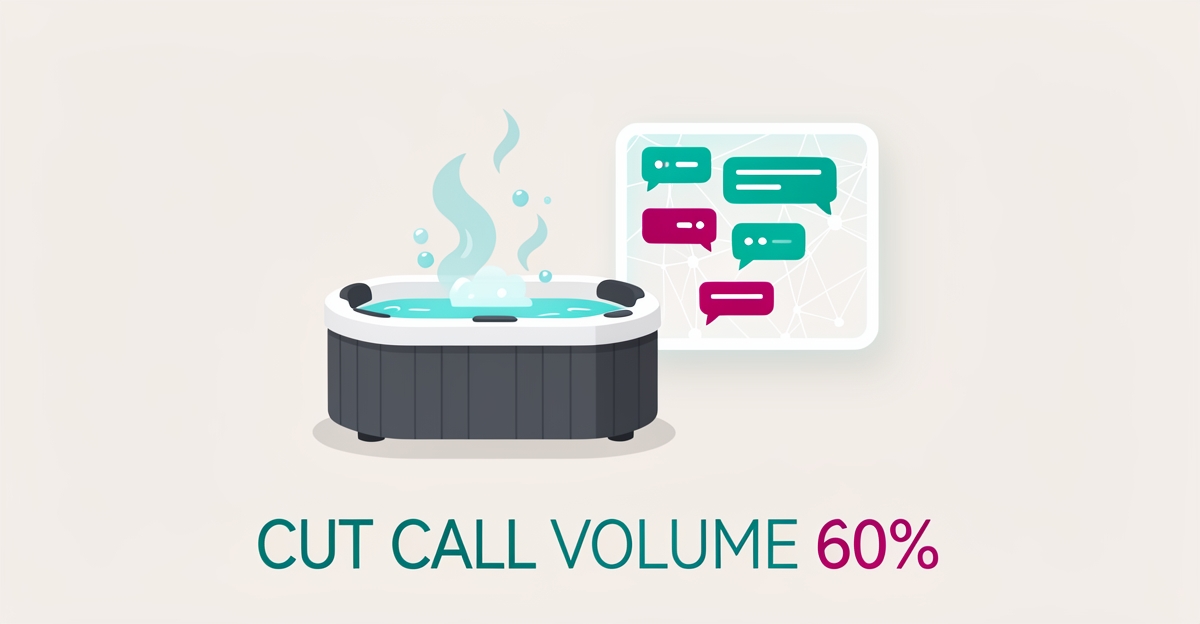
AI-Powered Customer Support: How Hot Tub Service Companies Can Reduce Call Volume by 60% (2026)
Key Facts
- AI chatbots can reduce support ticket volume by 60-70% for hot tub service companies according to industry research
- 81% of customers prefer self-service options for routine inquiries based on customer service research
- 76% of customers expect companies to understand their specific needs and preferences per SalesGroup AI findings
- Businesses using AI chatbots typically see 2-3 times higher conversion rates on customer interactions per LiveAgent analysis
- AI-powered support systems achieve roughly 45% faster resolution times for customer inquiries based on implementation research
- AI Employees cost roughly 80% less than a human hire while working 24/7/365 per AIQ Labs cost comparison
- Hot tub service technicians spend less time on repetitive calls and more on complex repairs with AI chatbots based on service industry analysis
Hire a team member that works 24/7 — for less than a part-time wage.
AI receptionists, SDRs, dispatchers and 99+ roles. Trained on your business, fully managed.
Not sure where to start? Ask our AI planner
The Hidden Cost of Repetitive Hot Tub Service Calls
Hot tub service companies face a silent drain on their resources: repetitive customer inquiries. Technicians spend valuable time answering the same questions about chemical maintenance, pricing tiers, and emergency response windows, time that could be spent on complex repairs or preventive maintenance. This constant interruption not only reduces billable hours but also frustrates customers who wait on hold for simple answers.
Research shows that 81% of customers prefer self-service options for routine inquiries, yet many hot tub providers still rely solely on phone and email support. When customers can’t quickly find information about filter changes or warranty coverage, they default to calling, creating avoidable volume that strains small teams. Meanwhile, 76% expect companies to understand their specific needs, meaning generic FAQs often fall short of delivering the personalized experience modern consumers demand.
- Maintenance schedule questions (pH balancing, shock treatments)
- Pricing and package comparisons
- Emergency service availability and response times
- Warranty claims and part replacement procedures
- Seasonal opening and closing procedures
These repetitive interactions accumulate into significant hidden costs: delayed technician dispatch, increased labor expenses, and missed opportunities to upsell services during meaningful conversations. AIQ Labs addresses this with AI Employees, managed AI staff trained on a company’s specific service history, common issues, and customer communication patterns, turning frequent inquiries into instant, accurate resolutions without human intervention.
How AI Chatbots Achieve 60%+ Ticket Reduction in Field Services
Most hot tub service companies face a steady stream of repetitive customer inquiries about maintenance schedules, pricing details, and emergency response windows. These routine questions consume significant technician time that could be better spent on complex repairs and field work. AIQ Labs addresses this bottleneck with multi-agent systems that combine document retrieval with structured knowledge, enabling accurate, contextual responses to common service queries without human intervention.
This approach has demonstrated measurable impact in production environments. According to industry research, AI-powered chatbots can achieve a 60-70% reduction in support ticket volume by deflecting routine inquiries before they reach human agents. The same research shows that businesses implementing such solutions typically see 2-3 times higher conversion rates on customer interactions, as immediate, accurate responses build trust and reduce friction in the service journey. These results are not theoretical, AIQ Labs has deployed 200+ multi-agent systems and runs four live SaaS products daily, handling real customer interactions in production.
The system’s effectiveness stems from its layered intelligence. Retrieval mechanisms pull relevant information from both document stores and structured knowledge bases, ensuring responses are not only accurate but deeply contextual to the user’s specific hot tub model, service history, and warranty status. Meanwhile, a multi-agent architecture allows specialized agents to collaborate, one handling intent recognition, another accessing maintenance protocols, and a third managing escalation paths when human intervention is truly needed.
For hot tub service providers, this translates to fewer incoming calls about filter changes, chemical balancing, or scheduling availability. Technicians spend less time on repetitive phone triage and more time on value-driven repairs, while customers receive instant, consistent answers 24/7. The system continuously learns from each interaction, refining its understanding of common pain points and improving deflection rates over time, turning customer support from a cost center into a scalable, self-improving asset.
Implementing Your AI Support System: From Knowledge Base to Live Deployment
Getting an AI support system live is less about technology and more about preparation. The businesses that see results fastest are the ones that treat deployment like hiring and training a new team member, with clear expectations, quality source material, and ongoing coaching.
Start by auditing what your customers actually ask. Pull your last few months of call logs, emails, and text messages, then sort them by topic: water chemistry questions, filter cleaning schedules, winterization timing, pricing inquiries, and emergency response expectations. This analysis reveals the repetitive queries that consume your team's time, the same questions, asked dozens of times per week, that an AI system can answer instantly.
Next, define what success looks like before you build anything. According to implementation research from OMQ, businesses should establish clear KPIs upfront, including ticket deflection rate, automation rate, and customer satisfaction score. Without these benchmarks, you have no way to measure whether the system is actually working or just adding another layer of complexity.
Your knowledge base is the foundation everything else sits on. Gather your service manuals, maintenance checklists, pricing sheets, and the answers your best technicians give to common questions. Structure this material so the AI can retrieve it accurately, a chatbot trained on vague or outdated information will confidently give wrong answers about chemical dosages or warranty terms, which damages trust faster than no chatbot at all.
Integration is where the system becomes genuinely useful rather than just informative. Connect your AI to the tools your business already runs on:
- Scheduling software, so the AI can book service calls, not just describe your availability
- CRM and customer records, so it recognizes returning customers and their service history
- Phone, SMS, and web chat, so customers reach it on whichever channel they prefer
When these connections work together, a customer texting at 9 PM about a leaking hot tub gets an immediate troubleshooting response, a booked service window, and a confirmation, all without waking your on-call technician.
The deployment model matters as much as the technology. AIQ Labs offers three ways to get there: Start Monthly for an ongoing managed AI Employee, Build in Milestones for a fixed-price rebuild of your most expensive workflow, or Own It Outright if you want to own the system with no ongoing fees. The Start Monthly option costs roughly 80% less than a human hire, with the build, training on your business, tool integrations, monitoring, and improvements all included. That structure removes the two biggest barriers SMBs face, large upfront investment and the need for in-house technical staff to maintain the system. See pricing details for the full breakdown.
Finally, treat launch day as the beginning, not the finish line. A LiveAgent analysis of AI customer support found that businesses implementing AI see 60–70% reductions in support ticket volume and roughly 45% faster resolution times, but those results come from systems that are monitored and refined over time. Review conversation logs weekly at first, flag the questions your AI fumbles, and feed those gaps back into the knowledge base.
As Yasmin Altmann of OMQ puts it, "The best results come from businesses that regularly evaluate and optimize their AI system." A well-maintained AI support system compounds in value: every resolved query makes it smarter, every month it handles a larger share of your call volume, and your technicians spend their days on complex repairs instead of repeating the same answers about pH levels.
Still paying for 10+ subscriptions that don’t talk to each other?
We build custom AI systems you own outright. No vendor lock-in. Full control.
Not sure where to start? Ask our AI planner
Frequently Asked Questions
How much can an AI chatbot actually reduce our hot tub service calls?
Will our customers actually use a chatbot instead of calling us?
What do we need to prepare before launching an AI support system?
Can a chatbot do more than just answer questions, like actually book service calls?
What happens when the AI can't answer a question?
Is this affordable for a small hot tub service company, and do we need technical staff to maintain it?
Turn Repetitive Calls into Revenue-Focused Time
Hot tub service companies are losing valuable technician hours to repetitive inquiries about maintenance, pricing, and emergency response, time that could be spent on complex repairs and preventive care. AI-powered support, like the AI Employees built by AIQ Labs, deflects up to 70% of these routine tickets by delivering instant, contextual answers 24/7, while continuously learning from interactions to improve over time. The result is faster resolution, higher customer satisfaction, and technicians free to focus on revenue-driving work. To see how this applies to your business, start with a free two-minute Fit Check and schedule a no-obligation 30-minute strategy call to map your biggest support bottlenecks and identify high-ROI automation opportunities.
Make AI your competitive advantage — not just another tool.
Strategy, implementation and ongoing optimization. One partner, end to end.
Not sure where to start? Ask our AI planner