AI-Powered Disease Prediction: How Fish Farms Can Prevent Outbreaks
Key Facts
- Behavioral shifts like reduced feeding or erratic swimming often appear 24–48 hours before physical symptoms of disease.
- AI systems can analyze behavioral patterns continuously and alert farm staff quickly, including in low-connectivity remote environments when paired with edge hardware.
- Early AI alerts give farms days or weeks of lead time before clinical symptoms appear across the fish population.
- Sudden pH drops and other environmental stressors can precede disease susceptibility by several hours in high-density pens.
- AI models detect multi-variable risk signals—like reduced feeding plus erratic swimming—that threshold-based alarm systems miss entirely.
- Custom AI systems trained on farm-specific data typically outperform generic models because fish behavior and water chemistry vary by location.
Hire a team member that works 24/7 — for less than a part-time wage.
AI receptionists, SDRs, dispatchers and 99+ roles. Trained on your business, fully managed.
Not sure where to start? Ask our AI planner
The Hidden Cost of Late Disease Detection in Aquaculture
Fish farms face significant losses when disease outbreaks go undetected until visible mortality occurs, as early signs are often subtle and easily missed in high-density pens. By the time fish show clear symptoms or die, pathogens have already spread rapidly through the population, locking in treatment costs and irreversible stock losses. Manual monitoring struggles to keep pace with the speed of disease transmission in confined aquatic environments, where behavioral changes and environmental shifts precede visible illness by critical hours or days.
AI models overcome this limitation by continuously analyzing behavioral patterns—such as feeding irregularities, swimming anomalies, and social interactions—alongside environmental data like water temperature, dissolved oxygen, and pH levels. These systems detect subtle deviations that signal the onset of disease long before mortality spikes, enabling preemptive intervention. AIQ Labs develops custom AI systems that integrate these data streams to identify emerging threats and alert farm staff in real time, shifting disease management from reactive to proactive.
This early detection capability directly reduces both mortality rates and operational costs associated with outbreaks. By intervening during the incubation phase, farms can isolate affected pens, adjust feeding protocols, or apply targeted treatments before widespread infection occurs. The result is not only healthier stock but also avoided expenses from emergency interventions, lost biomass, and disrupted production cycles. For aquaculture operations operating on thin margins, this preventive approach transforms disease control from a recurring cost center into a measurable efficiency gain.
- Behavioral shifts like reduced feeding or erratic swimming often appear 24–48 hours before physical symptoms
- Environmental stressors such as sudden pH drops can precede disease susceptibility by several hours
- High-density pens accelerate pathogen spread, making early detection essential for containment
- Manual checks typically miss subclinical signs due to infrequent sampling and observer variability
- AI systems provide continuous, objective monitoring unaffected by fatigue or shift changes
By integrating AI into routine farm management, operators gain a continuous vigilance layer that complements—not replaces—expert husbandry. This technological safeguard ensures that interventions happen at the optimal biological and economic window, preserving both fish welfare and farm profitability. The shift from guessing to knowing transforms disease risk from an inevitable loss into a manageable variable, aligning operational resilience with long-term sustainability goals in modern aquaculture.
How AI Reads Behavioral and Environmental Signals Before Outbreaks
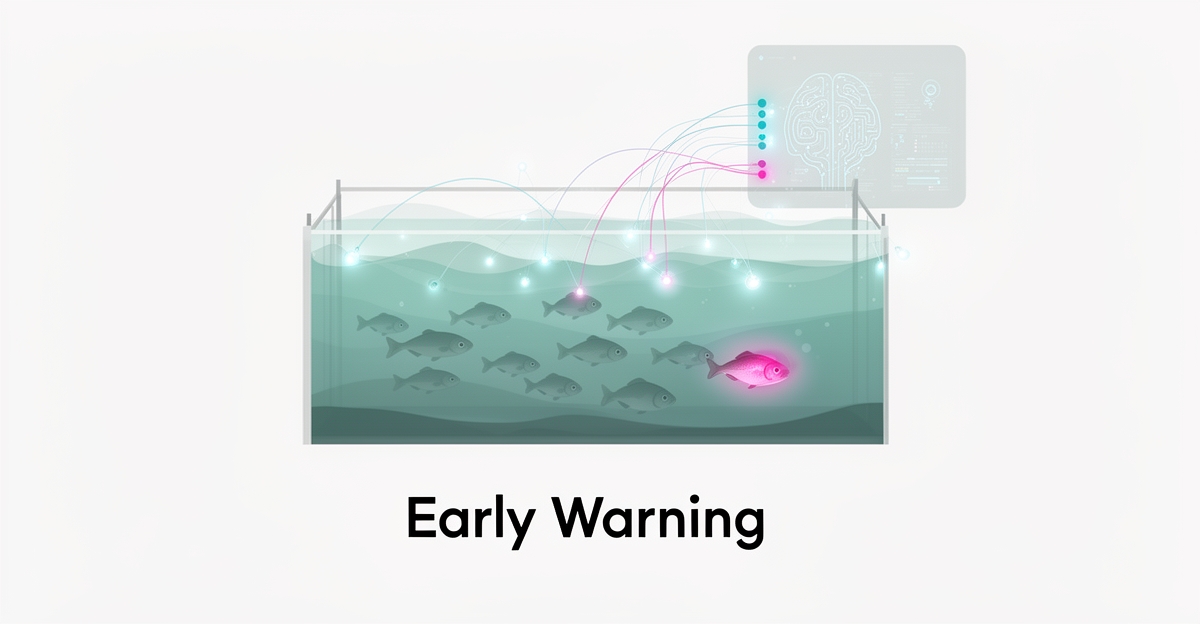
Fish behavior holds subtle clues long before disease becomes visible to the human eye—changes in swimming patterns, feeding responses, and social interactions can signal stress or infection hours or days before symptoms appear. AI systems developed by AIQ Labs continuously monitor these behavioral indicators alongside critical environmental data such as water temperature, dissolved oxygen levels, and turbidity to detect anomalies invisible to farm staff. By analyzing real-time streams of sensor and video data, these models establish baseline patterns for healthy fish and flag deviations that precede outbreaks, enabling intervention before mortality spikes.
Unlike traditional threshold-based alarms that trigger only after a single parameter crosses a dangerous level, AI models use pattern recognition to identify complex, multi-variable correlations that indicate early disease risk. For example, a combination of reduced feeding response, erratic swimming, and a slight drop in oxygen may collectively signal an emerging issue—even if each factor remains within "safe" limits individually. This holistic analysis allows AI to detect subtle shifts that rule-based systems miss, providing earlier and more accurate warnings.
The system's strength lies in its ability to learn what "normal" looks like for a specific farm under varying conditions—accounting for species, life stage, time of day, and seasonal changes—so alerts are context-aware and less prone to false positives. Machine learning models refine their accuracy over time by correlating sensor and behavioral data with eventual health outcomes, improving predictive power with each cycle. This adaptive intelligence transforms raw data into actionable foresight, turning reactive disease management into a preventive strategy. With edge-compatible hardware, such systems can also analyze patterns and issue alerts quickly, even in low-connectivity remote or offshore locations.
By integrating behavioral and environmental sensing with continuous learning, AI moves beyond simple monitoring to become an early-warning partner for fish farmers. The technology doesn't replace human expertise—it amplifies it, giving staff the lead time needed to adjust feeding, isolate at-risk populations, or apply targeted treatments before disease spreads. This shift from reaction to prevention not only improves fish welfare but also protects yield and reduces operational losses, making AI a critical tool in sustainable aquaculture management. For farms exploring this capability, starting with a Fit Check offers a path to assess how AI-powered behavioral and environmental analysis can be tailored to their specific operations.
From Alert to Action: How Early Warning Systems Reduce Mortality and Costs
When an AI system flags an emerging disease pattern, the clock starts ticking — but now it ticks in the farm's favor. Automated alerts reach farm staff through mobile notifications and dashboard warnings, delivering days or weeks of lead time before clinical symptoms appear across the population. This window transforms outbreak response from reactive crisis management into proactive intervention.
- Targeted treatment of affected pens instead of whole-farm medication
- Adjusted feeding and oxygenation to support immune response
- Strategic harvesting schedules to protect biomass value
- Biosecurity escalation before pathogen spreads between sites
The economics of prevention compound quickly. Early intervention typically reduces mortality events while cutting treatment expenditures — less medication used, fewer labor hours for administration, and protected production cycles that stay on schedule. Deployments designed for remote farm environments can analyze behavioral and environmental data continuously without requiring constant cloud connectivity.
AI-powered monitoring shifts the fundamental economics of disease management. Instead of absorbing losses from outbreaks that spread undetected, farms invest in precision responses that preserve both fish welfare and financial performance. The alert becomes the starting point for a coordinated, data-driven action plan — one that protects the entire production cycle from a single early signal.
Implementing AI Disease Prediction: What Fish Farms Need to Get Started
Most fish farms already collect the data needed to predict disease outbreaks—they just aren't using it that way yet. Sensors monitor water temperature, dissolved oxygen, and pH levels. Feeding systems track consumption patterns. Cameras observe fish behavior. The challenge isn't gathering more data; it's connecting these existing streams into an intelligent system that spots trouble before it becomes visible to the naked eye.
AI-powered disease prediction works by analyzing behavioral and environmental data to detect subtle changes that signal stress or infection. AI models can identify early warning signs that human observers typically miss, giving farm staff critical time to intervene before an outbreak spreads.
The implementation process typically unfolds in phases:
- Data integration: Connect existing sensors, feeding systems, and cameras into a unified platform that continuously collects and organizes information
- Baseline training: The AI model learns what "normal" looks like for your specific operation—your fish species, water conditions, and seasonal patterns
- Pattern recognition: The system identifies correlations between environmental shifts, behavioral changes, and historical disease events
- Alert deployment: Farm staff receive notifications when the AI detects anomalies that match pre-outbreak signatures
Custom AI systems outperform generic solutions because they're trained on your farm's unique conditions. Water chemistry varies by location. Fish behavior differs by species and density. A model trained on data from a Norwegian salmon farm won't perform well in a tropical tilapia operation. Farm-specific training ensures the AI understands your baseline and can spot deviations that matter.
AIQ Labs builds custom systems that farms own outright, eliminating ongoing subscription dependencies. Depending on scope, work can be structured as a fixed-price workflow build for a single high-cost monitoring process, or as a phased AI operating system that connects sensing, alerts, and reporting across the whole operation. The development process starts with a discovery phase to map existing data sources and identify integration points. Development and testing typically follow, with the system learning from your historical data and real-time inputs. The entire implementation—from initial assessment to live deployment—generally takes weeks to a few months, depending on data availability and system complexity.
The result is a proactive disease management system that reduces mortality and operational costs by catching problems early. Rather than reacting to visible symptoms, farms can intervene when AI detects the invisible patterns that precede outbreaks.
Still paying for 10+ subscriptions that don’t talk to each other?
We build custom AI systems you own outright. No vendor lock-in. Full control.
Not sure where to start? Ask our AI planner
Frequently Asked Questions
How early can AI detect signs of disease in fish before visible symptoms appear?
What kind of data does AI analyze to predict disease outbreaks in fish farms?
Can AI systems for fish farms work in remote or offshore locations without constant internet?
How does AI reduce costs and mortality in aquaculture operations?
Do fish farms need to install new sensors to use AI for disease prediction?
Why are generic AI models less effective for fish farm disease prediction than custom ones?
From Reactive Losses to Predictable Performance
Disease risk in aquaculture has long been treated as an unavoidable cost of high-density farming, but AI is changing the equation from guesswork to early, measurable action. By continuously reading behavioral shifts and environmental signals, farms can spot the 24–48 hour window before clinical signs appear and intervene with targeted treatment, adjusted feeding, or biosecurity escalation instead of whole-farm crisis response. That shift preserves biomass, protects production cycles, and turns disease management into a controllable variable rather than a recurring loss. For operations already collecting sensor, feeding and video data, the opportunity is to connect those streams into a farm-specific early warning system that learns your normal and alerts staff quickly. AIQ Labs builds custom AI systems that analyze these patterns and alert farm staff before outbreaks occur, reducing mortality and costs for fish farms. If you want to see what a proactive system could look like for your site, start the 2-minute Fit Check at https://aiqlabs.ai/apply and book a free 30-minute strategy call at https://aiqlabs.ai/book to map your biggest bottleneck and identify high-ROI automation opportunities.
Make AI your competitive advantage — not just another tool.
Strategy, implementation and ongoing optimization. One partner, end to end.
Not sure where to start? Ask our AI planner