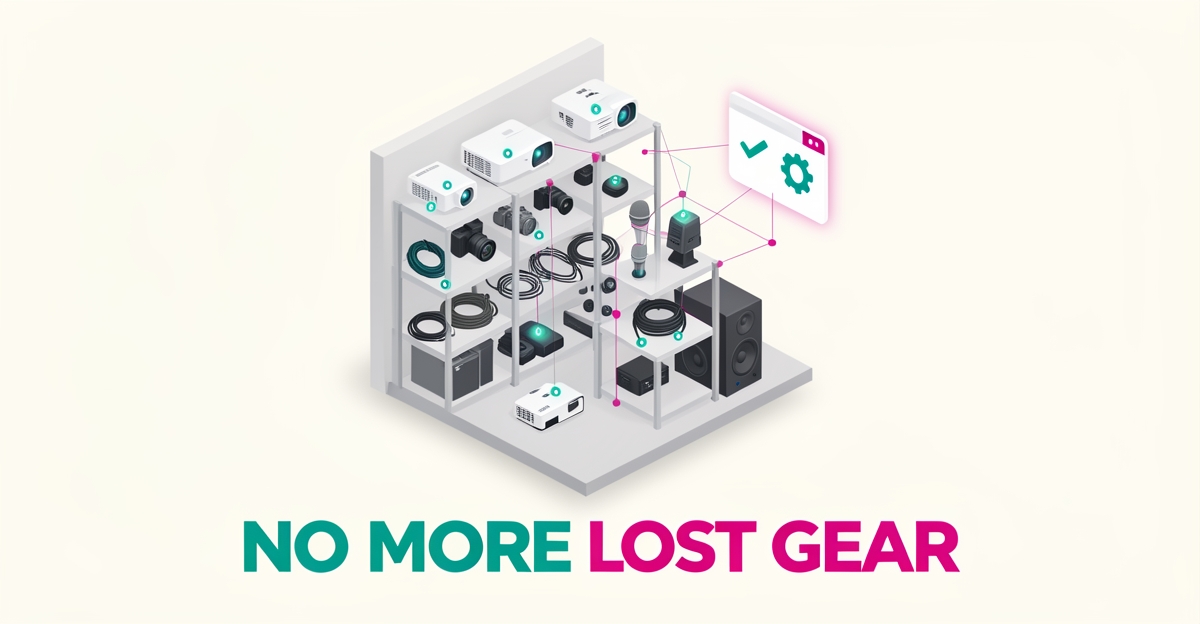
AI-Powered Equipment Inventory: How AV Companies Can Reduce Lost or Misplaced Gear
Hire a team member that works 24/7 — for less than a part-time wage.
AI receptionists, SDRs, dispatchers and 99+ roles. Trained on your business, fully managed.
Not sure where to start? Ask our AI planner
The Hidden Cost of Lost AV Gear: Why Traditional Tracking Fails
AV companies managing high-value gear across multiple locations face a silent revenue drain: lost or misplaced equipment isn't just an inconvenience, it's a direct hit to profitability and customer trust. Inventory holding costs alone typically run 20-25% of a product's value each year, turning idle or misplaced gear into a continuous financial leak. When critical items go missing during peak demand, the consequences escalate quickly. A single unavailable projector or mixer can cost far more than its replacement value, disappointed clients don't always come back, and in a referral-driven industry, one missed show travels fast. These losses compound when teams waste hours searching for equipment instead of fulfilling jobs or maintaining client relationships. Traditional tracking methods, relying on manual logs, periodic counts, or disconnected spreadsheets, fail to provide the real-time visibility needed to prevent these gaps. Without accurate, up-to-the-minute data, AV companies operate blind, reacting to shortages only after they disrupt service. This reactive approach not only increases carrying costs through overcompensating safety stock but also erodes service reliability. The result is a cycle where inventory inaccuracy becomes a predictable revenue leak, undermining margins and damaging long-term client retention in an industry where trust and timely delivery are paramount. AIQ Labs helps AV companies break this cycle through AI Workflow Builds that rebuild the inventory workflow that costs you the most, fixed price, delivered in phases.
How AI Transforms Equipment Tracking: From Reactive Searches to Proactive Orchestration
Traditional inventory management operates like a fire department, waiting for the alarm to sound before springing into action. AI-powered systems flip this model entirely, shifting AV companies from reactive scrambling to predictive orchestration that anticipates needs before they become emergencies.
This transformation relies on three core technologies working in concert. Machine learning algorithms analyze historical usage patterns to forecast demand, while IoT sensors and RFID tags provide real-time visibility into equipment location and status. Computer vision completes the stack by automating counting and verification, eliminating the manual errors that plague spreadsheet-based tracking.
The financial impact can be substantial. Industry analyses of AI inventory systems commonly report accuracy above 99% alongside meaningful reductions in carrying costs, often in the 20-35% range for companies that move from manual tracking to automated, demand-aware systems. For AV companies managing high-value projectors, LED walls, and audio gear across multiple warehouses and job sites, these systems eliminate the costly guesswork of manual tracking.
The practical shift looks like this:
- Demand forecasting positions gear ahead of bookings instead of scrambling after a conflict is discovered
- RFID and sensor tracking flag items that leave the warehouse without a matching job assignment
- Automated daily balancing across locations reduces last-minute inter-facility transfers and rush shipping
These systems don't just locate gear faster, they predict when equipment needs maintenance, automatically generate prep checklists for upcoming events, and optimize stock levels across locations. Old systems sit and wait for a stockout, an overstock, or a reorder somebody forgot, then your team scrambles to clean it up. AI flips this by reading demand before it lands and positioning assets ahead of need.
At AIQ Labs, we build these production-ready inventory automation systems specifically for AV workflows, 200+ multi-agent systems deployed to date, integrating machine learning forecasting with RFID tracking to create a single source of truth for high-value equipment. The result is proactive management that prevents losses rather than merely documenting them after the fact.
Implementation Roadmap: Starting Small to Scale AV Inventory Automation
Starting small is how successful AV companies scale AI inventory automation without disruption. Begin by targeting your highest-volume equipment category, like cameras or lighting rigs, where demand forecasting delivers the fastest wins. Focusing AI on one high-impact use case first typically allows organizations to reach measurable ROI within a few months by eliminating most manual planning tasks. This approach builds confidence, secures budget for expansion, and proves value before tackling broader inventory challenges.
Before deploying any AI model, prioritize data quality, garbage in, garbage out still applies. Consolidate scattered equipment logs, standardize records across warehouses and job sites, and ensure a solid stretch of clean historical data exists for training. Successful implementations begin with fixing data quality before deploying models, since inaccurate inputs undermine even the most advanced forecasting algorithms. Only then should you integrate the AI system with your existing tools via APIs, connecting to your rental management software, CRM, or accounting platform to enable real-time data flow and automated workflow triggers.
Establish success metrics upfront to track progress and justify scaling. Define clear targets for forecast error reduction, stockout incidents, and recovered warehouse space before implementation begins. Even modest improvements in demand-sensing accuracy translate into fewer stockouts and more on-time deliveries, key benchmarks for AV operations managing time-sensitive gear. With these foundations in place, AIQ Labs' milestone-based delivery model ensures each phase delivers tangible value, letting you stop, assess, and scale only when ready.
- Start with demand forecasting for one high-volume equipment category
- Clean and standardize historical data before model training
- Integrate via APIs with existing rental and management systems
- Set success metrics for forecast accuracy, stockouts, and space recovery
- Scale incrementally using AIQ Labs' milestone-based approach
Still paying for 10+ subscriptions that don’t talk to each other?
We build custom AI systems you own outright. No vendor lock-in. Full control.
Not sure where to start? Ask our AI planner
Frequently Asked Questions
How much can AI inventory systems reduce carrying costs for AV companies?
What accuracy rate can AV companies expect from AI-powered inventory tracking?
How long does it typically take to see ROI from implementing AI inventory automation?
Can AI really prevent stockouts that damage customer trust in the AV industry?
What's the first step AV companies should take when implementing AI inventory tracking?
Is poor data quality a real barrier to AI inventory success for AV companies?
Turn Lost Gear into Found Profit
Lost AV equipment isn't just a nuisance, it's a measurable drain on profitability, client trust, and operational efficiency, with holding costs alone consuming a fifth or more of gear value annually and stockouts putting client relationships at risk. AI-powered inventory systems break this cycle by shifting from reactive searches to proactive orchestration, using machine learning, IoT, and computer vision to push accuracy above 99%, cut carrying costs, and eliminate most manual planning tasks. The path forward starts small: target your highest-volume gear, clean and standardize historical data, integrate via APIs with your existing tools, and set clear metrics for forecast accuracy and stockout reduction. With a milestone-based approach, you prove value before scaling, no big-bang bets. Ready to stop losing gear and start gaining control? Start the Fit Check, a free, no-obligation first step to map your biggest inventory bottleneck and see where AI delivers the fastest ROI.
Make AI your competitive advantage — not just another tool.
Strategy, implementation and ongoing optimization. One partner, end to end.
Not sure where to start? Ask our AI planner