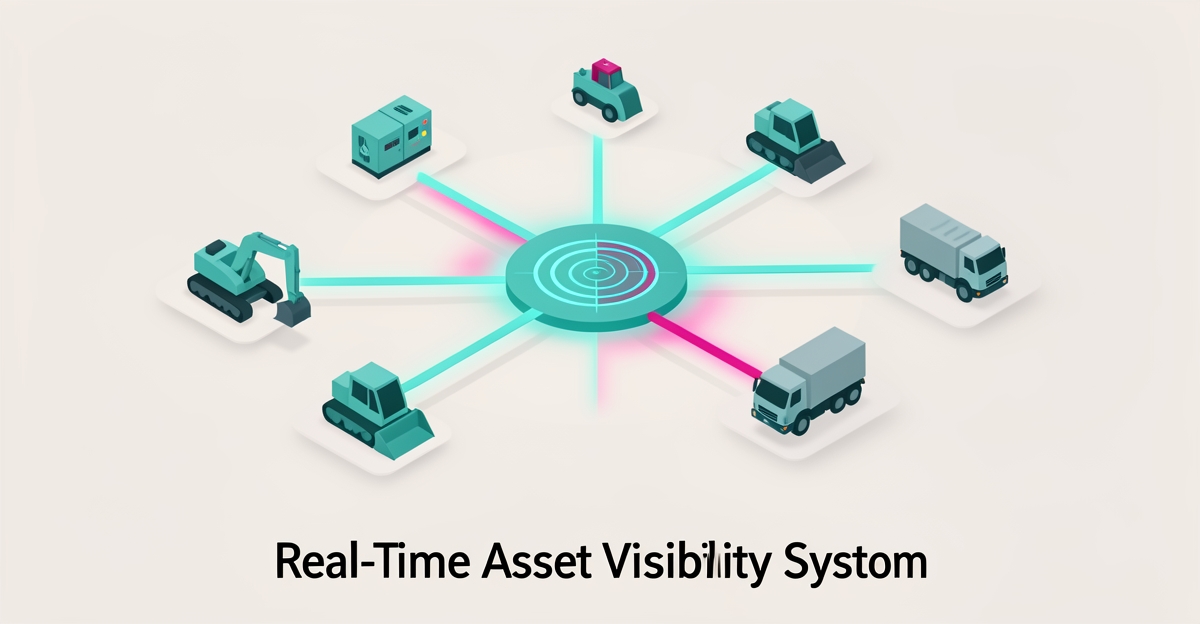
# AI-Powered Equipment Tracking: How to Build a Real-Time Asset Visibility System
**Quick Answer:** Stop losing equipment to blind spots. AIQ Labs builds real-time asset visibility systems that fuse GPS, IoT, and field logs into predictive, self-optimizing tracking, cutting downtime and boosting utilization. Start with a free 30-minute strategy call to see how AI turns tracking into a strategic advantage.
## Key Facts
- Real-time asset visibility depends on fusing three data streams: GPS for position, IoT sensors for usage and condition, and field logs for operational context
- Multi-agent AI systems can cross-validate signals, for example, flagging possible theft when GPS shows movement but engine sensors show no activity
- AI employees typically cost around 80% less than a comparable human hire while operating 24/7/365 without breaks or vacation
- Closed-loop integrations let a geofence breach create a CRM task or an hours-of-use threshold auto-generate a work order
- A phased build approach lets you prove value on one workflow before scaling across the fleet
## Table of Contents
1. [The Asset Visibility Crisis: Why Manual Tracking Fails at Scale](#the-asset-visibility-crisis-why-manual-tracking-fails-at-scale)
2. [Architecting the AI Visibility Stack: GPS, IoT, and Multi-Agent Intelligence](#architecting-the-ai-visibility-stack-gps-iot-and-multi-agent-intelligence)
3. [From Data to Decisions: Real-Time Dashboards, Alerts, and Autonomous Workflows](#from-data-to-decisions-real-time-dashboards-alerts-and-autonomous-workflows)
4. [Integration Playbook: Connecting Tracking Intelligence to Your Business Systems](#integration-playbook-connecting-tracking-intelligence-to-your-business-systems)
5. [Deployment Models: Build, Hire an AI Employee, or Partner for Transformation](#deployment-models-build-hire-an-ai-employee-or-partner-for-transformation)
## The Asset Visibility Crisis: Why Manual Tracking Fails at Scale
Manual spreadsheets, GPS pings, and field logs create the illusion of control while equipment slips through the cracks. At scale, fragmented tracking becomes a visibility crisis that drives cost and risk.
Operations teams react to missing assets instead of preventing loss. The problem is fragmentation: brand and asset performance metrics only work when unified, not siloed. The same fragmentation plagues equipment data, where location, usage, and status live in separate systems.
Financial impact compounds quickly. Idle capacity goes unnoticed, maintenance becomes reactive, and utilization data arrives too late to act on. Meanwhile, AI-driven demand keeps reshaping supply chains, raising expectations for real-time visibility into physical assets and materials.
GPS, IoT, and field logs alone cannot close the gap. The core blockers are structural:
- Data integration complexity when combining GPS data, IoT sensor readings, and field logs
- Real-time processing requirements to analyze data as it arrives for actionable insights
- Scalability concerns as tracked assets grow without compromising performance or accuracy
- Data quality and accuracy issues that undermine trust in location and usage metrics
Without orchestration, teams get raw signals instead of decisions. **AI orchestration** is what turns fragmented inputs into a single source of truth. AIQ Labs builds scalable, production-grade AI systems that work with GPS, IoT, and field logs to track equipment location, usage, and status in real time.
Effective visibility also depends on how data is presented. Clustered column charts, scatter plots, and pivot table line charts remain essential tools for presenting equipment tracking data in immediately comprehensible ways.
Manual tracking fails because it cannot correlate signals across systems fast enough. An AI-driven system replaces reactive firefighting with continuous visibility, predictive maintenance, and optimized deployment across the fleet.
## Architecting the AI Visibility Stack: GPS, IoT, and Multi-Agent Intelligence
Building a real-time asset visibility system requires more than just connecting GPS trackers, it demands a sophisticated architecture that fuses location telemetry, sensor streams, and unstructured field data into actionable intelligence. AIQ Labs engineers these systems using multi-agent frameworks that reason over complex, real-time inputs to deliver continuous situational awareness.
At the core, GPS provides foundational location data, but raw coordinates alone offer limited value without context. Effective asset tracking depends on integrating multiple data streams, GPS for position, IoT sensors for usage and environmental conditions, and field logs for operational context, into a unified view. This fusion enables the system to distinguish between an asset idling in a yard versus actively operating on a job site, or detect anomalies like unauthorized movement or overheating equipment.
The architecture employs a multi-agent framework where specialized agents collaborate through reasoning-and-acting loops. One agent processes GPS telemetry to track geofence breaches and route deviations, another analyzes IoT sensor streams for vibration, temperature, and runtime patterns, while a third parses unstructured field logs, such as maintenance notes or operator reports, to infer usage intent and predict maintenance needs. These agents share state through a shared memory layer, enabling cross-validation: for example, if GPS shows movement but sensor data indicates no engine activity, the system flags potential towing or theft.
The system's intelligence layer applies predictive reasoning to anticipate issues before they escalate. By correlating historical usage patterns with real-time sensor readings, the multi-agent framework can forecast component wear or schedule proactive maintenance. This predictive capability transforms reactive tracking into prescriptive asset management, reducing downtime and extending equipment lifecycle.
Scalability is achieved through modular agent design, where new sensor types or data sources can be added without disrupting existing workflows. The system maintains low-latency processing by running inference at the edge for time-sensitive tasks, like collision avoidance or immediate alert
AI Employees
Hire a team member that works 24/7 — for less than a part-time wage.
AI receptionists, SDRs, dispatchers and 99+ roles. Trained on your business, fully managed.
See If You’re a Fit — AI Employees from $700/mo
Not sure where to start? Ask our AI planner
ing, while heavier analytics, such as usage trend analysis or compliance reporting, occur in the cloud. This hybrid approach ensures responsiveness without sacrificing analytical depth.
For businesses implementing such systems, the technical foundation must prioritize data integrity and actionable output. Even minor inaccuracies in location or sensor data can cascade into flawed decisions. The architecture therefore includes validation layers that cross-check GPS drift against known road networks, filter sensor noise using statistical thresholds, and flag inconsistent log entries for human review.
Ultimately, the AI visibility stack doesn't just report where assets are, it understands what they're doing, why they're doing it, and what they're likely to do next. By treating location, usage, and health as interconnected signals rather than isolated metrics, the system delivers the contextual awareness needed to optimize deployment, prevent failures, and maximize return on asset investment. This level of insight turns equipment tracking from a cost center into a strategic advantage.
## From Data to Decisions: Real-Time Dashboards, Alerts, and Autonomous Workflows
Raw tracking data becomes operational intelligence when transformed into actionable dashboards and automated workflows. AIQ Labs builds systems that convert GPS coordinates, IoT sensor streams, and field logs into real-time visibility platforms where decisions happen instantly. The foundation lies in creating custom KPI dashboards that surface critical metrics at a glance, utilization rates, maintenance needs, and location-based bottlenecks, while predictive analytics forecast equipment failures before they occur, turning reactive maintenance into strategic planning.
These dashboards leverage visualization techniques proven effective for complex asset data, such as clustered column charts comparing utilization across equipment types and scatter plots revealing usage patterns that signal impending wear. Custom combo charts overlay predictive maintenance alerts on real-time status feeds, giving operators immediate context for intervention decisions. Pivot table analysis enables drilling down by site, shift, or operator to uncover systemic inefficiencies invisible in aggregate views.
Automated escalation workflows convert dashboard insights into action without human delay. When sensors detect abnormal vibration patterns or location deviations exceeding geofence boundaries, the system triggers tiered responses: first notify supervisors via SMS, then initiate safety protocols if thresholds persist, and finally schedule autonomous maintenance dispatch if issues escalate. AI agents monitor these workflows continuously, learning from historical resolution patterns to refine escalation logic and reduce false positives over time.
The true operational leap comes from autonomous workflows where AI agents initiate actions without human triggers. When predictive models indicate a high probability of bearing failure within 48 hours, the system automatically generates work orders, checks technician availability, verifies part inventory, and schedules maintenance during lowest-impact operational windows. If utilization analytics show consistent underuse of specific equipment types across regions, the agent initiates reallocation requests to high-demand sites or flags assets for procurement review, closing the loop from data insight to physical asset optimization without manual intervention. This end-to-end automation transforms equipment tracking from a monitoring function into a self-optimizing operational network.
## Integration Playbook: Connecting Tracking Intelligence to Your Business Systems
A standalone tracking dashboard is only half the equation. The real value of equipment intelligence emerges when location, usage, and status data flows directly into the systems your teams already use, closing the loop between the field and the back office.
The practical backbone for this is the Model Context Protocol (MCP), which lets AI systems connect to external tools and take real action rather than just report. AIQ Labs builds these connections into CRM platforms like HubSpot, Salesforce, and Pipedrive, scheduling tools, payment processors, and industry-specific software, the same integration layer its own production systems use daily across four live SaaS products.
A sensible integration roadmap follows four stages:
- **Map your data flows**, identify which system owns each record: asset master data in the ERP, work orders in the CMMS, customer site history in the CRM.
- **Connect via MCP servers**, expose each platform as a tool the tracking AI can query and update, replacing brittle point-to-point scripts.
- **Define closed-loop triggers**, a geofence breach creates a CRM task; hours-of-use thresholds auto-generate a CMMS work order; job completion updates field service schedules.
- **Add validation and audit trails**, every automated action is checked before execution and logged, which matters in regulated environments.
Once data flows freely, visualization closes the loop for decision-makers. Clustered column and pivot-table line charts turn raw utilization streams into clear comparisons across sites, seasons, and asset classes, the same summaries that feed automated reorder and dispatch logic.
Start with one closed loop, tracking to work orders, prove the value, then extend to CRM and finance. That phased approach mirrors how AIQ Labs structures workflow builds: each integration ships, gets validated, and stays yours.
## Deployment Models: Build, Hire an AI Employee, or Partner for Transformation
Building a real-time asset visibility system is a capital decision, not just a technical one. The path you choose shapes ownership, speed, and long-term operating cost.
Organizations typically land on three implementation patterns. Each maps directly to how AIQ Labs structures engagements.
**Custom milestone-based build** gives you a system you own outright. AIQ Labs architects production-grade AI that ingest
AI Development
Still paying for 10+ subscriptions that don’t talk to each other?
We build custom AI systems you own outright. No vendor lock-in. Full control.
See If You’re a Fit — AI Employees from $700/mo
Not sure where to start? Ask our AI planner
s GPS streams, IoT sensor readings, and field logs, then unifies them into a single visibility layer. You approve and pay per phase, keep everything built so far, and retain full IP. This model fits teams that want **true ownership** and plan to scale the asset tracking platform across departments. For a broader connected layer across operations, an AI Operating System approach builds the same visibility capability as one connected operating layer, delivered in phases and owned outright.
**Managed AI Employee** shifts the model from software to staff. Instead of buying a subscription dashboard, you hire an AI Dispatcher or AI Inventory Manager from AIQ Labs' library of AI Employees, covering 99+ roles, that works 24/7/365 alongside your human team. The employee books checks, qualifies maintenance requests, updates location records, and follows up on usage anomalies via phone, email, and chat. It is delivered via Start Monthly, a flat monthly plan that typically costs around 80% less than a comparable human hire, with build, training, integrations, monitoring and improvements included.
**Full AI Transformation Partnership** is for organizations moving up the maturity curve from pilots to embedded operations. AIQ Labs acts as a lifecycle partner for assessment, governance, adoption and scaling. The engagement covers AI readiness evaluation, custom agent development on multi-agent frameworks, enterprise integration with CRM, accounting and operations tools, governance and compliance frameworks, and change management to drive adoption.
Choosing between them comes down to control versus speed and internal capacity:
- **Build in Milestones:** One workflow or department system, split into phases. Approve and pay per phase; stop anytime and keep everything built so far.
- **Start Monthly AI Employee:** Setup plus flat monthly plan. Build, training, integrations, monitoring and improvements included; pause or adjust anytime.
- **Own It Outright:** One project price or monthly Build Partnership. Full ownership of code, agents and data when complete.
Cost context matters when you compare build versus buy. Subscription visibility stacks can accumulate quickly, and pricing varies widely across vendors, which is why ownership models that eliminate per-seat creep deserve a hard look. See pricing for how AIQ Labs structures its payment models.
With AIQ Labs, the deployment model you select determines whether you rent capability, hire it, or own it.
## Frequently Asked Questions
### Why does manual tracking with spreadsheets and GPS pings fail at scale?
Manual methods create fragmented data where location, usage, and status live in separate systems, leading to reactive firefighting instead of prevention. At scale this causes idle capacity to go unnoticed, reactive maintenance, and utilization data that arrives too late to act on.
### How does AI orchestration turn fragmented equipment data into a single source of truth?
AI orchestration fuses GPS telemetry, IoT sensor streams, and unstructured field logs through multi-agent frameworks with reasoning-and-acting loops. Specialized agents cross-validate signals, for example flagging towing or theft when GPS shows movement but engine sensors show no activity.
### What data streams do I need to combine for real-time asset visibility?
Effective tracking integrates GPS for position, IoT sensors for usage and environmental conditions, and field logs for operational context. This fusion lets the system distinguish idling in a yard from active operation on a job site and detect anomalies like unauthorized movement or overheating.
### How should I visualize equipment tracking data so teams can act on it fast?
Use comparison techniques proven for asset data such as clustered column charts for utilization across types and scatter plots for usage patterns signaling wear. Pivot table line charts enable drilling down by site, shift, or operator to uncover systemic inefficiencies.
### Can equipment tracking data connect directly to my CRM and work order systems?
Yes, value comes from closing the loop between field and back office via integrations like Model Context Protocol. A geofence breach can create a CRM task and hours-of-use thresholds can auto-generate a CMMS work order, with validation and audit trails for regulated environments.
### Should I build, hire an AI employee, or partner for a full transformation?
It depends on control versus speed. Build in Milestones if you want full ownership of a department-level system. Start Monthly with a managed AI employee if you need capability fast without infrastructure. Partner for transformation if you're embedding AI across operations. A free strategy call can help you map the right fit.
## From Signals to Strategic Advantage
Real-time asset visibility stops being a reporting exercise when GPS, IoT sensor streams and field logs are orchestrated into a single source of truth. An AI-driven stack fuses location telemetry with usage context through multi-agent reasoning, turns raw signals into predictive maintenance and deployment decisions, and closes the loop via dashboards, automated alerts and integrations with the ERP, CMMS and CRM systems teams already use. The result is fewer surprises, higher utilization, and equipment that works as a managed asset, not a cost center. Start with one closed loop, such as tracking to work orders, prove the value, then extend. If you're mapping a build, a managed AI employee, or a full transformation, start the 2-minute Fit Check at https://aiqlabs.ai/apply for a free 30-minute strategy call to map your biggest bottleneck and identify high-ROI automation opportunities.
AI Transformation Partner
Make AI your competitive advantage — not just another tool.
Strategy, implementation and ongoing optimization. One partner, end to end.
See If You’re a Fit — AI Employees from $700/mo
Not sure where to start? Ask our AI planner