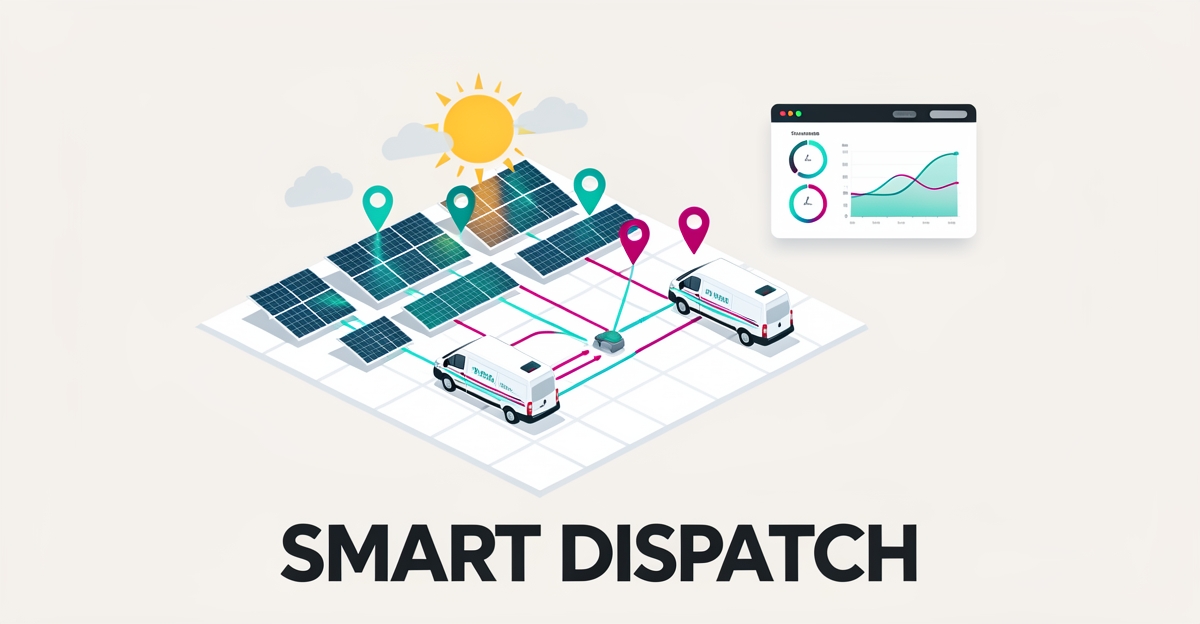
AI-Powered Field Dispatch: How Solar Installers Reduce Downtime and Improve Technician Utilization
Key Facts
- Technicians typically spend a meaningful share of work hours, often 15-20%, in transit or waiting between assignments
- Weather-related rescheduling commonly adds days of delay per installation during seasonal transitions
- Utilization rates tend to drop during seasonal weather transitions, especially in shoulder seasons
- Emergency dispatch changes typically raise labor costs through overtime and inefficient routing
- Modern AI weather models generate forecasts in minutes instead of hours, as of late 2026
- AI forecasting systems like Google's WeatherNext outperform prior state-of-the-art models on most variables and timeframes
- Deterministic AI forecasts can extend up to 10 days ahead, giving dispatchers a real planning window
Hire a team member that works 24/7 — for less than a part-time wage.
AI receptionists, SDRs, dispatchers and 99+ roles. Trained on your business, fully managed.
Not sure where to start? Ask our AI planner
The Hidden Cost of Manual Dispatch in Solar Installation
Solar installers lose valuable billable hours daily to idle technicians, inefficient routing, and weather-related scheduling disruptions that cascade into project delays. These operational inefficiencies directly erode profitability by keeping skilled crews waiting instead of generating revenue on job sites. Weather drives both demand volatility and supply uncertainty in renewable energy operations, making traditional scheduling methods increasingly inadequate for modern solar installation workflows.
The hidden cost manifests in three critical areas: technicians waiting between jobs due to poor route optimization, crews idle during forecasted weather windows that never materialize, and emergency rescheduling that disrupts entire project timelines. Solar companies leveraging AI for operational decision-making typically achieve better resource allocation by processing complex weather patterns and job variables simultaneously. This transforms dispatch from a reactive function into a proactive profit center.
- Technicians commonly spending 15-20% of work hours in transit or waiting between assignments
- Weather-related rescheduling adding days of delay per installation during peak seasons
- Utilization rates dropping during seasonal weather transitions
- Emergency dispatch changes increasing labor costs through overtime and inefficient routing
AIQ Labs addresses these challenges through custom dispatch automation that integrates real-time GPS data, technician availability, and job complexity metrics to eliminate guesswork from field operations. By treating downtime as a solvable operational variable rather than an unavoidable cost, solar installers can redirect lost billable hours toward actual installation work, directly improving both technician utilization and project profitability without expanding headcount. For teams that want dispatch handled as a managed service rather than another tool to run, our AI Employees cover dispatcher-style roles alongside 99+ others.
How AI Dispatch Assigns the Right Tech to the Right Job
AI-powered dispatch systems automatically assign technicians based on real-time data, eliminating the guesswork of manual scheduling. These systems analyze location, availability, and job complexity to ensure the right technician is sent to the right job at the right time. By processing large volumes of data, AI identifies patterns that human dispatchers might miss, reducing idle time and improving project flow.
Modern AI models can discern complex patterns hidden in years of observational data, learning continuously to make faster and more accurate predictions. This same capability applies to field dispatch: AI systems process technician GPS locations, skill sets, past job completion times, and real-time traffic conditions to optimize assignments. The result is less downtime between jobs and higher technician utilization rates.
AIQ Labs builds custom dispatch AI systems that integrate with GPS and scheduling tools to maximize technician efficiency and on-time performance. These systems continuously learn from historical performance data, adjusting assignments based on factors like weather delays, parts availability, and technician certifications. Over time, the AI becomes more accurate at predicting job duration and matching technicians to tasks where they perform best.
- Real-time location tracking ensures technicians are assigned to the nearest available job
- Skill-based matching reduces rework by sending qualified technicians to complex installations
- Dynamic rescheduling adapts to traffic, weather, or last-minute cancellations
Unlike manual dispatch, which relies on static schedules and dispatcher intuition, AI systems adapt continuously to changing conditions. They prevent overbooking of skilled technicians while avoiding underutilization of available staff. This intelligent matching directly impacts solar installers' bottom line by increasing the number of jobs completed per technician per day without adding headcount.
As AI models process more field data, they refine their understanding of which technician-job combinations yield the fastest completion times and highest quality outcomes. This creates a feedback loop where dispatch decisions improve over time, leading to more predictable project timelines and better customer satisfaction. For solar installers managing fluctuating workloads, this level of automation transforms dispatch from a reactive task into a proactive operational advantage.
Weather Intelligence as a Dispatch Superpower
Solar installers lose money every time a crew arrives to find clouds rolling in or a roof too wet to work. Weather is not a background factor for field teams; it drives both demand volatility and supply uncertainty in solar work.
AI-powered dispatch turns that volatility into a planning advantage. Instead of reacting to the morning sky, teams can anticipate conditions days ahead and re-sequence jobs before trucks roll. That shift cuts wasted truck rolls, protects on-time performance, and keeps technicians billable.
AI weather models such as Google's WeatherNext show how far forecasting has advanced as of late 2026. These systems produce more accurate results than previous state-of-the-art models on the majority of variables and timeframes, and generate forecasts in minutes instead of hours.
The technology offers complementary views installers can use. Deterministic models provide precise forecasts up to 10 days ahead, ideal for locking in install windows. Ensemble approaches generate many possible weather scenarios over longer horizons to quantify risk.
Integrating those signals into dispatch decisions changes daily operations. Energy companies face a fundamental challenge: weather drives both demand volatility and supply uncertainty. For solar installers, that means rain delays, wind restrictions, and temperature-sensitive adhesive curing all become predictable constraints.
An AI dispatch system automatically assigns technicians based on location, availability, and job complexity, reducing idle time and improving project flow. When weather intelligence is layered in, the system can:
- Reschedule roof work 48-72 hours ahead when precipitation probability rises
- Cluster jobs by microclimate to avoid cross-site weather exposure
- Protect high-value installs by prioritizing clear-window slots for complex systems
- Reduce rescheduling calls by matching crew skill to weather-dependent tasks
The result is fewer no-go arrivals and more completed jobs per day. AIQ Labs builds custom dispatch AI systems that integrate with GPS and scheduling tools to maximize technician efficiency and on-time performance, embedding forecast triggers directly into assignment logic.
Weather intelligence also improves utilization forecasting. By modeling ensemble scenarios, dispatchers see not just if it will rain, but the range of outcomes and confidence levels. That allows proactive re-routing instead of reactive cancellations, preserving customer trust and margin.
For solar operations, the competitive edge is not better trucks, it is better timing. When forecasts are accurate, fast, and actionable, dispatch becomes a superpower.
Implementation Roadmap: From GPS Data to Automated Dispatch
Deploying AI-powered field dispatch begins with auditing current scheduling workflows to identify bottlenecks like manual assignment delays or mismatched technician skills. AIQ Labs starts with process mapping to capture how jobs are currently scheduled, tracked, and completed, laying the foundation for automation that reduces idle time and improves technician utilization. This assessment ensures the AI system aligns with real-world operational constraints before any code is written.
Next, integrate GPS tracking and calendar tools such as Google Calendar or industry-specific scheduling software to enable real-time location feeds and availability sync. Define job complexity rules based on factors like system size, roof type, or permitting requirements so the AI can match the right technician to each task. Layer in weather-aware scheduling by connecting to modern forecasting tools, which provide deterministic forecasts up to 10 days ahead, allowing proactive adjustments for rain or high winds that could delay installations. These steps create a closed-loop system where dispatch decisions continuously optimize for efficiency and on-time performance. If you want to start by rebuilding the single workflow that costs you the most, our fixed-price Workflow Builds are phased and scoped to one bottleneck at a time. To explore how AIQ Labs can build a custom dispatch automation platform for your solar installation business, with flexible engagement models like Start Monthly, Build in Milestones, or Own It Outright, start with a free strategy call to map your biggest bottleneck and identify high-ROI automation opportunities.
Measuring ROI: Utilization Metrics That Matter
Implementing AI-powered dispatch is only half the battle; proving its value requires tracking the right performance indicators. Without clear metrics, even the most sophisticated automation risks becoming another expensive tool that fails to deliver operational clarity.
Start with technician utilization rates, the percentage of paid hours spent on revenue-generating work versus driving, waiting, or administrative tasks. AI dispatch systems automatically assign technicians based on location, availability, and job complexity, but you need baseline measurements to capture improvement. Track this weekly to identify patterns in idle time reduction.
Next, monitor on-time performance and schedule adherence. Modern AI forecasting tools can predict conditions with remarkable precision, current systems generate accurate forecasts up to 10 days ahead, enabling proactive scheduling adjustments. When your dispatch system integrates similar predictive capabilities, you should see measurable improvements in arrival window accuracy and job completion estimates.
- Jobs completed per crew per week (measure throughput before and after AI implementation)
- Average drive time between sites (track reduction in non-billable travel hours)
- First-time fix rates (ensure efficiency gains don't compromise work quality)
- Schedule adherence variance (difference between promised and actual arrival times)
These metrics matter because energy operations face fundamental volatility, weather drives both demand and supply uncertainty. AI dispatch helps you adapt to this variability, but only consistent measurement reveals whether you're actually reducing downtime or simply adding technological complexity.
AIQ Labs approaches this measurement phase differently than typical software vendors. Rather than locking you into a subscription dashboard with predetermined KPIs, we build custom dispatch systems that you own outright. This means your utilization tracking integrates directly with your existing GPS and scheduling tools, capturing the specific data points that matter to your operation without monthly per-user fees eating into your ROI. For operations ready to connect dispatch with scheduling, inventory, and customer communication in one layer, see our AI Operating Systems.
The solar industry increasingly relies on sophisticated asset management platforms that use similar AI optimization principles across large renewable portfolios. Your dispatch metrics should demonstrate comparable operational intelligence.
Ready to establish your baseline? Start with the two-minute Fit Check at aiqlabs.ai/apply, then schedule a free 30-minute strategy call at aiqlabs.ai/book. We'll map your current utilization rates and identify exactly where AI dispatch can reduce your idle time, if the numbers don't support a clear win, we'll tell you.
Still paying for 10+ subscriptions that don’t talk to each other?
We build custom AI systems you own outright. No vendor lock-in. Full control.
Not sure where to start? Ask our AI planner
Frequently Asked Questions
How much idle time do solar crews actually lose with manual dispatch?
Can AI weather forecasting really help us avoid rain delays?
What is ensemble forecasting and when should we use it?
Which metrics prove AI dispatch ROI for solar installers?
Will AI dispatch work with the GPS and calendar tools we already use?
Is AI dispatch only for large solar companies?
Turning Weather Uncertainty into Your Competitive Edge
Solar installers lose significant billable hours to inefficient dispatch, weather-related delays, and poor technician utilization, costs that directly erode profitability. AI-powered field dispatch transforms these challenges by intelligently matching technicians to jobs using real-time GPS, skill sets, and weather intelligence, reducing idle time and increasing jobs completed per crew. By integrating modern forecasting tools for precise, multi-day forecasts and dynamically rescheduling based on microclimates, companies can proactively avoid wasted truck rolls and protect on-time performance. The result is higher utilization rates, lower labor costs from emergency changes, and more predictable project timelines, all without adding headcount. To see how this applies to your operation, start with the two-minute Fit Check at aiqlabs.ai/apply, then schedule a free 30-minute strategy call to map your biggest bottleneck and identify where AI dispatch can drive measurable ROI.
Make AI your competitive advantage — not just another tool.
Strategy, implementation and ongoing optimization. One partner, end to end.
Not sure where to start? Ask our AI planner